
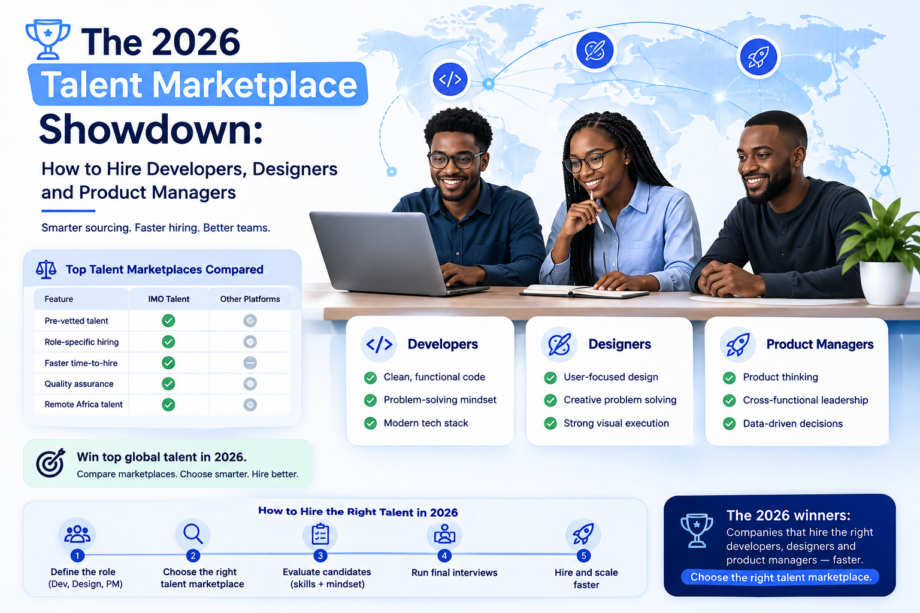
Founders and hiring managers know the drill: you need a developer, so you open one platform. You need a designer, so you open another. You need a product manager, and suddenly there’s no obvious place to look at all. This is the reality of hiring tech and creative talent today a fragmented landscape split into isolated ecosystems, where “Product Talent” is frequently left out of the conversation entirely.
This guide directly compares talent marketplaces for tech and creative roles plus the often-ignored category of product talent by vetting rigor, cost, and best-fit use case. Whether you’re hiring your first contractor or scaling a team, this breakdown will help you match the right platform to the right role, instead of defaulting to whichever brand you’ve heard of most.
- The Tech Stack: Best Platforms for Developers & Engineers
Developer hiring platforms differ mainly in how rigorously they vet candidates and how quickly you can get someone onboarded.
Toptal – The “Elite” Standard
Toptal is known for extremely selective screening, with a widely cited acceptance rate under 3%. It’s built for companies that need highly vetted developers for complex, long-term, or mission-critical projects. The trade-off is cost Toptal sits at the premium end but for teams that need enterprise-grade talent without the risk of a bad hire, it remains a benchmark.
Turing – The “Remote-First” Machine
Turing built its reputation on deep remote talent pools across Eastern Europe, LATAM, and Asia, combined with AI-based matching to speed up sourcing. It’s a strong option when time-to-hire and cultural fit across distributed teams matter as much as raw skill. Pricing lands in the mid-to-upper range
Upwork – The “Flexible” Marketplace
Upwork remains the go-to for short-term, well-defined tasks a landing page fix, a script, a quick integration. Vetting is largely self-reported (reviews, ratings, portfolios), which means more variance in quality, but it wins on cost-effectiveness and a huge variety of skill levels, from junior freelancers to seasoned specialists.
- The Creative Suite: Best Platforms for Designers
Design hiring depends far more on portfolio and taste than on technical benchmarks which shapes an entirely different set of leading platforms.
Dribbble – The “Portfolio” Hub
Dribbble functions as a curated design talent showcase, historically built around an invitation-only community. It’s best suited for finding brand, UI, and visual designers whose curated design talent is on public display ideal when hiring for visual branding work. Cost typically falls in the mid range.
99designs – The “Contest” Model
99designs flips the model: instead of hiring one person, you run a contest and receive multiple concepts from multiple designers. It’s built for speed and getting multiple concepts fast great for logos, one-off landing pages, or quick brand refreshes. Cost is low to moderate, though it’s less suited to ongoing design partnerships.
Toptal (Design) – The “Strategic” Option
Toptal applies the same rigorous vetting to design that it applies to engineering, but the focus shifts toward senior designers, design systems, and UX strategy. Where Dribbble is about execution and visual portfolios, Toptal’s design network is about design leadership the person shaping product direction, not just producing assets. Cost is premium.
- The Missing Link: Best Platforms for Product Managers
Most “talent marketplace” comparisons stop at developers and designers but Product Managers, Product Owners, and Product Marketers are just as essential to building successful products, and they require their own hiring playbook.
LinkedIn Premium – The “Generalist” Source
LinkedIn Recruiter Lite remains the safest default: verified career histories, advanced filters, and the largest overall pool of candidates. It’s a reliable safe bet for standard PM roles, especially at mid-to-large companies. Cost sits in the mid-to-upper range.
Product Hunt Jobs – The “Community” Play
Product Hunt’s job board pulls from an audience of already-engaged, community-active product people. It’s particularly strong for cultural fit and candidates with genuine startup experience, making it a natural fit for early-stage companies. Cost is low.
Niche Communities (Mind the Product, PMHQ) – The “Specialist” Route
For senior or highly specialised roles AI Product Manager, Growth PM, Platform PM niche communities like Mind the Product and PMHQ often surface candidates who never appear on mainstream job boards. These channels are largely free but time-intensive to source from, making them a hidden gem for teams willing to invest the search effort.
- How to Choose: A Decision Framework
The “Speed vs. Quality” Trade-off
If you need someone fast for a bounded task, lean toward Upwork or 99designs. If you’re hiring a strategic long-term partner, lean toward Toptal or niche communities accepting a longer search in exchange for higher confidence.
The “Budget” Matrix
Low (<$5k): Upwork, 99designs, ProductHunt Jobs
Mid ($5k–$20k): Dribbble, LinkedIn Premium, Turing
High (>$20k): Toptal, specialized recruiters, niche communities for senior product roles
The “Role” Checklist
Developer: prioritise vetting rigor above all else
Designer: prioritise portfolio quality and stylistic fit
Product Manager: prioritise domain experience and track record
This is also where the fragmentation problem becomes most visible: hiring across all three categories often means managing three separate accounts, three separate vetting standards, and three separate invoices. For teams that want to avoid juggling three different platforms for developers, designers, and product managers, newer marketplaces like IMO Talent are consolidating vetted tech, creative, and product talent into a single hiring flow a direct response to the fragmentation problem outlined throughout this article, rather than a replacement for every specialist platform above.
Conclusion & Next Steps
Hiring great talent isn’t about finding “the one best platform” it’s about matching the right marketplace to the right role, budget, and timeline. Developers demand rigorous vetting, designers demand strong portfolios, and product managers demand real domain experience. Treat each category on its own terms, and apply a startup-first mindset: match the platform to your company’s actual stage, not its aspirations.
The practical next step is simple: start with one platform per role, test the vetting process on a small project, then scale what works.
Final Summary
Best for Developers: Toptal (Quality) / Upwork (Speed)
Best for Designers: Dribbble (Portfolio) / 99designs (Speed)
Best for Product Managers: LinkedIn (Experience) / ProductHunt (Community)
Overall Winner for Vetting: Toptal
Overall Winner for Flexibility: Upwork
Emerging Cross-Category Option: IMO Talent
