
Introduction
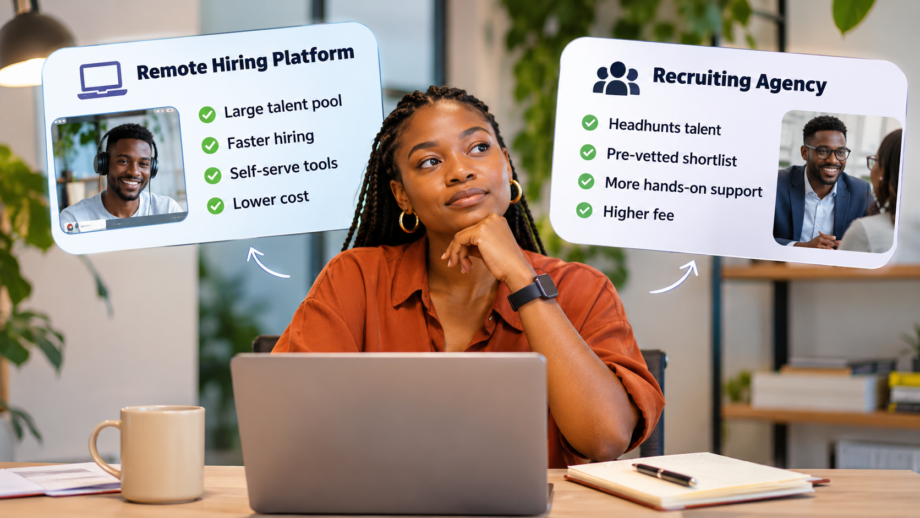
Remote hiring platforms hand you reach and speed; recruiting agencies hand you judgment and a pre-vetted shortlist. That’s the core split. Platforms source from a broad pool of active job seekers and leave most of the screening to your team, while agencies headhunt passive talent and do the first round of vetting for you, at a much higher fee.
Most employers meet this choice at the worst possible moment: a role has been open for weeks, the hiring manager is nagging, and someone in finance wants to know why the recruitment budget is bleeding. So the decision gets made on price alone.
Bad idea.
Cost matters, obviously. But the real question is who does the hard work of deciding whether a candidate is real and good, and who pays for that work. Pay in fees, or pay in your own team’s hours. Either way, the bill arrives.
Okay, so what actually separates the two models?
How Do Platforms and Agencies Differ at Their Core?
Platform Model
A remote hiring platform is a marketplace with software bolted on. You post a role or search a database, filter by skills, time zone and rate, and the system ranks profiles using matching logic. Some add assessments, some handle payroll or act as an EOR (employer of record) so you can employ someone abroad without opening a local entity. Many are subscription-priced, so the cost per hire falls the more you use them.
You’re the driver, though. The platform is the road.
Agency Model
Recruitment agencies work the other way round. A recruiter takes your brief, goes out to find people, talks to them, and brings back a shortlist. It’s a service, built on relationships and market intuition rather than on a searchable database. Analysts at Simera frame it as service-led versus data-led, which is about right.
Agencies come in flavours. Contingency firms only get paid when you hire. Retained search firms take money upfront, mostly for executive roles. Then there’s RPO (recruitment process outsourcing), where a provider runs a chunk of your talent acquisition function as an embedded partner. Three different animals, one label.
Underlying Incentives
Follow the money. A platform earns from subscriptions or a margin on matched talent, so it wants volume and activity. A contingency agency earns a placement fee only when someone starts, so it wants a fast, plausible hire. A retained firm wants to protect its reputation with you for the next search.
None of that is sinister. It just explains behaviour. A platform won’t lose sleep over your twelfth unsuitable interview; a recruiter who has staked a fee on you probably will.
Where Do Candidates Come From in Each Model?
Platform Sourcing
Platforms draw on whoever has signed up. That means active candidates: people who built a profile, applied, or are at least browsing. The pool can be huge and global, which is brilliant for multi-role international hiring across time zones. If you’re weighing options there, this comparison of platforms for hiring across time zones is worth a skim.
But a big pool isn’t a good pool. Keyword matches aren’t judgment. And a database full of people who are all applying to everyone is, frankly, a crowded room.
Agency Sourcing
Agencies push. They run searches on LinkedIn, lean on private networks, call people who’ve placed before, and use their own CRM and ATS (applicant tracking system) records built up over years. A good recruiter in a niche knows who is quietly unhappy at a competitor. No database holds that.
Passive Talent Access
Here’s the gap that matters most. Passive candidates aren’t looking, so they never appear in a platform search. Somebody has to approach them, persuade them, and handle the awkward conversation about why they should leave a comfortable job. That’s skilled, slightly tedious work, and it’s what you’re buying with an agency fee.
For senior or hard-to-fill roles, I’d pay for it every time. The best people for a specialist hire rarely type “remote engineering jobs” into a search bar.
Mind you, cold outreach has a downside. A clumsy agency message can dent your employer brand with exactly the people you want to impress.
Who Screens Candidates and How Rigorously?
Platform Screening
Platform screening is automated or left to you. Think keyword filters, coding challenges, skills tests, maybe an AI-scored assessment. Some curated platforms run their own interviews, and those are a different beast from open job boards; the piece on curated platforms versus remote job boards draws that line well.
Not all remote hiring platforms operate this way. IMO Talent takes a more curated approach, connecting global businesses with pre-vetted African remote professionals. Rather than leaving employers to screen hundreds of applications, IMO Talent focuses on candidate assessment and matching, helping businesses reduce screening time while accessing skilled remote talent across different industries.
Still, the final call on culture, communication and technical depth usually lands with your internal teams. So the sourcing time you saved turns into interview time you didn’t budget for.
Agency Screening
A recruiter conducts the first interviews, checks references, probes motivation, and tests soft skills before anything reaches you. You see maybe three people instead of thirty. Same idea in the breakdown of candidate vetting in platforms versus agencies, which sets out who carries which part of the load.
Is it flawless? No. Quality varies wildly between agencies, and a lazy one just forwards CVs with a nice cover note. Ask how they screen before you sign.
Verification Risks
Remote hiring has made one problem nastier. With no shared interview room, technical hiring commentators warn about AI-generated resumes and proxy interviewing, where somebody else sits the test. A self-serve funnel with no identity checks is exposed to precisely this.
Agencies aren’t immune, but they absorb that verification labour and often back the placement with a replacement guarantee. On a platform, the verification burden is yours. That’s worth knowing before you celebrate how many profiles you can search.
How Do Cost, Speed and Candidate Quality Compare?
Price first, because everyone asks. Traditional agencies typically charge 15% to 25% of first-year salary, and the same analysis puts median nonexecutive cost-per-hire around $1,200 through platform or internal sourcing against $9,000 to $20,000 through an agency. Roughly £950 versus £7,100 to £15,800. Big gap.
Speed is murkier. Platforms feel quick because the shortlist appears in days. But SHRM benchmarking puts median time-to-fill for nonexecutive roles at 39 calendar days, and that clock includes your own screening. For international moves, Recruitroo’s comparison says agencies average five to six months from decision to arrival, with direct platforms at three to four.
Quality is where the arguments start. Here’s how I’d summarise the trade-off:
Factor | Remote hiring platform | Recruiting agency |
|---|---|---|
Typical cost | Subscription or low per-hire fee | 15% to 25% of salary |
Speed to shortlist | Days, then your screening time | Longer upfront, tighter shortlist |
Pool | Active candidates, global | Passive and active, network-led |
Screening burden | Mostly yours | Mostly theirs |
Safety net | Varies, often limited | Placement guarantee common |
Bottom line: choose a platform when cost and speed matter most and you have the capacity to source and screen in-house; choose an agency when quality assurance, verification, and a hands-off process are worth the premium. Cheaper only counts if the hire sticks.
Which Role Types Suit Platforms and Which Suit Agencies?
Platforms suit repeatable, high-volume or mid-level roles where you know what good looks like and can test for it yourself. Customer support, mid-level developers, designers, marketers, operations staff. Roles with clear skills benchmarks and plenty of supply.
Agencies suit scarce or senior hires. Executive search, specialist engineers, finance leads, anyone where a wrong hire costs six months and a lot of pride. Recruitroo makes the same point: agencies for specialised senior hires needing deep networks, platforms for transparent multi-role international hiring.
The American Staffing Association notes that professional-managerial roles make up 21% of staffing placements and engineering, IT and scientific fields another 11%. Plenty of employers do lean on staffing agencies for exactly those categories.
One caution on language. A staffing agency that places temporary and contract workers isn’t the same as a retained search firm, and neither is an RPO provider. Check which one you’re actually talking to.
How to Choose Between a Platform, an Agency or Both
Ask yourself a handful of blunt questions:
Can your internal team genuinely interview and verify candidates, this month, without dropping other work?
Is the talent pool for this role active or passive?
What does a failed hire cost you in salary, onboarding and lost momentum?
Do you need a guarantee, or can you absorb the risk?
Is this a one-off, or the first of twenty similar roles?
If your answers are “yes, active, cheap to fix, no, twenty”, pick a platform. If they’re “no, passive, expensive, yes, one-off”, pick an agency. Mixed answers point to a hybrid. The guide on when to choose remote platforms or agencies covers the same ground from another angle.
My own bias is plain: for a role where getting the shortlist right matters, I’d rather pay for human screening than pretend an algorithm did the hard part.
What Hidden Costs Should You Check Before Committing?
Fees are the visible part. Underneath sit the ones that bite.
On platforms: your managers’ interview hours, assessment tools, a paid ATS to keep candidates organised, and the cleanup when a bad hire slips through. Add compliance, payroll and EOR charges if you’re employing across borders. Offshore hiring brings its own legal homework.
On agencies: the placement fee is rarely the end of it. Check the guarantee period, whether it’s a refund or a replacement, how exclusivity works, and whether a retained search fee is payable even if nobody gets hired. Some contracts also tie you to the agency for candidates you could have found yourself.
Total cost is salary plus fees plus the hours your people burn. Run that sum, not just the headline rate. The cost comparison of platforms and agencies goes deeper on the arithmetic.
How Can You Combine Platforms and Agencies Effectively?
Splitting your hiring isn’t cheating. Use a platform for the volume roles, and keep an agency on call for the two or three positions a year that really hurt to get wrong.
Another pattern works well: run a platform search yourself, and if it stalls after three or four weeks, hand the brief to an agency with your notes on who you’ve already seen. You get the cheap attempt first, and the agency doesn’t start blind.
Pressure is rising on the people doing this work, too. SHRM data shows extra-large organisations seeing a 67% jump in median requisitions per recruiter, while Gartner reports 65% of HR leaders expecting flat or lower budgets. Stretched teams can’t screen everything themselves, and that’s where a hybrid earns its keep. Keep one internal owner for the process, track time-to-fill and quality of hire by channel, and drop whichever route underperforms.
FAQ
What is the main difference between a remote hiring platform and a recruiting agency? Platforms give self-serve access to a database of mostly active candidates, with automated filtering and employer-led vetting. Agencies actively search, including passive talent, and screen candidates before presenting a shortlist.
Which is cheaper? Platforms, usually by a long way. Agencies charge around 15% to 25% of first-year salary. But platforms cost internal time, so compare total cost per hire.
Which finds better candidates? It depends on the role. For niche or senior positions, agencies reach people platforms can’t. For broad, repeatable roles, platforms deliver plenty of qualified applicants.
Can I use both? Yes, and many employers should. Platforms for volume, agencies for critical hires or stalled searches.
Is RPO the same as an agency? No. RPO outsources part of your recruitment process to a provider that works as an embedded partner, often on a longer contract.
Conclusion
Conclusion
Choosing between a remote hiring platform and a recruiting agency comes down to more than cost or speed. The right choice depends on your hiring needs, the level of screening required, and how much time your team can dedicate to recruitment.
While traditional platforms offer access to large talent pools and agencies provide more hands-on recruitment support, some solutions combine the advantages of both. IMO Talent bridges this gap by connecting global businesses with pre-vetted remote professionals, helping employers reduce the time and effort involved in sourcing and screening candidates.
Ultimately, successful remote hiring isn’t about choosing the biggest talent pool or the most expensive recruitment service. It’s about finding qualified professionals who match your business needs through a reliable, efficient, and transparent hiring process.
