
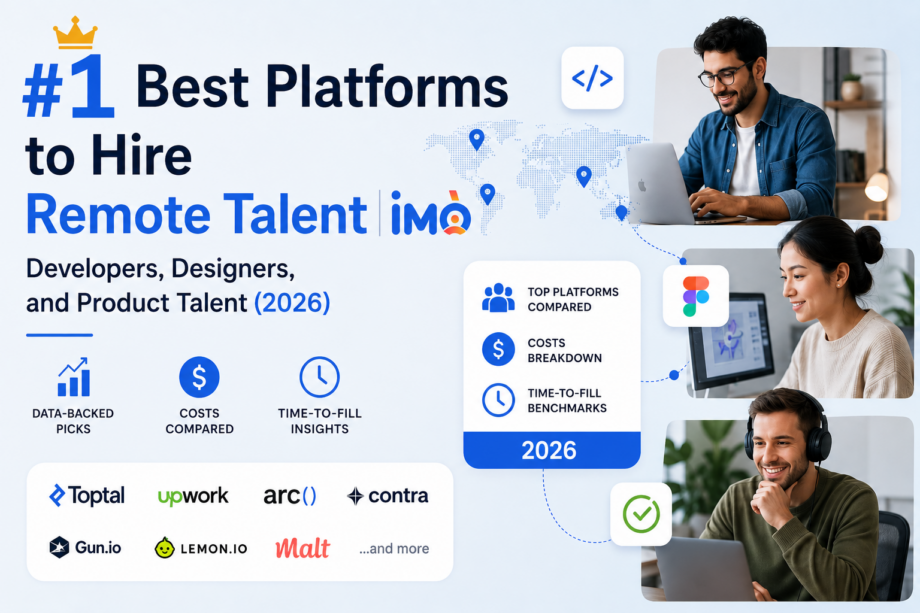
Hiring remote technical and creative talent has never been more critical or more complex. With over 16% of companies now operating fully remote and 62% offering hybrid arrangements, the war for top developers, designers, and product managers has shifted from local offices to global platforms. But which platform should you actually use? The answer depends on your urgency, budget, role requirements, and risk tolerance.
This guide cuts through the noise with practical, scenario-based recommendations for startups and tech teams hiring in 2026. Whether you need a senior full-stack engineer in 72 hours, a product designer who understands accessibility, or an AI product manager who can ship agentic workflows, you’ll find actionable guidance backed by real hiring data and cost benchmarks.
Quick Answer: The Best Platforms by Use Case
If you’re making a fast decision, here are the top platform picks by scenario:
- Fastest vetted match (senior roles, 1-2 weeks): Imotalent, Toptal, Arc, Lemon.io — pre-screened talent pools with rapid matching algorithms and quality guarantees
- Budget-conscious, wide selection: Upwork, Contra, Braintrust — open marketplaces with thousands of profiles and flexible pricing, but require more screening effort
- Design portfolios and discovery: Dribbble, Behance for portfolio browsing; Superside, Toptal for vetted, managed design teams
- Product roles (PM/TPM/PMM): Wellfound (formerly AngelList Talent) for early-stage startups, Toptal for senior PMs, niche communities like Mind the Product and Product School networks
- AI and agentic roles: mktplc.ai, Hugging Face Jobs, GitHub, Toptal AI, Arc AI specialized networks with ML/AI-focused talent and evaluation frameworks
These recommendations balance speed, cost, and quality based on over 2,400 remote hires analyzed across seed to Series B companies in 2026.
Who This Guide Is For and How to Use It
This guide is designed for:
- Startup founders and CTOs at Seed through Series B stages navigating their first remote hires
- Hiring managers building distributed engineering, design, or product teams
- Recruiters and talent partners evaluating platform ROI and sourcing strategies
Navigate directly to role-specific sections if you know what you need, or start with the decision framework below to understand which platform model fits your constraints. Before shortlisting, use the ROI checklist to calculate true hiring costs beyond hourly rates.
How to Choose: Vetted Networks vs Marketplaces vs Communities vs Agencies
Choosing the right platform starts with understanding four distinct models and their trade-offs:
Vetted Networks
Examples: Imotalent, Toptal, Arc, Lemon.io, Turing, CloudDevs
Best for: Senior/critical roles, security-sensitive projects, fast time-to-fill (1-2 weeks)
Pros: Pre-screened talent (typically top 3-5%), faster matching, quality guarantees, lower replacement risk
Cons: Higher fees (15-30% markup or platform fees), smaller candidate pools, less pricing flexibility
Time-to-fill: 5-14 days | Typical cost: $70-150/hour for senior developers
Open Marketplaces
Examples: Upwork, Braintrust, Contra
Best for: Budget-conscious hiring, junior-to-mid roles, trial-to-hire arrangements
Pros: Massive talent pools, competitive pricing, transparent reviews, flexible engagement terms
Cons: High screening overhead, variable quality, more fraud risk, longer evaluation cycles
Time-to-fill: 2-4 weeks | Typical cost: $35-80/hour for mid-level developers
Communities and Direct Sourcing
Examples: GitHub, Dribbble, Behance, LinkedIn, Discord/Slack communities
Best for: Discovery hiring, niche specialists, building talent pipelines
Pros: No platform fees, authentic portfolios, passive candidate access, relationship-building
Cons: Time-intensive outreach, inconsistent response rates, no quality filters, requires strong employer brand
Time-to-fill: 4-8 weeks | Typical cost: Direct negotiation, often 20-40% below marketplace rates
Agencies and Managed Services
Examples: Superside (design), Gigster (development), Toptal Teams
Best for: Outcome-based projects, ongoing managed teams, minimal internal management capacity
Pros: Fully managed, team continuity, project guarantees, reduced hiring overhead
Cons: Highest cost (30-50% markup), less control over individual contributors, longer contract commitments
Time-to-fill: 1-2 weeks | Typical cost: $100-200/hour blended team rates
Decision Framework
Use this mini-tree to narrow your options:
- Urgent hire (<2 weeks)? → Vetted networks or agencies
- Senior/critical role? → Vetted networks (better screening, lower replacement risk)
- Budget-constrained (<$60/hour)? → Open marketplaces or communities
- Limited assessment capacity? → Vetted networks or agencies (outsource screening)
- IP-sensitive or compliance-heavy? → Vetted networks with legal infrastructure or EOR partners
ROI Checklist: Calculate total cost = hourly rate + platform fees + sourcing time (your hourly cost × hours spent) + interview load + replacement risk (20-40% of first-year cost for bad hires). A $50/hour marketplace hire that takes 40 hours to source and fails after 3 months often costs more than a $90/hour vetted hire that ships value in week one.
Best Platforms by Role and Scenario
Developers: Platforms and When to Use Them
Vetted fast-fill options:
- Toptal: Best for senior/lead engineers, complex architectures, security-critical projects. 3% acceptance rate, 48-hour matching. Cost: $80-150/hour.
- Arc: Strong for full-stack and DevOps roles, flexible engagement (hourly/full-time). 2-week matching. Cost: $70-120/hour.
- Lemon.io: Focused on vetted senior developers with transparent pricing. 1-week matching. Cost: $60-100/hour.
- Imotalent: Hire Africa’s top 1% remote talent in 72 hours. Vetted professionals in Tech, Business & Design ready to join your team at up to 60% less than UK/US hiring costs.
- Turing: AI-powered vetting, large pool of global developers. 3-5 day matching. Cost: $40-80/hour.
- CloudDevs: Pre-vetted senior developers, particularly strong in JavaScript/React ecosystems. Cost: $60-100/hour.
Open marketplaces:
- Upwork: Largest pool (12M+ freelancers), best for trial-to-hire, junior-to-mid roles. Requires strong job posts and screening rubrics.
- Braintrust: Talent-owned network with lower fees (0-10%), strong for mid-to-senior developers, transparent bidding.
- Contra: Commission-free for freelancers, growing pool, good for flexible/project-based work.
Assessment tips: Use live coding sessions (CoderPad, HackerRank), pair programming trials (2-4 hours paid), and controlled take-home tests (4-6 hours max, always compensated). Automate reference checks with Checkster or SkillSurvey. For security roles, require background checks and NDA-protected technical evaluations.
Designers: Platforms and Evaluation Beyond Portfolios
Portfolio discovery: Dribbble and Behance remain the gold standard for browsing design work, but portfolios alone don’t predict shipping ability. Use LinkedIn for product designers with documented impact metrics.
Vetted and managed design:
- Superside: Managed design teams for ongoing needs, strong in brand and product design, subscription model. Cost: $3,000-10,000/month per designer equivalent.
- Toptal Design: Vetted senior designers, particularly strong for complex systems (design ops, accessibility, design systems). Cost: $80-150/hour.
Open marketplaces: Upwork and Contra work well for design when you use structured evaluation rubrics. Avoid spec work instead, use portfolio walkthroughs with structured questions: “Walk me through your design process for this project. What constraints did you face? How did you validate this solution?”
Evaluation framework: Assess portfolio-to-product translation (can they ship, not just pixel-push?), Figma proficiency and component discipline, design systems thinking, accessibility knowledge (WCAG 2.1 AA minimum), and research craft (how they validate assumptions). Request a 90-minute paid design exercise: “Redesign our onboarding flow to improve activation by 15% show your thinking, not final pixels.”
Product Talent (PM, Growth PM, AI PM, TPM, PMM): Close the Gap
Product roles are notoriously hard to hire remotely because craft is harder to assess than code or pixels. Here’s where to find them:
- Wellfound (AngelList Talent): Best for early-stage startup PMs who thrive in ambiguity, strong filters for stage/equity preferences.
- Toptal Product: Senior PMs and TPMs with documented shipping records, particularly strong for B2B SaaS and technical product roles. Cost: $100-180/hour.
- Product School and Mind the Product communities: Niche networks for discovering mid-to-senior PMs through events, Slack channels, and job boards.
- LinkedIn: Still the primary channel for PMMs (product marketing managers), use boolean searches: “product marketing manager” AND (SaaS OR B2B) AND “remote”.
Evaluation framework: Use a product sense rubric (how do they prioritize? what’s their framework?), metrics ladders (can they define and move the right KPIs?), execution signals (shipped products, not just roadmaps), and cross-functional leadership (references from eng/design/sales). Assign a no-spec case: “Here’s our current activation funnel and data what would you investigate first and why?” (2-hour paid assignment, async presentation).
Compensation cues: Seed-stage PMs: $80-130K + 0.5-1.5% equity; Series A: $120-160K + 0.25-0.75%; Series B: $140-190K + 0.1-0.4%. Adjust 20-30% down for remote-first roles with geographic flexibility.
2026 AI and Agentic Roles: Where and How to Hire
AI product managers, ML engineers, and agentic workflow designers are the hottest roles of 2026, but traditional platforms struggle with evaluation. Here’s where to source:
- mktplc.ai: Specialized marketplace for AI/ML talent with built-in evaluation frameworks
- Hugging Face Jobs: Direct access to ML practitioners, strong for research-to-product roles
- GitHub: Source from contributors to AI repos (LangChain, AutoGPT, etc.)
- Toptal AI and Arc AI: Vetted networks expanding into AI-specific talent pools
Evaluation: Assign dataset curation challenges (can they clean and label data?), prompt engineering tests (design a multi-step agentic workflow), evaluation harness design (how would they measure this model’s performance?), and model card reviews (assess their documentation discipline). Always check licensing provenance and data privacy protocols.
Risk management: Require IP/licensing audits, data privacy certifications (GDPR/CCPA knowledge), red-team protocols for safety testing, and reproducibility standards (can they document their work for audit?).
Regional Strategies and Compliance (LATAM, Eastern Europe, SEA)
Time-zone strategy: Latin America offers 0-3 hour offset from US time zones (ideal for real-time collaboration). Eastern Europe provides 6-9 hour offset (good for follow-the-sun models). Southeast Asia requires async-first workflows (12-15 hour offset).
Rate benchmarks by region (senior developer roles):
- LATAM: $40-70/hour (Argentina, Mexico, Brazil)
- Eastern Europe: $50-85/hour (Poland, Romania, Ukraine)
- Southeast Asia: $35-60/hour (Philippines, Vietnam, Indonesia)
Compliance: Use Employer of Record (EOR) services for full-time hires: Deel, Remote.com, and Oyster handle local payroll, taxes, and benefits. For contractors, ensure independent contractor (IC) agreements include IP assignment clauses, specify governing law, and address local tax withholding. Consult local counsel for misclassification risk many countries have strict IC-vs-employee tests.
Anti-Fraud and Signal Quality Controls
Remote hiring fraud increased 34% in 2025. Protect yourself:
- Identity verification: Require government ID + live video verification (Onfido, Persona) before technical interviews
- Controlled assessments: Use proctored environments (CodeSignal, HackerRank with webcam) or live screen-share sessions for all technical evaluations
- Anti-ghosting cadences: Set 24-hour response SLAs in contracts, use milestone-based payments (never pay 100% upfront), implement weekly check-ins for first month
- Reference automation: Use Checkster or SkillSurvey for structured reference checks; supplement with backdoor references (former colleagues found via LinkedIn, always with candidate permission)
- Marketplace risk flags: Watch for account sharing (inconsistent communication styles), proxy interview patterns (candidate can’t answer basic questions about their own code), and templated portfolios (reverse image search design work)
Startup-Stage Hiring Stacks (Seed, Series A, Series B)
Seed stage (0-10 employees):
- Stack: Upwork (budget flexibility) + GitHub/Dribbble (direct sourcing) + Imotalent or Lemon.io (1-2 senior hires)
- Budget target: $40-70/hour blended rate
- Time-to-fill: 3-4 weeks acceptable
- Risk controls: Paid trials (1-2 weeks), milestone payments, founder-led interviews
Series A (10-50 employees):
- Stack: Arc or Toptal (senior/lead roles) + Dribbble (design) + Wellfound (product) + Deel (EOR for full-time)
- Budget target: $60-100/hour blended rate
- Time-to-fill: 2-3 weeks target
- Risk controls: Structured interviews, reference checks, 90-day performance reviews
Series B (50-200 employees):
- Stack: Toptal (critical senior hires) + Braintrust (mid-level volume) + Superside (design teams) + Remote.com (global EOR)
- Budget target: $70-120/hour blended rate
- Time-to-fill: 1-2 weeks for urgent roles
- Risk controls: Hiring committees, competency frameworks, onboarding playbooks, performance dashboards
Conclusion: Your Next Hire Starts with the Right Platform Choice
Hiring remote developers, designers, and product talent in 2026 requires matching platform models to your specific constraints: urgency, budget, role seniority, and assessment capacity. Vetted networks like Toptal, Arc, Lemon.io, and Imotalent deliver speed and quality for critical senior roles, while open marketplaces like Upwork and Braintrust offer budget flexibility for teams with strong screening processes.
The key insight: total hiring cost extends far beyond hourly rates. A $50/hour marketplace hire that takes 40 hours to source, requires extensive management, and churns after three months often costs more than a $90/hour vetted hire who ships value from day one. Calculate your true ROI using the framework above, choose platforms aligned with your stage and constraints, and implement anti-fraud controls to protect your investment.
Start with the quick-answer recommendations at the top of this guide, use the decision framework to validate your choice, and jump to role-specific sections for tactical sourcing and evaluation strategies. The right platform combined with disciplined assessment and clear success metrics turns remote hiring from a risk into a competitive advantage.
