

What if your next senior backend architect isn’t sitting in a London office, but is instead delivering world-class code from Lagos or Nairobi? You’re likely exhausted by recruitment cycles that drag on for eight weeks and local salary expectations that make it difficult to hire Node.js developers in Africa. It’s a common struggle; you need high-velocity engineering to stay competitive, yet the local talent market remains stubbornly tight and expensive.
This 2026 guide shows you how to access elite, pre-vetted talent from a pool of 4.7 million professionals and reduce your hiring costs by 60% without compromising on technical excellence. We’ll prove that you don’t have to choose between quality and your bottom line. You’ll discover how to secure senior experts who integrate into your agile workflows in days, not months. We’ll break down the top tech hubs of 2026 and provide a clear framework for vetting remote talent with total confidence.
Key Takeaways
- Discover why the African tech market is the ideal choice for real-time collaboration with UK teams due to perfect time zone alignment.
- Learn how to identify senior engineers who specialise in high-performance, asynchronous backend systems built to scale.
- Find out how to hire Node.js developers in Africa using a rigorous 72-hour vetting process that secures the top 5% of talent.
- See how you can scale your engineering capacity 2.5x faster by optimising your budget without sacrificing technical standards.
- Get practical tips on offloading administrative hurdles so your team can focus entirely on shipping high-quality code.
Why Hire Node.js Developers in Africa in 2026?
Africa has officially shifted from being an “emerging market” to a global powerhouse for JavaScript talent. By 2026, the continent has established itself as the go-to region for companies that need to scale their backend infrastructure quickly and reliably. When you decide to hire Node.js developers Africa provides a level of technical depth and operational efficiency that is hard to match in traditional outsourcing hubs. These aren’t just coders; they are “digital native” engineers who have grown up building cloud-first architectures for a mobile-first population.
This growth is backed by tangible progress. Massive investments in Africa’s fast-growing digital infrastructure, including extensive subsea cables, have made high-speed, stable internet a standard across the continent. Cities like Lagos, Nairobi, and Accra now boast developer densities that rival major European tech hubs. Because many of these engineers were trained through remote-first academies and international programmes, they possess a level of professional discipline that is essential for distributed teams. They understand how to manage their time and communicate progress without being prompted.
The 2026 Tech Landscape in Africa
The tech ecosystem in 2026 is unrecognisable from a decade ago. High-speed connectivity is no longer a luxury, and tech hubs in Nigeria and Kenya have become centres of excellence for backend engineering. If you’re looking to hire Node.js developers Africa is currently the most strategic choice for UK-based firms. The rise of remote-first education has produced a generation of developers who are not only technically proficient but also highly disciplined independent workers. They are used to collaborating across borders and managing their own workflows without constant supervision.
Time Zone and Cultural Synchronisation
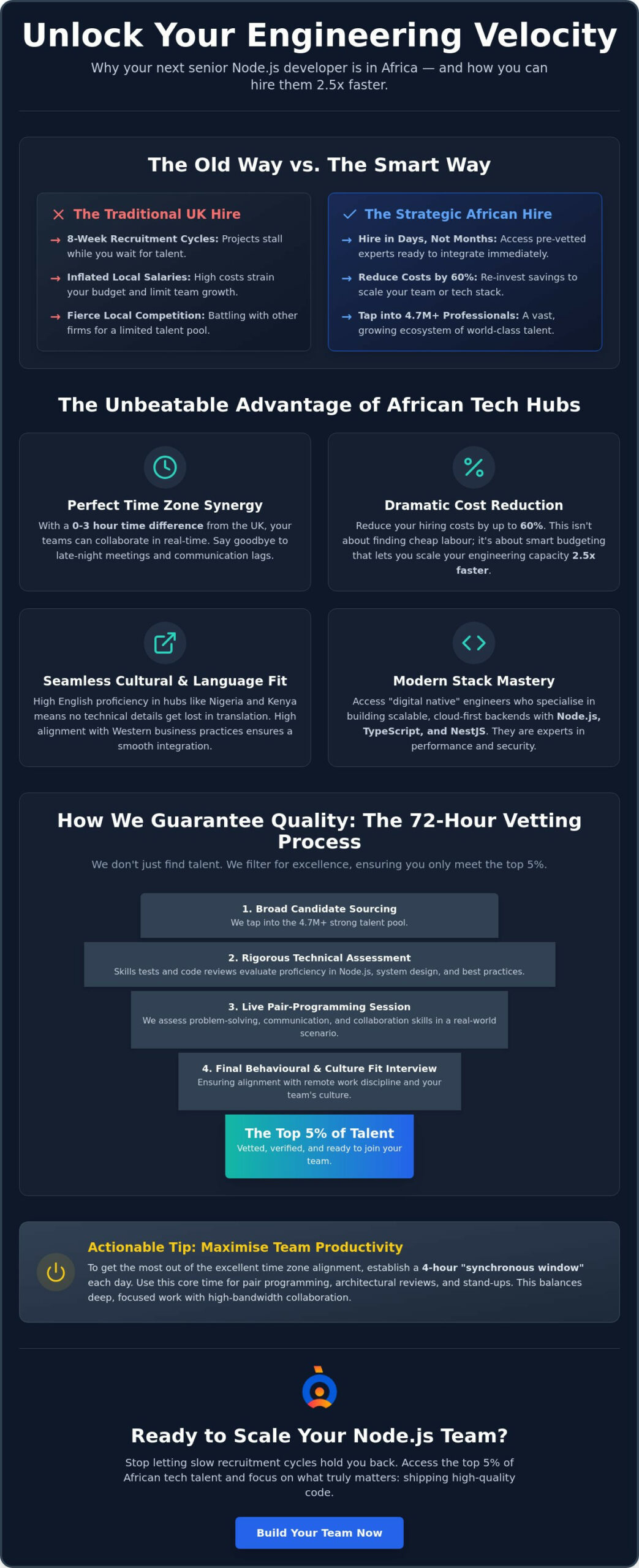
The “secret sauce” for agile teams is the fact that most African tech hubs operate within a window of zero to three hours of GMT or BST. This overlap is vital for Node.js teams because it allows for real-time collaboration, instant feedback on pull requests, and participation in daily stand-ups without anyone having to work antisocial hours. Time zone alignment ensures your team moves at high velocity without the communication lag that plagues teams spread across 12-hour gaps.
Beyond the clock, there’s the language advantage. High English proficiency in Nigeria, Kenya, and Ghana means there’s no risk of complex technical requirements getting lost in translation. Cultural alignment with Western business practices is also exceptionally high, ensuring that your new hires hit the ground running and integrate into your existing team culture with ease.
Technical Excellence: What to Expect from African Node.js Engineers
African engineers aren’t just filling gaps in the global workforce. They are setting benchmarks for how modern, high-traffic backends should be built using JavaScript. When you hire Node.js developers Africa, you’re tapping into a community that prioritises performance and security from day one. These developers have a deep understanding of the Node.js event loop, which is essentially the engine that allows the platform to handle thousands of connections at once without slowing down. They specialise in “non-blocking I/O,” a fancy way of saying they write code that can do multiple things at the same time rather than waiting for one task to finish before starting the next.
This technical depth is a major reason why the e-Conomy Africa 2020 report identifies the continent’s developer ecosystem as a primary driver of digital growth. Most senior talent has also transitioned to TypeScript. Think of TypeScript as a version of JavaScript with a built-in safety net; it adds strict rules that catch errors before the code even runs. For enterprise-level apps, this means fewer crashes and much easier maintenance over time. If you want to see how these skills translate to your specific project, you can connect with vetted Node.js experts who are ready to hit the ground running.
Modern Stack Proficiency
You’ll find that African Node.js specialists are highly selective about the tools they use. Many prefer NestJS for large-scale projects because it provides a rigid, clean structure that keeps code organized as the app grows. For smaller, lightning-fast services, Express.js remains the gold standard. They don’t just write logic; they ensure it connects seamlessly with modern databases. Whether it’s the structured data of PostgreSQL, the flexibility of MongoDB, or using Redis to cache data for instant retrieval, the focus is always on speed and reliability.
Cloud-Native and DevOps Mindset
The best developers in this region don’t stop at writing code. They understand how that code lives in the real world. Most senior talent is proficient in cloud platforms like AWS, Google Cloud, or Azure. They use Docker and Kubernetes to “containerise” their work, ensuring that the application runs exactly the same on a developer’s laptop as it does on a live server. By setting up automated pipelines that test and deploy code instantly, they help your business ship new features with total confidence.
The 72-Hour Vetting Process: How We Guarantee Quality
Speed is a competitive advantage in 2026, but it shouldn’t come at the cost of technical integrity. Most companies wait weeks to find a suitable candidate, only to realise the person they’ve hired isn’t ready for the fast-paced nature of modern backend work. Because the global demand for remote tech talent is at an all-time high, we’ve built a system that allows you to hire Node.js developers Africa with total confidence in just 72 hours. We don’t just “find” developers; we curate the top 5% of talent through a rigorous, four-step vetting process designed to eliminate the risk of a bad hire.
Our focus is on “operational readiness.” This means that when a developer joins your team, they aren’t spending their first week figuring out how to use your tools or communicate with your managers. They are ready to contribute to your codebase on day one. By maintaining a pre-vetted, active pool of experts, we bypass the traditional recruitment lag. You get access to senior engineers who have already proven they can handle the pressure of scaling a backend under tight deadlines.
Rigorous Technical and Soft Skill Testing
Every developer in our network has undergone intensive live coding sessions. We don’t use generic multiple-choice tests; we ask candidates to solve real-world architectural problems. We look at how they handle Node.js design patterns and whether they can explain their logic clearly. Communication is just as vital as code. We assess English fluency and “remote-readiness,” ensuring every hire has the autonomy to meet deadlines without constant hand-holding. If you’re also looking for frontend experts to complement your backend team, you might find our guide on how to hire React developers in Africa effortlessly a helpful resource.
The IMO Talent Matchmaking Engine
Technical skills are only half the battle. A developer who is a genius but doesn’t fit your culture will eventually cause friction. Our matchmaking engine looks at your specific team dynamics and agile workflows to find the perfect fit. This level of precision is part of our commitment to efficient remote talent placement. We act as a bridge, connecting you with professionals who don’t just fill a seat but actually enhance your engineering culture.
Cost vs. Quality: The Strategic Advantage of African Hiring
The decision to hire Node.js developers Africa is often framed as a budget-clever move. It is. But the real story is about velocity. By choosing to build your team in this region, you can scale your engineering capacity 2.5x faster than you could in the UK or US for the exact same spend. This isn’t about cutting corners. It’s about access to senior talent who deliver the same architectural output as their London counterparts without the London price tag. When you remove the need for expensive city-centre office space, local payroll taxes, and high-end equipment stipends, your overheads drop significantly. For a deeper dive into the numbers, check out our Cost of Hiring Developers in US vs Africa: The 2026 Budgeting Guide.
The 60% Cost Reduction Explained
The math is simple but impactful. A senior Node.js developer in London or San Francisco often commands a salary that makes rapid scaling impossible for most mid-sized firms. In tech hubs like Lagos or Nairobi, that same budget allows you to hire a senior lead and a supporting mid-level developer. Lower cost does not mean lower quality in a globalised market where technical talent is the only true currency. These savings can then be reinvested into your product development or marketing efforts, giving you a massive competitive edge. If you are ready to optimise your budget, you can hire vetted Node.js developers through our platform and see the difference in your bottom line immediately.
Long-Term Retention and Loyalty
One of the hidden costs of local hiring is churn. In highly competitive Western markets, developers often jump ship every 12 months for a slight pay rise. African developers show significantly higher loyalty to global firms that offer stable, remote roles and professional growth. This means you spend less time and money on recruitment and training every year. Managed talent solutions help you maintain this high performance over years, not just months. When your team stays together longer, your codebase remains cleaner and your product evolves faster.
Ready to Scale? Build Your Node.js Team with IMO Talent
Scaling a backend shouldn’t feel like a second job. If you’ve been struggling with recruitment cycles that drag on for months, it’s time to shift gears. We’ve simplified the journey to hire Node.js developers Africa so you can focus on shipping features while we handle the logistical complexities. Our platform is built for speed and technical excellence, ensuring that your engineering team grows without the usual friction. For a broader look at how this fits into your overall growth plan, see our Hire Remote Developers from Africa: The 2026 Strategic Guide.
We believe that your time is best spent on product strategy and architectural decisions. That’s why we take over the administrative heavy lifting. From initial vetting to the final contract, we ensure that every developer is ready to hit the ground running. You aren’t just getting a resume; you’re getting a fully vetted professional who has been tested against the highest industry standards for 2026.
From Request to Onboarding in 4 Steps
Our process is designed to be lean and transparent. We’ve eliminated the fluff to ensure you get the talent you need in record time. Here is how we make it happen:
- Step 1: You define your specific tech stack and seniority requirements. Whether you need a NestJS expert or a microservices specialist, we get the details right.
- Step 2: You review a curated shortlist of pre-vetted Node.js experts. These are the top 5% of talent who have already passed our technical hurdles.
- Step 3: You conduct a final interview. This is your chance to ensure the developer aligns with your specific team culture and agile workflows.
- Step 4: You onboard your new developer within 72 hours. We handle the placement logistics so they can start contributing to your codebase immediately.
Continuous Support and Management
The relationship doesn’t end once the contract is signed. We provide ongoing performance monitoring and administrative support to ensure the partnership remains successful. Your dedicated account manager acts as a bridge, helping to maintain high engagement and productivity levels. This managed approach reduces the risk of churn and ensures your remote developers feel like a core part of your team. If you’re ready to stop searching and start scaling, hire your next senior Node.js developer today.
Take Control of Your Backend Scaling Strategy
Africa’s tech hubs have evolved into a primary source of high-end engineering for global firms. You now have a clear path to bypass long recruitment cycles and high local salary demands without sacrificing the quality of your codebase. By leveraging perfect time zone alignment and deep expertise in asynchronous architectures, your team can maintain high velocity and ship features faster than ever before.
When you decide to hire Node.js developers Africa through our platform, you’re accessing the top 5% of vetted talent. You’ll benefit from an average 60% cost reduction while securing senior experts who are ready to contribute on day one. We’ve removed the risk and the administrative burden, leaving you free to focus on your product strategy and core business goals.
Stop letting talent shortages dictate your roadmap. Hire elite Node.js developers from Africa in 72 hours with our guaranteed placement process. Your next architectural milestone is within reach, and we’re ready to help you hit it with total confidence. Let’s build something exceptional together.
Frequently Asked Questions
Is it difficult to manage Node.js developers in Africa due to time zones?
No, it’s actually one of the biggest advantages of the region. Most African tech hubs operate within zero to three hours of UK time, meaning your team can collaborate in real-time during the standard workday. To make the most of this, schedule your daily stand-up meetings during the mid-morning overlap. This ensures everyone is aligned and can solve blockers together without anyone having to work antisocial hours.
How do you vet the technical skills of Node.js developers?
We use a multi-stage process that includes live coding sessions and deep-dive architectural reviews. We test for a fundamental understanding of the “event loop,” which is the core engine that allows Node.js to handle many tasks at once. When vetting your own candidates, ask them to explain how they would prevent a single heavy task from slowing down the entire application. This reveals their practical seniority and problem-solving abilities instantly.
What is the average cost saving when hiring a developer from Africa?
Most companies see an average cost reduction of 60% when they hire Node.js developers Africa talent instead of recruiting locally in London or New York. These savings come from lower overheads and more competitive base salaries without any drop in engineering quality. To maximise this benefit, reinvest your saved budget into your product roadmap. This allows you to ship new features much faster than competitors who are stuck with high local payroll costs.
Can I hire a full team of Node.js developers at once?
Yes, we specialise in building entire engineering departments that are ready to scale together. We match developers based on their technical skills and how well they fit your specific team culture. If you’re building a new team from scratch, start by hiring a senior lead developer first. They can help set the coding standards and architectural foundations before you bring on mid-level developers to handle the bulk of the feature work.
What happens if the developer is not a good fit for my team?
We provide a replacement guarantee to ensure your project stays on track even if the first match isn’t perfect. Our dedicated account managers monitor performance and cultural integration to catch any potential friction early on. To avoid these issues, establish a clear 30-day trial period with specific milestones. This gives both your team and the developer a chance to ensure the working relationship is productive and the communication style is a match.
Do African developers have experience with AWS and microservices?
Yes, senior developers in this region are cloud-native and highly experienced in building apps using microservices, which involves breaking a large platform into smaller, independent parts. Most are proficient in Amazon’s cloud services (AWS) and modern deployment tools. When interviewing, look for developers who have experience with “containerisation” tools like Docker. This ensures that the code they write will run reliably on any server, making your deployment process much smoother.
How quickly can I actually have a developer working on my project?
You can have a senior developer integrated into your workflow within 72 hours of your initial request. Because we maintain a pre-vetted pool, it’s possible to hire Node.js developers Africa experts and have them coding on your project almost immediately. To speed this up even further, have your internal onboarding checklist and communication tools ready before you start the interview process. This ensures your new hire can start delivering value from their very first day.
Are there any legal or tax complications when hiring through IMO Talent?
No, we handle the administrative heavy lifting, including international contracts and payroll compliance. We act as the bridge between your company and the talent, so you don’t have to worry about the complexities of local labour laws in different countries. It’s still a good idea to consult your accountant about the tax benefits of hiring remote services in your specific region. This ensures you’re fully optimising your budget while remaining compliant with your local regulations.
