

Did you know that the global IT outsourcing market is projected to reach a staggering $618 billion by the end of 2026? While US firms grapple with 1.4 million unfilled technical roles, savvy leaders are looking at the cost of hiring developers in US vs Africa to stay competitive. You already know that the struggle to secure senior talent locally is an expensive battle, often made worse by high payroll taxes and the fear of hidden international costs. The quality gap has vanished.
We are here to show you a better way. This guide reveals how you can reduce your engineering overheads by up to 60% by tapping into an elite, pre-vetted talent pool. We will provide a clear cost-comparison table and a strategic roadmap to help you source world-class developers quickly and reliably. It is time to stop overpaying for local scarcity and start realising the value of global excellence. We move at high velocity to ensure your team scales without the traditional friction of international recruitment.
Key Takeaways
- Learn how to calculate the true cost of engineering by accounting for local taxes and benefits that typically inflate US budgets.
- Compare the 2026 cost of hiring developers in US vs Africa to find out how you can reduce overheads by 60% while maintaining high standards.
- Discover why African tech hubs provide a superior edge in English proficiency and communication compared to other popular outsourcing destinations.
- Transition from expensive traditional recruitment agencies to a vetted talent platform to slash your hiring spend immediately.
- Find out how a 72-hour matching process can help you scale your team at high velocity without the usual delays of local hiring.
Why Local Hiring is Breaking 2026 Engineering Budgets
Engineering budgets are under unprecedented pressure. While the demand for elite technical talent continues to climb, the financial reality of maintaining a local US team has reached a breaking point. For many founders, the base salary listed on a job offer is a misleading metric. It represents only a fraction of the actual capital required to keep a seat filled. To understand the true cost of hiring developers in US vs Africa, you must look at the “True Cost” of employment. This encompasses everything from payroll taxes to the physical and digital infrastructure required for a developer to function.
The 2026 US market is a paradox of high demand and tightening belts. Companies are expected to innovate at high velocity, yet the capital required to hire locally is evaporating. This is where geographic arbitrage becomes a decisive competitive advantage. The practice of offshoring has evolved from a simple cost-cutting exercise into a sophisticated strategy for accessing top-tier talent without the financial friction of the US market. Smart leaders are realising that local scarcity is a choice, not a necessity.
The Hidden Line Items in US Developer Salaries
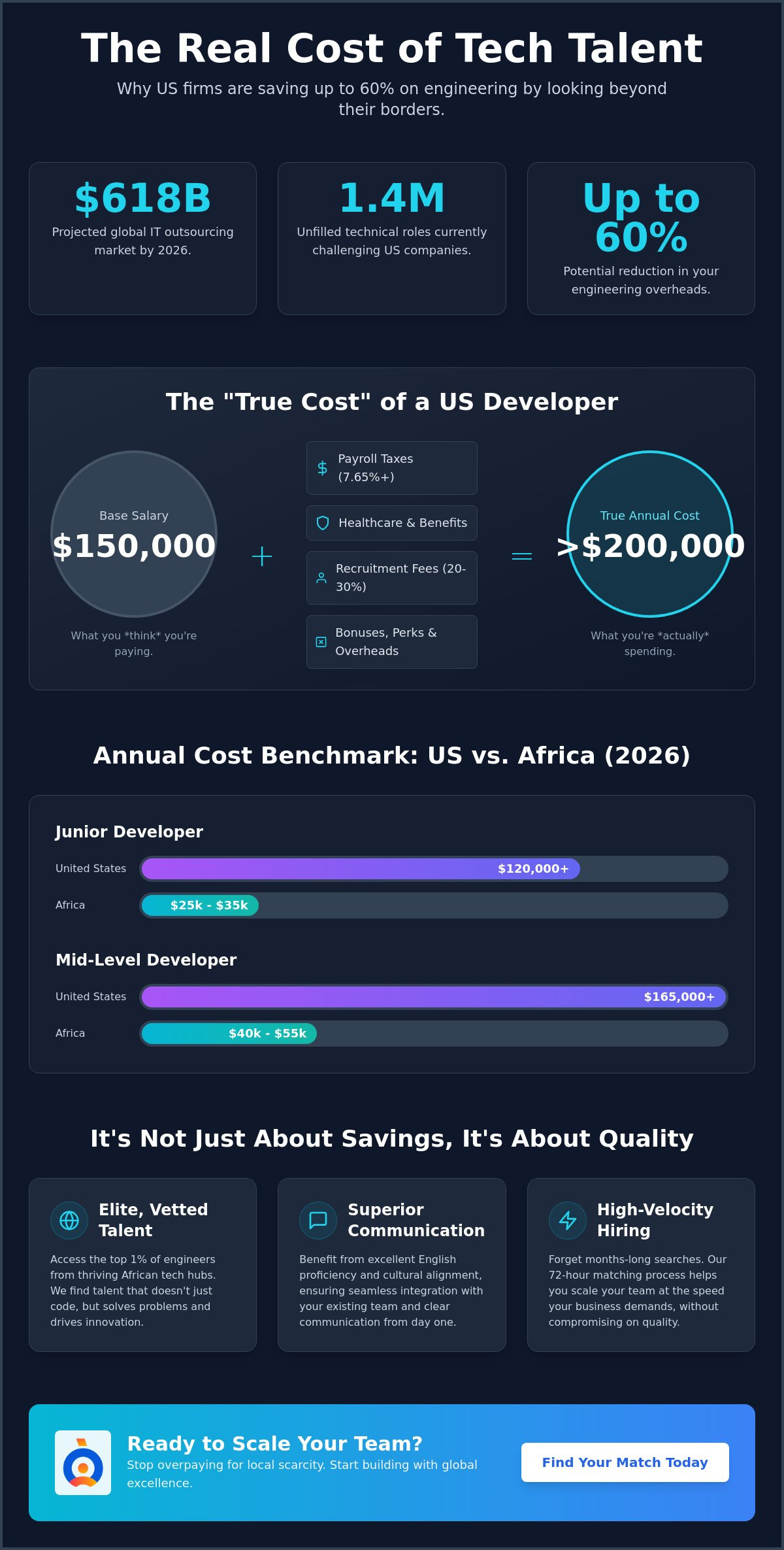
The maths of a US hire is often brutal. Beyond the six-figure salary, companies are burdened with employer-paid healthcare premiums and 401k retirement contributions that add significant weight to the monthly burn rate. State-specific payroll taxes vary, but they consistently push the final budget higher than anticipated. Then there is the recruitment fee. Traditional agencies often charge between 20% and 30% of a developer’s first-year salary just to find the candidate. When you add these variables together, a developer with a $150,000 base salary can easily cost a business over $200,000 in total annual spend. These hidden costs are the silent killers of engineering roadmaps.
The “Talent War” Tax
Local competition has created an artificial inflation known as the “Talent War” tax. To prevent senior engineers from being poached by big tech giants, smaller firms are forced to offer retention bonuses and expensive lifestyle perks. This drives the price of talent far beyond its actual output value. Small to mid-sized firms are effectively being priced out of their own local markets.
The stakes of a bad hire are also at an all-time high. In a market where salaries are peaking, losing three months to a developer who doesn’t fit can result in a six-figure loss when you factor in recruitment costs, training, and lost momentum. This volatility is why the cost of hiring developers in US vs Africa is such a critical comparison for 2026. Africa offers a stable alternative where you can secure the top 1% of talent without the chaotic bidding wars seen in major US tech centres.
Cost Breakdown: US vs Africa Developer Benchmarks
When you look at the cost of hiring developers in US vs Africa, the numbers tell a compelling story of efficiency. In 2026, the potential to reduce your engineering spend by up to 60% is a reality for firms that move beyond traditional local hiring. This isn’t about finding “cheap” labour. It’s about accessing a global market where the top 1% of talent is available at a fraction of the price of a mid-level engineer in San Francisco or New York. In hubs like Lagos, Nairobi, and Cape Town, a senior developer earns a salary that places them in the highest local economic bracket, ensuring high retention and deep commitment to your project.
True Annual Cost Comparison Table (2026)
If you look at U.S. developer salary benchmarks, you’ll see median figures that barely scratch the surface of total expenditure. The table below outlines the “All-In” costs, which include payroll taxes, benefits, and the management overhead required to keep a developer productive.
| Role Level | US (All-In USD) | UK (All-In GBP) | Africa (All-In USD) |
|---|---|---|---|
| Junior Developer | $120,000+ | £55,000+ | $25,000 – $35,000 |
| Mid-Level Developer | $165,000+ | £75,000+ | $40,000 – $55,000 |
| Senior Developer | $210,000+ | £105,000+ | $60,000 – $85,000 |
The cost of hiring senior developers Africa represents a strategic budget optimiser for companies looking to extend their runway without sacrificing technical depth.
Role-Specific Savings: From Frontend to DevOps
Specialised roles often command the highest premiums in the US. AI engineers and Cloud Architects are currently at the centre of a bidding war that makes local hiring almost impossible for startups. However, African tech hubs have seen a surge in backend and full-stack talent. Nigeria, for instance, has a high concentration of fintech-ready engineers skilled in Python, Java, and Go. These developers are used to building high-concurrency systems and can integrate into your DevOps pipeline immediately.
Hiring a full-stack engineer in Kenya or South Africa allows you to cover more ground with a smaller, more focused team. You aren’t just saving on the hourly rate. You’re saving on the complexity of managing a bloated local department. If you want to see how quickly you can bridge this gap, you might want to explore vetted talent matches that fit your specific stack. The financial benefit of this shift is immediate, allowing you to reallocate capital toward product growth rather than just keeping the lights on.
Quality and Communication: Addressing the Elephant in the Room
Let’s be honest about the bias. Many leaders assume that a lower price tag inevitably leads to lower quality code. When evaluating the cost of hiring developers in US vs Africa, it is vital to separate cost from value. The reality is that the quality gap has not just narrowed; in many cases, it has vanished. Africa holds a distinct advantage that many other outsourcing regions lack: native or near-native English proficiency. In countries like Nigeria, Kenya, and South Africa, English is the primary language of business and education. This eliminates the “lost in translation” friction that often plagues international engineering projects.
Success in remote hiring depends on a rigorous vetting process that looks beyond a CV. You need engineers who don’t just write clean code but also understand the nuances of product ownership and clear communication. By focusing on these soft skills alongside technical depth, you turn a potential risk into a massive operational win. It is time to realise that the “elephant in the room” is actually your greatest competitive edge.
The Rise of the Elite African Developer
The ecosystem has matured rapidly over the last decade. Global tech giants like Google and Microsoft have established major development centres in Nairobi and Lagos, while specialized training programmes have spent years cultivating world-class engineers. These aren’t just “good for the price” developers. They are elite specialists building high-concurrency systems for global audiences. Finding affordable remote developers in Africa often leads to higher retention rates than hiring in the US. While a Silicon Valley developer might jump ship for a slightly better perk, an African engineer working with a global firm often views the role as a career-defining opportunity. This results in lower turnover and deeper institutional knowledge for your team.
Seamless Integration and Timezone Synergy
Communication isn’t just about language; it’s about timing. For UK-based teams, the 1 to 3 hour difference is negligible. You can have a full working day of overlap, making your remote team feel like they are in the next room. For US East Coast teams, the 5 to 7 hour gap requires a bit more strategy, but it’s actually an advantage. Your African team can handle bug fixes or feature deployments while your US team is asleep, creating a “follow-the-sun” development cycle. To make this work, lean into asynchronous communication. Use tools like Slack or Notion to document decisions clearly so no one is waiting on a meeting to move forward. This approach keeps projects moving at high velocity without the need for constant, exhausting synchronisation.
5 Ways to Reduce Hiring Costs with Remote Talent
Scaling an engineering team in 2026 doesn’t have to be a financial burden. By shifting from a rigid, local in-house model to a vetted remote structure, you can bypass the most expensive hurdles of the US market. When you evaluate the cost of hiring developers in US vs Africa, the savings aren’t just in the salary. You are also cutting out the heavy taxes and office overheads that come with local staffing. This transition allows you to build a leaner, more agile organisation that prioritises output over presence.
To maximise your budget, you should focus on these five strategic moves:
- Move to a vetted remote model: Stop competing for the same small pool of local talent and open your search to elite African hubs.
- Use a talent platform: Avoid traditional recruitment fees by using a platform that provides direct access to pre-screened experts.
- Optimise for Managed Talent: Reduce your HR and administrative load by letting a partner handle the operational heavy lifting.
- Standardise your tech stack: Use a global stack like React, Node.js, or Python to simplify onboarding and ensure your remote team can hit the ground running.
- Leverage geographic arbitrage: Target high-cost roles like DevOps or Cloud Architects in regions where the talent is world-class but the market rate is more sustainable.
Eliminating the Recruitment Middleman
Traditional headhunters are a relic of a slower, more expensive era. They often demand success fees ranging from 20% to 30% of a developer’s first-year salary, which can instantly drain your quarterly budget. By using a platform with a pre-vetted pool of candidates, you eliminate these high-cost intermediaries. This approach doesn’t just save money; it saves time. You can reduce your “Time to Hire” from several months to as little as 72 hours, allowing you to hire with confidence and maintain your development momentum.
Managing Remote Teams Without the Stress
The “hidden” cost of international hiring often lies in the administrative friction. Handling global payroll and compliance without a local legal entity is a logistical nightmare for most founders. A talent management subscription solves this by providing a framework for long-term retention and legal compliance without the need for a local office.
Actionable Tip: Focus on output-based KPIs rather than hours logged. In a remote setting, the most successful teams are those that measure milestones and code quality rather than time spent at a desk. This shift in management style reduces the need for micro-management and empowers your developers to deliver their best work. When you compare the cost of hiring developers in US vs Africa, this operational efficiency is what truly helps you scale at high velocity. For a deeper breakdown of how to reduce hiring costs with remote talent while maintaining elite standards, the strategies around bypassing traditional recruitment friction are well worth exploring.
Scaling Your Team with IMO Talent
Scaling a team at high velocity requires more than just a job board; it requires a curated bridge to the world’s most efficient talent pools. IMO Talent is that bridge. By connecting you with Africa’s top 1% of technical specialists, we help you navigate the cost of hiring developers in US vs Africa with absolute certainty. We understand that in the tech world, time is literally money. Every day a position remains unfilled is a day of lost innovation. That is why our 72-hour placement promise is a core pillar of our service. We don’t just find talent; we find the right talent at a speed that traditional recruitment simply can’t match.
Our approach removes the guesswork from global hiring. Whether you need a senior backend engineer, a meticulous UI/UX designer, or a growth-focused business lead, we ensure the match is seamless. You aren’t just filling a seat. You are adding a high-performance partner to your mission. By leveraging this model, you can maintain a 60% budget advantage while out-pacing competitors who are still stuck in the local talent war.
The IMO Talent Vetting Standard
Our reputation as an elite facilitator is built on a rigorous four-step vetting process. It begins with a deep dive into technical proficiency, followed by a behavioural assessment to ensure a perfect cultural fit. We look for engineers who possess a product-first mindset. This means they don’t just execute tickets; they contribute to the vision. Our remote talent placement services cover tech, business, and design disciplines, ensuring your entire organisation is balanced and high-performing. We filter out mediocrity so you only ever interview the elite.
Actionable Tip: When onboarding your new remote developer, set up a “buddy system” with a local team member for the first two weeks. This speeds up the transfer of institutional knowledge and ensures the new hire feels like a core part of the team from day one. Clear documentation of your internal processes will also help them hit the ground running without constant back-and-forth questions.
Ready to Build Your Remote Powerhouse?
You have seen the data. The cost of hiring developers in US vs Africa shows a clear path to a 60% budget advantage. This isn’t a compromise; it is a strategic upgrade. By tapping into our curated network of professionals in hubs like Lagos and Nairobi, you gain access to a work ethic and technical depth that is becoming increasingly rare in local markets. The same cost advantages that apply to engineering roles extend equally when you hire remote business and design talent in Africa, making the continent a complete solution for scaling every function of your organisation. Don’t let exorbitant local payroll taxes or the local talent war stall your growth. You can start scaling your engineering, design, or business teams today with the confidence that every hire is pre-vetted and ready to integrate. Book a consultation with IMO Talent and let’s discuss how to optimise your 2026 budget for maximum impact.
Secure Your 2026 Competitive Edge
The financial landscape of 2026 requires a bold shift in how you build your engineering department. We have explored how the true cost of hiring developers in US vs Africa is no longer just about base salaries; it is about the massive savings found in reduced payroll taxes and administrative overheads. You now know that African tech hubs offer elite, English-speaking talent that can integrate into your workflow with minimal friction. By moving away from expensive local headhunters and embracing a vetted remote model, you can reclaim your budget and accelerate your product roadmap.
High-velocity growth doesn’t wait for traditional recruitment cycles. You can bypass the local talent war and access our pre-vetted network of tech, business, and design pros who are ready to deliver results. With a 72-hour candidate placement promise and a potential 60% reduction in hiring costs, the path to a high-performance team is clearer than ever. It’s time to stop overpaying for scarcity and start investing in global excellence.
Access the top 1% of African remote talent and save 60% on hiring costs
Take the first step toward a more efficient, agile organisation today. We are ready to help you scale with confidence and speed.
Frequently Asked Questions
Is it cheaper to hire developers in Africa than in the US?
Yes, hiring in Africa is significantly more cost-effective. Research shows that businesses can save between 40% and 70% on labour costs by looking beyond the US market. While a senior specialist in the US can cost around $160 per hour, an elite peer in Africa typically ranges from $25 to $55 per hour. This massive difference in the cost of hiring developers in US vs Africa allows you to scale your engineering team without the burden of local “talent war” inflation.
What is the average salary for a senior software engineer in Africa in 2026?
Senior developers in Africa generally earn between $35 and $55 per hour in South Africa, while senior talent in Nigeria typically ranges from $25 to $45 per hour. These rates provide a world-class living standard in their respective regions while remaining highly sustainable for US and UK firms. This economic balance ensures high retention and deep commitment to your long-term projects.
How do I handle payroll and taxes for remote developers in Africa?
You don’t need to set up a local legal entity to hire in Africa. Most companies use a specialised talent platform or an Employer of Record to manage global payroll, local tax compliance, and benefits. This approach allows you to pay your team in USD or local currency while ensuring you stay compliant with all relevant labour laws automatically and without administrative stress.
Will there be a language barrier when hiring African tech talent?
No, English is the primary language of business and education in major hubs like Nigeria, Kenya, and South Africa. African developers often possess a level of English proficiency that surpasses other popular outsourcing regions. You can expect clear, technical communication and a deep understanding of complex product requirements from the very first meeting.
What are the best countries in Africa for hiring remote developers?
Nigeria, Kenya, and South Africa are the top destinations for 2026. Nigeria is a powerhouse for fintech and backend engineering, while Kenya’s “Silicon Savannah” excels in mobile and cloud solutions. South Africa offers a mature tech ecosystem with senior talent that is highly experienced in working with global enterprise-level systems and high-concurrency environments.
How does the vetting process work for African developers?
A rigorous vetting process typically involves four distinct stages: a technical assessment, a live coding challenge, a soft skills interview, and a cultural fit check. We focus on developers who don’t just write clean code but also understand the nuances of product ownership. This ensures you only ever meet the top 1% of talent who are ready to integrate into your team immediately.
Can I hire a full team in Africa within a week?
Yes, you can build a full team in as little as 72 hours when using a high-velocity placement partner. While traditional recruitment often takes months, a pre-vetted network allows you to identify and match with specialists across tech, business, and design disciplines almost instantly. This speed is a critical advantage for firms that need to maintain development momentum. For organisations looking to extend beyond engineering, the same approach applies when you need to hire remote business and design talent in Africa to build a fully rounded, high-performing team.
What is the timezone difference between New York and major African tech hubs?
The difference is typically between 5 and 7 hours. This creates a strategic overlap where your African team can handle deployments or bug fixes while your US team is starting their day or finishing their evening. This cost of hiring developers in US vs Africa comparison also highlights the “follow-the-sun” model, which keeps your engineering projects moving 24 hours a day.
