

African tech talent is no longer your backup plan; it’s the primary engine for high-velocity engineering teams in 2026. You’ve likely felt the sting of the US and UK salary bubble and the exhausting eight-week recruitment cycles that often end in high attrition. It’s frustrating to watch your burn rate climb while your product roadmap stalls. You need a more efficient way to hire remote developers from Africa without the typical friction of global sourcing.
This guide provides the blueprint to access elite, pre-vetted engineers and scale your engineering capacity with 60% cost efficiency. We’ll show you how to bypass the uncertainty of infrastructure and manage the evolving regulatory landscape, such as South Africa’s 2026 focus on the “Right to Disconnect.” You’ll discover the exact framework to hire a senior developer in under a week, leveraging a talent pool of 12 million annual graduates across hubs like Nairobi, Lagos, and Cape Town. We’ll transform your hiring process from a bottleneck into a strategic advantage.
Key Takeaways
- Identify why explosive tech growth in Lagos and Nairobi makes Africa the strategic choice for 2026 scale-ups.
- Implement a rigorous vetting framework that prioritizes technical assessments over traditional resumes to ensure elite talent quality.
- Discover the financial blueprint to hire remote developers from Africa and reduce your burn rate by 60% compared to Western markets.
- Resolve operational friction by aligning strategic overlap hours and verifying infrastructure standards for seamless remote integration.
- Transition from talent search to interview in 72 hours using a pre-vetted pool designed for immediate engineering impact.
Why Africa is the Strategic Choice for Remote Tech Talent in 2026
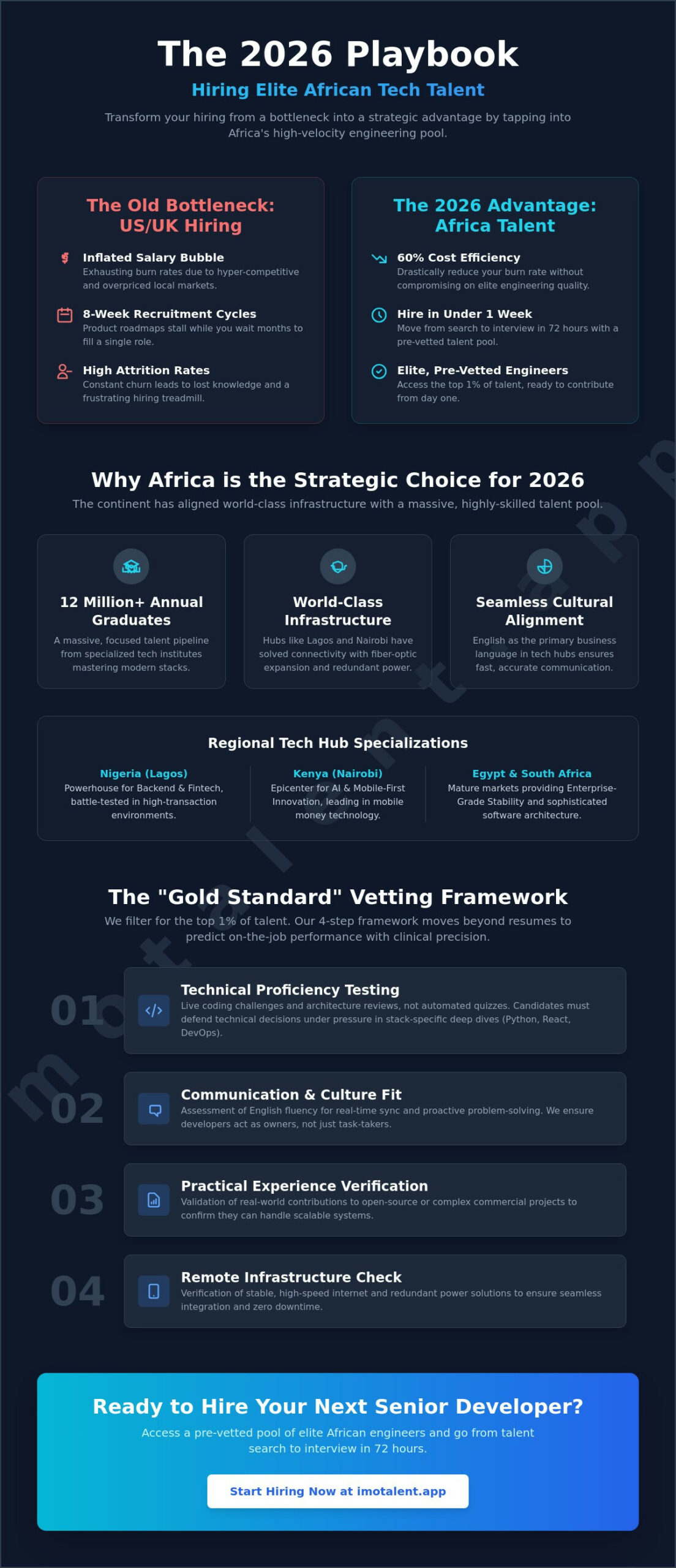
Africa has moved beyond its reputation as an emerging market to become a global tech powerhouse. In 2026, the continent represents the youngest and fastest-growing developer population on the planet. This isn’t accidental. It’s built on a long history of technological achievement that now meets world-class infrastructure. Major hubs like Lagos, Nairobi, and Accra have solved previous connectivity hurdles with fiber-optic expansion and redundant power systems. Forward-thinking companies choose to hire remote developers from Africa because they need high-performance engineering without the friction of traditional outsourcing. The year 2026 marks the definitive tipping point where African infrastructure and talent availability have aligned to create a massive strategic advantage for global scale-ups.
Cultural alignment and language proficiency are no longer barriers; they’re core strengths. With English as the primary language of business in key tech hubs, communication is fast and accurate. There’s a natural synergy with Western work cultures that minimizes the “lost in translation” risks common in other offshore regions. You aren’t just getting code; you’re getting partners who understand the nuances of global product development.
The Talent Density of Regional Hubs
The African tech ecosystem is diverse, with specific cities specializing in distinct engineering disciplines. This specialization allows for targeted hiring based on your project’s technical requirements:
- Nigeria: The powerhouse for backend and fintech engineering. Lagos-based engineers are battle-tested by high-transaction environments and complex financial regulations.
- Kenya: Known as the “Silicon Savannah,” Nairobi is the epicenter for AI and mobile-first innovation, benefiting from a robust history of mobile money leadership.
- Egypt and South Africa: These mature markets provide the enterprise-grade stability and sophisticated software architecture required for long-term, scalable systems.
Education and Skill Specialization
The talent pipeline is massive and highly focused. Africa produces more than 12 million graduates annually. Many of these top-tier students funnel through specialized tech institutes designed to meet international standards. These developers aren’t just learning basic syntax; they’re mastering modern stacks like React, Next.js, and Python. This rigorous training shows in global hackathons, where African teams consistently outperform their international peers from more established markets. When you hire remote developers from Africa, you access a pool that prioritizes technical precision and rapid adaptation to new frameworks. They’re ready to integrate into your existing CI/CD pipelines and contribute from day one.
The 4-Step Vetting Framework: Ensuring Elite Quality
A standard resume is a liability in 2026. It highlights past titles but fails to predict future performance in a high-velocity remote environment. As Africa’s tech ecosystem has experienced tremendous growth, the sheer volume of candidates requires a more sophisticated filter. To hire remote developers from Africa who actually deliver, you must move beyond surface-level credentials. Our 4-step vetting framework is designed for speed and clinical precision. It eliminates the guesswork, ensuring that every candidate presented is ready for immediate integration into high-stakes engineering teams.
Our IMO Talent “Gold Standard” is the benchmark for candidate selection. It is a curated process that filters for the top 1% of the continent’s talent pool. This methodology allows you to hire remote developers from Africa who are not just skilled, but strategically aligned with your growth goals. We act as the gatekeeper so you can focus on building your product.
Technical Proficiency Testing
Elite quality starts with rigorous technical validation. We don’t rely on automated quizzes. Instead, we use live coding challenges and architecture reviews. Candidates must defend their technical decisions under pressure. We conduct stack-specific deep dives into Python, React, and DevOps. We also verify real-world contributions to open-source or commercial projects. This ensures they possess the practical experience to handle complex, scalable systems. It’s a binary result: they either have the mastery or they don’t. If your team’s roadmap depends heavily on Python, our dedicated guide to hiring Python developers in Africa provides a deeper breakdown of the sourcing and vetting steps specific to that stack.
Communication and Culture Fit
Technical brilliance is wasted without effective collaboration. We assess English fluency for real-time synchronization across time zones. We also test for proactive problem-solving. A remote developer must act as an owner, not just a task-taker. Part of our selection process includes verifying their physical remote infrastructure. We check for reliable backup power and high-speed internet. This operational readiness is non-negotiable for 2026 scale-ups. If you are ready to streamline your recruitment, explore our pre-vetted talent for your next engineering role.
Cost vs. Value: The Economic Reality of African Hiring
Hiring in the US or UK has become a game of diminishing returns. You’re paying for local scarcity and inflated overhead rather than pure engineering output. When you hire remote developers from Africa, you disrupt this cycle. The economic reality is clear. You can access the same level of technical sophistication while reducing your burn rate by 40% to 60%. This isn’t about finding a “cheap” alternative. It’s about market arbitrage. You’re leveraging a global talent pool where the cost of living hasn’t decoupled from technical value. High-quality output remains the priority, but the price point is sustainable for rapid scaling.
Think about the hidden costs of local talent. Office space, equipment, localized taxes, and complex benefit packages add up quickly. A senior developer in Nairobi might earn between $4,000 and $8,000 per month. In London or San Francisco, that same role often demands triple that amount before factoring in employer contributions. By choosing to hire remote developers from Africa, you unlock capital that can be reinvested directly into product growth and market expansion. Lower cost doesn’t mean lower quality. It means you’re operating with a higher degree of financial intelligence in a global market.
Salary Benchmarks by Seniority
Rates vary across the continent, reflecting the maturity of local tech hubs. In 2026, mid-to-senior developers in Africa typically command between $25 and $80 per hour depending on their specialization. South African roles often see an average salary around ZAR 1,032,309 per year. Meanwhile, Nigerian engineers often provide exceptional value in backend and fintech roles. These benchmarks are competitive globally but remain highly efficient for Western scale-ups. Avoid the risks of independent contracting by using a structured placement model that handles local compliance and payments seamlessly.
ROI of Managed Talent Platforms
The true cost of hiring isn’t just the salary. It’s the recruitment overhead and the devastating price of a bad hire. Standard recruitment cycles take four to eight weeks. Every day a seat remains empty is a day your roadmap stalls. Our model prioritizes velocity. We reduce time-to-hire significantly, often placing senior talent in under a week. This efficiency pays for itself. You get a stable, loyal developer who is integrated into your culture from day one. Long-term retention is higher because these roles represent elite opportunities within the African market. It’s a high-performance partnership that scales with your ambition.
Operational Excellence: Managing Remote African Teams
Operational success in a global engineering team depends on systems, not proximity. Many leaders hesitate to hire remote developers from Africa due to perceived management friction. This is a strategic error. When you apply a rigorous operational framework, a distributed team becomes a high-velocity asset. You aren’t just managing people; you’re managing a 24-hour output cycle. This requires a shift from surveillance-based management to results-oriented systems. It works because the talent is ready and the infrastructure is mature. For a deeper look at the exact strategies required to integrate top-tier engineers into your existing workflows while bypassing infrastructure gaps and cultural friction, explore our high-performance playbook for managing remote African developers.
Compliance is the foundation of long-term stability. In 2026, the regulatory landscape across the continent has matured significantly. South Africa’s Department of Employment and Labour now prioritizes the “Right to Disconnect,” and SARS has tightened home office deduction rules. Navigating these nuances is critical to avoid legal friction. We handle these international labor complexities so your internal HR teams don’t have to. This allows you to scale without the administrative burden of local employment laws. It’s a clean integration that protects your business from the risks of permanent establishment.
Time-Zone and Sync Strategies
The time-zone gap is a managed workflow, not a barrier. West African hubs like Nigeria and Ghana provide a 5 to 6-hour daily overlap with US Eastern time. East African hubs align almost entirely with European working hours. We maximize this by establishing core sync hours for standups and architecture reviews. The remaining hours are dedicated to deep, asynchronous work. This model ensures that your roadmap moves forward while the US or Europe sleeps. It’s a continuous development loop that increases your team’s total daily output.
Infrastructure and Support
Infrastructure is a non-negotiable standard for elite performance. Every developer we place has verified access to high-speed fiber internet and redundant power solutions. This eliminates the risk of downtime during critical sprints. We also manage the local administrative hurdles, including hardware procurement and delivery. By providing your team with the right tools and a stable environment, we ensure they operate at peak efficiency from day one. If you want to bypass the operational headaches of global hiring, get started with our managed placement service today.
The IMO Talent Advantage: Hire in 72 Hours
Speed is the ultimate differentiator for 2026 scale-ups. Traditional recruitment models are broken. They rely on passive job boards and slow-moving processes that take weeks to yield results. You don’t have time for that. To hire remote developers from Africa effectively, you need a partner that operates at the same velocity as your engineering sprints. IMO Talent provides that bridge. We’ve replaced the standard month-long wait with a precise, 72-hour recruitment lifecycle. This isn’t just a goal; it’s our operational standard.
We maintain a curated pool of the top 3% of tech talent across the continent. These individuals aren’t just looking for jobs. They’ve been rigorously pre-vetted against the technical and cultural standards discussed in this guide. This readiness allows us to bypass the noise and move directly to placement. You get the elite quality of a boutique agency with the speed of a high-tech platform. When you hire remote developers from Africa through our system, you’re choosing a path of zero friction and immediate impact.
The 72-Hour Recruitment Lifecycle
Our process is methodical and direct. We strip away the fluff to focus on three critical steps that move your project forward:
- Step 1: Needs Assessment: We define your role profiling and technical stack requirements with clinical precision. We don’t just look at skills; we look at strategic alignment.
- Step 2: Instant Matching: We scan our pre-vetted pool and present the top 3 candidates who match your exact criteria. These are developers ready to start.
- Step 3: Rapid Interviewing: You move straight to the final interview stage. We’ve already handled the screening calls and basic coding tests.
Beyond the Hire: Managed Retention
Our commitment doesn’t end with a signed contract. We act as an active partner in your team’s long-term success. This includes ongoing performance monitoring and professional development support for the developer. We handle the local administrative hurdles and ensure the integration remains seamless as your project evolves. This managed approach is why our retention rates outperform the industry average. We don’t just fill seats; we build stable, high-performance engineering units that stay. You can scale your team with elite African talent in 72 hours and stop letting recruitment bottlenecks stall your innovation.
Secure Your Competitive Edge with Global Engineering Excellence
The tech landscape in 2026 demands more than just headcount; it requires elite specialized talent that integrates seamlessly into your roadmap. You’ve seen how regional hubs like Lagos and Nairobi have matured into world-class engineering centers. By choosing to hire remote developers from Africa, you aren’t just saving on costs. You’re accessing a loyal, high-performance talent pool that drives 60% more efficiency into your burn rate. The era of settling for slow recruitment cycles is over. Your engineering velocity is now a direct reflection of your global talent strategy.
Don’t let traditional hiring bottlenecks stall your innovation. You can bypass the friction of vetting and compliance with a partner that operates at your speed. Leverage our top 3% vetted talent pool and transform your engineering capacity today. We provide the bridge to excellence with a 72-hour placement guarantee. Start your 72-hour hiring sprint with IMO Talent and watch your product roadmap accelerate. The future of global tech is ready to scale with you. Let’s build it.
Frequently Asked Questions
Is it really possible to hire a senior developer from Africa in 72 hours?
Yes, we achieve this by maintaining an active, pre-vetted pool of the top 3% of technical talent. Unlike traditional agencies that start a search from scratch, we match your requirements with candidates who have already passed our rigorous technical and communication assessments. This readiness allows you to move directly to final interviews and secure a senior engineer within three business days.
How do African developer salaries compare to Eastern Europe or India?
African developer rates are highly competitive with Eastern Europe and India, often providing better value due to high English proficiency and time-zone alignment. While mid-to-senior developers command between $25 and $80 per hour, you avoid the hidden costs of language barriers and significant time gaps. This makes the total cost of ownership for an African engineering team more efficient for Western scale-ups.
What are the most common programming languages used by African developers?
The ecosystem is heavily focused on modern, scalable stacks including React, Next.js, TypeScript, and Python. Backend engineering often utilizes Node.js or Java, while mobile development centers on Flutter and React Native. These developers prioritize high-demand technologies used by global tech firms, ensuring their skills are immediately applicable to your existing codebase and CI/CD pipelines. If your team relies heavily on React, our detailed guide on how to hire React developers in Africa walks you through the exact sourcing and vetting steps for this specific stack.
How do you handle the time difference between Africa and the US/UK?
We manage time differences through a strategic overlap model that ensures four to six hours of synchronous collaboration daily. West African hubs align closely with US Eastern time, while East African hubs share nearly identical working hours with Europe. This balance allows for real-time standups and architecture reviews while preserving dedicated blocks for deep, asynchronous work to maximize 24-hour productivity.
What happens if the remote developer is not a good fit for my team?
We provide a replacement protocol to ensure your project momentum remains uninterrupted. If a placement doesn’t meet performance or cultural expectations, we initiate a new matching cycle immediately. Our goal is long-term retention, so we work closely with both parties during the integration phase to identify and resolve friction points before they impact your roadmap.
Do I need to worry about the internet or power infrastructure in Africa?
No, because we verify that every developer has redundant power solutions and high-speed fiber internet before placement. Major tech hubs like Cape Town and Nairobi have mature infrastructures that support enterprise-grade remote work. We ensure our talent operates from environments that meet global hardware and connectivity standards, eliminating the risk of downtime during critical development sprints.
How does IMO Talent ensure the quality of its developers?
Quality is guaranteed through our multi-stage vetting framework which includes live coding challenges, architecture defense, and soft-skill testing. We don’t rely on automated scripts; our technical experts conduct deep dives into a candidate’s specific stack and past project contributions. This clinical approach ensures you hire remote developers from Africa who possess both technical mastery and operational readiness.
What are the legal and tax implications of hiring remote workers from Africa?
We handle the complexities of international labor laws and local tax compliance to protect your business from legal risks. This includes navigating specific regional regulations like South Africa’s recent focus on the “Right to Disconnect” or Kenyan work permit waivers for East African nationals. Our managed placement model ensures that your engagement follows all local employment standards, allowing your HR team to focus on internal operations. For teams specifically looking to hire Python developers in Africa, understanding these compliance nuances is especially important when structuring long-term backend engineering contracts.
