

Your global scaling strategy is only as fast as your weakest integration point. You recognize that the African tech ecosystem is brimming with elite talent, yet the perceived logistical friction of managing remote African developers often feels like a barrier to entry. It’s natural to feel anxious about power reliability in hubs like Nairobi or the complexity of cross-border compliance while you are trying to ship code from your UK headquarters. You want the 40-60% cost efficiency, but you cannot afford to compromise on your high-velocity Jira sprints or Slack workflows.
This playbook eliminates those hurdles. You will master the exact strategies required to integrate top-tier engineers into your existing team while bypassing the infrastructure gaps and cultural “yes-man” biases that stall traditional outsourcing models. We are moving beyond the “growth-at-all-costs” mindset of 2025 and into a 2026 reality focused on profitability and operational excellence. We will explore how to automate hardware logistics, navigate local labor laws without the administrative headache, and build a seamless bridge between London and the continent’s most sophisticated tech hubs.
Key Takeaways
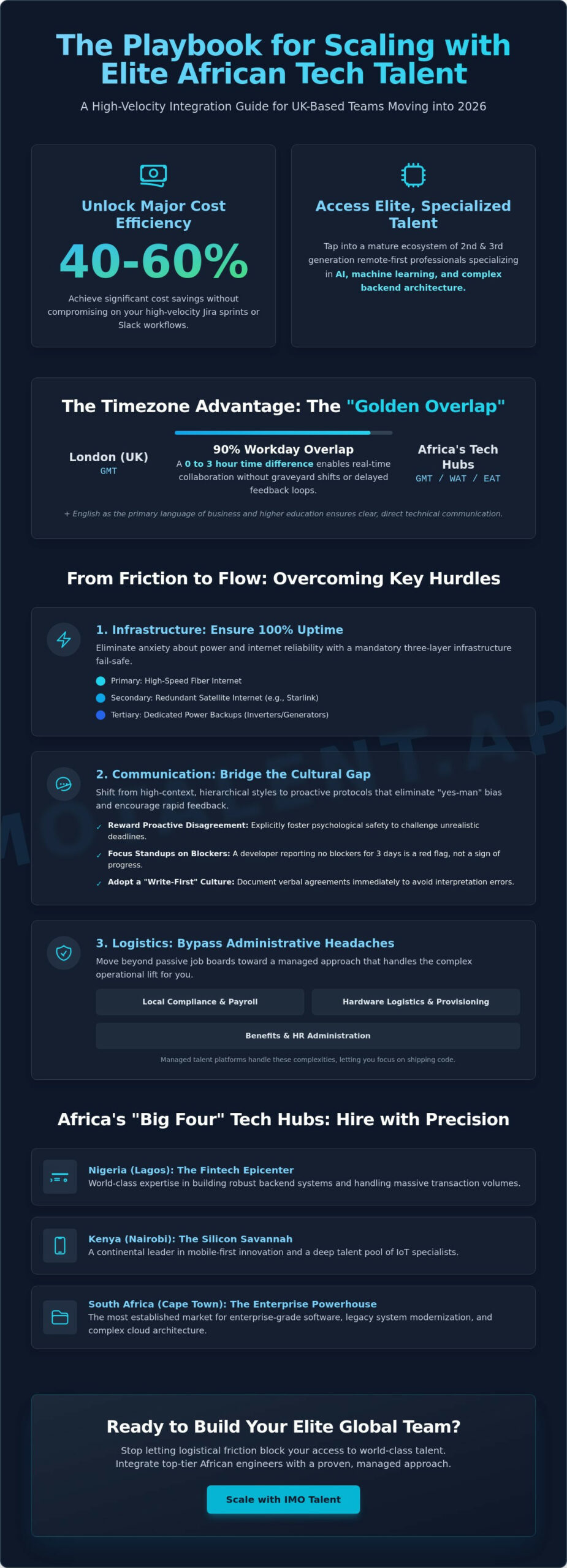
- Leverage the 0-3 hour timezone alignment between London and Africa’s “Big Four” tech hubs to maintain real-time collaboration without the friction of traditional offshoring.
- Eliminate communication bottlenecks by shifting from high-context, hierarchical styles to proactive protocols that encourage technical disagreement and rapid feedback.
- Ensure 100% uptime by implementing a three-layer infrastructure fail-safe involving fiber, satellite internet, and dedicated power backups.
- Master the art of managing remote African developers by moving beyond passive job boards toward managed talent platforms that handle local compliance and hardware logistics.
- Optimise your first 90 days using a “Remote-Ready” vetting framework that prioritises proactivity and cultural alignment alongside elite technical proficiency.
The 2026 African Tech Landscape: Why Global Teams are Scaling Here
The narrative that Africa is merely a source of “cost-effective” labor is obsolete. In 2026, the continent has emerged as a primary source of elite, specialized talent in AI, machine learning, and complex backend architecture. This shift is driven by a mature ecosystem where developers are now 2nd or 3rd generation remote-first professionals. These engineers aren’t just learning to work globally; they have been doing it for a decade. They understand the cadence of international product cycles and the rigour required for enterprise-grade deployments.
For UK firms, the strategic advantage of managing remote African developers lies in this operational maturity. The “Big Four” tech hubs, including Lagos, Nairobi, Cairo, and Cape Town, attract the lion’s share of venture capital. African tech startups raised over £560 million in Q1 2026 alone. This concentration of capital has fostered a engineering culture that mirrors the standards of London or Berlin. While the Internet in Africa continues to see rapid infrastructure investment from satellite and fiber providers, the real value is the human capital that has scaled alongside these improvements. Successfully managing remote African developers requires moving beyond the “outsourcing” mindset toward a model of high-performance integration. If you are ready to take that step, our comprehensive guide on how to hire remote developers from Africa provides the full strategic blueprint for accessing this elite talent pool with 60% cost efficiency.
The Timezone and Language Advantage
Collaboration thrives on synchronicity. Unlike Asian outsourcing hubs that require graveyard shifts or delayed feedback loops, the GMT, WAT, and EAT timezones offer a 0-3 hour difference from the UK. This creates a “Golden Overlap” where your entire team is online and active for 90% of the working day. English is the primary language of business and higher education in these major hubs. You won’t struggle with translation layers or misunderstood requirements. Communication is direct, technical, and optimized for high-velocity environments.
Identifying Hub-Specific Strengths
Every region offers a distinct competitive edge. Selecting the right hub depends on your specific technical stack and product goals. Nigeria is the epicenter of high-velocity Fintech. Nigerian developers excel in building robust backend systems and handling massive transaction volumes. Kenya, known as the “Silicon Savannah,” is a leader in mobile-first innovation and IoT specialists. South Africa remains the most established market for enterprise-grade software engineering, offering high proficiency in legacy system modernization and complex cloud architecture. This regional specialization allows you to hire with clinical precision. You aren’t just filling a seat; you are integrating a specialist who understands the specific pressures of your industry.
Bridging the Cultural Gap: Communication Protocols for African Teams
Cultural alignment is the invisible engine of team velocity. While the timezone overlap discussed previously solves the logistics, communication protocols bridge the cognitive gap. Africa’s burgeoning tech scene is a vital response to the global tech talent crisis; however, success hinges on understanding regional communication nuances. In many West African hubs, communication is often “high-context.” This means meaning is frequently layered within social cues and professional hierarchy. Contrast this with the “low-context” preference of UK engineering leads who value explicit, literal instructions. Bridging this gap requires a deliberate shift in how your team interacts.
The most common friction point is the “Respect for Hierarchy” trap. In many African cultures, contradicting a senior manager is seen as a breach of etiquette. This can lead to a “Yes-man” bias where developers agree to technical requirements or deadlines they know are unrealistic. To counter this, you must explicitly reward proactive disagreement. Shift your daily standups away from status updates. Focus exclusively on blockers. If a developer doesn’t report a blocker for three days, it’s a management red flag, not a sign of smooth sailing. Adopting a “Write-First” culture ensures that verbal agreements are documented immediately, leaving no room for regional interpretation errors.
Fostering a “Safe to Fail” Environment
Psychological safety is the prerequisite for “Extreme Ownership.” If your team fears repercussions for missed sprints, they’ll hide risks until they become catastrophic. You need to build a culture where reporting a bug or a delay is seen as a high-performance trait. Use anonymous feedback loops to uncover project risks early. This allows engineers to flag technical debt or infrastructure hurdles without feeling like they’re challenging authority. When managing remote African developers, your goal is to transform them from task-takers into product owners who feel empowered to push back on scope creep.
Standardizing the Tech Stack and Documentation
Ambiguity is the enemy of distributed teams. Standardizing on tools like Notion and Jira is non-negotiable for managing remote African developers. These platforms serve as the “single source of truth” that mitigates asynchronous gaps. You must practice “Over-Documentation.” Every ticket needs a clear “Definition of Done” (DoD) that leaves zero room for cultural interpretation. If you’re looking for a partner to help bake these protocols into your workflow from day one, consider exploring how vetted talent platforms can streamline your integration process. Clear documentation ensures that a developer in Lagos and a product manager in London are looking at the exact same roadmap with the same expectations.
Solving the Infrastructure Friction: Power, Internet, and Hardware
“What if the power goes out?” is the primary objection UK managers raise before managing remote African developers. It’s a valid concern, but in 2026, it’s a solved logistical problem for elite talent. Professionals in hubs like Lagos or Nairobi don’t rely on the municipal grid. They operate with a “Three-Layer Fail-Safe” system. This involves primary fiber connectivity, satellite backup, and mobile data as a tertiary failover. By treating infrastructure as a managed line item rather than a risk factor, you ensure your sprints remain uninterrupted regardless of local grid instability.
Hardware logistics present a different challenge. International shipping from the UK often results in exorbitant customs duties and month-long delays at the border. Local procurement is the superior strategy. It allows for next-day delivery of high-spec machines and ensures compliance with local warranty laws. Providing a coworking stipend is the highest-ROI investment you can make. It guarantees a professional environment with industrial-grade generators and high-speed redundant links, effectively offloading the infrastructure risk to a specialized facility. This approach transforms potential downtime into a non-issue.
Energy Fail-Safes: UPS and Inverters
Grid fluctuations shouldn’t dictate your release schedule. Every senior remote engineer requires a minimum of a 1kVA UPS or a solar-powered inverter system to bridge power gaps during grid transitions. We recommend structuring an “Infrastructure Stipend” as part of the total compensation package to cover these costs. A senior developer must possess a high-spec laptop with a minimum of 16GB RAM and a 1kVA+ UPS to ensure continuous operation during grid transitions. This proactive investment eliminates the “offline” excuse entirely.
The Starlink Revolution in Africa
By May 2026, Starlink had secured authorization in at least 25 African countries, completely neutralizing the “unreliable ISP” argument. While local fiber remains the primary choice for low latency in hubs like Cape Town, satellite internet serves as the ultimate redundant layer. Providing Starlink as a secondary connection is a minor operational cost compared to the productivity loss of a single offline day. This technology has opened up “Tier 2” cities, allowing you to source elite talent beyond overcrowded capitals while managing remote African developers with the same confidence you have in your local London team.
Vetting and Onboarding: The First 90 Days
High-velocity engineering teams don’t leave integration to chance. When managing remote African developers, the first 90 days determine the long-term ROI of the hire. You need a vetting process that filters for ownership as much as it filters for syntax. Elite talent is already in high demand; your onboarding must mirror the sophistication of your engineering standards to retain them. This isn’t about passive observation. It’s about active, structured integration that turns a “new hire” into a “core contributor” within the first sprint. For a deeper look at how to structure this entire sourcing and onboarding process from the ground up, the 2026 strategic guide to hiring remote developers from Africa covers the exact frameworks used by high-growth engineering teams.
Your vetting and onboarding strategy should follow a rigorous, four-step progression:
- Step 1: The “Remote-Ready” Tech Assessment. Move beyond generic LeetCode puzzles. Test for real-world scenarios, such as debugging a legacy codebase or optimizing a slow API endpoint in your specific stack.
- Step 2: Cultural Alignment Interview. Test for the proactivity mentioned in previous sections. Ask for examples of when they challenged a technical decision or identified a project risk early.
- Step 3: The “Paid Trial” Week. Validate real-world output before long-term commitment. Assign a discrete feature or a set of bug fixes to see how they handle your CI/CD pipeline and documentation standards.
- Step 4: Structured Onboarding. Integrate them into the “Tribal Knowledge” of the firm. This includes everything from unwritten coding conventions to the specific nuances of your product’s user base. To ensure this step delivers maximum impact, follow the 2026 integration template for onboarding remote African professionals, which provides a proven 90-day framework to make new team members productive by week two.
Verifying Skill and Authenticity
Senior-level expertise is verified through live problem-solving. Portfolios can be polished; live coding reveals the true depth of an engineer’s technical logic. Background checks present a unique challenge in regions without centralized credit or employment bureaus. You must leverage local vetting partners who understand the regional landscape to ensure 100% talent authenticity. If you want to bypass the complexity of verifying credentials and technical depth yourself, you can hire pre-vetted African tech talent through a managed platform that handles the entire verification stack for you.
The 72-Hour Integration Framework
Speed is a signal of operational excellence. Your new developer should have full access to Slack, Jira, and GitHub by the morning of Day 1. Delays in access are momentum killers. Assign a “Local Buddy”-a senior peer who understands both the technical stack and the cultural bridge you are building. This buddy serves as the first point of contact for “small” questions that might otherwise go unasked. Set “Quick Win” tasks for the first week. Completing a minor feature or fixing a well-documented bug builds immediate confidence and demonstrates that the engineer is already adding value to the UK team. Once your developer is onboarded, protecting that investment becomes the next priority — our 2026 checklist for remote worker retention in Africa gives you the exact strategies to keep your top performers engaged and reduce costly churn.
The Managed Talent Advantage: Why IMO Talent Wins
Job boards are data graveyards. They provide a list of names but leave the logistical burden of managing remote African developers entirely on your shoulders. IMO Talent operates as a managed talent platform. This means we don’t just find talent; we integrate it. We handle the “African Friction” that usually stalls global teams. This includes everything from cross-border payments to local compliance and hardware logistics. You get the output of an elite engineering team without the administrative overhead.
Speed is our primary metric. While traditional hiring cycles take months, our 72-hour placement guarantee moves you from “need” to “hire” at high velocity. We don’t stop at the contract signing. We provide ongoing performance monitoring and retention as a service. This ensures your developers remain aligned with your UK team’s goals long after the initial onboarding. You focus on the product roadmap while we maintain the operational integrity of your distributed team.
Eliminating Compliance and Payroll Risk
IMO Talent acts as the Employer of Record (EoR). This protects your firm from the complexities of local labour laws across different jurisdictions. You don’t need an African entity to hire in Lagos or Nairobi. We manage local taxes, pensions, and healthcare on your behalf. Our transparent pricing model allows you to achieve a high-velocity engineering team at 40-60% lower cost than UK-based equivalents. Crucially, we ensure talent receives above-market rates. This creates a high-retention environment where your developers are focused on shipping code, not navigating payroll delays.
The Elite Vetted Network
Our vetting process is rigorous. We only accept the top 3% of applicants into our network. This ensures you are working with engineers who possess both technical mastery and the proactivity required for remote-first success. We have already solved the vetting hurdles mentioned in previous sections. Whether you need specialists in React, Node.js, AI, or Product Management, our network is operationally ready. You can hire your next senior developer in 72 hours with IMO Talent and start scaling your engineering velocity today.
Scale Your Engineering Velocity with Elite African Talent
The transition from local staffing to a high-performance global team is a matter of operational readiness. By implementing the infrastructure fail-safes and communication protocols outlined in this playbook, you eliminate the friction traditionally associated with distributed engineering. Managing remote African developers is now a streamlined process for UK firms that value technical excellence and rapid product iteration. The landscape has matured; the talent is ready.
Success requires an elite partner. IMO Talent removes the administrative burden of cross-border compliance and technical vetting. We provide access to a curated network of the top 3% of African tech talent with a 72-hour placement turnaround. You can achieve a 60% reduction in hiring costs while maintaining the highest engineering standards. Build your elite remote team with IMO Talent today and start scaling your development velocity. The future of global engineering is here. It’s time to lead it.
Frequently Asked Questions
How do you handle power outages when managing remote African developers?
Elite developers maintain 100% uptime by using redundant power systems, including 1kVA+ UPS units and solar inverters. Most senior professionals also work from coworking hubs equipped with industrial-grade generators. These infrastructure fail-safes ensure that local grid instability never interrupts your deployment cycles or sprint velocity.
Is there a significant cultural difference in communication styles?
Communication in many African tech hubs is often “high-context,” where social nuance and hierarchical respect are prioritized. You can bridge this gap by implementing a “low-context” written culture that rewards proactive disagreement and technical pushback. Clear documentation and explicit protocols ensure that requirements are never misunderstood due to cultural etiquette.
What is the average cost saving when hiring developers from Africa vs the US?
Hiring in Africa typically results in a 40-60% reduction in total engineering costs compared to UK or US markets. For instance, while a mid-level developer in South Africa earns between £15,000 and £21,000 annually, a comparable US profile often exceeds £100,000. These savings allow you to scale your team without compromising on technical quality.
How do I pay my remote African developers legally and securely?
The most secure method is using an Employer of Record (EoR) to manage local taxes, pensions, and healthcare compliance. This eliminates the administrative burden of establishing local entities in multiple jurisdictions. Managed platforms ensure that all payments are secure, transparent, and fully compliant with both UK and local regulations.
Which African countries have the best software engineers in 2026?
Nigeria, Kenya, South Africa, and Egypt remain the dominant “Big Four” hubs for elite talent in 2026. Nigeria is the epicenter for high-velocity Fintech and backend systems. Kenya leads in mobile-first innovation, while South Africa offers the most mature ecosystem for enterprise-grade software engineering and complex cloud architecture.
Do African developers work in the same timezone as the UK or US?
African timezones are ideal for UK firms, offering a “Golden Overlap” of 0-3 hours for seamless real-time collaboration. This makes managing remote African developers much more efficient than traditional Asian offshoring. For US-based firms, the 6-10 hour difference usually requires a more asynchronous or “follow-the-sun” workflow.
How does IMO Talent ensure the quality of the developers?
We maintain an elite network by accepting only the top 3% of applicants through a rigorous multi-stage vetting process. This includes live coding assessments, cultural alignment interviews, and verified background checks. Our focus is on managing remote African developers who are already “remote-ready” and capable of immediate integration into high-velocity engineering teams.
What tech stacks are most common among African remote professionals?
React, Node.js, and Python are the most prevalent stacks across the continent’s major tech hubs. There is also a high concentration of expertise in mobile technologies like Flutter and backend languages optimized for Fintech. In 2026, we have seen a significant surge in specialized AI and machine learning talent tailored for local and global applications.
