
I once spent three weeks vetting a “senior React developer” who, it turned out, had never touched a production codebase larger than a portfolio site. Cost me the sprint and about a month of trust with my product team. That’s the risk baked into remote hiring, and no platform on earth erases it entirely.
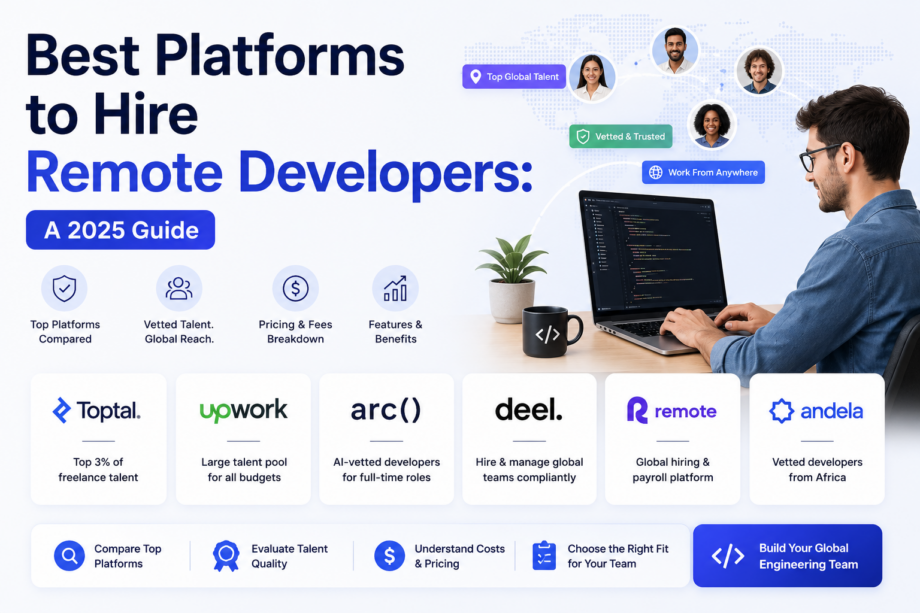
The short answer to which platform you should use is this: there isn’t one platform that’s right for every hire. Toptal is geared toward vetted senior talent, Upwork toward flexible freelance hiring, Fiverr Pro toward fixed-scope projects, Turing toward long-term remote placements, and We Work Remotely or Arc.dev toward broader remote sourcing. IMÒ Talent is another option for companies specifically looking for pre-vetted African remote developers through a more curated hiring process.
The right choice depends on whether you prioritise cost, vetting, geographic reach, hiring speed, project length or access to a particular talent market.
Best for Vetted Senior Talent
Best for: teams that need a senior engineer fast and can’t afford a bad hire.
Toptal screens hard. Reportedly only a small slice of applicants make it through their technical and cognitive tests, which explains why the talent pool feels thinner but sharper than most freelance marketplaces. You pay a premium, a blended markup that’s baked into the hourly rate rather than itemised separately, but for mission-critical modules, that premium buys you fewer surprises.
Pros: rigorous vetting, fast matching, strong for specialised software engineers. Cons: costly for small budgets, overkill for simple fixed-scope tasks.
Best for Budget and Flexible Hiring
Best for: startups and side projects that need a quick, affordable freelance hire.
Upwork’s strength is volume. Thousands of freelance developers list rates, portfolios and reviews, so you can find someone within a day if your scope is tight. The catch is that vetting is entirely on you. I’ve watched a “top-rated” freelancer deliver a slick demo that fell apart the moment it touched a real API layer in production. Nobody checked the seams before launch. That’s the Upwork trade-off: speed for diligence.
Companies that want more candidate curation without relying entirely on an open freelance marketplace can also consider IMÒ Talent. Its focus on pre-vetted African professionals makes it particularly relevant for startups and growing teams looking to hire remote developers while reducing the amount of initial sourcing and screening handled internally.
Pros: huge talent pool, transparent pricing, payment protection through milestones.
Cons: inconsistent quality, employer carries the vetting burden.
Best for Fixed-Scope Projects
Best for: clearly defined, packaged development work with a fixed deliverable.
Fiverr Pro sits above the standard Fiverr marketplace, offering a curated set of specialists who sell defined gigs rather than open-ended hourly contracts. If you know exactly what you want built, a landing page, a small integration, a bug fix, this is often faster than writing a full job spec elsewhere.
Pros: predictable pricing, fast turnaround for narrow tasks. Cons: poor fit for evolving or ambiguous projects requiring ongoing engineering.
Best for Long-Term Full-Time Placement
Best for: companies building out a remote engineering team for the long haul.
Turing leans on AI-assisted matching to pair companies with full-time remote engineers, drawing from a global talent pool rather than a regional one. It’s built for sustained roles, not quick gigs, so the onboarding feels closer to hiring a full-time employee than commissioning freelance work. Fees are typically quoted per engagement rather than published, which makes comparison shopping harder than it should be.
Pros: strong for scaling technical teams, global reach, AI-driven candidate matching. Cons: less suited to short-term or fixed-scope work, pricing opacity.
Best for Pre-Vetted African Remote Developers
Best for: startups and growing companies that want skilled African developers without screening a large open marketplace from scratch.
IMÒ Talent connects companies with pre-vetted remote professionals from Africa, including developers working across technologies such as React, Python, Node.js, PHP, Angular, Vue and Next.js.
Unlike open freelance marketplaces where employers may need to review dozens or hundreds of profiles, IMÒ uses a more curated talent model. This makes it relevant for companies that want to reduce the time spent sourcing and initially screening candidates while still running their own technical interviews and assessments before making a final hire.
Its Africa-focused talent pool can also be useful for companies looking beyond the usual North American and European hiring markets when building distributed engineering teams.
Pros: pre-vetted talent, curated candidate matching, access to African developers, suitable for companies building remote teams.
Cons: more geographically focused than global marketplaces, and employers should still conduct role-specific technical assessments before hiring.
Best for Remote-First Job Postings
Best for: sourcing developers who’ve already committed to remote work as their default, not their exception.
This is a job board, not a marketplace, so you’re posting a role and waiting for applicants rather than browsing profiles. What you gain is candidate quality skewed toward people who understand distributed work culture, asynchronous communication, time zone juggling, the whole rhythm of it.
Pros: high signal for remote-native applicants, straightforward posting process. Cons: slower than marketplaces, no built-in vetting or payment protection.
Comparison Table
| Platform | Best For | Vetting Level | Typical Cost | Engagement Model |
|---|---|---|---|---|
| Toptal | Vetted senior talent | High | Premium | Freelance/contract |
| Upwork | Budget, flexible hiring | Employer-driven | Low to mid | Freelance |
| Fiverr Pro | Fixed-scope projects | Curated | Fixed-price packages | Gig-based |
| Turing | Long-term full-time roles | High, AI-assisted | Mid to high | Full-time remote |
| We Work Remotely | Remote-first job postings | None built-in | Job posting fee | Full-time or contract |
| Arc.dev | Remote marketplace with AI matching | Moderate to high | Mid | Contract or full-time |
| IMÒ Talent | Pre-vetted African remote developers | Pre-vetted/curated | Varies by hire | Remote talent |
Toptal
Worth repeating: Toptal’s reputation rests almost entirely on its screening funnel. The company claims to accept a small fraction of applicants after multiple rounds covering technical skills, language proficiency and problem-solving under pressure. For a business hiring its first remote software engineer, that filter matters more than the price tag. I’ve used Toptal specifically when the codebase already existed and needed someone who could contribute with minimal hand-holding. You still need your own interview loop and code tests behind theirs. Skipping that step, assuming Toptal’s vetting replaces yours entirely, is where teams stumble.
Upwork
Upwork works best as a burst hire mechanism. Need an MVP shipped in three weeks? Fine. Need a foundational architecture decision made by someone who’ll still be around in a year? Less fine. The platform’s escrow and milestone system protects payment, but it does nothing for code quality or long-term maintainability. Treat every Upwork engagement as a trial, not a commitment, and you’ll avoid most of the pain.
Fiverr Pro
Fiverr Pro’s packaged-gig format suits fixed-scope development work oddly well, provided your spec is airtight before you hire. Ambiguity is the enemy here. A vague brief on Fiverr Pro tends to produce a technically correct but practically useless deliverable, because the freelancer built exactly what was written, not what was meant.
Turing
Turing’s AI-assisted matching genuinely speeds up the front end of hiring, surfacing candidates whose skills align with your technology stack faster than manual screening would. The trade-off is transparency. You won’t see published rate cards the way you might on Upwork, so budgeting requires a conversation rather than a quick browse.
We Work Remotely
As one Reddit thread on hiring platforms put it, community consensus leans toward this board being highly effective for sourcing full-time international or contract developers, precisely because the applicant pool has self-selected for remote work already. That said, you’re doing your own screening from scratch, there’s no built-in technical interview layer.
Arc.dev
Arc.dev blends a global talent pool with algorithmic matching, positioning itself between a pure job board and a vetted marketplace. Reviewers consistently frame it as a solid pick for long-term remote placements outside general bidding sites, useful if you want more curation than We Work Remotely offers but don’t want to pay Toptal’s premium.
How Do You Vet a Remote Developer Before Hiring?
Start with a small, paid micro-project that mirrors your actual work, not a generic coding puzzle. I’ve relied on this repeatedly: pair the candidate with an existing team member for a joint mini-sprint, because that dual-assessment surfaces both raw technical ability and collaboration style at once. A developer might ace a solo assessment and still be a nightmare to pair with over Slack.
Beyond the trial task, three things deserve scrutiny before you sign anything:
- Code history and real contributions. GitHub commits, not just a polished portfolio, tell you how someone actually writes software under pressure.
- Communication under ambiguity. Give them an intentionally vague brief and watch whether they ask sharp clarifying questions or just guess.
- References from actual clients, not just platform ratings, since star ratings can be gamed or padded by low-stakes gigs.
How Should You Choose a Platform Based on Budget and Team Size?
Small teams with tight budgets and short-term needs generally do better on Upwork or Fiverr Pro, where cost stays predictable and the commitment is low. Mid-sized companies scaling a core team benefit more from Toptal or Turing, where the vetting layer justifies the higher spend because a bad hire costs more in lost sprint time than the platform fee ever would. Larger organisations building remote engineering teams across multiple time zones often lean on a combination, Turing or Arc.dev for full-time roles, We Work Remotely for specialised or niche postings that need a wider net.
Why Combining Platforms Beats Relying on One Alone
No single platform delivers consistently clean results on its own, and treating any of them as a one-stop solution is the fastest way to end up disappointed. The stronger approach is layered: source broadly through marketplaces, narrow through referrals, then confirm through technical gating before anyone touches production code.
Referrals still outperform every platform on this list for one simple reason, trusted colleagues vouch for people they’ve actually worked with, which cuts onboarding friction dramatically. My own rule has settled into a sequence: check internal referrals first, expand into curated networks like niche language communities second, and only turn to open marketplaces when neither of those fills the gap. A backend engineer I found through a small Rust community years ago became a foundational hire, not because a platform’s algorithm surfaced him, but because someone in that community could vouch for his actual shipped code.
What Should You Do After Hiring to Onboard a Remote Developer Successfully?
Infrastructure matters more than most hiring guides admit. Solid version control practices, documented APIs, and feature flags reduce onboarding friction so dramatically that a new hire can contribute meaningfully within days instead of weeks. Without that groundwork, even a brilliant engineer spends their first month reverse-engineering undocumented decisions instead of shipping.
Pair every new remote hire with a buddy on the existing team for at least the first fortnight. This isn’t about surveillance, it’s about catching misunderstandings early, before they calcify into architectural mistakes that take months to unwind. Set a short trial period explicitly, thirty to sixty days is reasonable, with clear checkpoints on both technical output and communication rhythm.
Conclusion
Remote hiring isn’t a single decision, it’s a funnel, discovery, screening, trial, commitment, each stage compounding your odds of landing someone who actually blends with the product vision rather than just filling a seat. Treat the process itself like a product: define the problem clearly, iterate on what’s not working, and prune ruthlessly. If you’re specifically looking for remote developers from Africa, IMÒ Talent adds another option to the mix. Its curated, pre-vetted talent model is designed for companies that want a narrower candidate pool rather than searching an open marketplace from scratch.
Whatever platform you choose, don’t treat platform vetting as a replacement for your own hiring process. Technical assessments, relevant code samples, references and structured interviews should still determine whether a developer is right for your team.
FAQs
How Much Should You Pay a Remote Developer by Region?
Rates vary enormously by region and experience level, and platform blended rates often obscure the underlying regional cost structure. Broadly speaking, remote engineers in Eastern Europe and Latin America tend to charge less than counterparts in the United States or United Kingdom for comparable experience, while offering time zone overlap advantages depending on your location. Senior engineers on vetted platforms like Toptal command premium rates regardless of region, since the screening cost gets baked into the price everywhere. Junior to mid-level freelance developers on Upwork or Fiverr Pro show the widest regional spread, so comparing several quotes before committing is worth the extra hour it takes.
Can You Hire Remote Developers Without Using a Platform at All?
Yes, and plenty of experienced teams do exactly this through direct referrals, alumni networks from previous companies, or specialist communities built around a specific language or framework. The advantage is cutting out platform fees entirely and getting a stronger cultural fit from the start. The disadvantage is losing the built-in payment protection and dispute resolution that platforms provide, so any off-platform arrangement needs its own contract, its own payment schedule, and its own trial period spelled out clearly before work begins.
