

The most competitive engineering teams in 2026 aren’t fighting over the same over-saturated London talent pools. They’ve already pivoted to a more sophisticated model. To build remote team Africa operations is no longer a simple outsourcing tactic; it’s a high-velocity strategic advantage for scale-ups that refuse to be stalled by three-month recruitment cycles or domestic salary bloat. You likely recognize the frustration of losing top-tier candidates to astronomical counter-offers and the administrative headache of international compliance.
This blueprint masters the framework for identifying, vetting, and scaling high-performance teams across the continent’s premier tech hubs. We’ll show you how to access a pre-vetted senior talent pool and secure a 60% reduction in hiring costs without compromising on quality or speed. You’ll learn how to navigate the 2026 regulatory environment, including South Africa’s Skills Development Levy and Kenya’s tiered NSSF contributions, ensuring your team is integrated in days rather than months. We move quickly from the initial value proposition to the exact mechanics of global scale.
Key Takeaways
- Leverage perfect timezone alignment between UK operations and African tech hubs to ensure seamless, real-time collaboration.
- Master the blueprint to build remote team Africa assets using a 72-hour vetting framework that eliminates traditional recruitment delays.
- Identify high-performance roles across Tech, Design, and Product Management to anchor your global distributed workforce.
- Implement “Day Zero” onboarding protocols to bridge cultural gaps and accelerate team productivity from the very first hour.
- Scale with confidence by accessing a curated pool of senior talent, achieving elite results while significantly reducing operational overhead.
Why Africa is the Strategic Choice for Remote Teams in 2026
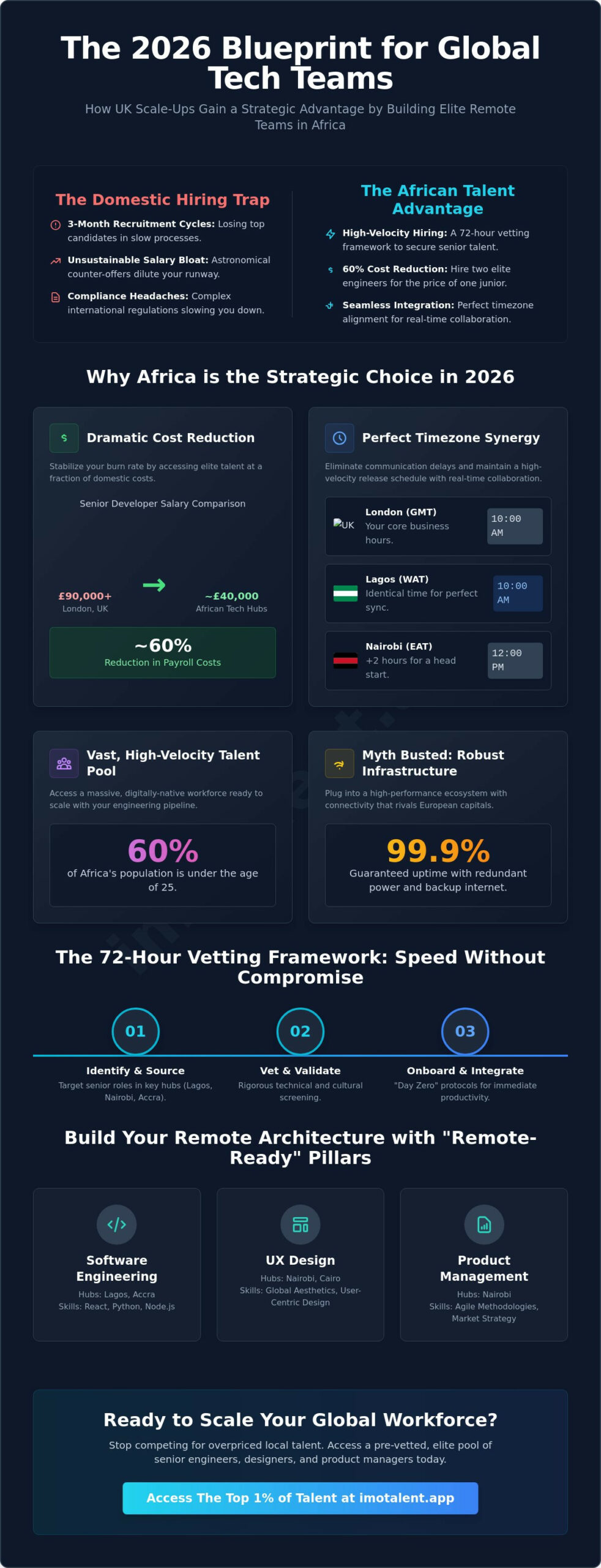
The global talent war has a new frontline. For UK-based scale-ups, the decision to integrate remote work with African talent isn’t just a cost-saving measure. It’s a play for elite-level seniority in a market that never sleeps. By 2026, Africa’s developer population has matured into a sophisticated, high-performance ecosystem. Over 60% of the population is under the age of 25. This creates a massive, high-velocity workforce that is digitally native and ready to scale immediately. You aren’t just hiring developers; you’re securing the future of your engineering pipeline.
Traditional hubs in Southeast Asia are failing to meet the demands of modern, agile teams. The 7 to 12 hour time difference creates a management nightmare that stalls production. Africa solves this through perfect synergy. Tech hubs in Lagos, Nairobi, and Cairo operate within GMT, WAT, and EAT. For a London-based CTO, this means real-time collaboration. There is no more “waiting for the morning” to fix a critical bug or push a deployment. When you build remote team Africa operations, you sync your engineering cycles perfectly with your business hours. This alignment is the secret to maintaining a high-velocity release schedule.
The Economic Case for African Talent
Series A and B startups face a brutal reality in the UK market. Developer salaries in London have reached unsustainable levels, often exceeding £90,000 for senior roles. In major African hubs, you can secure the same level of technical precision for roughly £35,000 to £45,000. This represents a 60% reduction in payroll costs. It stabilizes your burn rate and allows you to hire two senior engineers for the price of one junior in the domestic market. The ROI extends beyond the balance sheet. African talent in emerging markets shows significantly higher retention rates, reducing the hidden costs of recruitment churn. Founders looking to maximize this advantage can explore how to hire African talent for startups through a structured 2026 framework that covers cost optimization and elite vetting in detail.
Infrastructure and Connectivity in 2026
The “infrastructure myth” is dead. Major African cities now boast high-speed fibre connectivity that rivals European capitals. Elite developers don’t work from unstable home setups. They operate from world-class serviced offices or high-end coworking spaces. In Lagos, these spaces are accessible from ₦9,999 per month, while Nairobi offers dedicated desks for approximately KES 17,500. These hubs provide 99.9% uptime through redundant power systems and backup satellite internet. When you build remote team Africa structures, you’re plugging into a robust, high-performance infrastructure designed for the global stage. For the tech leaders visiting these hubs, Nomadipity.com offers a specialized social network to connect with other frequent flyers and share travel rewards experiences. Excellence is the baseline, not the exception.
Designing Your Remote Architecture: Roles, Hubs, and Time Zones
Structuring a distributed workforce requires more than just a Slack channel. It demands a clinical approach to role selection and geographic placement. To build remote team Africa operations that actually scale, you must start with “remote-ready” pillars: Engineering, Design, and Product Management. These roles are inherently suited for distributed environments because their output is measurable and their workflows are digitally native. Africa’s growing workforce provides a unique opportunity to secure these senior roles at a fraction of the cost found in Shoreditch or Silicon Roundabout.
When you build remote team Africa architectures, you’re not just hiring individuals; you’re designing a high-velocity engine. Choosing between West and East Africa depends on your operational rhythm. Nigeria and Ghana (WAT) are ideal for UK teams because they share the same time zone for half the year. Kenya (EAT) offers a slight head start on the day. This is perfect for teams that want to implement a “Follow the Sun” model. By staggering your African team with your UK headquarters, you can maintain 24/7 development cycles. Code pushed in London at 5 PM can be reviewed and iterated upon by a team in Nairobi before the London team even wakes up.
Core Disciplines: Where the Talent Lives
Software Engineering is the foundation. West African hubs like Lagos and Accra are teeming with React, Python, and Node.js specialists. Meanwhile, East African hubs like Nairobi have become centres of excellence for Product Management and UX Design. African designers are no longer just following trends; they are setting them. They bring a fresh, global aesthetic that resonates with modern users in 2026. If you need to fill these gaps quickly, you can access the top 1% of tech talent through elite placement services.
Time Zone Optimization
Mapping WAT to London is effortless. There’s zero lag. For companies with a US presence, the synergy remains strong. The “Golden Hour” of overlap between Lagos and San Francisco typically occurs between 4 PM and 6 PM WAT, allowing for high-bandwidth synchronous communication before the West Coast starts their day. Balance this with asynchronous workflows to prevent burnout. Use declarative documentation and recorded handovers to keep the momentum high without requiring constant presence. This methodical approach ensures that your distributed team operates as a single, cohesive unit regardless of the physical distance.
The 72-Hour Vetting Framework: Speed Without Compromise
Traditional recruitment is a bottleneck. In the high-stakes environment of 2026, waiting three months to fill a senior engineering seat is a strategic liability. While your competitors are stuck in endless interview loops, your growth stalls. To build remote team Africa assets that drive immediate value, you must replace the “hiring lottery” with a high-velocity framework. Speed is your edge. We’ve compressed the journey from role definition to candidate presentation into a 72-hour sprint. This isn’t about rushing; it’s about precision and preparation. If you want to understand the full strategic picture, our guide on how to hire remote developers from Africa covers the complete 2026 blueprint in depth.
The secret to this velocity lies in a pre-vetted talent pool. We don’t start the search when you call. We’ve already finished it. By maintaining a live database of the top 1% of African professionals, we eliminate the noise of general job boards and LinkedIn spam. This allows scale-ups to move from a state of “searching” to “onboarding” in record time. You get access to senior talent that has already cleared the most rigorous technical and professional hurdles in the industry.
Our Four-Step Vetting Protocol
Excellence is non-negotiable. Our audit process ensures that every candidate is ready to contribute from day one. We move beyond static CVs to evaluate real-world performance through four critical layers:
- Step 1: Technical Mastery – We conduct live technical assessments and deep-dives into architectural thinking. We validate code quality and the ability to solve complex, scalable problems.
- Step 2: Communication & Context – We ensure near-native English proficiency and the ability to communicate technical concepts clearly. Cultural alignment with UK business standards is a primary focus.
- Step 3: Reliability Audit – Remote work requires extreme autonomy. We test for “remote-readiness,” verifying that candidates have the discipline and infrastructure to manage their own output without constant supervision.
- Step 4: The Match – We filter for specific team dynamics. We don’t just find a developer; we find the right personality fit for your existing engineering culture.
Eliminating Recruitment Friction
General job boards are 90% noise. For every qualified candidate, there are hundreds of mismatched applications that waste your internal resources. We use AI-assisted matching to bypass this friction, identifying the exact technical stack and seniority level required for your specific project. IMO Talent delivers candidate shortlists in 72 hours because they maintain a live, constantly updated database of the top 1% of African professionals who have already cleared every stage of their rigorous audit. This methodical approach ensures you build remote team Africa operations with total confidence and zero delay.
Operational Excellence: Onboarding and Retaining Top-Tier Talent
Execution is where most global scale-ups fail. You can’t just build remote team Africa operations and expect them to run on autopilot. Success requires a “Day Zero” onboarding strategy. This means every tool, access credential, and project brief is ready 48 hours before the start date. We eliminate the friction that typically kills momentum in the first week. By the time your new hire logs in, they’re already positioned to contribute to your sprint. It’s about professional readiness, not just technical access.
Retention in 2026 is won through cultural integration and administrative stability. Elite African developers are in high demand globally. To keep them, you must bridge the gap between your UK headquarters and your distributed hubs. Performance monitoring shouldn’t feel like surveillance. Instead, use high-output KPIs focused on code quality and architectural impact. Regular “Sync” points and weekly rituals build the cohesion needed for long-term success. Empathy isn’t a soft skill here; it’s a strategic requirement for maintaining a loyal, high-growth workforce.
The Managed Talent Advantage
Placement is only the first step. The real challenge lies in the administrative burden of international compliance. Handling Nigerian pension contributions of 10% or South African UIF requirements can distract your HR team from their core mission. Managed talent services handle the legal headache. They ensure that payroll, benefits, and local taxes are managed with clinical precision. This allows you to focus on scaling while we handle the operational details. You can outsource the administrative burden to elite facilitators who understand the nuances of each market.
Communication Stack for 2026
Slack is no longer enough. High-performance teams in 2026 rely on high-fidelity asynchronous documentation. This reduces the need for constant meetings and allows your team in Lagos or Nairobi to work autonomously. Use tools that prioritize clarity and context over real-time chatter. When synchronous time is needed, schedule it during the “Golden Hour” of overlap to maximize impact. This methodical approach ensures your distributed team operates with the same intensity as an in-house unit. Consistency is the foundation of excellence.
Scaling Your Global Workforce with IMO Talent
The transition from a domestic-only team to a distributed global powerhouse is the defining move for scale-ups in 2026. You have the blueprint. You understand the geographic advantages and the operational requirements. Now, you need the engine to execute. IMO Talent acts as the elite facilitator for this expansion, removing the friction from the recruitment process. We don’t just provide names; we provide high-performance assets. To build remote team Africa structures with IMO Talent is to choose certainty over speculation. Your next senior engineer, designer, or product manager is already in our vetted pool, ready to deploy.
Our model is built for speed and technical precision. We’ve eliminated the traditional three-month lag that stalls growth. By maintaining a live, curated network of the top 1% of African tech talent, we deliver candidate shortlists within 72 hours. This isn’t a generalist approach. We focus on senior-level professionals who understand the demands of global markets and high-growth engineering cultures. You gain instant access to a talent density that is increasingly difficult to find in the UK or US markets.
The IMO Difference: Quality, Speed, and Support
The economic impact of our partnership is immediate. UK scale-ups typically see a 60% reduction in hiring costs compared to London-based equivalents. This capital can be reinvested into product development or market expansion. We provide peace of mind through an end-to-end talent management subscription. We handle the complexities of local compliance, payroll, and benefits, ensuring your team remains focused on output rather than administration. Our track record includes helping tech teams scale from a single hire to 20 senior professionals in just six months. We provide the infrastructure; you provide the vision.
Your Next Steps to a Global Team
Scaling should feel like a progression, not a struggle. The process begins with a discovery call where we define your ideal talent profile and technical requirements with clinical precision. Within 72 hours, you’ll review a curated shortlist of candidates who have already cleared our rigorous four-step vetting protocol. There are no job boards to manage and no LinkedIn spam to filter. We act as your strategic gatekeeper, ensuring only the most elite professionals reach your desk. The future of your engineering team is waiting. Build your high-performance remote team with IMO Talent today.
Secure Your Competitive Edge in the Global Talent Market
The transition toward distributed engineering is a structural requirement for high-growth firms. By leveraging the time zone synergy of African tech hubs, you eliminate the friction of asynchronous delays while achieving a 60% reduction in hiring costs compared to London-based talent. You now have the framework to bypass traditional recruitment bottlenecks and scale without the risk of a hiring lottery. Our 72-hour candidate presentation guarantee ensures that your roadmap stays on track regardless of domestic market conditions.
To build remote team Africa assets is the most efficient path to sustainable growth in 2026. We provide the technical precision, cultural alignment, and fully managed payroll support your business needs to thrive. Your next senior developer is ready to integrate into your workflow immediately. Don’t let domestic talent shortages stall your development when elite global professionals are within reach. We act as your elite facilitator, handling the administrative complexity so you can focus on product excellence.
Access Vetted African Tech Talent in 72 Hours
The future of your engineering team starts today. Move with speed and build with confidence.
Frequently Asked Questions
How do you ensure the quality of remote developers in Africa?
High-performance outcomes are guaranteed through our rigorous four-step vetting protocol. We move beyond static CVs to conduct live technical assessments and architectural audits. Every candidate must demonstrate senior-level mastery and near-native English proficiency. This gatekeeper approach ensures you build remote team Africa assets that are ready to contribute from day one. We filter for the top 1% of professionals who possess the autonomy required for elite remote environments.
What are the typical cost savings when hiring a remote team in Africa?
UK scale-ups typically achieve a 60% reduction in total hiring costs when compared to domestic London rates. You can secure senior-level expertise for roughly £35,000 to £45,000, whereas an equivalent hire in the UK often exceeds £90,000. This efficiency allows you to double your engineering capacity without increasing your burn rate. It’s a strategic play for financial optimization that doesn’t compromise on technical seniority or operational speed.
Can I hire for roles other than software engineering, like Product or Design?
We provide elite placement across Tech, Design, and Product Management pillars. Our vetted pool includes senior UX/UI designers who lead global aesthetic trends and product managers who understand complex market dynamics. Whether you need to scale your business operations or your creative team, we apply the same rigorous vetting standards. This ensures every hire integrates seamlessly into your high-growth environment regardless of their specific discipline or technical stack.
How does IMO Talent handle international payroll and local tax compliance?
We manage the entire administrative lifecycle through our talent management subscription. This includes handling international payroll, statutory contributions, and local tax compliance in hubs like Nigeria, Kenya, and Egypt. You avoid the legal headache of navigating disparate labour laws or currency volatility. Our system ensures your team is paid accurately and on time, while your HR department remains focused on high-level strategy rather than international bureaucracy.
What is the time zone difference between West Africa and the UK/US?
West Africa Time (WAT) offers perfect synergy with UK operations. Hubs in Lagos and Accra share the same time zone as London for half the year, with only a one-hour difference during Daylight Saving Time. For US-based firms, the “Golden Hour” of overlap allows for high-bandwidth synchronous communication. This alignment is a primary reason why companies build remote team Africa operations to maintain real-time collaboration without the lag of traditional outsourcing.
How fast can I realistically have a new remote hire starting work?
You can expect a curated shortlist of senior candidates within 72 hours of your initial discovery call. Our pre-vetted talent pool allows us to move at a velocity that traditional recruitment agencies cannot match. Once you select your candidate, our “Day Zero” onboarding protocol ensures they’re ready to start work within days. We eliminate the three-month recruitment cycles that typically stall the momentum of high-growth engineering teams.
What happens if a placed candidate is not a good fit for my team?
We provide a replacement guarantee to ensure total alignment with your team dynamics. If a candidate doesn’t meet your performance standards or cultural requirements, we move immediately to find a more suitable match from our elite pool. Our goal is long-term operational excellence, not just a one-time placement. We act as an active partner in your success, ensuring your distributed team remains a high-output asset for your organization.
Is there a minimum team size required to start building with IMO Talent?
There is no minimum team size required to leverage our services. We partner with scale-ups at various stages, whether you’re making your first senior remote hire or expanding an existing department. Our infrastructure is designed to scale with your needs. You can start with a single engineer and grow to a team of 20 or more in record time. For early-stage companies looking to get started, our dedicated resource on how to hire African talent for startups provides a practical step-by-step approach tailored to founders at every stage. We provide the same elite level of support regardless of your current headcount.
