

Did you know that Africa’s developer population has surged to over 1 million professionals in 2026, yet most global teams still struggle to fill their senior roles? It’s a common frustration. You’ve likely watched your product roadmap stall because local talent is either priced out of reach or stuck in a three-month notice period. If you want to hire Python developers Africa, you need a strategy that bypasses the noise and the fear of a bad hire. We understand the hesitation. Recruiting in unfamiliar markets feels risky when you can’t afford to lose momentum.
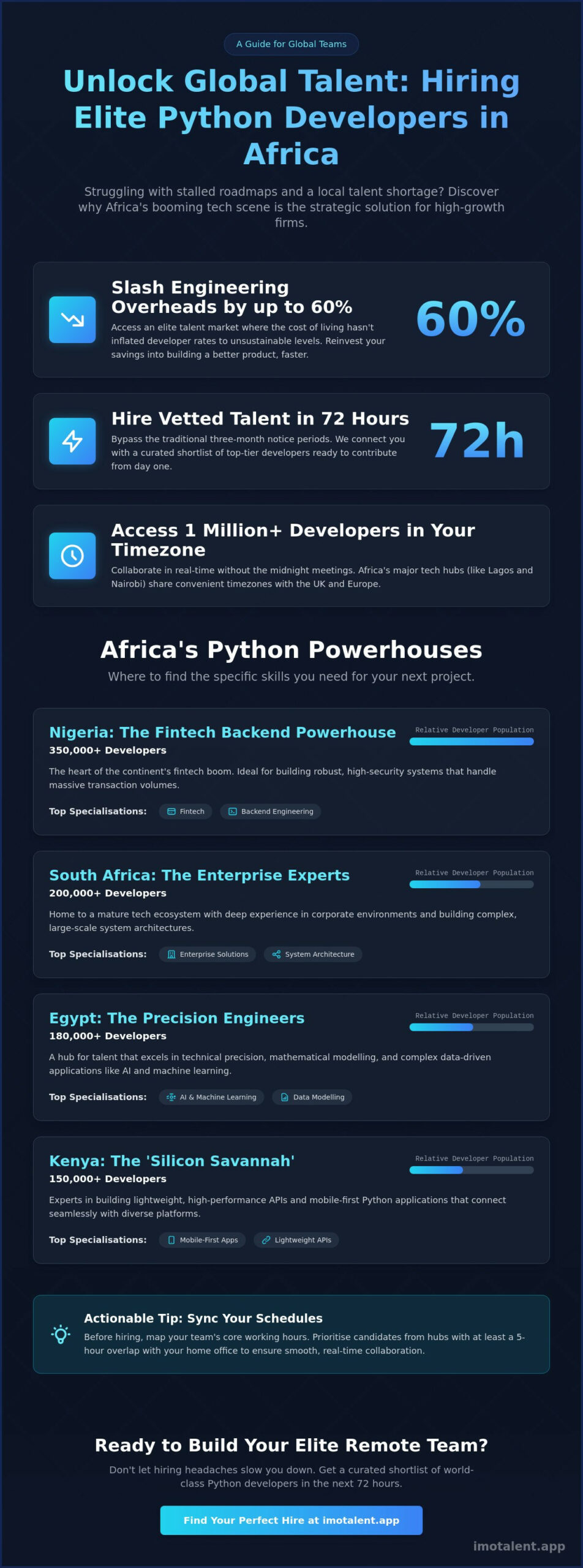
This guide is your shortcut to excellence. You’ll discover how to hire Python developers Africa to slash your engineering overhead by 60% while shrinking your recruitment cycle to just 72 hours. We’re moving past the “cheap labour” myth to focus on elite technical proficiency and operational readiness. We’ll preview the top tech hubs from Lagos to Nairobi, break down the latest 2026 salary benchmarks, and provide a clear framework to hire Python developers Africa with absolute certainty. It’s time to build a high-performing, diverse team without the traditional hiring headaches.
Key Takeaways
- Understand why Africa’s tech hubs are now the primary destination for high-growth AI and fintech firms seeking elite Python skills.
- Master the strategy to hire Python developers in Africa and reduce your overheads by up to 60% while maintaining a high-velocity roadmap.
- Adopt a vetting framework that prioritises practical problem-solving and remote autonomy over outdated, generic coding tests.
- Set up your new hires for immediate success with a proven 30-day onboarding plan and daily communication rituals.
- Discover how to bypass lengthy recruitment cycles and receive a curated shortlist of qualified candidates in just 72 hours.
Why Africa is the New Global Hub for Python Development
Africa isn’t just catching up; it’s setting the pace. While Western markets struggle with talent gaps, the move to hire Python developers Africa has shifted from an experimental move to a core business strategy for global leaders. You aren’t just looking for a coder; you’re looking for momentum. With a youthful, tech-native workforce that is scaling faster than almost any European market, the continent offers a fresh perspective on complex problem-solving.
Python has become the undisputed heavy-lifter in this region. It powers the massive fintech and AI sectors that are currently transforming local economies. This growth is deeply linked to the rapid mobile technology adoption in Africa, where developers are building sophisticated backend systems that handle millions of transactions daily. When you hire Python developers Africa, you tap into a pool that understands how to build for scale under pressure. They are used to creating high-performance applications that must work reliably across diverse digital infrastructures.
For UK and European businesses, the synergy is perfect. London shares the same time zone as Lagos, and Nairobi is only a few hours ahead. You get real-time collaboration without the midnight meeting fatigue typically associated with Asian or American outsourcing. It means your daily stand-ups happen when everyone is actually awake and productive, ensuring that communication remains a bridge rather than a barrier.
Breaking the Talent Shortage in the West
If you’ve tried to recruit in London or Manchester lately, you know the pain. The local Python talent gap isn’t just annoying; it’s stalling product launches. Senior developers are either too expensive or simply unavailable. This has forced a shift from traditional outsourcing to true global team integration. Senior African developers are increasingly choosing remote global roles over local corporate positions. They don’t want to be a ‘resource’; they want to be a partner in your success.
The Economic Logic of African Hiring
The maths is simple but powerful. A senior Python developer in London can command a salary that makes scaling a team feel impossible. By choosing a strategy to hire Python developers Africa, you can reduce your engineering overhead by up to 60% without losing a step in velocity. You aren’t cutting corners; you’re accessing a market where the cost of living hasn’t inflated developer rates to unsustainable levels. You can then reinvest those saved funds into faster product iteration. The African Tech Dividend is the 60% cost reduction combined with high-quality output.
The Technical Landscape: Where to Find the Best Python Skills
To find the right talent, you need to know where the specialists live. Africa isn’t a monolith; different regions have developed distinct technical identities based on their local industries. When you look to hire Python developers Africa, your choice of location should align with your specific project requirements. Understanding these regional strengths is the first step toward a successful integration that lasts.
Nigeria stands as the powerhouse of backend engineering. With over 350,000 developers, it’s the heart of the continent’s fintech sector. If you’re building robust, high-security systems that handle massive transaction volumes, Nigerian engineers are often the best fit. Meanwhile, Kenya, known as the ‘Silicon Savannah’, has around 150,000 developers who specialise in mobile-first Python applications. They’re experts at building lightweight, high-performance APIs (the bridges that allow different software to talk to each other) that connect seamlessly with mobile platforms. This regional expertise is a major reason why the continent has become the fastest-growing developer community globally as of 2026.
If you want to hire Python developers Africa who can handle mature enterprise-level projects or complex data modelling, South Africa and Egypt are the established leaders. South Africa hosts over 200,000 developers, many of whom have years of experience in corporate environments and large-scale system architecture. Egypt follows closely with 180,000 professionals who excel in technical precision and mathematical modelling. If you’re unsure which hub fits your specific tech stack, we can help you find the perfect match for your project’s unique demands.
Python for AI and Data Science in Africa
Nairobi and Cape Town are currently leading an AI-focused revolution. Developers in these hubs aren’t just writing simple scripts; they’re building complex machine learning models using frameworks like TensorFlow and PyTorch. Because they often solve local logistics and agricultural challenges with limited resources, these engineers tend to be more proficient in creating highly efficient, data-heavy applications. They know how to make every line of code count. If your roadmap includes machine learning or generative AI features, you should also explore how to hire AI developers in Africa to complement your Python team with dedicated specialist expertise.
Framework Specialisation: Django vs Flask
The choice between Django and Flask depends entirely on your project’s scale. Django is the “batteries-included” option, perfect for building massive, secure platforms quickly because it comes with built-in tools for everything from user authentication to database management. On the other hand, Flask and FastAPI are better for lightweight microservices; small, fast tools designed to do one thing perfectly. While these sound like technical details, they dictate the type of specialist you need on your team. If your backend architecture also relies on JavaScript runtimes, you may want to hire Node.js developers in Africa to build a well-rounded, high-performance engineering team.
How to Vet Python Talent: A Framework for Quality
Quality isn’t a happy accident; it’s the result of a rigorous, repeatable process. When you decide to hire Python developers in Africa, you can’t rely on generic coding tests that measure memorisation rather than logic. You need to see how a candidate handles a messy, real-world backend challenge. We look for developers who understand the latest stable releases, like Python 3.14.6, and can explain their architectural choices with clarity. A deep portfolio review is essential. Look for contributions to open-source projects or experience managing complex commercial backends to see how they handle code in the wild.
A successful hire also needs to pass the ‘Remote-Ready’ test. This goes beyond technical skill to evaluate their setup and mindset. Do they have a reliable power backup? Is their internet connection stable enough for high-stakes deployment? More importantly, do they have the autonomy to solve problems without waiting for a ticket to be assigned? This level of self-management is what separates a good developer from an elite one who can integrate into your team seamlessly and maintain your cultural alignment. You’re building a team, not just filling a seat.
The IMO Talent Vetting Process
We’ve built our reputation as a master matchmaker by filtering for the top 5% of tech talent. Our process includes live coding interviews with senior peers who know exactly what to look for in a complex Python environment. This intensive pre-vetting is why we can offer our 72-hour hire promise. We don’t just find you a developer; we find you the right developer who is ready to hit the ground running on day one.
Soft Skills that Matter for Remote Python Teams
Technical brilliance is only half the battle. English proficiency is a massive advantage when hiring from countries like Nigeria and Kenya, where it is the primary language of business and education. This linguistic alignment is a key driver in the rapid growth of Africa’s internet economy. It ensures that your daily stand-ups and Slack threads remain clear and productive.
Look for proactive communication. You want someone who asks “Why are we building this?” rather than just “How do I build this?”. This problem-solving mindset is essential for asynchronous work where your team might be spread across different time zones. They should be able to document their code effectively and communicate progress before you even have to ask for an update. Self-management is the secret sauce that keeps your roadmap on track without constant supervision.
Actionable Tips for Managing Your African Python Team
Hiring is only the first step toward scaling your velocity. The real magic happens during integration. When you hire Python developers in Africa, you aren’t just adding a remote worker; you’re expanding your team’s culture. To ensure this pays off, you need an onboarding roadmap that covers the first 30 days. Don’t leave your new hire guessing. Define exactly what success looks like in week one, week two, and by the end of the month. A clear plan prevents the “remote drift” that kills many global projects before they even start.
Communication rituals are your most powerful tool. Daily stand-ups keep everyone aligned, but Slack etiquette is where the day-to-day work lives. Encourage a culture of documentation. If a decision isn’t in your project management tool, it didn’t happen. You should also address infrastructure support early. While we vet for reliable setups, elite teams often provide a hardware stipend or use platforms that facilitate local equipment delivery. This ensures your developer has the high-performance machine needed to run complex Python 3.14.6 environments without lag.
Synchronous vs Asynchronous Work
The 1 to 2 hour time difference between Africa and Europe is a massive strategic advantage. You don’t need to work at 3 am to stay in sync. Establish “core hours” for collaboration, typically between 10 am and 2 pm, where everyone is online for brainstorming and feedback. Use video calls for these high-touch moments, but keep technical specifications in written documentation. This allows your developers to focus on deep work during their local afternoon while you handle project management. If you are ready to build this high-velocity engine, you can start your talent search today.
Building Long-Term Retention
Top talent stays where they feel valued. Integrating remote African devs into your company culture means treating them as core team members, not just names on a Jira board. Invite them to general company meetings and celebrate their wins publicly. Ongoing management and support are vital for keeping your best engineers from being headhunted. For a deeper dive into these strategies, read our Managing Remote African Developers guide. It provides a detailed playbook for high-performance integration.
Finally, don’t let legal and payroll complexities slow you down. Navigating international tax laws and employment regulations in countries like Nigeria or Kenya can be a headache if you do it alone. Most successful global teams use an Employer of Record (EOR) or specialized placement platforms to handle contracts and payments. This keeps you compliant with local labour laws while ensuring your team gets paid on time, every time, in their local currency or USD.
The 72-Hour Solution: Why IMO Talent is the Strategic Choice
In a market where product cycles are measured in weeks, waiting a month to hire is a failure. Most traditional agencies or generic marketplaces leave you sifting through hundreds of CVs. We’ve changed the game. When you hire Python developers in Africa through our platform, you aren’t just getting a list of names. You’re getting a curated match in just 72 hours. Speed is our competitive advantage. It allows you to maintain velocity while your competitors are still stuck in the first round of interviews.
We take the “Master Matchmaker” approach. This means we don’t just look at technical skills; we look at how a developer fits into your specific team dynamic. Our end-to-end management covers everything from that first introduction to ongoing retention support. It’s a safer, more reliable way to scale than rolling the dice on a freelance marketplace. We mitigate the risk of a “bad hire” by doing the heavy lifting before you even see a candidate. You get the certainty of a vetted professional ready to contribute immediately.
Cutting Costs, Not Quality
Recruiting in the UK is expensive and slow. By moving your search to Africa, you can achieve a 60% saving on engineering costs compared to local recruitment. This isn’t about finding “cheap” labour; it’s about accessing a market with a more efficient cost-to-quality ratio. Our subscription model goes beyond the initial hire. We provide long-term performance monitoring to ensure your new developer continues to deliver at an elite level. This creates a partnership focused on sustained growth, not just one-off placement.
Get Started with Your First African Python Developer
Modern scale-ups are moving away from slow, traditional agencies for a reason. They need agility. Our simple four-step process takes you from application to a successful hire with zero friction. First, we define your specific technical needs. Second, we match you with pre-vetted talent from our elite pool. Third, you interview the top choices to find the perfect fit. Fourth, you start building. It’s a streamlined path designed for high-growth teams that don’t have time to waste.
Ready to scale? Hire your Python developer in 72 hours with IMO Talent.
Ready to Scale Your Engineering Velocity?
Africa’s tech landscape has evolved into a global powerhouse, offering a unique combination of technical brilliance and strategic cost-efficiency. By choosing to hire Python developers in Africa, you’re tapping into a pre-vetted pool of the top 5% of talent, ready to integrate into your team with zero friction. You’ve seen how regional hubs like Nigeria and Kenya provide specialised expertise, from robust backends to mobile-first APIs. Now, it’s about execution. You don’t have to settle for lengthy recruitment cycles or inflated local costs that stall your product roadmap.
We’ve streamlined the entire process so you can reduce your hiring costs by 60% while maintaining high output. Our model ensures you receive qualified candidates within just 72 hours, allowing you to focus on building, not just searching. It’s time to move past the traditional hiring headaches and embrace a high-performing, diverse remote team. Hire Vetted Python Developers in 72 Hours and take your product to the next level. Your next senior engineer is ready to start. Let’s get to work.
Frequently Asked Questions
How much does it cost to hire a Python developer in Africa compared to the UK?
Hiring in Africa typically reduces your engineering overheads by up to 60% compared to the UK. While a senior developer in London commands a high premium, rates in hubs like Lagos or Nairobi are much more sustainable. This allows your team to reinvest savings into faster product iteration without sacrificing any technical depth or quality. It is a strategic move for scale-ups looking to extend their runway.
Is the time zone difference a problem when hiring Python developers in Nigeria or Kenya?
The time zone difference is negligible, usually ranging from zero to two hours. Nigeria often shares the same time as the UK, while Kenya is only three hours ahead. This overlap ensures real-time collaboration during core business hours. It means your daily stand-ups and brainstorming sessions happen when everyone is awake and productive, avoiding the midnight meetings common with other remote regions.
How do you ensure the code quality of remote Python developers?
We ensure code quality through a rigorous vetting process that identifies the top 5% of talent. This includes live coding sessions and peer reviews focused on real-world logic rather than just theory. We look for developers who are proficient in the latest stable releases and can explain their architectural choices clearly. This ensures that every line of code written for your project meets global engineering standards.
What are the legal requirements for hiring remote workers in Africa?
Hiring remote workers requires compliance with country-specific labour laws, tax requirements, and localised employment contracts. To simplify this, many global firms use an Employer of Record (EOR) service to manage payroll and legal compliance. This setup protects your business from the risks of misclassifying employees and ensures that all local regulations are met without adding to your internal administrative burden.
Can I hire a full team of Python developers through IMO Talent?
You can definitely scale quickly by hiring entire cross-functional teams through our platform. We don’t just place individual developers; we can help you build a cohesive unit of engineers, designers, and business talent. This approach is ideal for companies needing to launch new product lines or clear a massive backlog without the friction of managing multiple individual recruitment cycles.
What Python frameworks are most common among African developers?
Django, Flask, and FastAPI are the most common frameworks used by African developers in 2026. Django remains the top choice for large-scale enterprise projects, while FastAPI is the preferred tool for high-performance microservices. For data-heavy applications, you will find expertise in libraries like Polars and Ray. This technical diversity allows you to find the right specialist regardless of your specific project architecture.
How does the 72-hour hiring process work?
Our 72-hour process works by leveraging a pre-vetted talent pool that is already “remote-ready” and technically assessed. Once you define your specific requirements, we present a curated shortlist of qualified candidates within three days. This bypasses the traditional month-long sifting process. It allows you to hire Python developers in Africa at high velocity, ensuring your product roadmap stays on track without the usual recruitment delays.
Do African Python developers speak fluent English?
African developers in major hubs like Nigeria, Kenya, and Ghana are typically fluent in English. It is the primary language of instruction in universities and the standard for professional business communication across the continent. This linguistic alignment is a major reason why UK firms prefer these markets. It ensures clear communication in daily stand-ups, technical documentation, and collaborative Slack threads.
