

Introduction
A remote hiring platform for a regulated industry should give you six things: time-stamped activity logs, tamper-resistant records, before-and-after change tracking, role-based access controls, e-signature records, and a captured reasoning trail showing which rule drove each decision. Add searchable reports and configurable retention, and you have the core of a defensible audit trail. Anything less is a filing cabinet with a login screen.
Most buyers assume “we keep logs” means “we’re covered.”
It doesn’t.
Healthcare, financial services, fintech and government contracting all share one uncomfortable truth: when a regulator, a litigator or a disgruntled candidate comes knocking, nobody cares what your software did. They care what you can prove. This guide walks through what an audit trail actually is in hiring, why raw logs fall short, which features matter, which regulations push you towards them, and what to ask a vendor before you sign.
What Is an Audit Trail in Regulated Hiring?
Think of it as the story of a hire, told by the system rather than by whoever remembers it best. Every action, every decision, every handoff, in order.
Core Components
A proper audit trail pins down four things for each event: who acted, what they did, when it happened, and what changed as a result. Good ones go further and capture why. That means the policy rule applied, the evidence behind it, and the outcome.
Strip any of those away and the record gets shaky. A timestamp with no named person is gossip. A named person with no reason is a shrug.
Audit Trail vs System Log
A system log is written for engineers. It tells you a server threw an error at 02:14 or that a record was updated. An audit trail is written for auditors, lawyers and regulators, and it has to survive hostile reading. NIST’s guide to computer security log management is a decent baseline for how logs should be generated, stored and protected, but a compliant hiring trail sits one layer above that. It turns technical events into business evidence.
Why Raw Logs Fall Short
Here’s my blunt view: a line saying “someone changed something at 2:14” is compliance theatre. It tells an auditor nothing about whether a candidate was screened out fairly.
Picture a candidate rejected after a remote video interview. The log shows a status flipped from “review” to “declined.” Fine. Who flipped it? On what criteria? Were those criteria the same ones applied to the other applicants? Raw logs go silent right where the questions get hard.
Why Do Regulated Industries Need Hiring Audit Trails?

Because hiring in these sectors is a regulated activity, not an admin chore. Someone handling patient records or client money has to be vetted, and the vetting has to be provable. If you want a feel for how the screening side fits in, our piece on why background checks matter for remote hires covers the groundwork.
Accountability
Every decision needs an owner. Shared logins destroy that instantly, which is why single-user credentials matter so much. When a hiring manager approves a candidate with a gap in their right-to-work paperwork, the trail should say who, when, and on what authority. Accountability that depends on memory evaporates within months.
Compliance
Compliance is where the pressure lands hardest. Employment records fall under statutory retention rules, and the EEOC’s recordkeeping requirements set out how long applications and hiring decisions must be preserved in the US. Federal contractors face their own record retention rules under 41 CFR 60-1.12. Operating from the UK or EU? GDPR layers on top, with duties to document how personal data gets processed.
Miss a deadline and the penalty isn’t a polite letter.
Fraud Detection
Remote hiring invites fraud. Fake identities, doctored certificates, proxy interviewees, even the odd candidate who isn’t who their camera suggests. A trail that links identity checks, interview sessions and device or location data into one timeline lets you spot the oddities. Two applicants sharing an IP address and a suspiciously similar CV? You’ll only see it if the records talk to each other.
What Audit Trail Features Should a Remote Hiring Platform Provide?
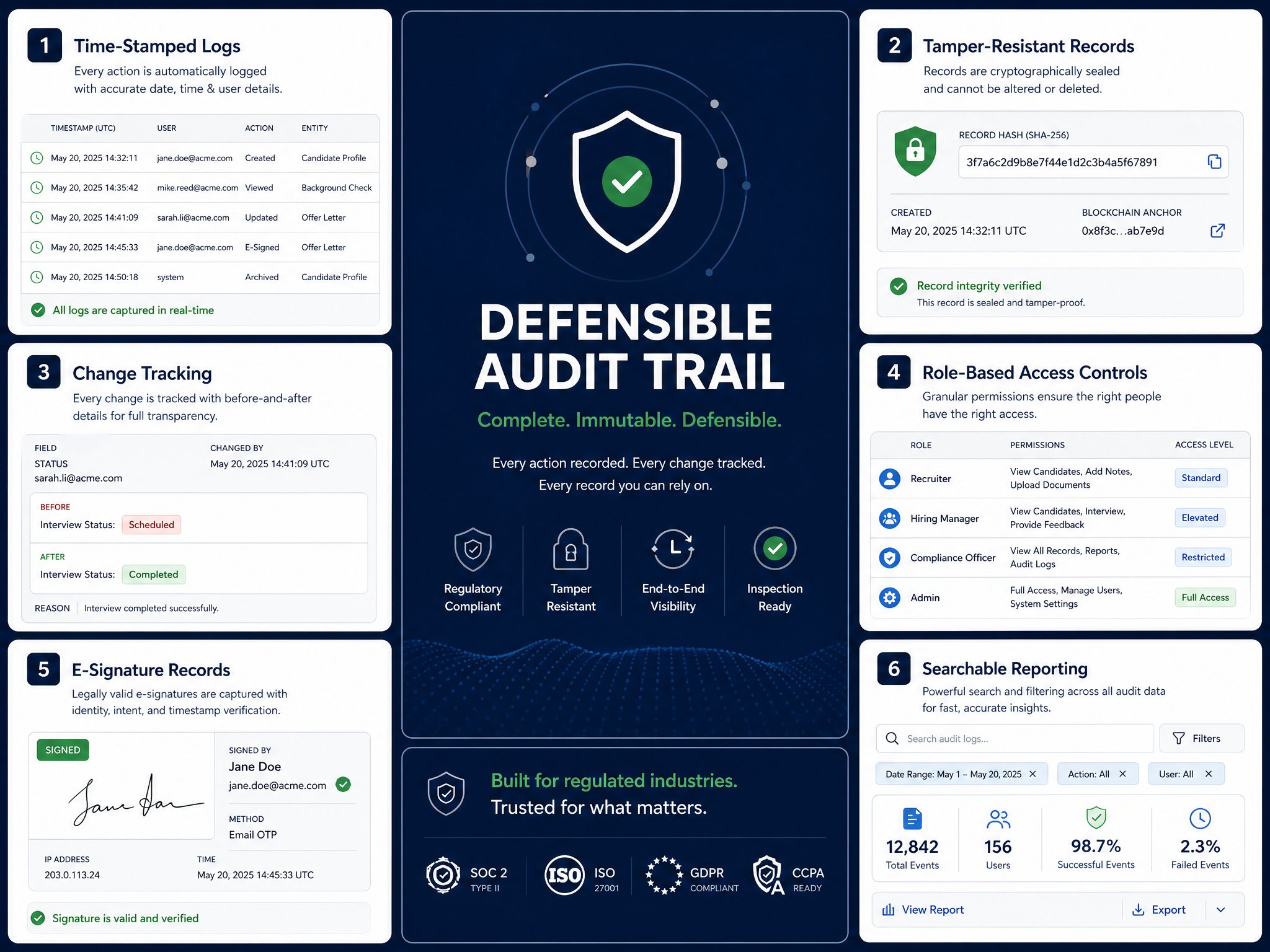
This is the part buyers skim, then regret skimming. Here’s the short version before I dig in:
- Time-stamped activity logs tied to named individuals
- Tamper-resistant, append-only records
- Before-and-after change tracking
- Role-based access controls with logged permission changes
- E-signature records with their own evidence packages
- Searchable reporting and configurable retention
Time-Stamped Activity Logs
Every view, edit, download, message and approval gets logged with a synchronised timestamp and a unique user ID. Not just edits. Viewing matters too, particularly for sensitive candidate data. Under HIPAA, the technical safeguards in § 164.312 call for unique user identification and audit controls, and the same logic applies cleanly to hiring files.
Ask whether timestamps come from a trusted, synchronised clock. Local browser time is useless in a dispute.
Tamper-Resistant Records
Fancy dashboards are overrated if the underlying record can be fudged. I’d rank tamper-proofing above almost everything else. Look for append-only storage, cryptographic hash chains, or database-level controls that make edits detectable or impossible. If an administrator can quietly rewrite history, you don’t have evidence. You have a diary.
Before-and-After Change Tracking
When a score moves from 62 to 78, the trail should show both values, who moved it, and when. Same for edited interview notes, adjusted screening criteria and revised job requirements. Version history lets you reconstruct what the decision-maker saw on the day. Without it, disputes turn into one person’s word against another’s.
Role-Based Access Controls
Recruiters shouldn’t see payroll data. Finance shouldn’t see interview notes. Role-based permissions limit exposure, and the logging of permission changes matters just as much as the permissions themselves. If someone was granted admin rights on a Friday evening and used them over the weekend, you want that on record.
E-Signature Records
An e-signature isn’t a squiggle on a PDF. A defensible one captures the signer’s verified identity, the exact document version, the timestamp, and the consent trail. For regulated contracts and onboarding paperwork, FDA’s Part 11 guidance on electronic records and signatures is the clearest picture of what “trustworthy” means, even if you’re not in life sciences.
How Should Decision Reasoning Be Recorded?
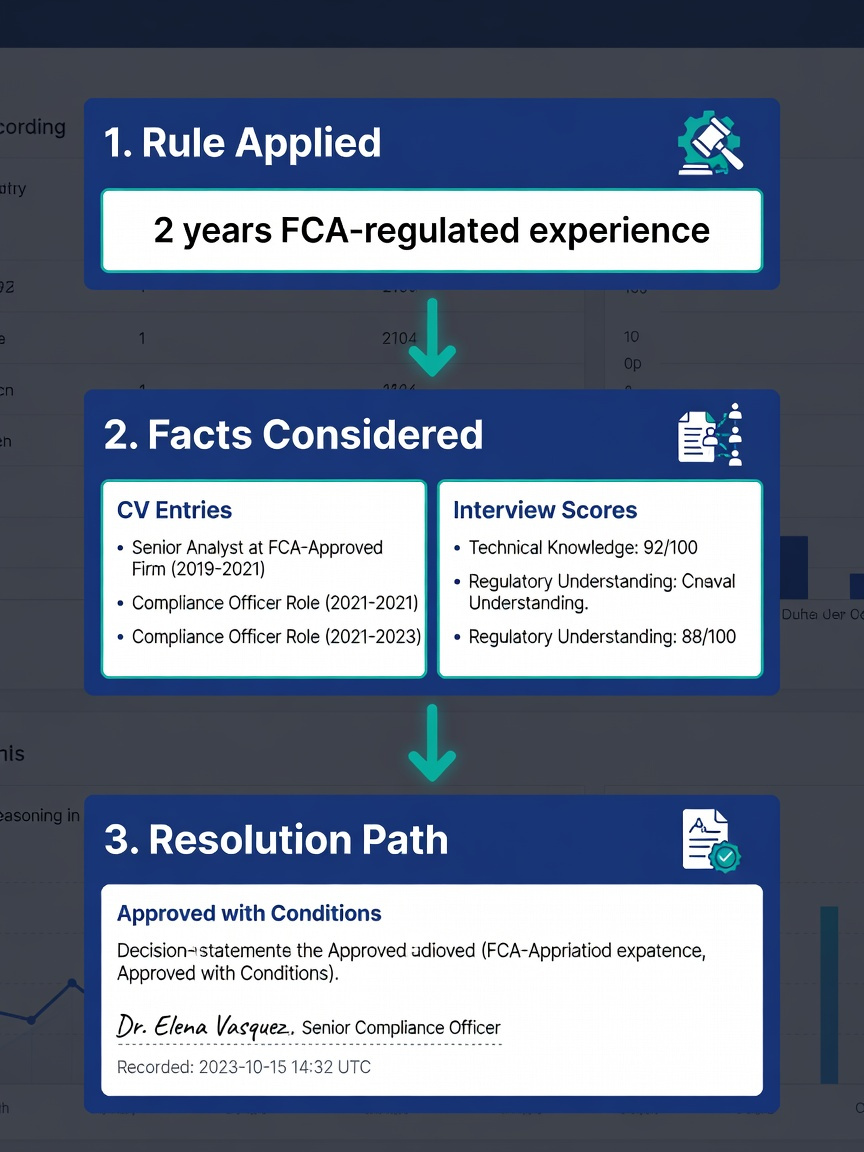
This is where I’m most opinionated, and where most platforms are weakest. Recording that a decision happened is easy. Recording why it happened takes design.
Rule Applied
Capture the specific policy rule being tested. “Minimum two years’ FCA-regulated experience” is a rule. “Not a fit” is not. If an AI tool or a recruiter screens someone out, the system should show which criterion triggered it, and that the same criterion was applied across the candidate pool.
Facts Considered
List the underlying facts that fed the rule: the CV entries, the verification result, the interview score. Link them, don’t paraphrase them. A good trail points to the evidence rather than describing it from memory.
Resolution Path
Then record the outcome and who finalised it. For automated or AI-assisted calls, require a named human to review and sign off on high-stakes decisions. “A recruiter was involved” proves nothing. Regimes such as the EU AI Act treat hiring as high-risk and expect real human oversight, which means your logs need to show it happened, not imply it. Our fairness flywheel piece digs into the bias side of that.
Which Regulations Shape Audit Trail Requirements?
No single rulebook governs this. It depends on your sector and your jurisdiction, so you’ll likely be juggling several at once.
| Regulation | What it pushes you towards |
|---|---|
| HIPAA | Unique user IDs, access logging, audit controls for health data |
| GDPR (Art. 30) | Records of processing, accountability for personal data |
| EEOC / 29 CFR 1602 | Retention of applications and selection decisions |
| 41 CFR 60-1.12 | Federal contractor applicant tracking and retention |
| SOC 2 | Evidence of security, integrity and confidentiality controls |
| SOX, SEC, PCI DSS | Financial reporting and cardholder data controls |
| EU AI Act | Human oversight and transparency for high-risk hiring AI |
On GDPR, Article 30’s requirements for records of processing are the place to start. For vendor assurance, the AICPA Trust Services Criteria behind SOC 2 reports tell you what a clean report should actually cover. Check with employment counsel for your own jurisdiction; I’m a content strategist, not your solicitor.
What Questions Should You Ask Vendors?
Skip the feature tour. Ask awkward things.
Can any administrator, including yours and ours, edit, delete or switch off audit logs? How is immutability enforced, technically? Can you export the full trail for one candidate, with reasoning, in a readable format? Does retention deletion preserve the audit history while removing personal data? What happens to the trail if we leave? Which third-party tools, such as background check or video interview vendors, feed into the same timeline?
If the answers get vague, that is your answer. For a broader scorecard, the evaluation checklist on audit trails and immutable record keeping is a handy companion, and our comparison of regulated hiring platforms shows how options stack up.
Follow Best Practices for Managing Audit Trails
Switching the thing on is the easy part. Running it is the job.
Review the trail on a schedule, not only when something breaks. Sample a handful of hires every quarter and try to reconstruct each decision from the records alone. If you can’t, neither can an auditor. Set retention periods per record type, not one blanket rule, and make sure deletion workflows don’t wipe the audit history along with the personal data. Restrict who can run reports. Train hiring managers on why free-text notes should be factual and respectful, because those notes become exhibits.
Also, tie your logging practice to a recognised framework. NIST’s log management guidance is useful here, covering storage, protection and review routines that auditors recognise.
Can Admins Edit or Disable Audit Logs?
No. Not in a regulated setting, and not for convenience.
If a platform admin can turn the trail off, then the trail only proves what the admin wanted proved. Regulators care about integrity above internal tidiness. The right architecture makes logs write-once, separates log storage from application permissions, and records any attempt to change settings as an event in itself. Even your own IT team shouldn’t hold the keys.
FAQ
What’s the difference between an audit trail and an audit log? A log is a raw technical record of events. An audit trail is a structured, chronological evidence set linking actions, people, reasoning and outcomes.
Do small teams really need this? If you hire into a regulated role, yes. Regulators don’t scale their expectations to your headcount.
How long should hiring records be kept? It varies by law and role. US federal rules commonly set minimum periods, while GDPR pushes you to delete once the purpose ends. Get legal advice for your jurisdiction.
Is an e-signature log enough on its own? No. It proves consent to a document, not that the hiring decision behind it was fair.
Can AI screening be audit-ready? Yes, if it records the rule applied, the facts weighed and a named human who reviewed the outcome.
Conclusion
An audit trail earns its keep on the worst day, the day someone challenges a hire or a rejection. Prettier dashboards won’t help you then. Immutable history, clear before-and-after changes, joined-up records across identity, screening and interviews, and a recorded reason behind every high-stakes call will.
So before you sign with any vendor, ask yourself one thing. If a regulator walked in tomorrow, could the platform tell the whole story without you?
