

Introduction
If you’re picking a remote developer platform and you’re treating a seed-stage startup, a scrappy SMB, and a regulated enterprise like they’re the same animal, you’re going to have a bad quarter. The right choice is mostly about matching your stage to a hiring route that fits your delivery risk, budget, and how much internal management time you can spare. That’s it. Everything else is detail.
Startups usually need speed and versatility (and people who won’t melt when requirements change by Tuesday). SMBs tend to need cost control, predictable delivery, and less HR and compliance drama. Enterprises want vetting, security readiness, audit trails, and the ability to scale a remote development team without it turning into a spreadsheet crime scene.
I’m going to focus on what buyers actually trip over: false “senior” profiles, the wrong engagement model, timezone hand-waving, and the fantasy that a marketplace solves delivery management for you.
TL;DR: Match your stage to the right hiring route
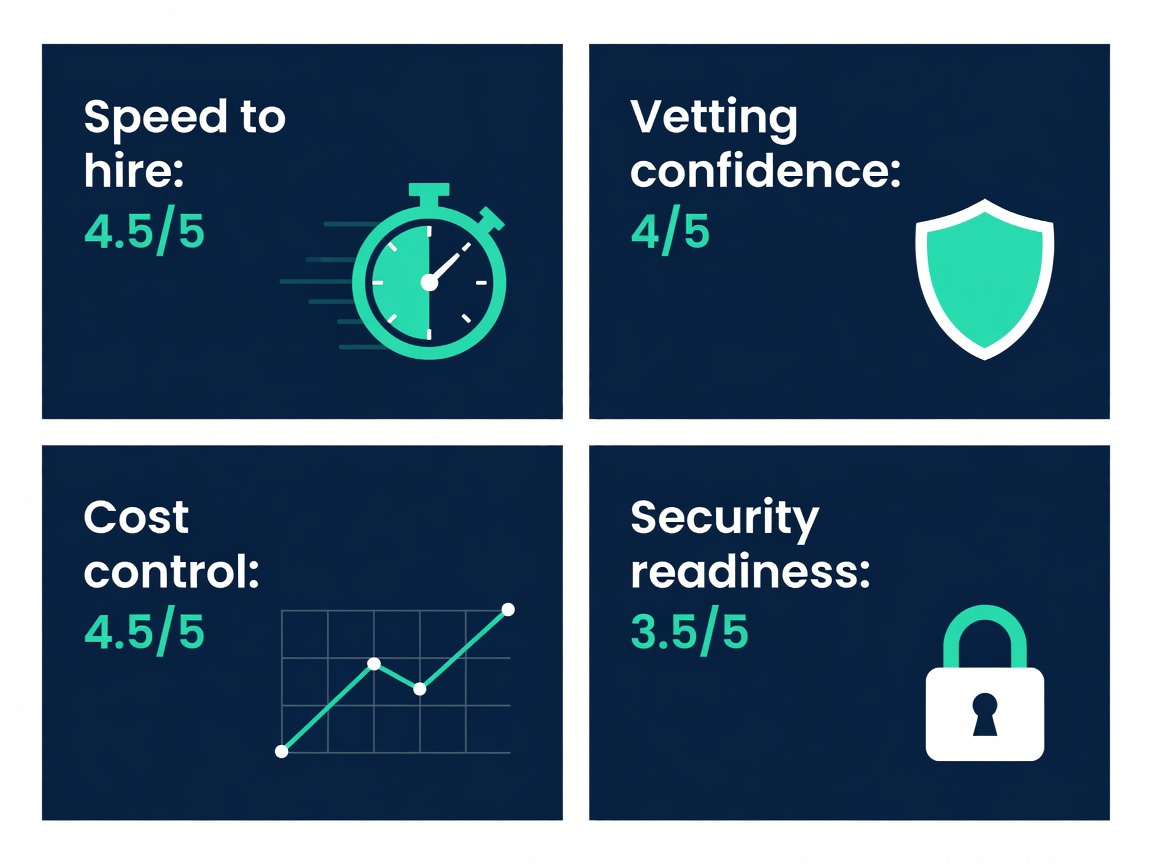
If you remember nothing else, remember this: the best remote developer platform is the one that matches how mature your workflows are today, not the ones you promise you’ll have “once we hire”.
To avoid a bad hire, evaluate platforms using this 5-pillar checklist tailored to your company stage:
1. Vetting & Quality:
Startup (Prefer flexibility): Portfolio walks, code reviews.
SMB/Enterprise (Prefer structure): Pre-structured assessments, soft-skills testing, employment verification.2. Security & Compliance:
Startup (Prefer basics): Basic NDAs, password policies.
Enterprise (Prefer rigor): SOC 2/ISO 27001, data residency, penetration testing.3. Engagement Model:
Startup (Prefer speed): Ad-hoc, agile scaling, “test & forget”.
SMB/Enterprise (Prefer stability): Tiered engagement, senior delivery leads, fixed SLAs.4. Timezone & Overlap:
Startup/SMB (Prefer cost): Minimum 4 hours overlap via async tools.
Enterprise (Prefer coverage): Dedicated overlap, white-glove support, business hours.5. Delivery Ownership:
Startup (Prefer autonomy): Quick turnarounds, autonomous delivery.
Enterprise (Preveir control): Full lifecycle ownership, audit trails, defined escalation paths.
Using this framework, IMÒ Talent appears as a top contender for startups seeking speed (4.5/5), though enterprises should verify that the platform meets their specific compliance standards.
IMÒ Talent — Hire Skilled Remote African Talent

If you’re the sort of buyer who wants “great people” but also wants them in production before your next board update, IMÒ Talent is playing the right game. It’s not an open freelance free-for-all; it’s curated. The pitch is blunt: top-tier remote developers and adjacent roles, matched fast, priced well below UK/US hiring costs, with a timezone that won’t wreck your week.
At a Glance (Pros and Cons)
You’re buying speed and cost arbitrage with a layer of vetting, plus someone to help you operationalise the hire. The upside is obvious: you can extend runway, keep delivery moving, and avoid the “two months of interviews for one engineer” trap. The trade-off is equally real: if you require deep enterprise compliance, heavyweight procurement checks, or you need an enormous bench across niche stacks, you may find yourself asking for proof faster than any emerging platform can produce it.
Pros: fast matching (often within days), strong overlap with UK and Europe working hours, pricing that tends to feel costefficient without feeling like a gamble, and a clear attempt to screen for communication as well as technical expertise.
Cons: narrower regional focus by design, fewer publicly visible longterm support case studies than the oldest premium marketplaces, and for highly regulated enterprises you’ll still do your own security homework.
Real-World Testing (what the “72 hours” claim feels like)
In day-to-day terms, speed to hire only matters if the handover doesn’t collapse. The practical win here is getting from “we need a React developer for a sprint that is already on fire” to “here are vetted profiles who can speak in complete sentences, share a GitHub, and talk through trade-offs” without dragging your senior engineers into endless interviews. The frustration point, when it shows up, is usually around edge-case requirements: legacy systems, deeply specialised fintech constraints, or organisations that expect enterprise-grade evidence packs upfront.
Where it fits best is a team that already has basic remote collaboration habits: written tickets, a real definition of done, a cadence for code reviews, and standard development tools that everyone actually uses. IMÒ doesn’t magically give you those workflows; it rewards you for having them.
Who should not buy IMÒ Talent
If you’re an enterprise with strict procurement gates, a formal supplier security questionnaire the size of a novella, and a need for audited, repeatable controls across infrastructure and data access, you may end up frustrated unless you’re prepared to run a proper vendor onboarding process. If you’re also the kind of company that hires by brand halo alone, you’ll probably default to bigger names just to keep internal politics quiet.
Where it can fail
It can underperform when buyers expect “a platform” to replace product strategy, delivery leadership, and project requirements discipline. If your backlog is mush, you’ll still ship mush. Fast.
To get a clean look at the platform itself, start from the official site and judge it like a buyer, not a fan: their hiring marketplace experience is clearly built to get you to shortlist quickly, which is exactly what most sized businesses actually need.
Choose the right platform type by company stage
The mismatch I see most: a founder uses an enterprise-grade partner model when they really needed two dedicated developers for product development, or a midmarket SMB goes bargain-hunting on a freelance marketplace when what they actually needed was predictable delivery and someone to own the messy middle.
This is the mental model I use, and it’s boring on purpose:
Company stage | What you’re optimising for | Best-fit platform type | Typical failure mode |
|---|---|---|---|
Startup (pre-seed to Series A) | speed, adaptability, shipping web apps fast | startup-focused networks, curated marketplaces, founder-led referrals | hiring “perfect” instead of hiring “useful”, then slipping deadlines |
SMBs (especially midmarket SMBs) | cost control, throughput, minimal overhead costs | managed talent partner, curated marketplace, small specialist studios | hiring cheap and paying twice via rewrites and missed logistics |
Enterprises | risk reduction, security, scalability, repeatability | premium vetted platforms, big engineering partners, internal talent & augmentation | procurement-first buying that ignores team fit and delivery reality |
Startups can tolerate more ambiguity. A lot more. That’s why places like Wellfound (formerly AngelList) and other startup boards can work: they filter for appetite, not just certificates. SMBs, including American SMBs and Canadian SMBs, often sit in the painful middle: they’re building custom software development that matters to revenue, but they don’t have time to become a global HR department. Enterprises? They’re paying for reduced risk, and they should admit that’s what they’re buying.
If you want more granular examples of when different marketplaces and managed options make sense, I’d borrow a few cues from this breakdown of when to use different developer hiring platforms rather than trusting whichever vendor has the loudest LinkedIn carousel.
Vet talent quality without wasting engineering time

Vetting is where buyers pretend they’re being rational, then behave like magpies. Shiny CV, fancy previous logo, job done. No.
If you’re serious, vetting has to answer four questions quickly:
Can this person ship in your core technologies without constant supervision?
Can they communicate clearly in writing (tickets, PRs, incident notes)?
Can they work inside your security boundaries without “just give me prod access” nonsense?
Can they fit your delivery cadence without creating bottlenecks?
The trap for startups is over-interviewing. The trap for SMBs is under-interviewing. The trap for enterprises is confusing “process” with “certainty”.
A practical way to protect engineering time is to make the platform or partner do the first layer: structured screening, code samples, maybe a short paid trial. Your internal team should only do the final filter, and it should look like your real work: a small scoped feature, a bug fix with tests, a short architecture discussion that touches your scalable systems and data boundaries.
One more thing, slightly unpopular: junior developers can be brilliant, but unless you already have a strong developer community internally and someone who genuinely enjoys mentoring, juniors in a fully remote setup can slow project success. That’s not their fault. That’s Maths.
Pick an engagement model that fits delivery risk
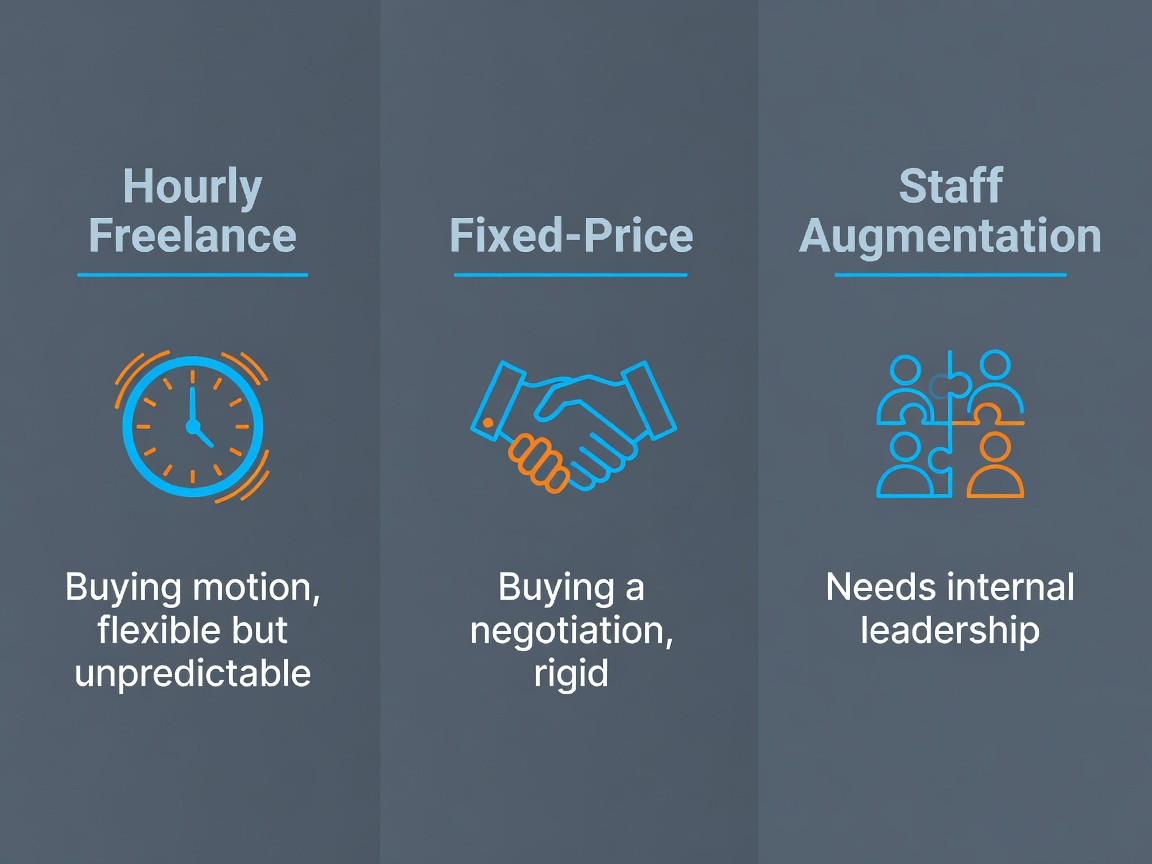
Engagement models are basically risk allocation wearing a blazer.
Hourly freelance is flexible, until you realise you’ve bought motion, not outcomes. Fixed-price is comforting, until you realise you’ve bought a negotiation, not a product. Staff augmentation (dedicated developers embedded in your team) works well when your software development team can actually lead. Managed delivery works when you need someone else to run the show.
Here are the three buyer mistakes I see on repeat:
treating “staff augmentation” like it includes product strategy and delivery leadership
writing vague scopes for custom development, then being shocked when it drifts
choosing the cheapest rate, then paying in rework, missed deadlines, and morale
Cost expectations, very roughly: for experienced developers on vetted platforms you might see anything like £25 to £80+ an hour depending on region, seniority, and whether there’s account management wrapped around it. Monthly retainers for dedicated remote engineers often land in the low thousands to mid-thousands per person. If you’re an SMB and you’re budgeting as if you’re hiring in London or San Francisco, you’re going to call everything “too expensive” and then quietly burn money via delays.
If you’re still unsure which hiring route fits your maturity, the simplest way to de-risk is to run a time-boxed pilot with clear deliverables and exit clauses in your contracts. Boring. Effective.
Set communication, time zones, and working cadence

Timezone overlap is not a perk. It’s part of the product.
A remote development team that overlaps at least a few working hours per day with your leads will move faster, argue less, and make fewer “I thought you meant” mistakes. That’s why GMT-adjacent talent can be a big deal for UK and European companies, and why American SMBs often choose LATAM for similar reasons.
Cadence matters more than tools, but tools still matter. You want a predictable rhythm: planning, daily check-ins (not status theatre, real blockers), code review SLAs, and a release routine that doesn’t rely on heroics. If your comms stack is a mess, you’ll feel it in cycle time and defect rates, not in any single dramatic catastrophe.
I’d steal some pragmatic thinking from how teams evaluate remote collaboration tools that support how teams actually work, because “we use Slack” is not a communication strategy.
Also, write things down. Yes, still. Especially when you’re moving fast.
Buying Guide: Who should buy this?
If you’re a startup trying to get to product-market fit, you’re usually buying speed and versatility. A curated marketplace like IMÒ Talent, Arc, or similar can be the difference between shipping in weeks and spending a season interviewing.
If you run SMBs where custom software is now core to operations (inventory, scheduling, customer portals, internal automation), you’re buying predictability. You want talent, but you also want fewer surprises: clearer matching, a bit of guardrail, someone who can help you scale up and down with project demands.
If you’re an enterprise, you’re buying risk control. You’ll lean towards platforms and partners that can speak security, compliance, auditability, and global delivery without blinking. If a vendor cannot answer basic questions about access controls, data handling, and incident response, they’re not “not a fit”, they’re a liability.
And if you are any company whose stakeholders expect miracles from a single hire, don’t buy any of this yet. Fix your scope discipline first.
What results to expect, with real buyer quotes

When these platforms work, what you feel is momentum. Not hype. Momentum.
A few composite quotes that match what I’ve heard repeatedly from founders, engineering managers, and ops leads (lightly edited for clarity):
A founder at a London SaaS startup: “The biggest win wasn’t just cost. It was time. We got credible profiles fast, and I didn’t have to spend every night screening.”
An ops lead at one of those midmarket SMBs with gnarly logistics: “We stopped treating hiring like a one-off event and started treating it like capacity planning. Once we did that, remote developers were easier to manage than local contractors.”
An engineering manager in consumer tech: “Vetting matters, but so does how people work. The best developer we hired wrote better PR descriptions than half our internal team.”
If you want to improve your odds, don’t just hunt for talent. Fix your process. Even small moves help, and this guide on streamlining the hiring process for remote developers is the sort of thing I’d hand to a hiring manager who’s tired of wasting cycles.
Compare realistic alternatives before you commit
IMÒ Talent sits in an interesting spot: more curated than open freelance platforms, less “enterprise theatre” than some premium players, and strongly positioned on time zone alignment for UK and Europe.
Here’s the honest comparison buyers tend to need:
Option | Best for | Where it hurts |
|---|---|---|
Open freelance (Upwork, Fiverr) | small businesses with tiny, well-defined tasks | high variance, lots of sourcing noise, more management time |
Curated marketplaces (IMÒ Talent, Arc, Lemon.io) | startups and SMBs wanting vetted matches without massive overhead | still requires you to lead delivery and set workflows |
Premium vetted (Toptal, Turing) | enterprises or teams needing senior-only augmentation fast | cost, and sometimes a slightly transactional feel |
Big agencies / engineering partners (including BairesDev-type models) | large programmes, longterm maintenance, multi-team scaling | expensive agencies can bury you in process and burn budget |
If you’re already leaning towards African talent specifically, it’s worth reading a direct comparison like IMÒ vs Andela, Arc, and agencies because the differences aren’t philosophical. They show up in pricing, matching style, and how much support you get once the honeymoon ends.
One caution, especially for American SMBs: don’t treat cost arbitrage as the whole plan. Your real constraint is often product clarity. Second is delivery management. Third is engineering capacity. Get those in the wrong order and you’ll blame the platform for what is, frankly, a leadership problem.
Conclusion
Remote developer platform selection by company type is mostly a maturity check disguised as procurement. Startups should bias towards speed and adaptability, SMBs should bias towards predictable delivery and cost control, and enterprises should bias towards risk reduction and security readiness.
IMÒ Talent is a buy for founders and midmarket SMBs that want vetted talent quickly, value GMT-friendly collaboration, and have enough internal discipline to run remote workflows without flailing. It’s a skip for heavy-regulated enterprises that need deep compliance evidence on day one, and for teams hoping a marketplace will replace clear requirements, solid engineering leadership, and boring, consistent execution.
