

Introduction
Most teams assume a global payroll platform is basically “connect HR, press go, everyone gets paid”. The end-to-end onboarding process is actually a sequence you can’t skip without getting stung: discovery and scope, secure data collection, integrations and migration, country configuration, parallel runs, then sign-off on the first payroll with governance baked in for month two and beyond. That’s the blueprint. Anything else is vibes.
If you want the sober version, this multi-phase shape is the same one you’ll see echoed by analysts like Gartner and practitioner bodies like the Global Payroll Association, because cross-border mistakes are never cute, they’re expensive and public.
What happens before kickoff?
Scope and countries
Before anyone talks about a payroll system, decide what “done” even means. Countries are not just flags in a dropdown. Each one drags in registrations, statutory reporting, banking rails, local payroll calendars, and local employment requirements that your central team will not intuit. If you’re expanding into new jurisdictions while also swapping providers, you’ve got two projects pretending to be one.
Also decide your hiring model per country. If you’re using an Employer of Record for some markets and a legal entity for others, that split changes your payroll onboarding process radically, and it’s why I like keeping an eye on practical guidance around EOR vs entity comparisons before you promise timelines to the business.
Worker types and pay components
Worker types sound simple until they aren’t. Employees, contractors, time employees, freelancers, independent contractors, plus interns and consultants in some places. Different tax treatment, different paperwork, different rules for benefits, and different risks if you misclassify.
Lock down the pay components early: base, overtime, commissions, allowances, equity events, signing bonuses, deductions, reimbursements. This is where scope creep hides, smiling.
Success criteria and timeline
Put success criteria in writing and make it measurable. Not “smooth onboarding experiences”. Actual outputs.
A decent minimum set looks like:
Parallel results match legacy within agreed variance thresholds for every country and worker category.
All statutory deductions, filings, and payment cut-offs are met for the first live cycle.
Role-based access, audit trails, and retention rules are live before production data lands.
If you want a reality check on why teams are feeling squeezed, the figures in ADP’s global payroll survey read like a collective cry for help: more regulations, more security pressure, more demand for global visibility, same headcount.
Map requirements and ownership
HR, finance, IT, legal roles
This falls apart when everyone assumes someone else owns the “boring” bits. HR usually owns employee information and the employee onboarding process. Finance owns approvals, funding, accounting mapping, and cost centres. IT owns SSO, integrations, and security controls. Legal owns employment contracts, local compliance interpretation, and the “are we even allowed to do that” questions.
If you’re scaling remote employees in fast-growth markets, it’s worth reading how other teams treat high-impact remote onboarding as an operational discipline, not a welcome email.
RACI and approval gates
A RACI is unglamorous, which is why it works. Keep it brutally specific, especially for approval gates like “country config signed off” and “first pay run released”.
Workstream | Responsible | Accountable | Consulted | Informed |
|---|---|---|---|---|
Worker data & documents | HR ops | HR lead | Legal | Managers |
Integrations (HRIS, time, finance) | IT | IT lead | Payroll, Finance | HR |
Country rules & statutory set-up | Payroll | Payroll lead | In-country experts, Legal | Finance |
Funding & payments | Treasury/Finance | CFO delegate | Payroll provider | HR |
Vendor and in-country partners
A payroll provider selling “global coverage” is not the same as having local expertise for every corner case. Gartner’s view that no true global payroll solution covers every nuance out of the box is painfully accurate in the real world, so treat in-country partners as part of your delivery model, not an afterthought.
Collect worker data securely
Required fields and formats
Data collection is where payroll onboarding quietly succeeds or dies. Standardise formats before you ingest anything: names (including local scripts), addresses, dates, bank account structure, tax IDs, start dates, compensation, and contract type. If you don’t normalise early, you’ll spend the entire first month reconciling nonsense.
Papaya Global’s write-up on common payroll data errors is a good reminder that “tiny” issues like missing deadlines and misclassification show up later as failed payments and frantic weekend work.
Identity, right-to-work, tax IDs
Identity and right-to-work checks are not box-ticking. They’re employment risk management. For the UK specifically, keep an eye on the shift towards stricter digital checks, because from 1 October 2026 the register requirement changes the operational workflow for providers doing checks at scale, as outlined in this explainer on digital right to work checks.
Tax IDs are country-specific, and collecting them late is how your “first payroll” turns into an apology tour.
Privacy, retention, access controls
You are moving sensitive staff data across borders. Make privacy operational: define lawful basis, minimise what you collect, and document transparency. If you’re using AI-driven onboarding software features, this GDPR-focused HR and payroll checklist is the sort of practical sanity check you want before procurement gets starry-eyed.
For retention and governance, map your Records of Processing Activities properly; Cookiebot’s GDPR checklist is blunt in a way most internal policies aren’t.
And if data is leaving the EEA, follow the European Data Protection Board guidance on international data transfers. Not as a legal flourish. As an engineering requirement.
Connect systems and move data
HRIS, time, expenses
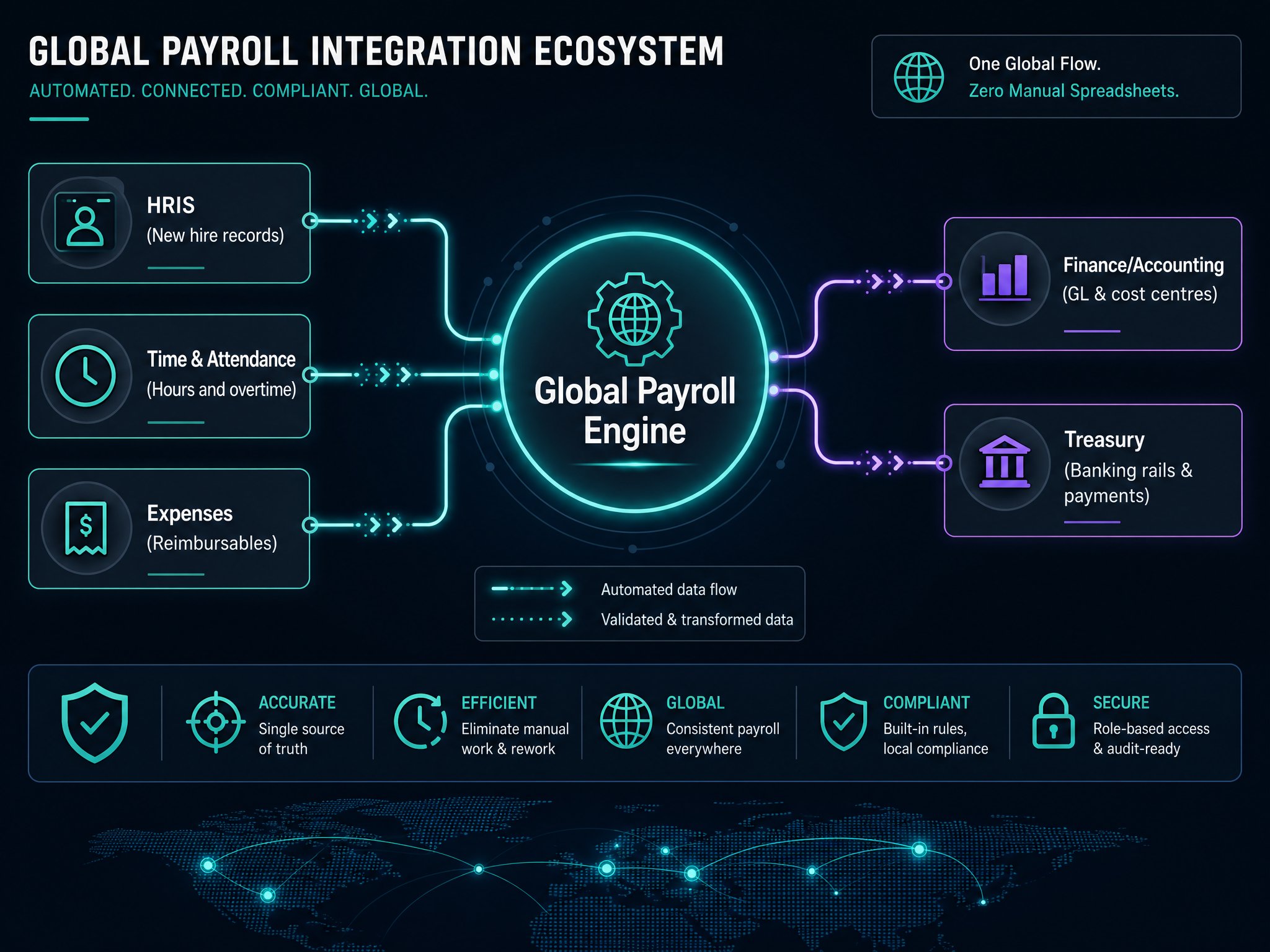
Integrations are where manual work multiplies. HRIS feeds the new hire records, time feeds hours and overtime, expenses feed reimbursables. The more you rely on spreadsheets, the more your payroll onboarding checklist becomes a prayer.
Native Teams’ rundown of global payroll challenges calls out integration gaps as a recurring cause of data discrepancies, and yes, it’s as dull and as deadly as it sounds.
Accounting, GL, cost centres
Finance cares about accounting output more than your platform dashboard. Map your GL accounts, cost centres, and project codes early, then test posting files into your finance system. If your reports don’t tie out, you’ll get blocked at sign-off no matter how “clean” the payslips look.
Banking, payments, treasury
Payments is not a footnote. It’s the whole point. Decide funding model, payment timing, and whether you’re batching payments centrally or pushing through local bank account rails. Watch FX costs too; teams regularly get blindsided by markups and pass-through fees that can add 15 to 25 per cent, which this 2026 provider analysis flags clearly.
Configure rules per country
Statutory deductions and filings
This is where compliance becomes real: social security, income tax withholding, employer contributions, local filing schedules, and year-end forms. Country-by-country guidance like Deel’s global payroll compliance checklist helps you spot what your platform configuration still needs, especially when you’re juggling international payroll across multiple regimes.
Contracts, benefits, leave
Benefits and leave policies are a localisation trap. Maternity rules, sick pay, public holidays, accrual logic, probation clauses, local employment laws. Make sure the employment agreement inputs match what payroll calculates, or you’ll pay the wrong amounts with total confidence, which is the worst kind of wrong.
Currency, pay calendars, cut-offs
Set currencies, pay frequencies, cut-offs, and approval windows per country. Remote employees spread across time zones will miss deadlines unless you publish a calendar people can actually follow. This is also where a tiny “cut-off” decision becomes a workflow decision for managers, HR, and payroll processing.
Run parallel payroll and validate
Test cases and edge scenarios
Parallel payroll is non-negotiable. Run at least one full cycle (two if you’ve got variable comp) and test ugly scenarios: mid-month starts, retro pay, terminations, unpaid leave, benefit changes, exchange rate swings, and contractor invoices. If you only test happy paths, you’re not testing.
Reconciliation and variance thresholds
Decide your variance thresholds before anyone sees the numbers, because humans are excellent at moving goalposts when stressed.
Output | Typical checks | Example threshold |
|---|---|---|
Net pay | Per worker, per country | ±0.50% unless explained |
Employer costs | Taxes, contributions | ±1.00% due to rounding/rates |
GL totals | Cost centres, departments | Exact match required |
Also validate security posture while you’re here. If the vendor can’t speak to ISO 27001:2022 controls in a way that satisfies your risk team, you’re gambling with employee data; SoSafe’s overview of ISO 27001:2022 is a decent starting point for what “good” sounds like.
First pay run sign-off
First live payroll sign-off should be a formal gate with named approvers, not an email chain where everyone silently hopes someone else checked. Once it runs, set ongoing governance: monthly audit routines, change control for local regulations, and a feedback loop so the onboarding process improves instead of fossilising.
FAQ
If we are only hiring a handful of new employees, do we still need all this? Yes, because small companies still get fined, and one missed payment can wreck trust faster than any culture deck can rebuild it.
How long does payroll onboarding take? Expect weeks, not days, especially if you’re adding countries, integrating with a hr system, and dealing with registrations.
Can we automate most of this? Some parts, sure, but the hard bits are judgement calls: worker classification, local compliance interpretation, and sign-off discipline.
What is the biggest cause of a poor onboarding experience for remote staff? Late or wrong pay. Everything else is background noise.
Conclusion
If you treat global payroll onboarding like a technical install, you’ll get a technical failure. Treat it like an operational launch across law, money movement, identity, and data governance, and your first payroll becomes boring in the best way. That’s the goal. Boring, accurate, on time, repeatable.
