
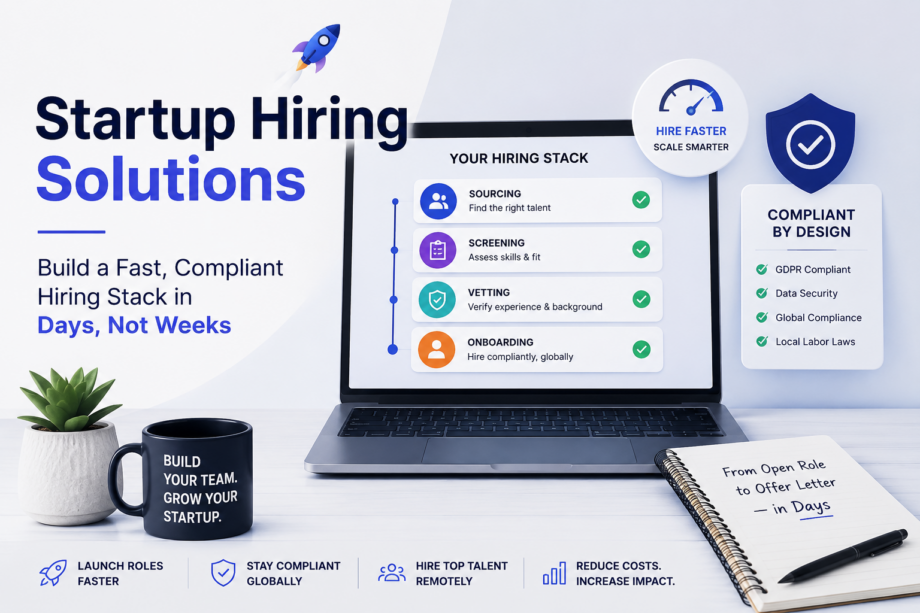
For founders and first people-ops hires at seed to Series A startups, every day without the right team member is a day of lost momentum. You need to hire fast but not recklessly. This guide shows you how to assemble a hiring stack in 48 hours and make your first hire in 14–30 days while staying compliant. You’ll learn which platforms to use, how to choose between contractors and employees, and get a day-by-day playbook to execute your first hiring sprint with confidence.
Quick Answer: Best Hiring Platforms for Startups Needing Quick Onboarding
If you need to start hiring today, here’s your essential stack:
- ATS (fastest to implement): Workable (Starter tier) or Ashby (startup bundle) both require less than one day to set up and offer intuitive candidate tracking
- Global EOR/Payroll: Deel or Remote enable fast, compliant onboarding for employees and contractors internationally without establishing legal entities
- US Payroll + HR: Gusto or Rippling streamline employee onboarding, HRIS management, and IT provisioning with same-day setup
- Background checks: Checkr instant integrations with major ATS platforms and 1–3 day turnaround times
- Sourcing channels: Wellfound, YC Work at a Startup, and Hired for tech roles; LinkedIn Recruiter Lite for broader searches
- Developer marketplaces: Arc, Lemon.io, Toptal, Mercor, and Imotalent combine speed with pre-vetted talent pools for technical roles
- Rule of thumb: If hiring more than 3 roles per month, invest in a full ATS. If hiring cross-border, add an EOR from day one to avoid compliance risks.
What Startup Hiring Solutions Cover (Scope + Outcomes)
Core Components
A complete startup hiring stack connects eight essential functions: an applicant tracking system (ATS) to manage candidates, sourcing channels to find talent, scheduling tools to coordinate interviews, assessment platforms to evaluate skills, reference and background check services, offer management systems, onboarding workflows, and payroll or EOR solutions. These components work together to create a seamless pipeline from first contact to productive team member.
Outcomes to Measure
Track these key metrics to optimize your hiring process:
- Time-to-first-hire (TTFH): Target 14–30 days from stack setup to first accepted offer
- Time-to-hire (TTH): Aim for 21–45 days from job posting to start date
- Cost-per-hire (CPH): Early-stage startups typically spend $1,500–$4,000 per hire including tools and sourcing
- Offer acceptance rate: Maintain above 65% for individual contributor roles; above 50% for senior positions
- 90-day ramp time: Track how quickly new hires reach full productivity
These benchmarks help you identify bottlenecks and refine your stack as you scale.
Contractor vs Employee: Fast, Compliant Choice (Decision Tree)
Decision Triggers
Choose the right classification to avoid costly misclassification penalties:
Use contractor classification when:
- Work is project-based with defined deliverables and end dates
- Worker sets their own hours and location
- Worker uses their own tools and equipment
- Worker serves multiple clients simultaneously
- Engagement is 20–30 hours per week or less
- Duration is under 6 months
Use employee or EOR classification when:
- Work is ongoing and core to business operations
- You set specific work hours and supervise daily activities
- Worker is dedicated to your company exclusively
- Benefits, equipment, or training are provided
- Role involves sensitive IP or security access
- Hiring internationally without a local entity (use EOR)
Risk Guardrails
Watch for misclassification red flags: exercising control over how work is performed, treating contractors like permanent staff, requiring 40-hour weeks from someone classified as a contractor, or assigning manager-like responsibilities without employee status. Violations can result in back taxes, penalties, and fines ranging from thousands to millions depending on jurisdiction and duration. When in doubt, consult an employment lawyer or use an EOR service that assumes classification risk.
14-Day Sourcing Sprint (Fast Path to First Hire)
Days 1–2: Set Up Stack
Begin by selecting and configuring your ATS—Workable or Ashby both offer startup-friendly pricing and quick setup. Integrate your scheduling tool (Calendly or GoodTime) and connect your email and calendar. Load job description templates for your first 2–3 roles. Choose sourcing channels: Wellfound for startup-focused candidates, plus one developer marketplace like Arc or Imotalent if hiring technical roles, and LinkedIn Recruiter Lite for broader reach. Finally, add Checkr for background checks and set up Deel, Remote, or Gusto for payroll based on your hiring geography.
Days 3–7: Pipeline Build
Post your first role on all selected channels simultaneously. Spend 2 hours daily sourcing: search Wellfound and LinkedIn, engage with relevant communities on Twitter or Slack, and leverage your network for referrals. Set a target of 50 sourced profiles and 20 applications per role by day 7. Review applications daily and move qualified candidates to phone screens within 24 hours. Speed signals seriousness to top candidates.
Days 8–14: Interview and Close
Conduct 30-minute phone screens days 8–10, focusing on role fit, motivation, and salary alignment. Advance 5–8 candidates per role to technical or work sample assessments. Schedule final interviews for days 11–13 with 2–3 finalists. Make your decision by day 14 and extend offers same-day. Include clear compensation, equity details, start date, and benefits. Follow up within 24 hours if you haven’t heard back. For competitive candidates, be prepared to negotiate quickly and close within 48 hours of offer extension.
Startup Hiring Stacks by Stage
Pre-Seed Stack ($50–$200/month)
At pre-seed, prioritize free or low-cost tools. Use Notion or Airtable as a lightweight ATS, post on free boards like Wellfound and YC Work at a Startup, leverage Calendly for scheduling, and handle payroll through Gusto’s basic plan or contractor payments via Deel. This minimal stack works for 1–3 hires and keeps monthly costs under $200.
Seed Stack ($300–$800/month)
As you hire your first 5–10 team members, upgrade to a proper ATS like Workable Starter ($149/month). Add LinkedIn Recruiter Lite ($170/month), Checkr for background checks (pay-per-use), and upgrade to Gusto or Rippling for HR automation. If hiring internationally, add Deel or Remote. This stack supports 2–4 hires per quarter with better candidate experience and compliance.
Series A Stack ($1,000–$2,500/month)
At Series A with 15–50 employees, invest in scalable infrastructure. Upgrade to Ashby or Greenhouse for advanced ATS features, add GoodTime for interview scheduling, implement Hired or specialized marketplaces for hard-to-fill roles, and use Rippling or Deel for global HR and IT provisioning. This stack supports 5–10 hires per quarter and provides analytics to optimize your hiring funnel.
Best Platforms for Quick Onboarding by Category
ATS: Workable vs Ashby
Workable offers the fastest setup (under 2 hours) with intuitive UI and strong integrations at $149/month for startups. Ashby provides more powerful analytics and automation at $400/month but requires slightly more configuration. Choose Workable if you need to hire this week; choose Ashby if you’re building for scale.
Global EOR: Deel vs Remote
Both Deel and Remote enable compliant international hiring in 150+ countries. Deel excels at contractor management with flexible payment options, while Remote offers stronger employee benefits packages. Pricing starts around $49/month per contractor and $599/month per employee. Both onboard workers in 1–5 days depending on country.
Developer Sourcing: Marketplaces vs Direct
For technical roles, pre-vetted marketplaces dramatically reduce screening time. Arc provides freelance and full-time developers with 2–3 day matching. Lemon.io focuses on vetted senior engineers with 48-hour placement. Toptal offers premium talent at higher rates with rigorous screening. Mercor uses AI-powered matching for fast placement. Imotalent specializes in connecting startups with pre-screened technical talent, offering curated matches within days. These platforms charge 15–30% markups but save weeks of sourcing time.
Background Checks: Checkr
Checkr dominates the startup space with instant ATS integrations, 1–3 day turnaround, and transparent pricing ($35–$100 per check depending on package). Alternative: Certn for Canadian companies.
Measuring Success & Next Steps
After your first hire, track these metrics weekly: application-to-interview conversion (target 15–25%), interview-to-offer conversion (target 20–40%), and offer acceptance rate (target 65%+). If conversion rates are low, audit your job descriptions, response times, and interview experience. If time-to-hire exceeds 45 days, identify bottlenecks—usually slow scheduling, lengthy decision processes, or inadequate sourcing volume.
As you approach 5+ hires, invest in ATS analytics to identify your best sourcing channels by quality and cost. Optimize your stack every quarter: eliminate unused tools, negotiate volume discounts, and add automation for repetitive tasks. Most importantly, document your hiring playbook so the next person who joins can execute without reinventing your process.
Conclusion
Building a fast, compliant hiring stack doesn’t require months of research or enterprise budgets. With the right combination of ATS, EOR, sourcing channels, and background check tools, you can make your first hire in 14–30 days while staying compliant globally. Start with the Quick Answer stack, follow the 14-day sprint, and measure your results against startup benchmarks. Your hiring infrastructure is your competitive advantage—build it intentionally from day one.
Frequently Asked Questions
What’s the minimum viable hiring stack for a pre-seed startup?
Start with a free ATS alternative like Notion or Airtable, post on Wellfound and YC Work at a Startup (both free), use Calendly for scheduling (free tier), and set up Gusto or Deel for payroll. This costs $0–$100/month and handles your first 1–3 hires. Upgrade to a paid ATS like Workable once you’re hiring more than one role simultaneously.
How quickly can I realistically make my first hire?
With a focused sprint, 14–21 days is achievable for non-executive roles: 2 days for stack setup, 5 days for pipeline building, 7 days for interviews and offers, plus 1–3 days for decision and acceptance. Technical roles requiring specialized skills may take 25–35 days. Executive searches typically require 60–90 days.
Should I hire contractors or employees for my first team members?
Hire employees for core, ongoing roles that are central to your product or service—especially when you need control over work processes, IP protection, or full-time dedication. Use contractors for specialized projects, part-time work, or roles where the worker maintains independence. When hiring internationally without a local entity, use an EOR service to employ people compliantly as employees rather than misclassifying them as contractors.
What’s the difference between an EOR and international payroll?
An Employer of Record (EOR) becomes the legal employer in the worker’s country, handling all compliance, benefits, and HR administration while you direct the work. International payroll processes payments to your existing legal entities abroad. Use an EOR when you don’t have a legal entity in the country where you’re hiring (most common for startups). Use international payroll when you’ve already established local entities.
How much should I budget for hiring tools in my first year?
Pre-seed (1–5 employees): $600–$2,400/year for basic ATS, scheduling, and payroll. Seed (5–15 employees): $3,600–$9,600/year adding LinkedIn Recruiter, background checks, and EOR services. Series A (15–50 employees): $12,000–$30,000/year for advanced ATS, multiple sourcing channels, and global HR infrastructure. Plan for $200–$400 per hire in platform costs, plus sourcing fees if using recruiters or marketplaces.
What are the biggest hiring compliance risks for startups?
Misclassifying employees as contractors is the top risk, leading to back taxes, penalties, and legal fees. Other critical risks include hiring internationally without proper legal entities or EOR services, inadequate background checks for sensitive roles, missing I-9 verification for US employees, and failing to provide required benefits or pay minimum wages. Use EOR services for international hires and consult employment counsel when unsure about classification.
When should I hire a dedicated recruiter vs using founders for hiring?
Founders should lead hiring for the first 5–10 employees to establish culture and standards. Consider a recruiting contractor or part-time recruiter when you’re hiring 2+ roles simultaneously or spending more than 15 hours per week on recruiting. Hire a full-time recruiter when you’re consistently hiring 3+ people per month or have reached 20–30 employees. Until then, invest in tools and process rather than headcount.
