

What if you could stop choosing between your bottom line and your performance standards? You’ve likely felt the exhaustion of the local hiring wars, watching expensive developers churn while your overheads continue to spiral. It’s a common frustration, but it doesn’t have to be your reality. Finding offshore talent Africa quality is no longer about settling for less; it’s about accessing a curated ecosystem of elite professionals who are ready to scale with you at high velocity.
We understand the hesitation around hidden management costs and the complexity of international compliance. That’s why we’ve built this guide to show you exactly how to secure senior-level tech and business experts who match UK standards perfectly. You’ll discover how to reduce your hiring costs by 60% while maintaining a high-velocity workflow that keeps your projects on track and your churn rates low.
We’ll preview the most critical 2026 shifts, from Kenya’s recognition of remote workers as employees to Nigeria’s updated tax regimes for foreign income. You’ll get actionable insights on vetting, matching, and integrating a remote team that feels like a natural extension of your business. Let’s look at how you can bridge the talent gap with precision, speed, and absolute confidence.
Key Takeaways
- Learn why the 2026 talent market has moved beyond simple cost-cutting to focus on the high-performance hubs emerging from Africa’s booming tech sector.
- See how native English proficiency and GMT-aligned time zones eliminate the communication barriers typically found in traditional offshoring models.
- Master a four-step vetting framework to ensure the offshore talent Africa quality you hire consistently meets or exceeds elite UK standards.
- Follow our actionable 90-day integration plan to turn new hires into high-performing team members while reducing overheads by 60%.
- Discover how to bypass lengthy recruitment cycles with a streamlined 72-hour placement process for pre-vetted tech and business professionals.
The Quality Revolution: Why Africa is the New Frontier for Offshore Talent
The old offshoring playbook is dead. In 2026, forward-thinking companies have stopped looking at Africa as a budget alternative and started seeing it as a primary talent source. This shift marks the transition from cost-centric hiring to a quality-first approach. While a 60% cost reduction remains a massive operational win, the real story is the calibre of the people. Businesses are no longer just looking to save money; they are looking to solve the global talent crunch with elite expertise.
Africa’s “Youth Bulge” has matured into a formidable force of highly educated, tech-native professionals. By looking at the Economy of Africa, it is clear that the continent is pivoting toward a digital-first future. This isn’t just about volume. It is about a generation that has grown up solving complex problems with mobile-first solutions. These are “Global-Ready” professionals who don’t just follow instructions. They lead projects, innovate on the fly, and understand the nuances of international business.
Beyond the Cost: The Quality-First Mindset
Companies now turn to Africa for senior roles like Lead DevOps Engineers or Senior Product Managers. The remote work revolution has given African talent years of exposure to global workflows, making them indistinguishable from UK-based peers in terms of performance. To us, offshore quality is the alignment of technical mastery and cultural adaptability. It’s about finding someone who can code at a world-class level while communicating clearly in your Monday morning stand-up.
Pan-African Tech Hubs: More Than Just One Country
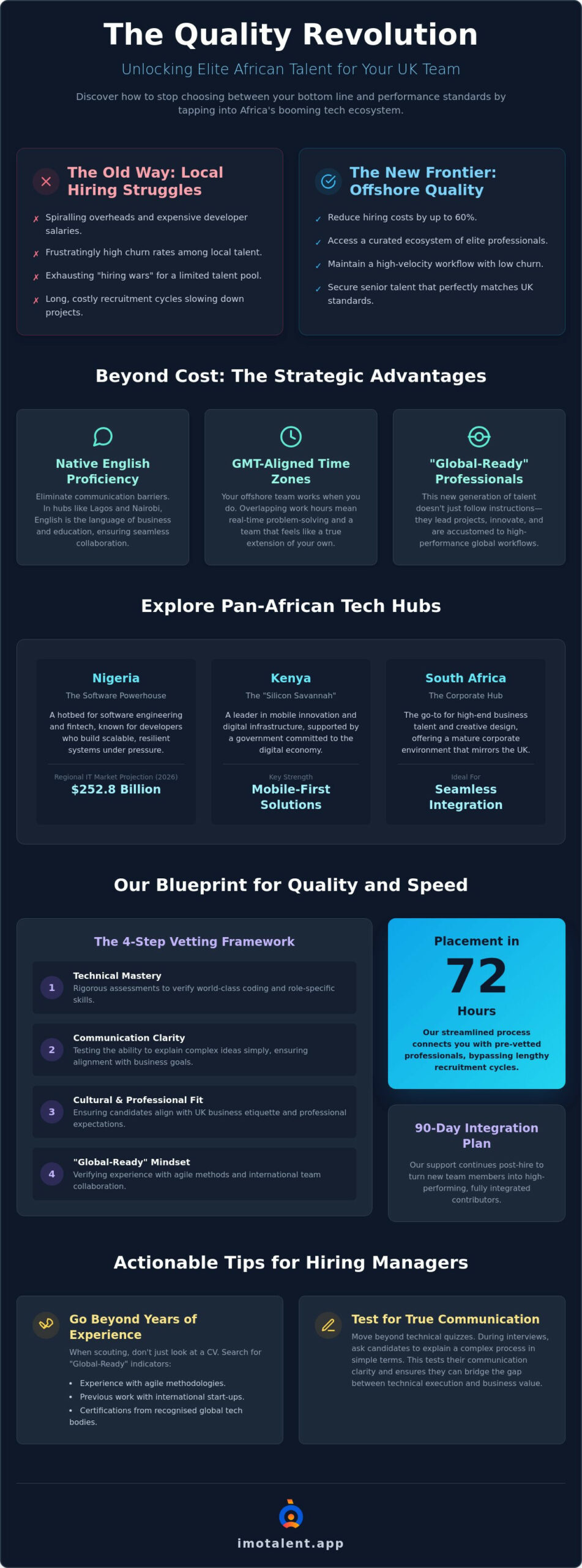
The market is incredibly diverse, and knowing where to look is half the battle. Nigeria has solidified its position as a powerhouse for software engineering and fintech. With the regional IT services market projected to hit $252.8 billion in 2026, Nigerian developers are at the forefront of this massive expansion. They are known for their grit and ability to build scalable systems under pressure.
Kenya, the “Silicon Savannah,” continues to lead in mobile innovation and digital infrastructure. Their new digital nomad visa and remote work legislation show a government committed to supporting the digital economy. Meanwhile, South Africa remains the go-to for high-end business talent and creative design. It offers a mature corporate environment that mirrors the UK, making integration seamless. This regional diversity ensures you can find offshore talent Africa quality that fits your specific industry needs without compromise.
Decoding the Skillset: Education, Language, and Cultural Alignment
Communication is the silent killer of offshore projects. When you hire in regions with significant language barriers, you spend more time translating requirements than shipping code. In hubs like Lagos, Nairobi, and Accra, English is the primary language of instruction and business. This creates a foundation for offshore talent Africa quality that is hard to find elsewhere. It’s not just about speaking the language; it’s about understanding the subtle nuances of British business etiquette and professional expectations.
Global tech giants have already done the heavy lifting. Google and Microsoft have established major engineering centres across the continent, validating the high skill level available. This massive investment is a key driver of Africa’s economic potential, turning the region into a global hub for sophisticated tech and business services. If you’re looking to scale your operations, you can explore pre-vetted professionals who are already accustomed to these high-performance environments.
Elite Education and the Rise of Self-Taught Excellence
The talent isn’t just coming from anywhere. Universities like the University of Cape Town or the University of Lagos produce graduates who are ready for the global stage. Beyond traditional degrees, we’ve seen a surge in intensive coding programmes and global certifications that focus on immediate industry needs. In the African context, “self-taught” is often a badge of honour. It signifies a professional who is resourceful, highly motivated, and capable of mastering complex tools without constant hand-holding.
Time Zone Synergy: The End of the Midnight Meeting
Stop waking up at 4 AM for stand-ups. Unlike Asian hubs that require a complete shift in your working day, African time zones (GMT to GMT+3) align perfectly with the UK. You get a full day of overlapping work hours. This synergy leads to faster sprint cycles and immediate feedback loops. UK managers often report a psychological boost when they realise their offshore team is active and reachable during their own core hours. It makes the “remote” aspect of the team feel virtually invisible.
This alignment is a major factor in maintaining offshore talent Africa quality over the long term. When teams work in sync, there’s less friction, fewer misunderstandings, and a much higher rate of project success. You aren’t just hiring a pair of hands; you’re gaining a partner who operates in your rhythm.
Guaranteeing Quality: The 4-Step Vetting Framework
Hiring for scale requires more than a glance at a CV. You need a filter that only lets the top 1% through. As the global tech talent shortage intensifies, the competition for elite skills has never been higher. We use a tech-enabled vetting ecosystem to strip away bias and focus entirely on raw performance. This methodical approach is the only way to consistently secure offshore talent Africa quality without the risk of hidden performance gaps. It’s why you can hire remote developers from Africa and expect them to outpace your local team from day one.
Vetting isn’t a one-time event; it’s a commitment to a standard. We treat the recruitment funnel as a high-velocity filter. By removing human bias through data-driven platforms, we ensure that every placement is based on merit and potential. This level of rigour is exactly why you can scale your team with total confidence. We don’t just find people who can do the job today; we find those who will set the pace for your team tomorrow. It’s about building a bridge between your needs and the continent’s most capable professionals.
Step 1 & 2: Technical Mastery and Cognitive Ability
We move beyond surface-level knowledge. Live coding challenges and architectural reviews separate the true seniors from those who simply have a few years on their CV. It’s about seeing how a candidate handles a breaking system or a complex integration. Cognitive testing serves as our best predictor for long-term success. It measures how a person processes new information and solves problems they haven’t encountered before. In a tech world that changes every six months, adaptability is the highest form of offshore talent Africa quality.
Step 3 & 4: Communication and Professional Integration
Technical skills are the baseline, but integration is where the real value is unlocked. We assess leadership, empathy, and a candidate’s comfort with remote collaboration tools like Slack, Jira, and Loom. The final interview ensures a perfect match between your company culture and the talent’s personality. We don’t just look for a ‘fit’; we look for someone who adds to your culture. Vetting for quality must include a ‘readiness to scale’ assessment to ensure the hire can handle the increasing complexity of your project as it grows.
Strategic Integration: Maintaining Quality Post-Hire
Finding the right person is only half the battle. If you want to maintain offshore talent Africa quality over the long term, you have to treat integration as a strategic priority. Many companies fail because they treat remote hires as a temporary “add-on” rather than a core part of the engine. High-performance teams are built on trust, clear expectations, and a shared vision. To do this right, you need a structured approach that moves beyond simple onboarding. You can dive deeper into this with our managing remote African developers playbook, which outlines the high-performance integration strategy in detail.
Clarity is the currency of remote work. We recommend an “Async-First” communication strategy. This means documenting decisions in Notion or Jira so that anyone can catch up without a meeting. It respects time zones and allows your team to focus on deep work. However, documentation isn’t a substitute for human connection. Regular 1-on-1s and video check-ins are essential for building trust. They give you a chance to spot bottlenecks before they become blockers. Use Slack for quick wins and Jira for tracking progress, but keep the big-picture conversations for face-to-face video calls.
Building a Unified Culture Across Continents
Don’t let your offshore team become an island. Involve your African talent in UK-based strategy sessions and even social events via video link. When people feel like they belong, they stay longer and work harder. Retention in the tech world is driven by growth. If your remote team can see a clear career path within your organisation, they’ll be far more invested in your success. Recognise their wins publicly. A shout-out in a general Slack channel goes a long way in driving loyalty. If you’re ready to scale with a team that stays, source your elite remote team today.
- Days 1-30: Focus on tooling and small wins. Ensure they have all access permissions and assign a “buddy” for quick questions.
- Days 31-60: Shift to ownership. Give them a specific feature or business process to lead. This builds confidence and demonstrates their offshore talent Africa quality.
- Days 61-90: Alignment and feedback. Conduct a formal review to discuss their long-term roadmap and how they can grow with the company.
Successful integration is about removing friction. When you provide the right tools and a welcoming culture, your remote hires stop being “the offshore team” and simply become “the team”. This mindset shift is what separates companies that struggle from those that scale at high velocity. By prioritising the first 90 days, you protect your investment and ensure that the high standards you hired for are maintained year after year.
Scale Fast with IMO Talent: Quality Placements in 72 Hours
Traditional recruitment is a momentum killer. In a market where speed is everything, waiting weeks to fill a critical gap puts your projects at risk. We’ve solved the quality vs speed dilemma by building a high-velocity bridge to the continent’s most capable professionals. With IMO Talent, you get the best of both worlds: a 60% reduction in hiring costs and 100% quality assurance. This isn’t just about filling seats. It’s about finding offshore talent Africa quality that integrates seamlessly into your existing workflow within days, not months.
We operate as an elite facilitator. Our process is designed for companies that value excellence but have no patience for slow-moving corporate bureaucracy. By maintaining a pre-vetted pool of senior experts, we can fulfil our 72-hour placement promise. You get immediate access to professionals who have already passed our rigorous four-step vetting framework. This readiness allows you to scale your operations without the typical friction of international hiring.
Our Curated Network of Elite Professionals
Most agencies focus on a single niche. We’ve built a curated network that spans Tech, Business, and Design. This holistic approach makes us a one-stop solution for scaling your entire operation. Whether you need a Lead Developer, a Senior Product Designer, or a Business Operations Manager, our remote talent placement service ensures you find the right fit instantly. Our focus on business and design roles sets us apart from pure dev shops, providing the rounded expertise needed for true organisational growth.
From Application to Onboarding: The Seamless Path
Our four-step process takes you from a talent gap to a new hire in just three days. We handle the heavy lifting, from initial vetting to final matching. But we don’t stop at the placement. We provide ongoing management support to ensure your new team member stays productive and engaged. This commitment to retention is why our clients see such high success rates with their remote teams. It’s a partnership built on operational readiness and mutual success.
The future of work is global, and the most competitive companies are already leveraging African talent to outpace their rivals. Don’t let local hiring wars slow your progress. With a 72-hour placement turnaround and significant cost savings, the path to a high-performance team is clearer than ever. It’s time to stop settling for “good enough” and start hiring the best.
Build Your High-Performance Remote Team Today
The talent landscape has shifted permanently. You no longer have to choose between protecting your budget and maintaining elite performance. By leveraging a rigorous vetting framework and focusing on strategic integration, you can turn remote hiring into your biggest competitive advantage. Accessing offshore talent Africa quality ensures your organisation scales at high velocity without the typical friction of international management.
You’ve seen how overlapping time zones and native English proficiency create a seamless extension of your UK team. It’s time to stop fighting expensive local hiring wars and start winning with a global mindset. You can reduce your overheads by 60% while gaining immediate access to the top 1% of professionals in tech, business, and design. This isn’t just about saving money; it’s about building a resilient, high-output team that is ready for the challenges of 2026.
Ready to transform your workflow? Hire elite, vetted African talent in just 72 hours with IMO Talent. We’re here to help you bridge the gap and start your next chapter of growth with absolute confidence.
Frequently Asked Questions
Is the quality of African developers comparable to those in the UK?
Yes, the technical depth is identical because the tools, languages, and frameworks used are global. Senior developers in hubs like Lagos or Nairobi often work for the same international firms as UK developers. You get offshore talent Africa quality that matches senior UK standards because these professionals solve the same complex architectural problems every day.
How do you handle the 1-3 hour time difference between the UK and Africa?
You don’t actually need to “handle” it because the overlap is almost total. Unlike hiring in Asia or the US, you share nearly all your core working hours. This means you can have real-time stand-ups and instant Slack replies without anyone working through the night. It makes the collaboration feel local rather than offshore.
What are the most popular tech stacks in the African talent market?
You’ll find a massive concentration of expertise in React, Node.js, Python, and mobile frameworks like Flutter. Nigeria is particularly strong in Java and fintech-focused engineering. Kenya leads the way in mobile-first technologies and cloud infrastructure. This diversity ensures you can find specialists for almost any modern software project or digital product.
Can I hire for non-technical roles like Design or Project Management in Africa?
Absolutely, the market for business and design talent is growing at a rapid pace. We place high-level Product Designers, Project Managers, and Operations experts who are accustomed to global standards. South Africa is a particularly strong hub for creative and strategic roles that integrate seamlessly with UK corporate structures and expectations.
How does the cost of hiring in Africa compare to Eastern Europe or India?
Africa sits in a unique “sweet spot” that balances high-end quality with competitive pricing. While some regions might offer lower rates for basic junior tasks, Africa provides senior-level offshore talent Africa quality at a more accessible price point than Eastern Europe. You get Western-standard output while still achieving your goal of reducing overheads.
What happens if a remote hire doesn’t work out?
We provide a talent replacement process to ensure your project never loses its momentum. While our rigorous four-step vetting process makes mismatches very rare, we act quickly to find a better fit if the initial placement doesn’t meet your specific needs. We stay involved to ensure the transition is smooth and your team stays productive.
How do you ensure the security and IP protection of my data?
Security is managed through robust legal contracts and adherence to local data protection laws. As of June 2026, over 40 African countries have enacted strict data protection legislation. We ensure all talent understands and adheres to international security standards. This protects your intellectual property and sensitive data just as strictly as a local hire would.
Is it difficult to manage payroll and taxes for remote workers in Africa?
It is quite straightforward when you have the right framework in place. New 2026 tax reforms in countries like Nigeria and Kenya have made it much clearer how remote workers should declare foreign income. We help you navigate these local regulations and compliance requirements. This ensures your payroll remains legal and your remote team stays focused on delivering results.
