
Right, let’s cut through the noise here. If you’re hiring remotely for a financial services role, whether that’s a fintech startup in London or a bank’s back office in Manchester, the background check isn’t a box-ticking exercise. It’s the difference between a compliant, defensible hiring decision and a regulatory headache that lands on your desk eighteen months later. A financial integrity check for remote finance staff needs to cover identity verification, adverse credit history, criminal record disclosure, sanctions screening, and (where the role sits under SM&CR) regulatory references from past employers. Get any one of those wrong and you’re not just risking a bad hire. You’re risking an FCA enforcement action.
That’s the blunt answer. Now let’s get into why it matters, what the law actually says, and how a platform like IMÒ fits into the picture when you’re building a remote team that touches money, client data, or regulated advice.
Why Do Financial Institutions Need Background Checks?
Here’s the thing nobody tells new hiring managers: financial services isn’t like hiring a graphic designer or a customer support rep. The moment someone touches client funds, gives regulated advice, or has signing authority, you’ve entered a different regulatory universe. Background screening in this sector exists because the cost of getting it wrong isn’t reputational embarrassment. It’s systemic risk.
Regulatory Drivers Behind Screening Requirements
The Financial Conduct Authority doesn’t leave this to chance. Firms authorised under the Financial Services and Markets Act have a statutory duty to ensure the people in key roles are, in the regulator’s own phrasing, “fit and proper.” That phrase gets thrown around a lot, almost to the point of losing meaning, but it’s doing real legal work. It means solvency, honesty, competence, and a clean-ish regulatory history. According to recent commentary from Checkback’s overview of FCA compliance, the “fit and proper” test under APER isn’t optional guidance, it’s baked into the authorisation gateway itself.
Risks of Skipping or Rushing Checks
Skip the check, or rush it because you’re desperate to fill a seat, and you’re gambling with things that don’t show up on a CV. Undisclosed bankruptcies. County court judgments. A criminal record for fraud that never made it past a soft search. I’ve seen recruitment teams treat background checks like an afterthought, something HR does after the offer letter goes out, and that’s backwards. The Recruiter.co.uk data on finance screening puts the candidate failure rate in financial services at 23 percent. Nearly a quarter of applicants don’t clear screening. That’s not a rounding error, that’s a structural risk if your process is weak.
Consequences of Non-Compliance
Non-compliance isn’t abstract either. Fines, yes, but also personal liability under SM&CR for senior managers who failed to exercise “reasonable steps.” Reputational damage that follows a firm for years. And frankly, the operational chaos of discovering six months in that your new hire lied about their employment history or, worse, is on a sanctions list. None of this is theoretical. It happens, and it happens more often in remote hiring where face-to-face verification simply isn’t part of the process.
What Legal Framework Governs Financial Services Background Checks?
FCA and SM&CR Requirements
The Senior Managers and Certification Regime sits at the centre of UK financial regulation. Under SM&CR, firms must obtain regulated references, not just standard employment references, for anyone performing a senior management function or certification function. These references cover the past six years and must disclose any conduct breaches, disciplinary action, or fitness concerns. From September 2026, the FCA’s Policy Statement PS25/23 extends conduct rules explicitly to serious non-financial misconduct too, meaning bullying, harassment, and similar behaviour now falls squarely within scope for all regulated firms. That’s a meaningful widening of what “fit and proper” actually means in practice.
Data Protection and Privacy Rules
Here’s where it gets legally tricky, and where a lot of otherwise diligent HR teams trip up. Criminal record data is “special category” information under UK GDPR, and processing it requires a specific lawful basis under Schedule 1 of the Data Protection Act 2018. You can’t just run a credit check or pull criminal history because it feels prudent. The ICO’s guidance on criminal offence data is explicit about this, and separately, the ICO’s pre-employment vetting guidelines require that candidates be told, clearly, what’s being collected and why. No blanket data hoovering. Privacy considerations aren’t a nice-to-have bolted onto compliance, they’re part of the same legal architecture.
Anti-Money Laundering Obligations
Then there’s AML. Firms handling client money have obligations under the Money Laundering Regulations to screen staff against sanctions lists and politically exposed persons (PEP) databases, not just once, but on an ongoing basis. The shift here, and it’s a big one, is toward what the industry now calls perpetual screening. The 2026 Veremark report on AML and CTF reforms flags that from 31 March 2026, static one-off checks won’t cut it anymore for firms serious about anti-money laundering compliance.
Which Checks Apply to SM&CR Staff?
If your hire sits under SM&CR, whether as a Senior Manager, Certified Person, or someone performing a controlled function, the screening bar sits considerably higher than for general staff.
Regulatory References and Fit and Proper Assessments
Regulated references are mandatory here, and they’re structurally different from a standard reference. They must specifically address conduct history and any breaches of individual conduct rules over the preceding six years. Firms are legally obligated to request them from every relevant past employer, not just the most recent one, and (this trips people up constantly) firms are equally obligated to provide honest regulated references when asked, even about employees who’ve since left under a cloud.
Criminal Record and Adverse Credit Checks
An adverse credit check becomes non-negotiable for anyone handling client funds or exercising significant financial discretion. This isn’t about penalising someone for a rough patch, it’s about identifying financial pressure that could create incentive for fraud. Pair that with a criminal record check, and for higher-risk roles, sanctions and PEP screening against regulator databases and international watchlists.
Ongoing Annual Monitoring
Here’s what surprises a lot of firms new to SM&CR: the check isn’t a one-time event. Best practice, increasingly formalised as expectation rather than suggestion, involves annual reassessment of credit standing, directorships, and sanctions status for certified staff. A clean check at hiring means nothing three years later if nobody’s looked again since.
Which Checks Apply to Non-SM&CR Staff?
Not every financial sector employee falls under the SM&CR umbrella, and treating every hire identically wastes time and money without adding proportionate risk mitigation.
Baseline Identity and Right to Work Checks
Every hire, regardless of seniority, needs identity verification and right to work confirmation. That’s foundational, not sector-specific, but it’s still the first domino.
Standard Employment References
For non-SM&CR roles, standard employment references (rather than the more onerous regulated references) usually suffice, covering employment history, dates, and general conduct.
Role-Based Additional Screening
That said, proportionality cuts both ways. A junior support analyst with database access to client account details still warrants a criminal record check and possibly a credit check, even without SM&CR status, because the access itself creates risk regardless of job title.
| Check Type | SM&CR Staff | Non-SM&CR Staff |
|---|---|---|
| Regulated reference (6-year history) | Mandatory | Not required |
| Standard employment reference | Not sufficient alone | Sufficient |
| Adverse credit check | Mandatory for most roles | Role-dependent |
| Criminal record check | Mandatory | Role-dependent |
| Sanctions/PEP screening | Mandatory | Role-dependent |
| Annual re-screening | Expected | Rare, but growing practice |
How Do You Screen Remote Finance Candidates Compliantly?
Verify Identity Without Face-to-Face Contact
Remote hiring strips away the old comfort of meeting someone in an office and eyeballing their passport. Identity Verification Technology, IDVT for short, has become the accepted substitute, using biometric matching and document authentication to confirm someone is who they claim to be, without a physical handshake. The Eurocom CI finance sector screening guide lists IDVT alongside five-year employment history verification and CCJ checks as baseline expectations for finance-specific screening now.
Cross-Border Legal Considerations
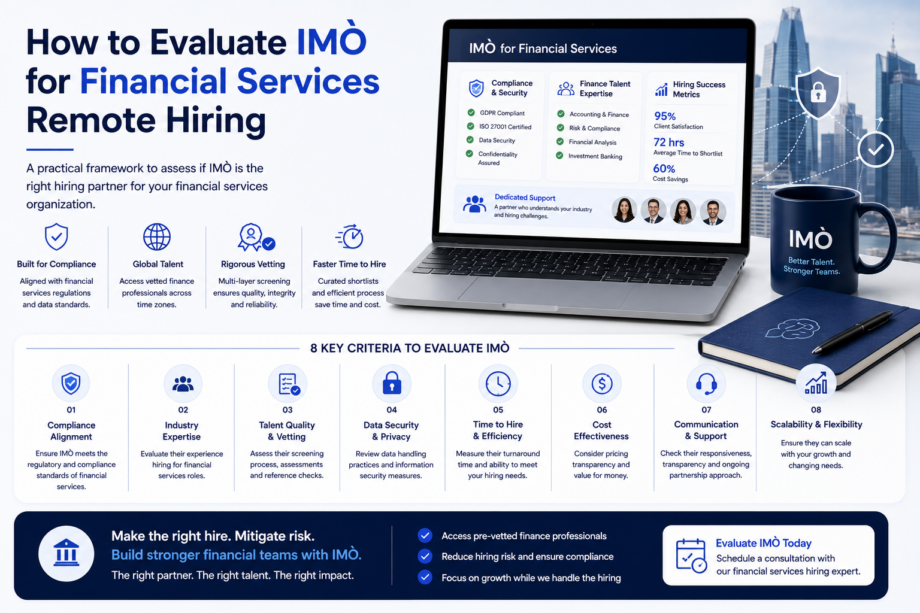
Hiring someone in Lagos or Nairobi to work remotely for a UK-regulated entity introduces a layer most domestic HR teams have never had to navigate: whose data protection law applies, whose criminal records databases are accessible, and whether local employment law even permits certain checks. This is precisely where questions arise about whether a niche platform like IMÒ fits the compliance picture for multi-country hiring, since cross-border due diligence isn’t a checkbox, it’s an ongoing legal judgement call.
Tools for Secure Remote Verification
Secure document upload portals, encrypted candidate data storage, and integration with regulator databases all matter more when there’s no physical office interaction to fall back on. A background checker built for remote-first hiring should handle this natively, not as a bolted-on afterthought.
How Do You Choose an Effective Background Screening Provider?
Criteria for Compliance-Ready Providers
Not all screening vendors understand financial sector nuance. Some are brilliant at consumer-facing employment screening but have never touched a regulated reference or an FCA authorisation requirement. When evaluating a provider, ask directly whether they’ve handled SM&CR regulated references before, whether their adverse credit checks pull from recognised UK credit reference agencies, and whether their sanctions check covers both UK and international lists. This is the same due diligence questioned when evaluating a remote talent partner’s vetting standards more broadly, financial services just raises the stakes considerably.
Integration With Existing HR Systems
A screening process that lives entirely outside your HR software creates duplicate admin and, worse, gaps where a candidate slips through without full sign-off. Look for providers offering API integration or at minimum clean data export, so results feed directly into your existing onboarding workflow rather than sitting in spreadsheets someone forgets to check.
Red Flags to Avoid When Selecting a Vendor
A few things should make you walk away from a vendor pitch immediately:
- Vague answers about how long checks take, or promises of “instant” results for adverse credit and criminal record checks that legitimately require days to process properly
- No clear explanation of their lawful basis for processing criminal record data under DPA 2018
- Inability to name which credit reference agencies or sanctions databases they actually query
- No option for ongoing or annual re-screening, only one-off checks
How Should You Implement a Screening Process Internally?
Building this internally rather than outsourcing entirely means mapping every role to its required checks before a single job advert goes live, not after an offer’s been made. Simona, an HR coordinator I spoke with recently while researching financial sector hiring practices, put it plainly: most compliance failures she’s seen weren’t malicious, they were just badly sequenced, background checks started too late in the process to actually inform the hiring decision. The fix is procedural discipline. Define which roles trigger SM&CR-level screening at the job description stage. Build a checklist per role tier. Assign clear ownership, usually HR working alongside compliance, so nobody assumes “someone else” ran the credit check.
What Information Should a Financial Background Check Include?
A genuinely thorough financial integrity check pulls together several distinct threads: identity verification against government-issued documents, employment history verification stretching back five to six years depending on seniority, an adverse credit check flagging bankruptcies and County Court Judgments, a criminal record check appropriate to role sensitivity, sanctions and PEP screening against current regulator databases, and for SM&CR roles specifically, regulated references detailing conduct history. Bank statements or proof of address sometimes feature too, particularly where residency verification matters for right-to-work purposes.
How Often Should Checks Be Repeated After Hiring?
Annually, for anything touching SM&CR obligations, and increasingly for AML-sensitive roles given the shift toward perpetual screening flagged by industry analysts. For lower-risk, non-SM&CR staff, a three-year cycle is common practice, though firms handling particularly sensitive financial crimes exposure sometimes tighten that further.
FAQ
Does every financial services employee need a full background check? No. Proportionality matters. SM&CR staff face the most rigorous requirements, while general staff typically need identity, right to work, and standard reference checks only, unless their specific role grants access to funds or sensitive data.
Can background checks be done entirely remotely and still be compliant? Yes, provided identity verification uses proper IDVT rather than a simple document photo, and the provider has a clear lawful basis for processing any special category data collected.
What happens if a regulated reference reveals a past conduct breach? It doesn’t automatically disqualify the candidate, but it must be assessed and documented as part of the “fit and proper” evaluation, with the reasoning for the final hiring decision recorded.
Conclusion
None of this is designed to make hiring in financial services feel impossible, though I’ll admit, the first time you map out SM&CR requirements against a remote hiring pipeline, it can feel that way. Get the framework straight though, identity, credit, criminal record, sanctions, regulated references where applicable, and repeat monitoring where required, and the rest becomes procedural rather than perilous. The firms that treat background screening as a genuine risk control, rather than paperwork to survive an audit, are the ones that don’t end up explaining themselves to the FCA eighteen months down the line.
