
Right, so someone in your Slack channel just dropped a link to a platform called IMÒ Talent and asked “have we tried this one yet?” That’s usually how this goes. You’re knee-deep in a hiring process that’s already stretched three weeks longer than planned, you’ve got a backend role sitting empty, and now there’s a new name to vet on top of everything else.
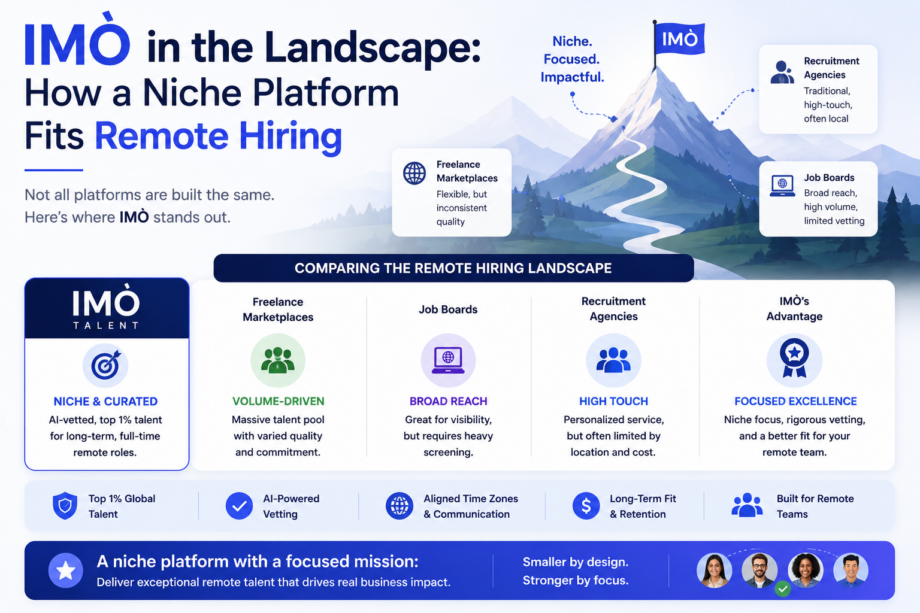
Here’s the direct answer before we go anywhere else: IMÒ Talent is a specialist remote hiring platform connecting UK, European and US businesses with vetted tech, business and design professionals across Africa, typically at 60 to 70% less than domestic hiring costs, with placements happening in as little as 72 hours. It’s not an Employer of Record. It’s not a freelance marketplace like Upwork. It sits in its own lane, somewhere between a boutique staffing agency and a curated talent network, and that positioning matters enormously for whether it fits what you’re actually trying to do.
I’ve spent a fair amount of time picking apart remote hiring tools for clients who are sick of guessing, and the honest truth is most comparison content out there just restates the marketing copy with slightly different adjectives. That’s not particularly useful when you’re trying to decide whether to commit a quarter’s budget to a platform you’ve never used. So let’s actually get into what IMÒ does well, where it creaks, and who should probably look elsewhere entirely.
IMÒ Talent at a Glance: Ratings and Verdict
Based on publicly available user feedback, pricing structures and platform mechanics, here’s roughly how IMÒ Talent stacks up across the metrics that actually matter when you’re choosing a remote hiring tool.
- Vetting Quality: 4.3/5 – multi-stage bootcamp process with technical and communication assessments, though the pool is smaller than legacy networks
- Cost Efficiency: 4.8/5 – flat monthly rates starting around £380, genuinely competitive against UK/US salaries
- Speed to Hire: 4.5/5 – 72-hour matching is fast, though not instant like some marketplace models
- Compliance Coverage: 2.5/5 – this is the platform’s soft spot, and we’ll get into why below
- Platform Tools: 3.8/5 – decent built-in workspace, but not as feature-dense as dedicated workforce management suites
- Support Quality: 4.4/5 – consistently praised by users for onboarding responsiveness
Pros:
- Flat-rate pricing with no hidden markup or hourly billing games
- Fast turnaround, often filling roles within 72 hours of a brief
- Dedicated, full-time talent allocation rather than shared freelancer bandwidth
- Free replacement policy if a match doesn’t work out
- GMT+1 timezone alignment, which genuinely helps with UK and European overlap
Cons:
- No built-in Employer of Record or global payroll infrastructure
- Requires a 3-month minimum commitment, awkward for short-term tasks
- Smaller talent pool than Toptal, Upwork or Andela
- Compliance and employment contracts are largely left to the client to sort out
How Does IMÒ Talent’s Vetting and Matching Process Work?
The mechanics are fairly straightforward once you see them laid out. Candidates apply, then go through what IMÒ calls a bootcamp, essentially a screening gauntlet covering technical skill, English communication proficiency, and a bit of cultural fit assessment. Only the ones who clear that bar make it into the active talent pool, which the platform claims sits above 1,000 vetted professionals across engineering, AI, design and business roles.
What happens next is where the AI-powered matching engine comes in. You submit your requirements, whether that’s a React developer with specific TypeScript experience or a growth analyst who’s worked with SaaS metrics, and the system filters candidates against your brief. Within 48 to 72 hours you’re typically looking at a shortlist. Compare that to the average recruitment process through a traditional staffing agency, which can drag on for three to eight weeks once you account for sourcing, screening and interview loops, and the speed advantage becomes obvious.
I’d be lying if I said this vetting depth rivals what Toptal or Andela run, both of which have built reputations on notoriously selective acceptance rates (Toptal famously accepts under 3% of applicants). IMÒ’s process is rigorous by the standards of a boutique platform, but it hasn’t been around long enough to build the same institutional trust. That’s not a knock, just a fact worth sitting with before you commit.
What Does IMÒ Talent Actually Cost?
Pricing is where IMÒ genuinely stands out, and it’s worth being specific rather than vague about it. Tech talent, meaning full-stack developers, mobile engineers, AI specialists and cloud architects, runs around £500 a month. Business talent, covering project managers, analysts, UI/UX designers and growth specialists, comes in at roughly £380 a month.
Compare that to hiring a mid-level software engineer domestically in London or Manchester, where monthly costs (once you factor in salary, National Insurance, pension contributions and recruitment fees) can easily hit £4,000 to £6,000 or more. Even against Upwork enterprise contracts, where hourly rates plus platform commission can quietly balloon your total cost, the flat-rate model here offers a kind of pricing predictability that finance teams tend to appreciate.
There’s a catch worth flagging though. The pricing structure assumes a 3-month minimum commitment with monthly billing thereafter, and 30 days’ notice if you want out. That’s fine if you’re building a long-term working relationship, less fine if you need someone for a two-week sprint. There are no setup fees and the replacement guarantee is free, which softens the blow if a match doesn’t pan out, but don’t mistake this for a pay-as-you-go freelance arrangement. It isn’t one.
Is IMÒ Talent Compliant for Multi-Country Hiring?
This is the section where I’d push back hardest on the marketing framing, because it matters. IMÒ Talent is not an Employer of Record. It doesn’t handle statutory employment contracts, tax withholding, local labour law compliance or benefits administration the way platforms like Deel or Remote.com do. If you’re hiring across multiple jurisdictions and need someone else to own the legal employment relationship, this platform simply isn’t built for that job.
What IMÒ offers instead is a marketplace-style engagement, typically structured as contractor arrangements, where the client company handles its own compliance obligations or works with a separate payroll provider to manage things properly. For a founder hiring their first two remote developers, that’s often manageable. For a company scaling international hiring across a dozen countries with genuine global payroll needs, you’re going to hit friction fast, and probably need to bolt on a separate EOR service anyway.
If multi-country compliance is your primary pain point, it’s worth reading through this breakdown of how IMÒ’s positioning compares against agencies and vetted networks before assuming one platform can do it all.
What Tools Do You Get for Managing Remote Hires?
Once someone’s hired through IMÒ, you’re not just handed a Slack handle and left to figure out workforce management on your own. The platform includes a built-in virtual workspace with task tracking, time tracking and performance monitoring baked in, alongside a dedicated account manager who handles onboarding documentation and check-ins.
It’s a reasonable toolset for small to mid-sized teams, but I wouldn’t call it a replacement for dedicated project management infrastructure like Jira or Linear if you’re running complex, multi-team engineering workflows. Think of it as a support layer bundled into the hiring relationship rather than a standalone product you’d choose on its own merits.
Who Should Use IMÒ Talent?
The clearest fit is early-stage and bootstrapped startups who need senior execution, think full-stack development, AI engineering or UI/UX work, without burning through runway on domestic salaries. Founders juggling a tight budget and an aggressive product roadmap tend to get outsized value here, because the 60% cost reduction isn’t marginal, it’s often the difference between shipping a feature this quarter or not shipping it at all.
UK and European SMBs sit in the sweet spot too, largely because of the GMT+1 timezone alignment. There’s something underrated about not having to schedule standups at 7am or 11pm just to catch overlap with your engineering team. And companies looking to add a dedicated project manager, analyst or growth specialist for long-term integration, rather than a quick gig, will find the full-time exclusive allocation model suits that intent far better than a freelance marketplace would.
Who Should Avoid IMÒ Talent?
If you need genuine multi-country compliance handled end-to-end, meaning employment contracts, statutory benefits, tax filings across a dozen jurisdictions, look elsewhere. This is where platforms built around global payroll infrastructure earn their keep, and IMÒ simply isn’t positioned to compete there.
Anyone needing someone for a one-off task lasting a few days should also skip this. The 3-month minimum commitment makes it a poor fit for bulk hiring tasks or short-term project sprints where you just need extra hands for a fortnight. And larger organisations running procurement processes that demand enterprise-grade vendor management, audit trails and formal SLAs might find the platform’s relatively lean, growth-stage brand presence a harder sell internally, particularly if your procurement teams are used to dealing with more established providers.
What Do Real Users Say About IMÒ Talent?
Public sentiment sits around a 4.3 to 4.5 out of 5 TrustScore, which is solid without being extraordinary. The praise clusters around a few consistent themes: founders repeatedly mention the value-to-cost ratio, particularly for shipping React or Node applications quickly on limited budgets. Onboarding gets singled out too, with several reviewers noting the account management team stayed hands-on from the first kickoff call through to project launch.
The complaints are fewer but worth noting honestly rather than glossing over. Some users flag the minimum contract length as restrictive for short-term needs. Others point out that because the platform is still relatively young, formally connected to an earlier iteration called imointerns.app, the overall talent pool remains more boutique than what you’d find on Upwork or through Toptal’s larger vetted network. Neither is a dealbreaker, but both are the kind of detail that gets buried in glowing testimonial sections if nobody bothers to mention them.
How Does IMÒ Talent Compare to Deel, Remote.com, Toptal and Upwork?
Numbers help more than adjectives here, so here’s a direct side-by-side.
| Feature | IMÒ Talent | Deel/Remote.com | Toptal | Upwork |
|---|---|---|---|---|
| Core Model | Vetted talent marketplace | Employer of Record + payroll | High-end vetted freelance network | Open freelance marketplace |
| Speed to Hire | 72 hours | 1-2 weeks (EOR setup varies) | 1-2 weeks | Varies, manual screening |
| Pricing | Flat rate (£380-£500/mo) | Per-employee EOR fees + salary | Premium hourly ($60-100+/hr) | Hourly + commission markup |
| Compliance Handling | Client-managed | Full EOR compliance | Client-managed | Client-managed |
| Vetting Depth | Multi-stage bootcamp | Varies by hire | Extremely selective (~3% acceptance) | Self-reported, unverified |
The takeaway isn’t that one of these wins outright, it’s that they’re solving different problems. Deel and Remote.com exist because companies need someone else to own the legal employment relationship across borders. Toptal exists because companies want the absolute top slice of vetted engineering talent and are willing to pay premium hourly rates for it. Upwork exists because sometimes you just need a freelancer for three weeks and don’t want a contract. IMÒ occupies the gap between all of these, cost-efficient, fast, vetted, but without the compliance backbone or the sheer scale of an established marketplace. For a broader look at how these models stack up feature by feature, this platform-by-platform comparison against Arc and Toptal digs deeper into the mechanics.
How to Evaluate and Switch Remote Hiring Platforms Without Disrupting Your Team
Switching providers midstream is one of those things that sounds simple in a planning meeting and turns messy the moment you actually attempt it. A few things worth doing properly before you make the jump:
- Audit your current hiring bottleneck first. Is it cost, speed, compliance, or vetting quality that’s actually broken? Don’t switch platforms to fix a problem the new platform doesn’t solve either.
- Run a parallel trial before fully committing. Hire one role through the new platform while your existing pipeline stays active, so you’re not risking total workforce disruption if the new match underperforms.
- Check contract overlap and notice periods. Existing contractor agreements and the new platform’s minimum commitment terms need to align, or you’ll end up double-paying during the transition window.
- Confirm who owns compliance. If you’re moving from an EOR-based platform to a marketplace model like IMÒ, someone on your side needs to explicitly own the employment contract and tax question, because nobody else will.
Getting this sequence wrong is how companies end up with a gap in coverage right when a critical remote position needs someone in the seat. It’s worth reading through this onboarding process blueprint for remote hiring platforms if you’re planning a switch across multiple roles at once rather than a single hire.
Final Verdict: Buy or Skip?
Buy if you’re a startup founder or SMB operator who needs vetted, full-time remote talent fast, cares deeply about cost efficiency, and is comfortable handling your own contractor compliance or pairing it with a separate payroll provider. The 60% cost reduction against domestic hiring, combined with genuinely fast turnaround and a free replacement guarantee, makes this one of the stronger boutique options in the current market.
Skip if you need an all-in-one global employment platform with built-in EOR compliance across multiple countries, or if you’re hiring for something short-term where a 3-month commitment doesn’t make sense. In those cases, you’re better served pairing this kind of vetted network with a dedicated compliance layer, or choosing a platform purpose-built for that job from day one. Worth checking how IMÒ fits within broader startup hiring stacks if you’re still weighing which combination of tools actually closes your specific gap.
