

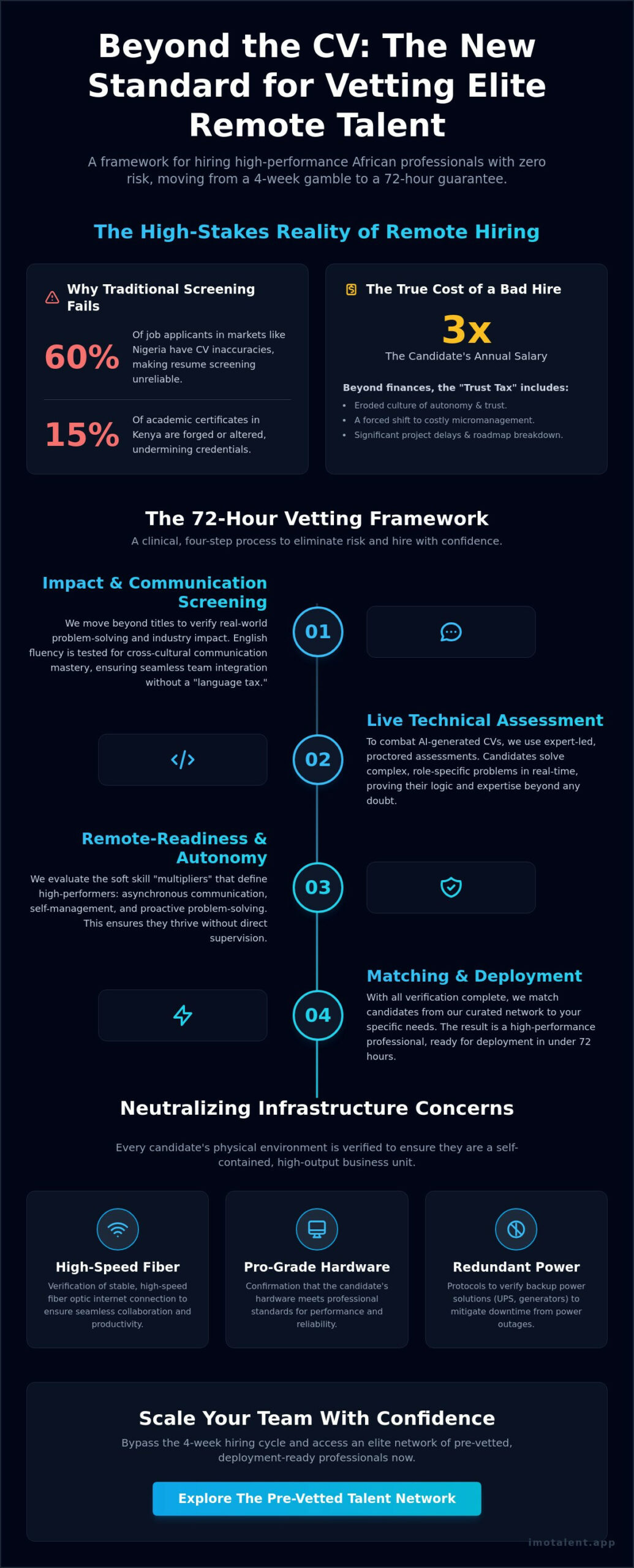
Recent audits in Kenya reveal that up to 15% of academic certificates are forged or altered. In markets like Nigeria, reports suggest over 60% of job applicants have inaccuracies on their CVs. These aren’t just statistics; they’re the primary reasons hiring managers hesitate to implement a remote talent vetting process in emerging markets. You likely fear technical incompetence or cultural misalignment will waste weeks of your time. It’s frustrating to see a candidate who looks elite on paper fail the final round, forcing you back to square one.
This guide eliminates that uncertainty. You’ll master a framework designed to identify and onboard high-performance African professionals with zero risk. We’re moving beyond traditional interviews to a system that verifies infrastructure and remote-readiness as strictly as a technical stack. You’ll gain a repeatable methodology that reduces time-to-hire while ensuring every placement is an operational win. Let’s build your bridge to elite global talent with total confidence.
Key Takeaways
- Move beyond the CV to verify remote-readiness and autonomy, ensuring candidates thrive outside a traditional office environment.
- Implement a rigorous four-step remote talent vetting process that slashes your time-to-hire to just 72 hours without compromising on quality.
- Master the soft skill “multipliers” that transform standard technical competence into high-performance, self-managed results.
- Neutralize infrastructure concerns with specific verification protocols for high-speed fiber, hardware standards, and redundant power solutions.
- Transition to a curated network model to bypass the traditional four-week hiring cycle and scale your team with elite, pre-vetted professionals.
Beyond the CV: Why Standard Vetting Fails for Remote Talent
A resume is a marketing document, not a performance guarantee. While many candidates visit Rezumi to optimize their profiles for automated tracking, a standard CV review remains dangerously insufficient in the context of global hiring. Effective vetting is a multi-dimensional verification of three distinct pillars: technical skill, physical environment, and psychological autonomy. Your remote talent vetting process must move beyond what a candidate says they can do; it must prove they can do it consistently in a distributed setting.
Traditional “in-office” interview styles are fundamentally flawed for remote selection. They prioritize charisma and physical presence, traits that don’t translate to Slack or Jira. A candidate might interview well in person but lack the self-discipline required for remote work. Relying on “gut feelings” during cross-border hiring is particularly risky. Cultural nuances and different communication styles can easily lead to false positives. Without a clinical, data-driven framework, you’re likely to hire the most charming candidate rather than the most competent one.
For 2026, the elite standard is “Remote-First Competency.” This is the primary filter for high-performance teams. It measures a professional’s ability to communicate asynchronously, manage their own hardware, and maintain high output without a manager looking over their shoulder. If a candidate lacks this core competency, their technical stack is irrelevant. You aren’t just hiring a developer; you’re hiring a self-contained business unit.
The Cost of a Bad Remote Hire
A failed remote placement is a financial drain. The total cost often hits 3x the candidate’s annual salary once you calculate recruitment fees, onboarding time, and the inevitable severance. However, the “trust tax” is often more expensive. One incompetent hire erodes the culture of autonomy you’ve worked to build. It forces managers into a defensive “micromanagement” loop, which frustrates your existing high performers. This leads to project delays and a total breakdown of your development roadmap.
Why 2026 Requires a New Vetting Standard
The rise of AI-generated CVs has made traditional screening obsolete. These applications are perfectly engineered to pass through automated filters, yet they often hide a lack of real-world expertise. To combat this, live, proctored assessments are non-negotiable. You must see the candidate solve problems in real-time to verify their logic. This level of scrutiny is essential for streamlining the hiring process for remote developers. By front-loading the rigor, you ensure that every candidate reaching the final stage is a guaranteed fit, not a gamble.
The 4-Step Framework for Vetting High-Performance African Talent
Speed is your primary competitive advantage. While traditional agencies spend four weeks navigating administrative hurdles, our remote talent vetting process delivers high-performance professionals in under 72 hours. This isn’t a shortcut; it’s the result of a pre-curated network where the heavy lifting is already done. We act as an elite gatekeeper, maintaining a high-velocity talent pool across tech, business, and design disciplines. By the time you need a hire, the verification is complete.
This framework is designed to eliminate the friction of global hiring. We focus on four clinical stages: Application, Rigorous Vetting, Matching, and Deployment. This linear progression ensures that only the most resilient and capable professionals reach your team. It’s a system built for 2026, where waiting a month for a developer means falling behind your competition. If you want to scale without the typical friction, you can explore our pre-vetted talent network today.
Step 1 & 2: Initial Screening and Communication Mastery
We begin by stripping away the fluff of a standard resume. Our team verifies work history and, more importantly, the actual industry impact of previous roles. We don’t just look for titles; we look for evidence of problem-solving. English fluency is a baseline requirement, but we go deeper into cross-cultural communication. Communication Mastery is the ability to resolve complex technical debt through clear documentation. This ensures that every hire can integrate into a global team without a “language tax” slowing down your sprints.
Step 3 & 4: Expert-Led Technical Assessment and Cultural Fit
Technical skills are verified through role-specific, proctored testing. Whether it’s a lead developer, a UI/UX designer, or a product manager, we use expert-led evaluations for vetting technical capabilities in real-world scenarios. We don’t rely on generic quizzes. We want to see how they handle edge cases and architectural trade-offs.
The final hurdle is cultural alignment. In 2026, “cultural fit” is no longer about shared hobbies; it’s about “Value Alignment” and an “Ownership Mentality.” We look for candidates who treat your product as if it were their own. This final review ensures that when we deploy a candidate, they’re ready for immediate integration. They don’t just fill a seat; they drive the roadmap forward from day one. This rigorous remote talent vetting process is why our placements stay longer and perform better than average marketplace hires.
Evaluating Remote-Readiness: Technical Skills vs. Soft Skills
Technical proficiency is merely the entry fee for the modern workforce. In a distributed environment, a developer who can code but cannot communicate is a liability. Your remote talent vetting process must differentiate between raw hard skills and the ability to apply them without supervision. We treat technical competence as the baseline; soft skills are the multiplier that determines the actual ROI of a hire. Without high-level self-management, even the most brilliant engineer will struggle to meet deadlines in an asynchronous environment.
Testing for “asynchronous communication” is a critical component of this evaluation. We look for candidates who provide context, anticipate follow-up questions, and document their logic clearly. This prevents the “waiting game” that often stalls cross-border projects. High-performance talent must also demonstrate problem-solving under pressure. When a server goes down at 2:00 AM, you don’t need someone who waits for instructions. You need a professional with the autonomy to diagnose and resolve the issue independently.
The Technical Baseline: Beyond Coding Challenges
Static take-home assignments are no longer reliable. In 2026, AI can solve most standard coding prompts in seconds. We prioritize live pair programming because it exposes a candidate’s thought process in real-time. This method allows us to test for architectural thinking rather than simple syntax knowledge. We want to see how they handle edge cases and technical debt. This level of scrutiny is what defines what are pre-vetted remote professionals. By verifying the “how” behind the code, we ensure they possess the senior-level logic required for complex builds.
The Soft Skill Multiplier: Measuring Autonomy
Measuring accountability requires a clinical approach. We use situational interviews to gauge “Time-Zone Agility,” ensuring candidates can maintain high-intensity output during your core team hours. Proactiveness is another non-negotiable trait. We ask targeted questions to see if a candidate takes ownership of tasks or simply waits for tickets to be assigned. Using a framework for evaluating soft skills for remote work helps us identify professionals who build trust through consistency. Remote-Readiness is the intersection of technical competence and self-governance. If a professional cannot manage their own workflow, they aren’t ready for a global role, regardless of their years of experience. This rigorous remote talent vetting process ensures that every match is operationally ready from day one.
Reducing Hiring Risks: Infrastructure and Regional Verification
“What if their internet goes out?” is the most common objection we hear from hiring managers. It’s a valid concern, but in 2026, it’s a solved problem for elite professionals. We don’t leave uptime to chance. A rigorous remote talent vetting process must treat a candidate’s physical environment as a mandatory performance metric. Technical brilliance is irrelevant if a developer can’t maintain a stable connection during a critical deployment.
Our approach shifts the burden of infrastructure from the employer to the vetting stage. We verify that every professional in our network operates with the same reliability as an on-site employee. By clinical auditing their hardware and power redundancy, we eliminate the operational risks typically associated with cross-border hiring. This level of scrutiny ensures that your remote team functions as a seamless extension of your local office.
Infrastructure Verification as a Vetting Step
We conduct mandatory hardware checks to ensure developers possess the processing power required for modern, resource-intensive stacks. A slow machine leads to slow sprints. Beyond the computer itself, we verify redundant internet connections and robust power solutions. This includes a physical audit of Uninterruptible Power Supplies (UPS) and Inverters. These aren’t optional extras; they’re non-negotiable requirements for achieving 99.9% uptime. We ensure that even during local grid maintenance, your projects continue without interruption. If you’re ready to bypass these logistical headaches, you can onboard African professionals with verified setups today.
Cultural and Time-Zone Alignment
Hiring from African tech hubs like Lagos, Nairobi, and Cape Town offers a distinct linguistic advantage. English is the primary language of business and education in these markets, ensuring high proficiency and cultural bridge-building. You won’t face the communication barriers often found in other offshore regions. African tech professionals have also built a global reputation for a high-intensity work ethic, particularly within the fast-paced environment of VC-backed startups.
The time-zone advantage for UK and EU companies is a massive operational win. With only a 0-2 hour difference, your remote talent works alongside your core team in real-time. This eliminates the “lag” of traditional outsourcing where feedback loops take 24 hours. You can leverage the GMT to GMT+3 window for seamless “follow-the-sun” development. This alignment allows for instant collaboration, live stand-ups, and rapid troubleshooting. It’s the most efficient way to scale a high-performance team without sacrificing the speed of communication.
Scaling with Confidence: The 72-Hour Vetting Advantage
Traditional recruitment is an anchor on your growth. Organizations typically waste four weeks navigating administrative friction, sifting through unverified applications, and conducting redundant interviews. This slow-moving cycle is obsolete. Our remote talent vetting process is built on a curated network model that flips the script. We front-load the rigor so you don’t have to. By the time you identify a gap in your team, the elite talent is already identified, verified, and ready for deployment.
This approach allows for a 72-hour turnaround from request to placement. It’s the only way to scale with velocity in 2026. You aren’t just getting a faster hire; you’re gaining access to a 60% cost reduction compared to local markets without the typical quality trade-off. We operate as your elite facilitator, ensuring that the financial optimization of hiring from Africa is matched by world-class technical output. Speed and quality are no longer a binary choice. For organizations looking to move even faster, partnering with an efficient remote talent placement service can help you bypass the traditional bottlenecks and implement a strategic scaling plan that prioritizes both speed and excellence.
From 72 Hours to Long-Term Retention
Vetting shouldn’t end when the contract is signed. A truly rigorous remote talent vetting process includes ongoing performance monitoring to replace the “hope it works out” strategy. We provide a managed talent framework that tracks integration and output during the critical first 90 days. This proactive oversight is why we maintain retention rates above 90%. We don’t just match resumes to job descriptions. We manage the relationship to ensure long-term operational success. A managed approach is the final, essential step in a vetting system that prioritizes results over simple placement.
The Strategic Advantage for Global Teams
Accessing a pre-vetted pool of African professionals is a strategic move for any global organization. The ROI is clear: you reduce your overhead, eliminate infrastructure risks, and gain team members who operate in your time zone. It’s time to shift your perspective from “hiring” to a “strategic talent partnership.” You need a partner that acts as a confident gatekeeper, protecting your culture while accelerating your roadmap. Don’t let traditional, slow-moving processes stall your expansion. You can scale your team with vetted African talent in 72 hours and start building with total certainty today.
Secure Your Competitive Edge with Elite Remote Talent
Relying on outdated hiring methods is a liability you can’t afford. You now have the framework to move beyond surface-level CV data and verify the infrastructure and autonomy required for remote success. By prioritizing live assessments and regional verification, you eliminate the risks of technical incompetence and communication lag. The modern landscape demands a shift from passive hiring to active, strategic talent acquisition.
Transitioning to a rigorous remote talent vetting process isn’t just about risk mitigation; it’s about strategic scaling. Our curated network of tech, business, and design experts allows you to achieve a 60% reduction in hiring costs without sacrificing the elite quality your roadmap demands. You can stop the four-week search cycle and start building with professionals who are already verified and ready to integrate. We provide the speed you need to stay ahead of the competition.
The bridge to Africa’s most capable professionals is open. It’s time to trade uncertainty for a high-velocity partnership that drives your business forward. Hire Vetted African Talent in 72 Hours and experience the immediate impact of a truly managed talent solution. Your next high-performance team member is ready when you are.
Frequently Asked Questions
How do you ensure the technical quality of remote talent?
Technical quality is guaranteed through expert-led, proctored assessments and live pair programming sessions. We move beyond static quizzes to evaluate how a candidate handles technical debt and architectural trade-offs in real-time. This clinical approach ensures that only senior-level logic reaches your production environment.
What is the difference between a freelance marketplace and a vetted talent platform?
A freelance marketplace is a passive job board where the burden of verification falls entirely on you. In contrast, a vetted talent platform acts as a confident gatekeeper, providing a pre-curated network of professionals who have already passed rigorous screening. We operate as an elite facilitator, eliminating the noise and risk of unverified applications.
How does the 72-hour hiring process work?
The 72-hour turnaround is possible because our remote talent vetting process is completed before you submit a request. We maintain a warm pool of pre-verified experts across tech, design, and business. When you identify a need, we match your requirements to our existing high-performance network for immediate deployment.
Is there a risk of cultural misalignment when hiring from Africa?
Risks are neutralized by focusing on major African tech hubs like Lagos, Nairobi, and Cape Town, where English is the primary language of business. We vet for “Communication Mastery” and “Ownership Mentality” specifically. Our professionals are trained to integrate into global startup cultures, ensuring alignment with your core values and operational rhythm.
How do you verify the internet and power stability of remote workers?
We conduct physical audits of every candidate’s workspace to verify high-speed fiber and redundant power solutions like UPS or inverters. This infrastructure check is a non-negotiable step in our vetting framework. We ensure that candidates meet specific hardware standards to guarantee 99.9% uptime for your projects.
Can I hire for non-technical roles like Product Management or Design?
Yes, our network includes elite Product Managers, UI/UX Designers, and Business Operations experts. Each role undergoes a specialized version of our remote talent vetting process tailored to their specific discipline. Whether you need a designer to lead a rebrand or a PM to manage a roadmap, the quality remains consistent.
How much can I actually save by hiring through a vetted African platform?
You can typically achieve up to a 60% reduction in total hiring costs when compared to local UK, US, or EU markets. These savings don’t come from lower quality but from the geographic arbitrage of accessing the African talent market. You gain senior-level expertise at a fraction of the traditional overhead.
What happens if a vetted hire doesn’t perform as expected?
Our managed talent approach includes ongoing performance monitoring to catch friction early. If a hire doesn’t meet the agreed-upon output, we act quickly to resolve the issue or facilitate a replacement from our pre-vetted pool. We don’t just walk away after the hire; we stay invested to ensure the placement drives long-term ROI.
