

In 2026, the traditional sixty-day hiring cycle isn’t just a bottleneck; it’s a terminal risk for your product roadmap. You’ve likely felt the sting of local talent costs hitting $16.90 per hour minimums while traditional agencies fail to deliver at the speed your growth demands. It’s a common frustration for founders who need to scale without exploding their burn rate. Mastering remote hiring for scale-ups now requires a shift toward velocity-to-value, where elite talent is deployed in days, not months.
This strategy reveals how to tap into a pool of over 1 million professional software developers across Africa to reduce your overhead by 60% while maintaining 72-hour placement speeds. You’ll learn how to integrate pre-vetted, high-performance tech and business experts who are ready to ship code from day one. We’re moving beyond the uncertainty of international vetting to provide a clear framework for managing a global remote workforce with zero friction.
Key Takeaways
- Stop losing runway to slow local hiring cycles and noisy job boards that stall your product roadmap.
- Leverage Africa’s high-speed tech hubs to access a rapidly expanding pool of elite, global-ready professionals.
- Discover a vetting framework for remote hiring for scale-ups that prioritizes remote leadership and operational readiness.
- Reduce your burn rate by 60% without sacrificing quality by strategically sourcing high-performance talent.
- Implement a high-velocity placement system that moves from initial brief to an elite shortlist in under 72 hours.
The Scaling Trap: Why Traditional Remote Hiring Fails Scale-ups in 2026
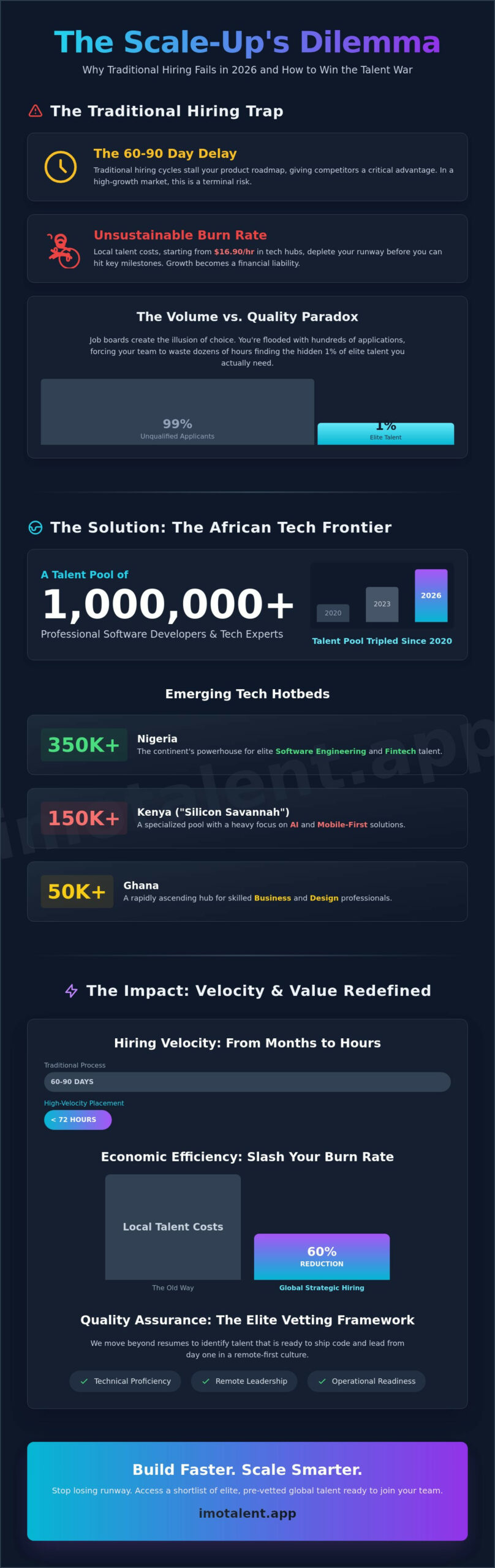
Growth is the primary objective for any scale-up, yet the traditional path to achieving it is increasingly fraught with financial risk. In 2026, founders face a brutal “Growth vs. Burn” paradox. Hiring locally in traditional tech hubs has become a strategic liability. With California’s minimum wage now at $16.90 per hour and mid-level engineer salaries reaching unsustainable peaks, the cost of scaling a local team can deplete a Series B runway before the product hits its next milestone. This financial pressure often forces leadership to choose between slowing down their roadmap or risking insolvency.
Traditional job boards exacerbate this problem. They are designed for volume, not precision. Posting a role often results in a flood of hundreds of applications within hours, yet the vast majority of these candidates fail to meet the rigorous technical standards required for high-velocity environments. This noise creates a massive hidden cost. Your internal teams spend dozens of hours sifting through resumes instead of building features. The global shift to remote work has made talent accessible, but it has also made the vetting process more complex. Without a curated approach, remote hiring for scale-ups becomes a bottleneck rather than an accelerator.
Speed as a Competitive Advantage
In the current market, a three-month hiring cycle is a terminal delay. Product momentum is the lifeblood of a scale-up. If your engineering team waits ninety days to fill a critical tech lead role, your competitors will outpace you. We focus on “Velocity-to-Value,” the metric that measures how quickly a new hire begins contributing to the bottom line. For companies aiming for Series C milestones, immediate talent availability is the difference between leading the market and playing catch-up. High-growth firms can’t afford the luxury of slow, traditional placement processes. You need talent that is ready to ship code on day one.
The Quality vs. Volume Paradox
A massive pile of applications is a liability, not an asset. It creates the illusion of choice while hiding the elite 1% of talent you actually need. Scale-ups require more than just technical proficiency. They need professionals who can lead, adapt, and execute in a remote-first culture. Moving beyond the “gig economy” mindset is critical for long-term success. You aren’t looking for a freelancer to complete a task; you’re looking for a long-term team member to build a legacy. Accessing pre-vetted pools of tech, design, and business talent ensures that remote hiring for scale-ups results in an investment in your company’s future, not just a temporary fix for a mounting backlog. This philosophy of quality-assured, rapid placement is also being applied to local operational needs by platforms like LetME, which connects businesses with reliable service personnel through a streamlined mobile interface.
The African Tech Frontier: A Strategic Hub for Global Scale-ups
The search for elite talent has moved beyond traditional borders. Africa has emerged as the most significant growth engine for the global tech workforce, boasting over 1 million professional software developers as of 2026. This population has tripled since 2020, creating a massive, untapped reservoir for remote hiring for scale-ups. This isn’t just about volume; it’s about the maturation of entire ecosystems. Major tech hubs in Lagos, Nairobi, and Accra now provide the high-speed connectivity and infrastructure necessary for seamless global integration. Reliability is the new standard, not the exception.
Scale-ups succeed when they find the intersection of skill and operational readiness. African developers aren’t just technical experts; they are often builders who have scaled products in some of the world’s most competitive fintech and mobile environments. This experience translates directly to the needs of fast-moving startups in the US and Europe. When you look at what recruiters look for in high-performing remote teams, the ability to self-manage and communicate with precision is at the top of the list. African talent consistently meets these criteria through a combination of rigorous education and a culture of innovation.
Emerging Hotbeds: Nigeria, Kenya, and Ghana
Nigeria remains the continent’s undisputed powerhouse with over 350,000 developers. It is the primary source for elite software engineering and fintech talent. Kenya, often called the “Silicon Savannah,” provides a specialized pool of 150,000 developers with a heavy focus on AI and mobile-first solutions. Ghana has rapidly ascended as a preferred hub for business and design professionals, offering 50,000 skilled workers who excel in operational roles. These markets provide the specialized expertise required to drive remote hiring for scale-ups at a fraction of local costs. For a comprehensive look at how to structure and scale operations across these premier hubs, the 2026 strategic blueprint for building a remote team in Africa provides an in-depth framework covering regulatory compliance and high-velocity talent integration.
Time Zone and Linguistic Synergy
Communication friction is the enemy of velocity. One of the most significant advantages of African talent is the natural alignment of time zones. Regions operating on GMT, WAT, and EAT allow for real-time collaboration with European teams and significant overlap with the US East Coast. This eliminates the “delayed response” cycle that plagues Asian outsourcing. Furthermore, English is the primary language of business and instruction across these hubs. This linguistic proficiency ensures that complex technical requirements are understood and executed without the barriers common in other remote markets. If you want to bypass these common hurdles, you can connect with pre-vetted African professionals who are ready to integrate into your workflow immediately.
Elite Vetting: How to Identify Remote-Ready Professionals
Resume filtering is a relic of the past. In 2026, remote hiring for scale-ups demands a “Master Matchmaker” framework that prioritizes output over credentials. Technical proficiency is no longer the sole benchmark. It represents exactly 50% of the vetting equation. The remaining half focuses on the candidate’s ability to operate, lead, and execute within a decentralized environment. This rigorous selection process is what allows for 72-hour placement speeds. When you eliminate the noise at the source, you only interview the elite. The Master Matchmaker framework isn’t about finding a “fit”; it’s about finding a catalyst. We analyze your specific tech stack and team culture to ensure the talent isn’t just skilled, but aligned with high-growth urgency.
The Multi-Stage Vetting Protocol
Vetting isn’t a filter. It’s a forge. Our protocol begins by looking past the CV to analyze actual project impact. We don’t care if a developer knows Python; we care if they’ve used it to scale a fintech platform under high load. This is followed by technical deep-dives that go beyond simple syntax. We conduct live architectural assessments to see how a candidate thinks through complex systems. Finally, behavioral evaluations test for ownership mentality. We use situational simulations to see how a candidate handles a production outage or how they prioritize tasks when their lead is offline. Scale-ups need builders who don’t need a manager to tell them what to do next because they’re already two steps ahead of the roadmap.
Assessing ‘Remote-Readiness’
Autonomy is the currency of the remote world. We evaluate candidates on their asynchronous work proficiency and their mastery of essential collaboration tools like Slack, Jira, GitHub, and Linear. High-velocity scale-ups can’t afford to train new hires on how to communicate in a distributed team. Following remote hiring best practices means identifying talent that understands the nuance of written communication. We test for high-fidelity documentation skills and the ability to solve problems without immediate oversight. Remote-Ready is the ability to operate with full autonomy while maintaining high-fidelity communication in a decentralized environment. This standard ensures that remote hiring for scale-ups results in immediate integration and zero friction.
By the time a candidate reaches your desk, they’ve already survived a protocol that eliminates 99% of applicants. This pre-vetted efficiency is the only way to maintain a 72-hour placement speed without sacrificing quality. Every hire must add to your company’s velocity rather than becoming a management burden. We prioritize candidates who have a track record of improving internal processes and a history of self-directed learning.
Economic Efficiency: Reducing Burn Without Sacrificing Quality
Runway is the ultimate metric for scale-up survival. Every dollar spent on inefficient local hiring is a dollar taken away from product innovation or market penetration. In 2026, the financial delta between local and international talent has reached a tipping point. By leveraging remote hiring for scale-ups, leadership teams can achieve a 60% reduction in talent spend without compromising on technical excellence. This isn’t just about saving money; it’s about strategic capital reallocation. Saved capital allows you to double your R&D output or accelerate your Series C roadmap by months. Efficiency is your most aggressive growth lever.
The Total Cost of Ownership (TCO) of a local hire includes more than just a high salary. It encompasses real estate, localized benefits, and the mounting complexity of state-specific compliance. For example, California’s “Stay-or-Pay” restrictions and expanded leave protections added new layers of administrative burden in 2026. Conversely, a managed remote hire simplifies your operational footprint. You gain elite performance while maintaining a lean, agile organization that can pivot as fast as the market demands. Scale-ups looking to navigate the full regulatory landscape of international hiring should review the detailed guidance on how to build a remote team in Africa, which covers compliance frameworks across key markets including South Africa and Kenya.
Cost Comparison: Africa vs. Global Tech Hubs
Data from 2026 highlights a stark contrast in salary benchmarks. A senior software engineer in Nigeria commands a salary between $42,000 and $72,000. In South Africa, senior roles range from $50,000 to $85,000. Compare these figures to US or UK tech hubs, where equivalent roles often exceed $180,000 plus benefits. This 60% cost-saving reality allows scale-ups to hire three elite engineers for the price of one local hire. You maintain high-end quality because the talent is sourced from the top 1% of their respective ecosystems. You get the same architectural depth and code quality at a sustainable price point. Founders who want a step-by-step approach to sourcing these professionals can follow the practical methods outlined in this guide on how to hire African talent for startups, which details the 2026 frameworks for identifying and onboarding elite candidates at scale.
Long-Term Retention and ROI
Hiring right the first time is the ultimate cost-saving strategy. The average cost-per-hire can exceed $20,000 for specialized roles when you factor in sourcing and interview hours. Churn is an expensive distraction that kills momentum. Managed talent placements consistently show higher retention rates than gig-based freelancers because these professionals are integrated as core team members, not temporary contractors. We focus on scaling for performance, not just for headcount. By matching you with talent that is culturally and technically aligned, we eliminate the friction that leads to early turnover. If you are ready to extend your runway and secure elite talent, you can start your high-velocity hiring process today.
The IMO Talent Ecosystem: Your High-Velocity Scaling Partner
High-velocity growth requires more than just a strategy. It requires an execution partner that operates at your speed. We’ve built an ecosystem specifically designed to bypass the friction of traditional talent acquisition. While job boards leave you with a mounting pile of resumes to review, we provide a direct pipeline to the top 1% of the African tech frontier. Our role is that of an elite facilitator. We ensure that remote hiring for scale-ups is no longer a logistical burden but a competitive advantage. We don’t just find talent; we place catalysts into your organization.
The transition from a local team to a global workforce is a pivotal moment for any scale-up. It requires a partner that understands the nuance of specialized roles across tech, business, and design. We’ve curated a pool of professionals who aren’t just experts in their fields, but are also trained to thrive in the decentralized, high-pressure environments that define the 2026 market. This focus on operational readiness is what sets our ecosystem apart from traditional agencies or generic freelance marketplaces.
The 72-Hour Placement Workflow
Our process begins with a deep-dive briefing. We don’t just look at your tech stack; we analyze your specific scale-up culture and growth milestones. This allows our experts to match you with candidates who possess the exact architectural depth or business acumen your team requires. Because our talent pool is pre-vetted and curated, we move from initial brief to a high-performance shortlist in under 72 hours. This speed ensures your product momentum never falters. Once you’ve selected your candidate, our seamless onboarding protocol guarantees they are productive from day one. You don’t have time for a three-month ramp-up, and our workflow reflects that reality.
Managed Solutions for Global Teams
Scaling a global workforce often brings an administrative burden that can distract leadership from core objectives. We eliminate this friction. Our end-to-end management covers the complexities of international payroll, administrative compliance, and ongoing talent support. We aren’t a gig marketplace; we are a long-term scaling partner. This means we provide continuous performance monitoring to ensure your new hires remain aligned with your evolving roadmap. Whether you need specialized tech talent, strategic business experts, or elite design professionals, we provide the infrastructure to manage them effectively. This comprehensive support allows your internal HR teams to focus on culture and strategy while we handle the operational mechanics of your global team.
We act as the bridge-builder between your ambitious goals and the global talent required to reach them. Our mastery of the African recruitment market allows us to navigate local nuances while delivering a high-end, tech-forward experience for your team. We’ve seen how the right talent placement can accelerate Series B and C milestones by providing the technical and business depth needed to scale operations. Don’t let traditional processes slow your burn rate or stall your expansion. You can Scale your team with IMO Talent today and experience the efficiency of a truly optimized remote workforce.
Master Your Growth Velocity
The 2026 landscape demands a radical departure from slow, traditional recruitment. You’ve seen how the African tech frontier offers a unique combination of elite skill and time zone synergy. By prioritizing “Remote-Ready” vetting over simple technical screens, you protect your culture and your roadmap. This strategic shift in remote hiring for scale-ups isn’t just a cost-saving measure; it’s an operational upgrade that ensures your team remains agile and high-performing. You have the framework; now you need the talent.
You don’t have to choose between quality and burn rate. You can secure vetted tech, business, and design experts who are ready to integrate immediately. Achieve a 60% reduction in hiring costs while maintaining the momentum your investors expect. The era of the sixty-day hiring cycle is over. It’s time to deploy elite talent at the speed of your ambition. We are ready to help you bridge the gap between your current capacity and your global potential.
Scale your remote team in 72 hours with IMO Talent. Your next growth milestone is closer than you think.
Frequently Asked Questions
How does remote hiring for scale-ups differ from traditional recruitment?
Traditional recruitment is a reactive, local process that often takes months to complete. Our approach to remote hiring for scale-ups is proactive and global. We replace slow, manual filtering with a high-velocity ecosystem of pre-vetted talent. This allows you to bypass the noise of traditional job boards and focus on deploying elite professionals who are ready to ship code or lead projects from day one. Speed is the primary differentiator.
Can I really find elite tech talent in Africa within 72 hours?
Yes, our 72-hour promise is possible because we maintain a curated, pre-vetted pool of professionals. We don’t start the search when you give us a brief; we simply match your requirements with elite talent already in our ecosystem. This eliminates the lengthy sourcing phase. You receive a shortlist of candidates who have already passed our rigorous multi-stage vetting protocol, ensuring immediate availability for your most critical engineering or leadership roles.
What is the typical cost saving when hiring through IMO Talent?
Scale-ups typically realize a 60% reduction in talent spend compared to hiring equivalent roles in US or UK tech hubs. This efficiency comes from tapping into emerging markets where high-quality talent is available at a more sustainable price point. These savings allow leadership to extend their runway or reinvest capital into critical product R&D. You maintain the same technical depth while significantly lowering your operational burn rate and overhead costs.
How do you ensure the quality and vetting of the professionals?
Our vetting protocol is a multi-stage process that evaluates both technical mastery and remote-readiness. We conduct live coding assessments and architectural deep-dives to verify skill levels. Beyond technical ability, we test for autonomy and asynchronous communication proficiency. This ensures that remote hiring for scale-ups results in team members who can execute with minimal oversight in a decentralized environment. Only the top 1% of applicants enter our curated talent pool.
Does IMO Talent handle the payroll and administrative management?
We provide end-to-end administrative management for all talent placements. This includes handling international payroll, compliance, and localized benefits administration. By removing the logistical burden of global hiring, we allow your internal team to focus on core product milestones. You get the benefits of a global workforce without the complexity of managing multiple international entities or navigating patchwork labor laws yourself. We act as your primary operational partner for global expansion.
What roles can I hire for on the IMO Talent platform?
You can hire for specialized roles across Tech, Business, and Design disciplines. This includes Senior Software Engineers, Product Managers, UI/UX Designers, and Business Operations experts. Our ecosystem is built to support the diverse needs of a growing organization. Whether you need an engineering lead to scale your infrastructure or a design professional to refine your user experience, we provide access to elite talent across these critical high-performance categories.
How do you manage time zone differences for remote teams?
We leverage the natural time zone synergy between Africa, Europe, and the US East Coast. Regions operating on GMT, WAT, and EAT provide significant overlap for real-time collaboration. This eliminates the communication delays often found in other offshore hubs. We prioritize matching you with talent that can maintain a consistent schedule with your core team, ensuring that your high-velocity workflow remains uninterrupted by geographical distance or lag in response times.
Is there a long-term commitment required for hiring talent?
We focus on long-term talent integration rather than gig-based tasks. While our placements are designed for long-term retention, our model remains flexible to support your specific scaling needs. We aim to provide core team members who grow with your company through various funding rounds. This approach reduces the high cost of churn and ensures that the knowledge and expertise gained by your remote team stay within your organization as you scale.
