

If you’re still paying $200,000 for a senior engineer in San Francisco while your competitors scale with identical talent for less than half that price, you aren’t just overpaying. You’re losing the efficiency race. The cost of hiring senior developers Africa has become the ultimate strategic lever for high-growth firms in 2026. While London benchmarks sit at $130,000 and Silicon Valley remains unsustainable, elite African talent offers a sophisticated alternative that resets your financial trajectory.
You’ve likely felt the friction of slow recruitment cycles and the complexity of international compliance. It’s frustrating to see budgets drained by bad hires and high churn in traditional hubs. We promise to show you exactly how to achieve 60% savings on total ownership costs without compromising on quality or speed. This article provides a comprehensive financial framework for 2026, verifies the data behind the African advantage, and introduces a streamlined path to elite, pre-vetted integration.
Key Takeaways
- Establish a clear financial framework for hiring by defining the total cost of ownership (TCO) for senior engineers in 2026.
- Access verified salary benchmarks for the top tech hubs in Nigeria, Kenya, and South Africa to inform your global talent strategy.
- Verify the data behind the 60% savings on the cost of hiring senior developers Africa when compared to high-cost Western markets.
- Identify the operational risks of direct hiring and why elite talent prefers managed platforms over gig marketplaces.
- Learn the mechanics of scaling your team in 72 hours while maintaining rigorous vetting and full legal compliance.
The Recruitment Iceberg: Why Western Senior Dev Costs Are Unsustainable in 2026
Hiring a senior software engineer in a Western tech hub involves a financial commitment that far exceeds the number on the offer letter. In 2026, the starting salary for a senior developer in San Francisco has solidified at $160,000, while London benchmarks frequently hit $130,000. These figures are merely the tip of the iceberg. To understand your actual expenditure, you must calculate the Total Cost of Ownership (TCO). This metric accounts for every dollar spent from the initial job posting to the first year of employment. The recruitment iceberg is the sum of visible salary and invisible operational overhead.
When you ignore the submerged costs of recruitment, your budget suffers. Traditional Western hiring models are failing because they rely on an outdated understanding of talent value. High churn rates in these hubs mean you aren’t just paying for talent; you’re paying for the constant risk of replacement. Understanding the broader economic landscape in Africa is vital for leaders who want to move beyond the high-cost saturation of Western hubs. This shift allows companies to stabilize their burn rate while maintaining elite engineering standards.
The Burden of Statutory Benefits and Taxes
In the US and UK, statutory benefits and payroll taxes create a massive financial drag. Employers must navigate FICA, disability insurance, and regional payroll taxes that vary wildly by jurisdiction. When you add premium health insurance and 401(k) matching to the equation, these overheads typically inflate the base salary by 30% to 40%. In a competitive market, you can’t skip these “extras” without losing talent to the nearest unicorn. This tax burden makes the cost of hiring senior developers Africa an increasingly attractive alternative for firms focused on capital efficiency.
Recruitment and Onboarding Friction
The hidden drain on your resources starts long before a candidate signs. Recruitment agencies often demand fees ranging from 15% to 25% of the first-year salary. For a $160,000 hire, that’s a $40,000 sunk cost before day one. Beyond the cash outlay, you have to account for internal interviewing hours. Technical leaders spend dozens of hours in vetting cycles instead of shipping code. If you make a mistake, the “Bad Hire” penalty is devastating; industry data suggests a mid-level hiring error costs roughly 1.5x the annual salary in lost productivity and severance. Managed platforms eliminate this friction by providing pre-vetted talent that integrates into your workflow immediately.
Senior Developer Salaries Across African Tech Hubs
Understanding the cost of hiring senior developers Africa requires a move beyond continental averages. In 2026, the market has bifurcated into local roles and elite remote positions. For international firms, senior compensation typically ranges from $36,000 to $96,000 per year. This range reflects a two-tiered payment system where top talent expects contracts pegged to USD or GBP to hedge against local currency volatility. This isn’t just about lower numbers. It’s about accessing engineers who manage high-load, high-complexity systems for global users. When you analyze the data, the financial advantage is clear, but the quality of talent is the real catalyst for growth.
In the African context, “senior” denotes more than just years of experience. It signifies an ability to build resilient architecture under infrastructure constraints. These developers are accustomed to high-load environments and rapid scaling. Because of this, the demand for senior talent in fintech and mobile applications is surging. If you want to optimize your budget, you can access pre-vetted engineers who have already proven their technical depth in these specialized fields. Currency stability is a primary driver for talent retention. Most elite engineers in Nigeria and Kenya now insist on USD-pegged contracts. This protects their purchasing power and ensures long-term commitment to your project. While the base salary is significantly lower than Western hubs, the quality of output remains elite.
Lagos, Nigeria: The Engineering Powerhouse
Lagos is the continent’s engineering engine. With over 120,000 active developers, the depth of talent in Node.js and React is unmatched. Local senior roles might sit between $22,400 and $48,000, but the elite tier working for Western firms commands a premium. These professionals expect robust remote setups, private health insurance, and performance bonuses. They are battle-tested in one of the world’s most demanding tech ecosystems. The sheer volume of talent makes Lagos a primary destination for companies looking to scale backend teams quickly without sacrificing technical rigor.
Nairobi and Cape Town: Specialized Tech Hubs
Nairobi, the Silicon Savannah, is the premier hub for AI and Python development. A senior developer here hired for a remote role typically benchmarks at $72,000, which is a key factor in the total cost of hiring senior developers Africa. Cape Town offers a different profile, specializing in fintech and high-end UX/UI design. South African seniors often earn between $30,800 and $53,200 locally, but specialized premiums for cloud or AI can add 20% to 40% to that base. Both hubs offer excellent English proficiency and near-perfect time zone alignment with Europe, facilitating seamless integration into existing agile workflows.
US/UK vs. Africa: A Side-by-Side TCO Comparison
In 2026, the financial chasm between Western payroll and global talent ecosystems is impossible to ignore. A senior developer in San Francisco costs your company roughly $250,000 annually when you factor in a $180,000 base salary plus benefits, taxes, and the recruitment fees we identified earlier. By contrast, a senior engineer in Nairobi or Lagos commands a total cost of ownership (TCO) closer to $90,000. This isn’t a compromise on quality; it’s a realization of geographic arbitrage. The 60% savings claim is a mathematical reality that fundamentally changes your burn rate.
Even when you provide premium hardware, high-end software licenses, and robust remote work stipends, the numbers don’t lie. Most elite African developers require high-performance MacBooks and a stipend for reliable fiber internet. These operational costs are negligible compared to the $40,000 you would spend on local recruitment fees alone in London or New York. Reclaiming this capital allows you to ship features faster and extend your runway without additional fundraising. You’re buying the same technical excellence at a price point that reflects local cost-of-living differentials rather than inflated tech hub bubbles. For companies concerned that sourcing affordable remote developers means sacrificing code quality, the TCO data from African tech hubs consistently proves otherwise.
The 3-Year ROI Forecast
Consider the long-term impact of scaling a team of five senior developers. Over three years, the cost of hiring senior developers Africa yields nearly $2.4 million in savings compared to a Silicon Valley team. This capital isn’t just saved; it’s reinvested into R&D and market expansion. Beyond the direct financial benefit, you gain operational stability. African tech professionals often demonstrate higher loyalty to international firms, which reduces the high-churn penalty that plagues Western tech hubs. Lower turnover means less knowledge debt and more consistent product velocity over the long term.
Addressing the Infrastructure and Management Gap
Managing remote talent requires a structured approach to be effective. You can build this infrastructure internally, but the hours spent on legal compliance and technical screening are expensive. Using a managed platform is significantly more efficient. Paying for a professional vetting service is cheaper than burning your CTO’s time on initial interviews or fixing the fallout of a bad hire. For a deeper look at these logistics, read our Hire Remote Developers from Africa: The 2026 Strategic Guide. This strategy ensures you secure elite talent in 72 hours instead of the traditional 45-day cycle.
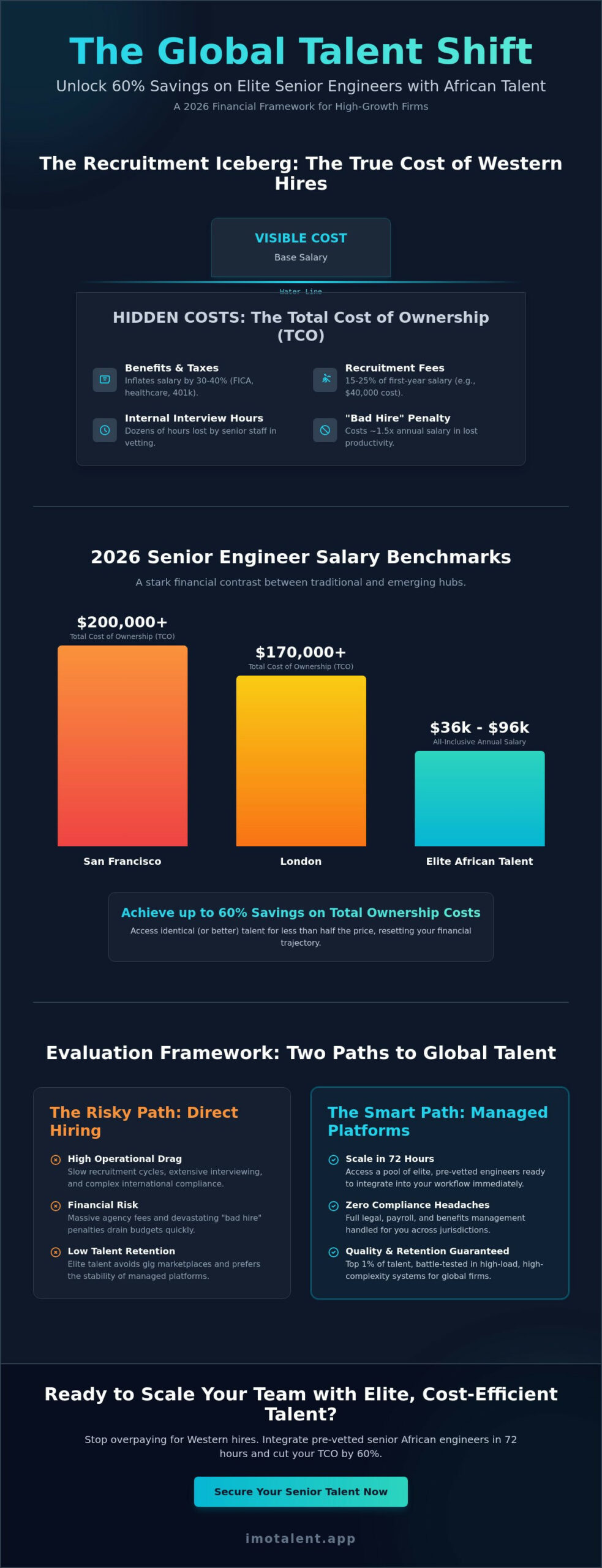
Evaluation Framework: Direct Hiring vs. Managed Talent Platforms
Choosing between direct hiring and managed platforms is a choice between manual labor and operational excellence. While DIY methods like LinkedIn or Upwork appear cost-effective, they ignore the substantial risk of misaligned talent. The cost of hiring senior developers Africa through unvetted channels often leads to expensive “bad hire” penalties. Elite African engineers avoid the noise of gig marketplaces. They prefer vetted platforms that offer career stability and high-end projects. This preference ensures you’re looking at the top 1% of the talent pool, not just the most available.
Managed platforms act as a buffer against legal and logistical complexity. They handle local labor laws, equipment delivery, and payroll compliance. This mitigation is vital for maintaining a lean operation. If you hire directly, you’re responsible for every administrative hurdle in a foreign jurisdiction. A managed talent subscription shifts this burden. It allows your team to focus on building product while experts handle the human capital logistics. You can hire senior African talent today to bypass these operational bottlenecks and start scaling immediately.
The Vetting Process: Is Quality Guaranteed?
Rigorous vetting is the cornerstone of a successful remote strategy. We utilize a 4-step process: initial screening, technical assessment, live coding, and culture-fit evaluation. Our technical benchmarks align with global standards used in San Francisco and London. This ensures that every candidate is “ready-to-work” on day one. By the time you see a profile, the candidate has already passed tests that filter out 98% of applicants. This precision reduces your time-to-hire and ensures high-performance output from the first sprint.
Administrative and Performance Management
Retention is the silent driver of ROI. Managed platforms achieve 90%+ retention rates because they provide ongoing support to both the developer and the employer. This includes managing time zone overlaps and establishing clear communication protocols. High-performance teams don’t happen by accident. They require intentional integration. For a deeper dive into these strategies, see our Managing Remote African Developers: The High-Performance Integration Playbook. Effective management ensures that your geographic arbitrage doesn’t come at the expense of team cohesion or project velocity.
Scaling with IMO Talent: Secure Senior Talent in 72 Hours
Speed is the ultimate competitive advantage in 2026. While your competitors lose 45 days to traditional recruitment cycles, you can integrate elite engineers in just 72 hours. This velocity doesn’t just save time; it preserves your product momentum and prevents roadmap drift. The cost of hiring senior developers Africa becomes significantly more attractive when you eliminate the weeks of lost productivity associated with local talent shortages. By moving from a 45-day cycle to a 3-day window, you reclaim over a month of high-level engineering output per hire.
Our end-to-end managed solution reduces your total hiring costs by up to 60%. This figure isn’t just a projection; it’s the result of removing the recruitment iceberg we identified in previous sections. You don’t pay 25% agency fees, and you don’t burn CTO hours on initial technical screenings. Global teams are already leveraging this model to scale backend and frontend squads with surgical precision. One recent integration involved a high-growth fintech firm doubling its engineering capacity in two weeks while maintaining a 95% retention rate through our managed ecosystem.
From Application to Onboarding: The 4-Step Streamline
Our process is built for high-velocity teams that can’t afford to wait. First, you define your specific technical stack and leadership requirements. Second, we provide immediate matches from our curated, pre-vetted network. Third, you conduct a final interview to ensure culture fit and specific project alignment. Fourth, we handle the legal onboarding and equipment logistics. IMO Talent acts as the elite gatekeeper for African tech excellence. This streamlined approach ensures you skip the noise of general job boards and move directly to high-performance results.
Your Next Strategic Move
2026 marks a permanent shift in how elite tech teams are built. You don’t have to struggle with local scarcity or the unsustainable salary inflation found in Western hubs. The tech world has moved toward global abundance, and the infrastructure is now in place to support seamless, cross-continental collaboration. It’s time to benchmark your specific hiring needs against the global reality. A strategic shift today ensures your burn rate remains sustainable while your engineering quality remains elite. You can hire top-tier senior developers from Africa now and start scaling with a partner that values operational excellence as much as you do.
Accelerate Your Engineering Velocity
The math for 2026 is definitive. Relying on local talent hubs with unsustainable salary bubbles is a strategic liability. By shifting your focus to high-load tech hubs in Nigeria, Kenya, and South Africa, you secure the same technical rigor found in London or San Francisco at a fraction of the overhead. We’ve demonstrated that the cost of hiring senior developers Africa provides a verified 60% saving on total ownership when you account for taxes, benefits, and recruitment fees. This isn’t just a budget adjustment; it’s a competitive reset.
Stop losing months to slow recruitment cycles and unvetted candidates. IMO Talent eliminates the friction of international hiring by providing an end-to-end managed solution with a 72-hour turnaround. You gain elite engineers, full compliance, and long-term retention support without the administrative burden. Your next milestone is closer than you think. Access Vetted Senior African Talent in 72 Hours and build the team your product deserves. The global talent pool is open; it’s time to lead the race.
Frequently Asked Questions
How does the cost of a senior developer in Nigeria compare to Eastern Europe?
Senior developers in Nigeria are significantly more cost-effective than those in Eastern Europe due to lower cost-of-living benchmarks. While Eastern European rates have climbed due to high demand and EU integration, Nigerian senior professionals command between $36,000 and $96,000 per year. This price point allows Western firms to secure elite talent without the premium inflation currently affecting traditional outsourcing hubs in Poland or Romania.
What are the typical “hidden fees” when hiring remote talent in Africa?
Typical hidden fees include high-performance hardware, reliable fiber internet stipends, and international payroll processing. You must also account for the administrative time required for local compliance and vetting. Factoring these into the cost of hiring senior developers Africa ensures your budget remains accurate and your remote team remains productive from day one.
Do African senior developers expect to be paid in USD or local currency?
Elite African developers almost exclusively expect contracts pegged to USD or GBP. This preference provides a necessary hedge against local currency fluctuations in countries like Nigeria and South Africa. Offering pegged contracts is a critical strategy for attracting the top 1% of the talent pool and ensuring long-term retention in a competitive global market.
How much can I save on recruitment fees by using a managed talent platform?
You can save between $25,000 and $40,000 per hire by bypassing traditional recruitment agencies. Most agencies charge a one-time fee of 15% to 25% of the developer’s annual salary. Managed talent platforms eliminate these massive upfront sunk costs by utilizing pre-vetted networks and streamlined matching processes that reduce your financial risk.
Is the 60% cost reduction inclusive of management and subscription fees?
The 60% cost reduction is a comprehensive figure that includes management and subscription fees. It compares the high statutory taxes, premium benefits, and six-figure salaries of Western hubs against the total operational expenditure of a managed African hire. This framework ensures you understand the actual impact on your bottom line rather than just looking at base salary benchmarks.
What happens if a senior developer placed through a platform doesn’t work out?
Managed platforms provide a replacement guarantee to mitigate the risk of a technical or culture-fit mismatch. If a developer doesn’t meet performance benchmarks within an initial period, the platform identifies a pre-vetted replacement at no additional placement cost. This protection eliminates the “Bad Hire” penalty that traditionally costs companies 1.5x the annual salary in lost productivity.
How do time zones in Africa (WAT/EAT/SAST) align with US and UK business hours?
African time zones offer near-perfect alignment with UK and European business hours. For US-based firms, WAT (West Africa Time) and SAST (South Africa Standard Time) provide a 4 to 6-hour overlap with the East Coast. This window is sufficient for daily standups and synchronous collaboration without requiring developers to work unsustainable night shifts or irregular hours.
Are there specific tax implications for UK/US companies hiring remote workers in Africa?
UK and US companies typically hire African talent as independent contractors or through an Employer of Record (EOR) to simplify tax implications. This structure ensures that local payroll taxes and statutory requirements are handled according to regional laws. It’s vital to work with a partner who understands these frameworks to avoid accidental permanent establishment risks or compliance errors during the scaling process.
