

Your next senior engineer isn’t in London or San Francisco. They are likely sitting in a high-tech hub in Nairobi, ready to ship production-ready code. If you’ve been considering a Kenya developers remote hire, you’ve probably realised that the local talent market has become a nightmare of bidding wars and talent droughts. It’s frustrating to feel forced into a choice between overpaying for local talent or risking poor communication with traditional offshore firms. You need high-velocity output without the astronomical burn rate.
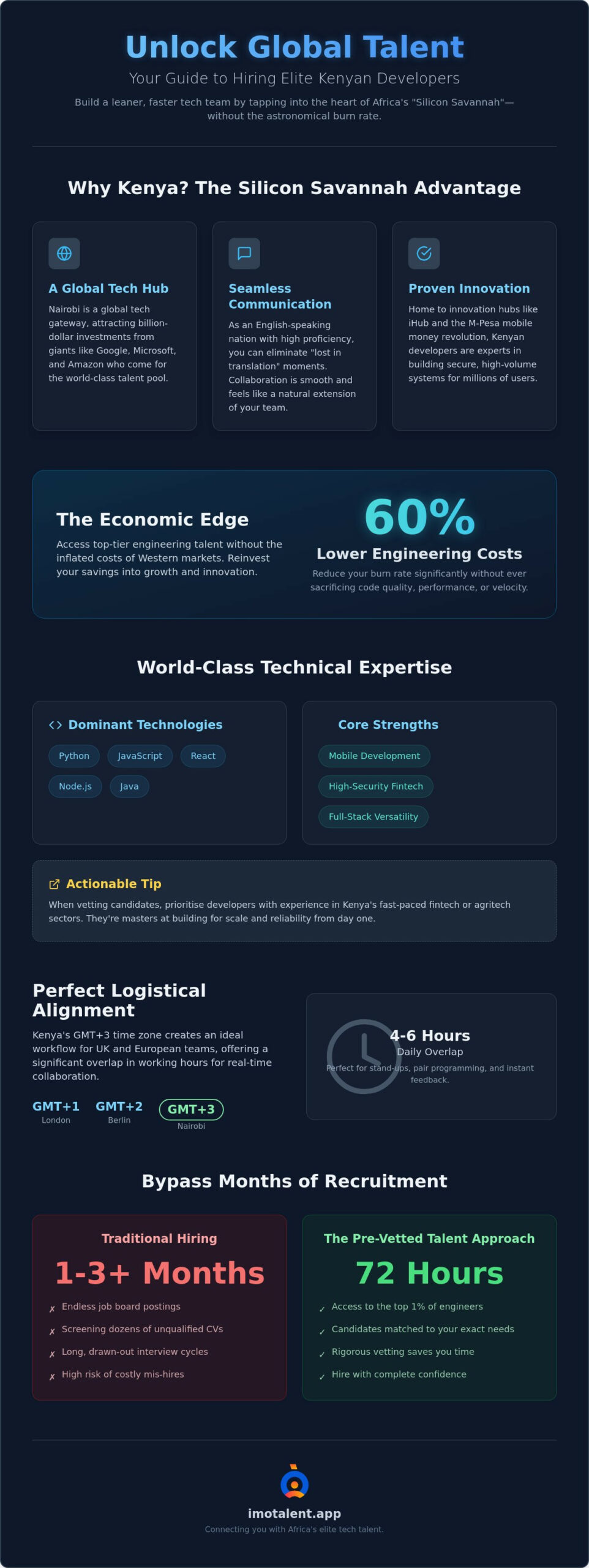
This guide explains how to access the Silicon Savannah to find elite engineers who can reduce your hiring costs by 60%. I’ll share the vetting frameworks used to identify the top 1% of talent and the logistics of seamless remote integration. We will look at how to hire a senior developer in days rather than months, ensuring your engineering standards stay high while your overheads drop significantly. It’s time to build a leaner, faster tech team with confidence.
Key Takeaways
- Understand why global giants like Google and Microsoft are investing in Nairobi and how this has created a world-class talent pool for your team.
- Identify the specific technical strengths of Kenyan engineers, particularly in mobile development and high-security fintech backends.
- Learn how a Kenya developers remote hire can reduce your engineering burn rate by 60% without sacrificing code quality or performance.
- Maximise team collaboration by leveraging Kenya’s GMT+3 time zone, which offers a perfect overlap for UK and European working hours.
- Discover how to bypass months of recruitment by using a pre-vetted matching process to find your next senior engineer in just 72 hours.
Why Kenya? Exploring the Silicon Savannah Tech Hub
Nairobi has earned its reputation as the “Silicon Savannah” for a reason. It is no longer just a regional player; it’s a global tech gateway. This transformation is anchored by massive government projects like the Konza Technopolis (Silicon Savannah), which aims to turn the country into a world-class technology hub. When you look at a Kenya developers remote hire, you aren’t just looking at a cost-saving measure. You’re tapping into an ecosystem that has attracted billion-dollar investments from the likes of Google, Microsoft, and Amazon. These giants didn’t set up engineering hubs in Nairobi by accident. They came for the talent.
One of the biggest hurdles in remote hiring is communication. Kenya solves this instantly. As an English-speaking nation, the level of proficiency is exceptionally high. This means no “lost in translation” moments during your morning stand-ups or in your Slack channels. This cultural and linguistic alignment makes Kenyan engineers feel like a natural extension of your team rather than a distant offshore resource. You’ll find that collaboration is seamless, allowing you to maintain high velocity without the friction typically associated with global hiring.
The Nairobi Tech Ecosystem
Nairobi’s tech scene is dense and high-energy. It’s home to legendary innovation hubs like iHub, where the next generation of software talent is forged. Much of this expertise was born from the mobile money revolution. Kenya’s M-Pesa didn’t just change how people pay for things; it created a massive pool of fintech experts who understand complex backend systems, security, and high-volume transactions. These developers are used to building products that must work perfectly for millions of users every single day.
Actionable tip: When you are vetting candidates, prioritise developers who have experience in the Kenyan fintech or agritech sectors. These industries are notoriously fast-paced and require engineers who can build for scale and reliability from day one.
Education and Global Standards
The talent pipeline is fueled by a robust education system that produces thousands of computer science graduates every year. Leading universities have modernised their curricula to match global demands, focusing on languages like Python, Java, and JavaScript. It’s also common to find developers who hold international certifications from AWS, Microsoft, or Google Cloud. This ensures they are already familiar with the modern tech stacks your team uses. Because of this rigorous background, a Kenya developers remote hire brings a pragmatic, problem-solving mindset to your project. The Kenyan tech talent pool is one of the most resilient and adaptable in Africa.
Technical Expertise: Top Skills Kenyan Developers Bring to Your Team
Kenyan engineers don’t just write code; they build solutions for complex, real-world problems. When you look for a Kenya developers remote hire, you are getting talent that is well-versed in the tech stacks that power modern enterprises. Because many of these developers have grown up in a startup-heavy environment, they tend to be “full-stack” by nature. They understand how the front-end talks to the back-end because they’ve often had to build both. This versatility is a massive asset for remote teams that need engineers who can own a feature from start to finish.
The consistent growth of Kenya’s ICT sector has fostered deep expertise in mobile development and high-security backends. Whether it’s Android, iOS, or cross-platform frameworks like Flutter, Kenyan devs are at the forefront of mobile innovation. This is largely due to the “mobile-first” reality of the African market. It has forced engineers to become experts in building lightweight, high-performance applications that work reliably under various conditions.
Dominant Programming Languages
Python, JavaScript (specifically React and Node.js), and Java are the heavy hitters in Nairobi. Python is the go-to for the burgeoning AI and data science scene, while JavaScript remains the king of web development. Java is still the backbone for many of the large-scale financial systems that operate across the continent. This means you can find developers who are comfortable with both legacy enterprise systems and modern, reactive web apps.
Actionable tip: If you need to scale quickly without the usual recruitment lag, you can use IMO Talent to find specialised React or Node.js developers in just 72 hours.
Emerging Tech: AI and Web3
Nairobi is seeing a surge in AI-driven startups, particularly in agriculture and healthcare. Kenyan developers are proactively learning how to integrate machine learning models to solve local challenges. Similarly, there is a strong interest in Web3 and blockchain technology. This isn’t just hype; it’s being used to create decentralised financial solutions for a population that is already comfortable with digital currency. The learning culture in the Kenyan tech community is incredibly proactive, with developers constantly upskilling through global bootcamps and certifications.
Beyond specific languages, Kenyan engineers are deeply familiar with Agile and Scrum methodologies. They use modern DevOps practices to ensure that code is not just written, but deployed reliably and securely. This alignment with global engineering standards means they can slot into your existing workflows without a steep learning curve. If you are ready to expand your capacity, consider how a vetted technical match from the region could accelerate your roadmap.
The Economic Edge: Quality Talent at a 60% Lower Cost
Scaling a tech team shouldn’t mean draining your capital. For many companies in the UK or US, the price of a local senior engineer has reached unsustainable levels. When you opt for a Kenya developers remote hire, you are choosing a path that offers roughly 60% cost savings without compromising on the calibre of the code. This isn’t about finding “cheap” labour. It’s about taking advantage of a globalised talent market where your currency goes much further. You are paying for expertise, not for the high cost of living in a western tech hub.
The disparity in costs is largely driven by the difference in living expenses. For example, a senior developer in Nairobi can live a high-end lifestyle on a salary that would barely cover rent and basic utilities in London or New York. This economic reality allows you to offer highly competitive local packages while still seeing a massive reduction in your burn rate. You can see a full breakdown in this cost of hiring developers in US vs Africa guide. By hiring remotely, you also eliminate the heavy overheads of premium office space, local insurance premiums, and on-site equipment maintenance.
Budgeting for Senior Talent
Comparing a senior developer in London to one in Nairobi reveals a stark difference in budget allocation. In London, you are often paying a premium just because the candidate lives in an expensive post code. In the Silicon Savannah tech hub, your investment goes directly into the engineer’s technical expertise. Because these salaries are elite by local standards, you benefit from what we call a “retention bonus.” Your hires are more likely to stay loyal to your company because you are providing them with a career-defining opportunity that far exceeds local market averages.
Actionable tip: Reinvest that 60% saving directly into your product roadmap. Use the extra capital to hire a second engineer or accelerate your marketing efforts to gain a competitive edge.
The ROI of Managed Placement
The real cost of hiring isn’t just the monthly salary; it’s the risk of getting it wrong. A bad hire can cost you months of progress and thousands in wasted resources. Using an efficient remote talent placement service mitigates this risk by ensuring every candidate is pre-vetted for technical skill and cultural fit. This isn’t a “gig” platform where you hope for the best. It’s a strategic partnership designed for long-term scaling. By focusing on quality from the start, you ensure that the lower initial cost translates into high-performance engineering over the long haul. A Kenya developers remote hire through a managed process offers a level of stability that freelance marketplaces simply cannot match.
Navigating the Logistics: Time Zones, Culture, and Connectivity
Practicality often outweighs potential when it comes to distributed teams. You can find the most gifted engineer in the world, but if they are offline when you need them, the partnership fails. A Kenya developers remote hire sidesteps these common offshore pitfalls by offering a geographical and infrastructural advantage that is hard to beat. Kenya operates on GMT+3, which provides a near-perfect alignment for UK and European businesses. Your morning stand-up is their mid-morning; your afternoon wrap-up is their evening. This synchronisation allows for real-time collaboration without the “delay-by-a-day” cycle that plagues teams hiring from Asia or the Pacific.
For US-based companies, particularly those on the East Coast, the overlap is equally manageable. There is a solid three to four-hour window where both teams are online simultaneously. This is the “golden hour” for high-bandwidth communication and complex problem-solving. Beyond the clock, the communication style in the Kenyan tech scene is direct and solution-oriented. You won’t find the passive “yes-culture” that often leads to project drift. Instead, you get engineers who are comfortable asking for clarification and suggesting better ways to implement a feature.
Seamless Time Zone Integration
To make the most of this overlap, schedule your core meetings between 10:00 and 14:00 UK time. This ensures everyone is at their peak productivity. For US teams, leaning into asynchronous work can actually become a secret weapon. While your local team sleeps, your Kenyan developers are moving the needle forward, essentially creating a 24-hour development cycle.
Actionable tip: Use tools like Slack for quick updates and Loom for video walkthroughs to bridge the time gap with US teams. Recording a five-minute video of a code review saves hours of back-and-forth emails the next day.
Reliability and Infrastructure
One of the most common myths is that African tech hubs suffer from poor connectivity. In reality, Nairobi and Mombasa boast high-speed fibre-optic internet that rivals many European cities. The professionals you’ll work with are well-aware of the requirements of global business. Most senior remote developers invest in secondary internet lines and backup power solutions, such as Uninterruptible Power Supplies (UPS) or inverters, to ensure they stay online even during rare local outages. Kenya has one of the most stable digital infrastructures in Africa, making it a reliable choice for long-term engineering partnerships.
If you are ready to stop worrying about logistics and start shipping code, it’s time to find a partner who understands the region. You can hire a vetted Kenyan developer through a process that handles all the heavy lifting for you.
Hire Elite Kenyan Developers in 72 Hours with IMO Talent
Traditional recruitment is broken. It’s often slow, expensive, and filled with uncertainty. When you need to scale your engineering capacity, you shouldn’t have to wait months to find the right fit. A Kenya developers remote hire through IMO Talent changes the equation entirely. We’ve built a streamlined, four-step process that moves at the speed of your business. We handle the heavy lifting of sourcing and initial screening, allowing you to focus on what matters: building your product. Our benchmark is simple. We aim to present you with qualified, pre-vetted candidates within just 72 hours.
This high-velocity approach doesn’t cut corners. We act as an elite facilitator, matching your specific technical requirements with the top 1% of talent in the Silicon Savannah. Whether you need a specialist in React, a backend expert for your fintech platform, or a full-stack engineer to lead a new feature, our matching engine is designed for precision. We don’t just send over a list of CVs. We provide a curated selection of professionals who are ready to integrate into your team and start contributing on day one.
The IMO Talent Vetting Process
Our vetting process is rigorous and multi-layered. We start with deep technical assessments and thorough portfolio reviews to ensure every developer has the “hands-on” experience they claim. But technical skill is only half the battle. We also conduct intensive soft-skills and communication vetting. We ensure that every engineer we place has the professional assertiveness and English proficiency required for high-level remote collaboration. This dual-focus approach significantly reduces the risk of a bad hire and ensures a long-term cultural fit.
Actionable tip: To hit that 72-hour matching target, start with a highly specific job description. Clearly outline your must-have tech stack, your team’s communication style, and the immediate projects the developer will tackle. The more precise you are, the faster we can find your perfect match.
Scaling Your Team Strategically
Hiring from Kenya shouldn’t be a one-off experiment. It’s a powerful long-term strategy for any tech-forward company. By choosing to hire remote developers from Africa, you’re building a leaner, more resilient organisation. You get the benefit of 60% cost savings and access to a talent pool that is eager to grow with your company. IMO Talent doesn’t stop at the placement; we provide ongoing support and talent management to ensure the relationship remains productive and professional.
The tech landscape of 2026 demands agility. You can’t afford to be held back by local talent shortages or astronomical hiring costs. It’s time to leverage the globalised economy and build the team your product deserves. Ready to hire? Get started with IMO Talent today.
Build Your Future Team in the Silicon Savannah
The global tech landscape has shifted. You no longer need to settle for local talent shortages or inflated salaries that drain your runway. Tapping into Nairobi’s elite engineering pool gives you a competitive edge that combines technical excellence with massive operational efficiency. By making a Kenya developers remote hire, you gain access to senior-level expertise while reducing your hiring costs by 60%. This isn’t just about saving money; it’s about scaling your product with speed and reliability.
You don’t have to navigate the logistics alone. From technical vetting to end-to-end recruitment management, the process is designed to be seamless and high-velocity. Before you reach out, refine your specific technical requirements to ensure you get the perfect match from the first interview. If you are ready to stop searching and start building, take the next step today.
Access the top 1% of Kenyan tech talent in 72 hours
Your next senior engineer is ready to ship code. Let’s get them on your team and start building the future together.
Frequently Asked Questions
Is it difficult to manage time zone differences when hiring developers in Kenya?
No, the time zone is actually one of the biggest advantages. Kenya operates on GMT+3, which provides a near-perfect overlap with the UK and Europe. For US East Coast teams, there’s a convenient four-hour window for real-time collaboration. This makes a Kenya developers remote hire much easier to manage than teams in Asia or Eastern Europe.
How do I handle payments and contracts for remote Kenyan developers?
You don’t have to navigate local labour laws or international banking hurdles alone. A dedicated partner like IMO Talent handles the end-to-end recruitment and management process. This means we take care of the contracts, local tax compliance, and monthly payments, so you can focus entirely on your product roadmap.
What is the typical English proficiency of Kenyan software engineers?
English is the official language of instruction and business in Kenya, so proficiency is exceptionally high. You’ll find that developers are articulate and comfortable leading technical discussions or writing complex documentation. There’s virtually no language barrier, which ensures that your morning stand-ups and Slack threads remain productive and clear.
How does the cost of hiring in Kenya compare to the UK or US?
You can achieve roughly 60% cost savings when compared to hiring senior talent in London or New York. These savings come from the lower cost of living in Nairobi rather than a reduction in skill. You’re able to offer a highly competitive local salary that attracts the top 1% of talent while significantly reducing your company’s burn rate.
What technical stacks are most common among Kenyan developers?
Python, JavaScript (React and Node.js), and Java are the dominant languages in the region. Because of Kenya’s history with mobile money innovation, there’s also a massive pool of experts in Android, iOS, and secure fintech backends. Most developers are “full-stack” by nature, having built products for the fast-paced local startup ecosystem.
How does IMO Talent ensure the quality of the developers in their pool?
Every candidate undergoes a rigorous pre-vetting process that covers technical skills, portfolio history, and soft skills. We don’t just check if they can code; we ensure they can collaborate effectively in a remote environment. This high-level screening means we only present you with elite professionals who are ready to ship production-ready code.
What happens if a remote hire is not a good fit for my team?
If a hire isn’t working out, we manage the entire transition and replacement process for you. Because we provide ongoing talent management, we stay close to both you and the developer to identify any friction early. Our goal is to ensure your team’s momentum isn’t stalled by a cultural or technical mismatch.
Do Kenyan developers have reliable internet and electricity for remote work?
Yes, major tech hubs like Nairobi have world-class fibre-optic infrastructure. Professional remote engineers are also very proactive about their setups. They typically invest in secondary internet lines and backup power systems, such as inverters or UPS units, to ensure they stay online and productive regardless of local conditions.
