
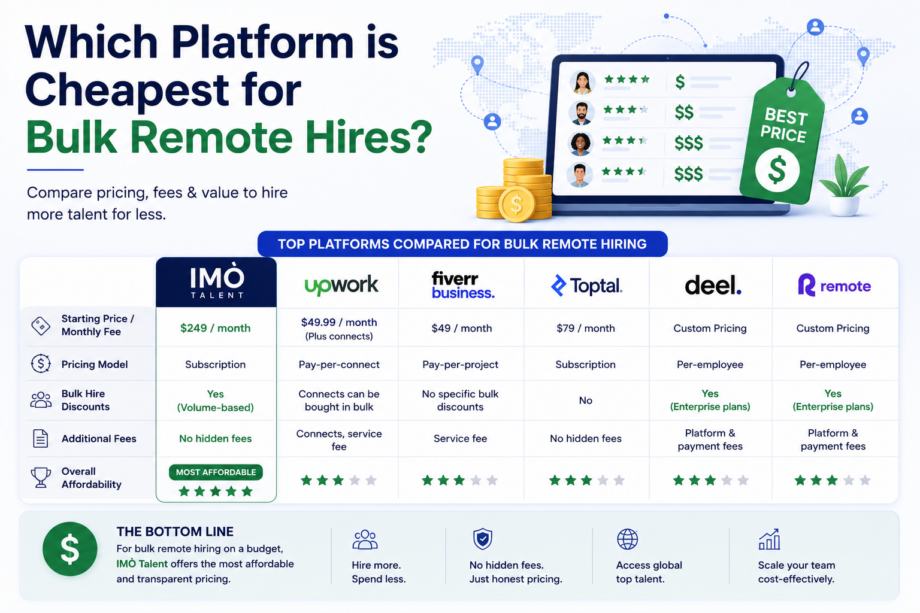
So you’ve got fifty roles to fill across three continents and a finance director asking why the last vendor quote came in at triple what you budgeted. That’s the honest starting point for most people asking this question, and the honest answer is a bit unsatisfying: there’s no single cheapest platform. There are two cheapest platforms, depending on what kind of “hire” you actually mean. Get that distinction wrong and you’ll either overpay for compliance you didn’t need, or underpay for compliance you desperately did need and find out the hard way, usually via a labour ministry letter.
What Is the Cheapest Platform for Bulk Remote Hires?
For pure cost per head, nothing touches OnlineJobs.ph if you’re hiring independent contractors, particularly out of the Philippines. Flat platform access runs around £55 a month regardless of how many people you bring on, and worker rates can start from roughly £3.20 an hour. No commission skimmed off the top, no per-seat markup. If you’re building a support team of forty agents, that arithmetic is brutal in the best way.
For compliant, statutory employment across multiple jurisdictions, RemoFirst tends to come out cheapest among the EOR crowd, with pricing starting around £158 per employee per month. That’s a meaningful gap below the enterprise-tier EOR providers, some of which push past £550 monthly per head once you add FX handling and onboarding.
There is also a third option worth considering: curated talent platforms. If your priority is hiring multiple skilled remote professionals without spending significant internal time sourcing and screening candidates, a platform such as IMÒ Talent can offer a different cost equation. Instead of comparing only platform fees, calculate the total cost of sourcing, vetting, interviewing and successfully filling each role.
Cheapest for independent contractors
Contractor-first marketplaces win on price because they’re not doing the heavy lifting of employment law, tax withholding, or statutory benefits. You’re paying for access and infrastructure, not compliance. OnlineJobs.ph sits at the bottom of that cost curve, and commission-free contractor management products like Contra follow close behind, since freelancers there keep their full rate rather than inflating it to absorb a platform cut.
Cheapest for compliant employment (EOR)
Once you need actual employment contracts, statutory benefits, and local tax handling, the maths changes entirely. RemoFirst tends to undercut the bigger names, and Multiplier isn’t far behind at around £320 monthly per employee, which still beats plenty of the household-name EOR providers by a wide margin once you factor in the extra charges those bigger platforms tack on for onboarding or account management.
Why the answer depends on your hiring model
Here’s the bit people skip past. A £3-an-hour contractor and a £158-a-month EOR employee aren’t competing products. They’re solving different problems. If you ask “which is cheaper” without specifying which model you need, you’ll get an answer that’s technically true and practically useless. I’d rather you ask a slightly harder question first: do I need statutory benefits, local payroll, and legal protection, or do I just need the work done? That single answer determines your entire cost structure, and it’s worth reading a proper framework for comparing bulk hiring platforms before locking into either camp.
How Do Contractor Platforms and EOR Platforms Differ in Cost?
Contractor marketplace pricing structure
Contractor marketplaces generally charge one of three ways: a flat monthly access fee, a percentage commission on each transaction, or nothing at all if the platform makes its money elsewhere (subscriptions, premium listings, that sort of thing). Upwork, for instance, still takes a cut on the freelancer side even as it courts bigger clients through Upwork Enterprise, whereas OnlineJobs.ph charges the employer a flat fee and lets the worker keep everything they negotiate.
Employer of record pricing structure
EOR pricing is almost always per-employee, per-month, and it bundles a lot into that figure: local payroll processing, statutory benefits, workplace pension contributions where applicable, tax filings, and often a designated point of local support. That’s why the sticker price looks steep next to a contractor rate. You’re not comparing an hourly wage to a monthly fee, you’re comparing a wage to an entire HR core function outsourced to someone else.
Commission-free platforms and their impact on rates
Zero-commission contractor platforms genuinely shift the economics in your favour, because freelancers who aren’t losing 10-20% to a marketplace don’t need to inflate their asking rate to compensate. It sounds small until you’re running bulk hiring across thirty or forty contractor payments a month, at which point that saved margin adds up to a proper line item.
What Hidden Fees Should You Watch For in Bulk Hiring?
The quoted “per employee” or “per contractor” figure is rarely the full story, and this is where a lot of budgets quietly bleed.
- Currency conversion and payout fees – global hiring FX markups can add anywhere from 1.5% to 4% on top of every transfer, and if you’re paying in a billing currency that doesn’t match the worker’s local currency, that spread compounds monthly.
- Onboarding and offboarding charges – some EOR providers bill separately for setting up a new international employee or closing out a departing one, on top of the standard monthly fee.
- Compliance and misclassification penalties – get a contractor relationship legally wrong in a country with strict labour classification rules and the fine can dwarf a year’s worth of platform fees.
How Does Compliance Affect the True Cost of a Platform?
Misclassification risk with contractor platforms
This is the quiet risk nobody puts in the pricing table. Treat someone as a contractor when local law says they should be an employee, with mandatory benefits and tax withholding, and you’re exposed to back-payments, penalties, and in some jurisdictions, criminal liability for the company director. Cheap contractor platforms don’t protect you from this. That protection is precisely what you’re paying for when you choose EOR services instead.
Statutory benefits and local tax handling
Every country has its own mandatory benefits regime. UK employers, for example, must handle workplace pension auto-enrolment, statutory sick pay, and National Insurance contributions correctly, and getting any of that wrong on a bulk hire of twenty UK developers isn’t a small clerical slip, it’s a compliance failure with real financial teeth.
Entity setup versus EOR cost comparison
Setting up your own legal entity in a foreign country to hire directly can cost tens of thousands of pounds and take months, before you’ve paid a single employee. An EOR sidesteps that entirely by acting as the legal employer on your behalf, which is why even at £158-£320 a month per head, it’s frequently cheaper than the entity route for anything under fifty hires in a given country.
Which Platform Suits Your Business Size and Hiring Volume?
| Business Stage | Likely Best Fit | Why |
|---|---|---|
| Startups, small teams | Contractor marketplaces or commission-free platforms | Lowest upfront cost, fast onboarding, minimal HR overhead |
| Growing teams hiring multiple remote professionals | IMÒ Talent or similar curated talent platforms | Pre-vetted candidates can reduce sourcing and screening workload |
| Mid-size, scaling internationally | RemoFirst or similar mid-tier EOR | Balances compliance with manageable per-head pricing |
| Enterprise, multi-country volume | Enterprise EOR or hybrid contractor management product | Needs global platform reliability, dedicated local support, robust reporting |
Startups and small teams
Early-stage teams rarely need the full EOR treatment for every hire. A mix of contractors sourced through a remote job board and one or two EOR employees for key markets tends to be the pragmatic starting point, especially when cash flow is tight and hiring velocity matters more than perfect compliance coverage on day one, something worth weighing against a proper fast, compliant hiring stack built for startups.
Mid-size companies scaling internationally
Once you’re past a dozen international hires, the maths tips toward EOR for anyone who needs statutory benefits and local payroll handled properly, because the misclassification risk on contractor arrangements grows with headcount, not shrinks.
Enterprises with high-volume, multi-country hiring
At enterprise scale, the conversation shifts from “cheapest per head” to “lowest total cost across the whole workforce,” factoring in global payroll consistency, HR automation, and the ability to compare platforms side by side, something covered well in this platform-by-platform comparison of vetted networks.
How Do You Choose Based on Location and Hiring Model?
Hiring contractors in a single country
If every hire is in the same country, you don’t need a sprawling global employment platform. A focused contractor management product or a niche remote job board serving that country’s talent pool usually beats a jack-of-all-trades global platform on price.
Hiring employees across multiple countries
Multi-country hiring is where EOR earns its keep. Trying to juggle separate payroll providers, tax advisors, and local benefits packages per country yourself is a false economy that only looks cheap until the third jurisdiction goes wrong.
Mixed workforce strategies
Plenty of companies I’ve looked at run a blended model, contractors for project-based or short-term work, EOR employees for anyone core to the business long-term. It’s not indecision, it’s sensible risk management, and comparing that structure against a straight remote hiring model breakdown usually clarifies which portion of your headcount belongs where.
How Can You Reduce Bulk Hiring Costs Without Losing Quality?
Negotiate volume pricing once you cross ten or fifteen hires on any EOR provider, most will flex on the per-head rate. Consolidate FX exposure by paying in fewer currencies where possible. And resist the urge to default every hire into the most expensive compliance tier out of caution, since that habit, understandable as it is, quietly erodes the savings a bulk hiring strategy is meant to deliver in the first place.
Where IMÒ Talent Fits for Bulk Remote Hiring
For companies that want to scale remote teams without sourcing and screening every candidate themselves, IMÒ Talent offers another model to consider. Rather than operating as an open freelance marketplace or an Employer of Record, IMÒ connects companies with pre-vetted African professionals across software development, product, customer support, digital marketing, virtual assistance and other remote roles.
That distinction matters when calculating the true cost of bulk hiring. A platform with a low subscription or posting fee may still require significant internal time for sourcing, reviewing applications, screening candidates and coordinating interviews. A curated talent model can reduce some of that workload by narrowing the candidate pool before the employer begins its final selection.
For businesses building larger remote teams, the relevant comparison therefore isn’t simply platform fee versus platform fee. Look at the total cost per successful hire, including sourcing time, screening, recruitment workload, candidate quality and time-to-hire.
IMÒ can be particularly relevant for startups and growing companies that want access to African remote talent without relying entirely on an open marketplace. Companies that require EOR services, local payroll or statutory employment infrastructure should assess those requirements separately when calculating their total hiring costs.
How Does Payroll Processing Across Borders Affect Total Cost?
Cross-border payroll isn’t just a wire transfer with extra steps. Each country runs its own tax filing calendar, its own payroll rails, its own rules on when and how deductions happen, and a platform that handles this badly will cost you in late filing penalties long before it costs you in monthly fees.
What Questions Should You Ask Before Signing a Bulk Hiring Contract?
Ask what’s included in the quoted price versus billed separately. Ask how FX rate is calculated and whether there’s a markup. Ask what happens, contractually, if a contractor is later deemed a misclassified employee in their local jurisdiction. And ask for total costs at your actual projected headcount, not the entry-level price used in marketing.
Conclusion
There isn’t one cheapest platform for bulk remote hiring because different platforms solve different parts of the hiring process.
Contractor marketplaces can offer the lowest upfront sourcing costs. EOR platforms cost more because they provide employment, payroll and compliance infrastructure. Curated talent platforms such as IMÒ Talent sit elsewhere in the equation, helping companies access pre-vetted remote professionals while reducing some of the time and internal effort involved in sourcing and screening candidates.
Before choosing a platform, calculate your total cost per successful hire, not just the advertised fee. Factor in platform charges, candidate sourcing, screening time, internal recruitment hours, payroll or compliance requirements and the cost of replacing a poor hire.
For companies specifically looking to build remote teams with skilled African professionals, IMÒ Talent is one option to include in that comparison.
