

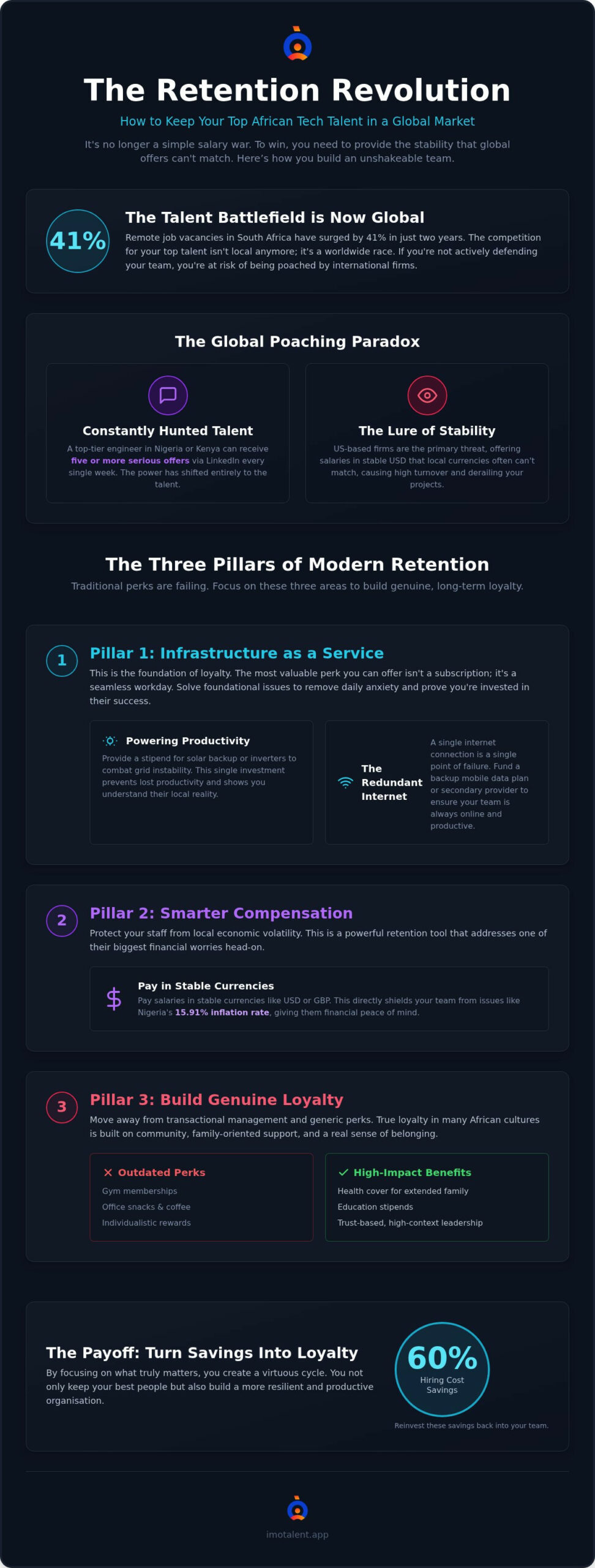
Did you know that remote job vacancies in South Africa have surged by 41% over the last two years? The competition for top-tier talent across the continent is no longer local; it’s global. It’s incredibly frustrating to spend weeks vetting a brilliant engineer only to lose them six months later to a US firm paying in USD. You want a stable, high-performing team, but the reality of high turnover and infrastructure hurdles makes remote worker retention Africa a constant challenge for even the most seasoned hiring managers.
The good news is that you don’t have to play a losing game of salary wars to keep your best people. This guide will show you how to build genuine loyalty and protect your team from poaching by using actionable strategies that go far beyond a simple monthly payment. We’ll explore how to offset inflation-driven pressure, solve connectivity gaps, and use your 60% hiring cost savings to create a work culture that talent simply won’t leave. From navigating Nigeria’s 15.91% inflation rate to leveraging new digital nomad visas in Kenya, you’re about to discover how to turn a remote role into a long-term career for your team.
Key Takeaways
- Treat reliable power and internet redundancy as core employee benefits to ensure your team remains productive and engaged.
- Protect your staff from local currency volatility by paying salaries in stable currencies like USD or GBP to match global market standards.
- Discover why remote worker retention Africa depends more on providing “Infrastructure as a Service” than on traditional office-style perks.
- Reinvest your 60% hiring cost savings into local stipends and performance monitoring to spot disengagement signals before they lead to resignations.
Why Remote Worker Retention in Africa is Different in 2026
The African tech market has fundamentally shifted. It’s no longer a “hidden gem” where savvy recruiters find undervalued talent; it’s a global battlefield. In 2026, the concept of remote worker retention Africa has been redefined. It is now the strategic effort to provide absolute stability for your team amidst local economic volatility and aggressive international competition. If you aren’t actively defending your borders, you’re already losing.
If you’re still offering a standard UK-style benefits package, you’re likely missing the mark. Perks like gym memberships or office snacks don’t resonate with a professional in Lagos who is dealing with a 15.91% inflation rate. These workers aren’t looking for “perks.” They’re looking for a partner who understands their local reality. Poaching by US-based firms is the primary threat to your team’s stability, as these companies often lure talent with the promise of pure USD salaries that local currencies simply can’t match. Understanding global remote work trends is essential, but applying them without local context is a recipe for high turnover.
The Global Poaching Paradox
Senior developers in hubs like Nigeria and Kenya are currently some of the most hunted professionals in the world. It is now standard for a top-tier engineer to receive five or more serious LinkedIn reaches every single week. The power dynamic has flipped. Talent has moved from being “happy to have a global job” to “seeking the highest-value global offer.” In 2026, this constant talent drain means project timelines are frequently derailed by sudden resignations, forcing companies to restart the expensive recruitment cycle every few months.
Cultural Nuances in Professional Loyalty
Building loyalty in African tech hubs requires a move away from transactional management. In many African cultures, the concept of community and family-oriented benefits carries far more weight than individualistic rewards. If your benefits package doesn’t account for the worker’s wider support system, it won’t build long-term stickiness. You need to think about health cover for extended families or education stipends rather than just a pension match.
Visibility within the organisation is another critical factor. Many remote workers feel like isolated contractors rather than core team members. To prevent this, you must implement trust-based leadership that prioritises high-context communication. This means moving beyond Slack messages and occasional emails to build genuine relationships. When a worker feels seen and valued by their leadership, they are far less likely to respond to that next recruiter in their inbox. It’s about creating a sense of belonging that a slightly higher salary elsewhere can’t easily replace.
Infrastructure as a Service: The Foundation of Loyalty
In 2026, the most valuable perk you can offer isn’t a subscription to a meditation app or a branded hoodie. It’s electricity. For a developer in Lagos or a business analyst in Cape Town, the constant threat of power cuts or “load shedding” is a massive psychological and professional stressor. When you step in to solve these foundational issues, you’re doing more than just keeping the lights on. You’re building a deep psychological contract. By providing the tools for a seamless workday, you prove that you’re invested in their success, not just their output. This level of support is a primary driver for remote worker retention Africa, as it removes the daily anxiety of infrastructure failure.
Linking infrastructure support directly to worker well-being is a strategy that many global firms overlook. When an employee doesn’t have to worry about their laptop dying mid-sprint or their internet dropping during a client presentation, their focus shifts entirely to high-level work. This leads to a measurable increase in output and a significant reduction in burnout. Supporting a “pro-workspace” setup creates a sense of permanence and professional respect that makes your company stand out in a crowded market.
Powering Productivity: Solar and Inverters
Grid instability is a reality that can cripple meeting attendance and destroy sprint velocity. In some regions, power can be out for hours or even days without warning. An actionable tip for any serious employer is to provide a dedicated stipend for solar backup systems or high-capacity inverters. This investment usually pays for itself within six months simply by avoiding the cost of lost productivity. It’s a proactive move that ensures your team remains operational while others are left in the dark. If you want a “set and forget” approach to these logistics, talent management that actually works can handle the administrative heavy lifting for you.
The Redundant Internet Strategy
Relying on a single Internet Service Provider (ISP) in major African tech hubs is a gamble. One ISP is never enough. The smartest global employers now mandate and fund dual-provider setups, such as a primary fibre connection paired with a 5G mobile link or Starlink. While the global average cost for 1GB of data is around $2.59, prices vary wildly, with Zimbabwe reaching as high as $43.75 per GB. Providing a £50 monthly internet stipend ensures your team has the best possible connectivity without it eating into their take-home pay. The cost-benefit ratio is undeniable; paying for redundancy is far cheaper than losing a day of senior engineering time.
Compensation Strategies: Beating Currency Volatility
Currency fluctuations in markets like Nigeria or Kenya can effectively cut a remote worker’s purchasing power in half almost overnight. In June 2026, Nigeria’s inflation rate remained high at 15.91%, while Malawi faced a staggering 21.1%. When local prices soar and the local currency devalues, a “competitive” salary can quickly become a struggle. If you want to master remote worker retention Africa, you must address the financial anxiety caused by economic instability. Paying a flat rate without considering local context is the fastest way to lose your best engineers to a US firm offering a stable USD alternative.
The “Inflation Buffer” is no longer a luxury; it’s a retention requirement. You should review salaries at least twice a year in high-volatility regions to ensure your team’s quality of life doesn’t drop. While you are likely enjoying a significant cost reduction compared to UK or US hiring, reinvesting a fraction of those savings into currency-protected pay will make you an elite employer. It’s about providing a floor of stability that allows your team to focus on their code rather than their bank balance.
The Power of Hard Currency
Paying in USD or GBP is the single strongest retention magnet in your arsenal. It provides a level of psychological security that local currencies simply cannot offer in 2026. This approach protects your staff from the “hidden pay cut” of devaluation. You’ll need to navigate local tax compliance to ensure the worker receives the full value of their contract, but the loyalty you buy in return is invaluable. When a developer knows their mortgage or school fees are safe regardless of local market swings, they’re far less likely to look at outside offers.
Localised Benefits that Actually Matter
Global “travel” insurance is often a lazy solution that fails to meet the needs of long-term staff. It usually doesn’t cover routine care or local specialists in cities like Nairobi or Cairo. Instead, invest in localised private healthcare that covers both the employee and their immediate family. This is a “sticky” benefit because it provides a safety net that is difficult to replace. Consider these additional high-value strategies:
- 13th-month pay: This is a common tradition in many African regions and is highly valued as a year-end bonus.
- Professional development budgets: Fund specialised certifications that help your team grow within your organisation.
- Quarterly reviews: In countries like Rwanda (13.6% inflation) or Burundi (18.4%), small, frequent adjustments are better than one large annual raise.
By tailoring your compensation to the specific economic pressures of each region, you create a workplace that feels both fair and protective. This isn’t just about the money; it’s about proving you understand the world your team lives in.
The 2026 African Remote Retention Checklist
Securing your team for the long haul requires a move from reactive fixes to a systematic audit of their daily experience. In 2026, remote worker retention Africa is won by the employers who treat their remote staff exactly like their HQ-based peers. Use this checklist to identify where your current strategy might be leaking talent and take immediate corrective action.
- Infrastructure Audit: Confirm you are actively funding the power and data redundancy discussed earlier.
- Compensation Review: Ensure pay adjustments match the 15%+ local inflation rates seen in markets like Nigeria or Malawi.
- Career Pathing: Map out a clear promotion route that the worker can realise within 12 to 18 months.
- Social Integration: Schedule quarterly in-person meetups or regional co-working hubs to build social glue.
- Managed Support: Use a dedicated platform to handle the complex administrative and compliance hurdles.
Building Social Capital Remotely
Remote work shouldn’t mean isolation. Building social capital is about creating “non-work” channels where your team can celebrate local holidays, cultural achievements, and personal milestones. Host regional co-working days in hubs like Accra, Nairobi, or Lagos to build bonds that Zoom calls cannot replicate. When integrating African talent into UK or US time zones, prioritise asynchronous work to prevent burnout. Your team shouldn’t be working until midnight just to catch a stand-up call; instead, build a culture that respects their local clock.
Career Visibility and Growth
African professionals often fear the “contractor ceiling”. This is the persistent worry that their career has a hard limit because they aren’t physically present in your head office. Shatter this perception by creating formal mentorship pairings between your HQ leadership and your remote African talent. This visibility ensures they don’t feel like an isolated resource but like a future leader within your firm. For a deeper dive into high-performance integration, read our guide on Managing Remote African Developers.
Scaling a global team is complex, but you don’t have to navigate these logistics alone. You can secure your team’s loyalty with IMO Talent and let our experts handle the ongoing management while you focus on growth.
How IMO Talent Secures Your Long-Term Retention
Most recruitment agencies consider their job done the moment a contract is signed. We don’t. At IMO Talent, we understand that placement is only the first step in a much longer journey. True remote worker retention Africa requires active, ongoing management to bridge the gap between global expectations and local realities. We act as your boots on the ground, providing a layer of stability that allows your team to thrive without the administrative friction that often leads to turnover.
Our local expertise is your greatest asset. We’ve developed a keen eye for “disengagement signals” that overseas managers might miss. Whether it’s a subtle shift in communication style or a drop in participation during social channels, our team identifies these red flags early. By mediating these moments before they escalate into resignations, we ensure your engineering or business teams remain stable and high-performing. We also handle the heavy lifting of local compliance and administrative support, removing the legal headaches that often complicate international hiring.
Ongoing Talent Management Subscriptions
Our monthly management subscription is designed to be a “set and forget” solution for global employers. This isn’t just about payroll; it’s about ensuring every professional stays integrated, productive, and happy. Our Talent Success Managers serve as dedicated mediators, helping to navigate cross-cultural communication and ensuring that your remote staff feel like core members of your organisation. This ongoing support is a critical component of efficient remote talent placement, as it protects your initial investment by significantly extending the employee lifecycle.
Ready to Build a Stable Team?
The 60% cost saving you achieve by hiring in Africa shouldn’t just sit on your balance sheet. It’s the fuel that powers a superior retention strategy. When you reinvest a portion of those savings into the infrastructure, hard-currency pay, and managed support we’ve discussed, you create a team that is virtually unpoachable. Our vetting process is rigorous, filtering not just for technical skill but for long-term commitment. This is our “Retention Guarantee” to you: we find the talent that wants to grow with your business.
Don’t leave your team’s stability to chance in a hyper-competitive market. It’s time to move beyond simple hiring and start building a legacy of high performance. Book a strategy call with us today to see how we can help you scale with confidence. Hire and Retain Top African Talent with IMO Talent and secure the future of your remote workforce.
Secure Your Competitive Edge in the African Tech Market
Retention in 2026 isn’t just about the number on a payslip. It’s about providing the stability that local infrastructure and volatile economies often cannot. By treating reliable power and hard-currency payments as foundational benefits rather than optional extras, you move from being a temporary employer to a long-term partner. Mastering remote worker retention Africa requires this shift in perspective; you’re building a professional sanctuary that protects your talent from the constant noise of global poaching.
You have a unique opportunity to scale your team strategically while reinvesting your 60% hiring cost savings into the very people who drive your success. With our 72-hour placement turnaround for vetted tech talent and comprehensive ongoing management, you don’t have to navigate these cultural and administrative complexities alone. We handle the local compliance and disengagement signals so you can focus on hitting your next milestone with a team that isn’t looking for the exit. It’s time to stop the cycle of turnover and start building a high-performing, loyal workforce that lasts.
Secure your remote team’s future—hire and manage with IMO Talent. Your elite team is ready; let’s make sure they stay that way.
Frequently Asked Questions
How much should I pay for a remote internet stipend in Africa?
A monthly stipend of £40 to £60 is the current benchmark for high-performing teams. This amount allows your staff to maintain two separate internet connections, which is a necessity given the infrastructure challenges in many regions. Since mobile data costs can reach $43.75 per GB in places like Zimbabwe, a dedicated allowance ensures your team doesn’t hesitate to use high-bandwidth video for meetings.
Is it better to pay remote African workers in USD or local currency?
You should always pay in a stable hard currency like USD or GBP to protect your team from local volatility. With inflation hitting 15.91% in Nigeria and 21.1% in Malawi in mid-2026, local salaries lose their value rapidly. Hard currency pay is the single most effective tool for remote worker retention Africa, as it provides the financial security talent needs to stay loyal.
What are the most common reasons remote developers in Africa leave their jobs?
Poaching by US firms and infrastructure-related burnout are the primary drivers of turnover. Senior developers often receive multiple weekly offers on LinkedIn promising higher USD salaries. Additionally, if an employer doesn’t support their need for backup power and data, the daily stress of trying to stay online during grid failures eventually leads them to seek a more supportive company.
How do I handle public holidays for a remote team across different African countries?
The best practice is to follow the worker’s local holiday calendar to prevent burnout and show cultural respect. If your team is spread across Nigeria, Kenya, and Egypt, use a shared calendar to track their specific national dates. You can also offer “floating holidays” that allow staff to choose between local dates or your UK bank holidays based on their personal preference.
Should I provide hardware like laptops, or a budget for them?
Providing a hardware budget for local purchase is far more efficient than shipping gear from the UK. International shipping often involves massive customs delays and high import duties that can double the cost. A budget of £1,500 every three years allows your team to buy high-spec gear locally with a valid warranty, which simplifies repairs and keeps them productive.
Can I offer healthcare benefits to remote workers in Nigeria or Kenya from the UK?
Yes, but you should use local private providers rather than UK-based plans or general travel insurance. Global travel policies rarely cover routine care or local specialists in cities like Nairobi or Lagos. By partnering with a local Health Maintenance Organisation (HMO), you ensure your team and their families have actual access to the best hospitals and clinics in their own cities.
How often should I fly my remote African team to our UK headquarters?
Aim for an HQ visit once every 12 to 18 months to build deep social capital. While these trips are excellent for bonding, they’re logistically heavy. It’s often more effective to supplement these with quarterly regional “hubs” in cities like Accra or Cape Town. These local meetups are easier to coordinate and provide the regular face-to-face time needed to keep a team feeling integrated.
What is the “13th-month” salary, and is it mandatory?
The 13th-month salary is a customary year-end bonus equivalent to one month’s pay, usually distributed in December. While it isn’t legally mandatory in every country, it’s a deeply ingrained professional tradition across much of the continent. Budgeting for this as a standard part of your package is a powerful way to show you respect local norms and value your team’s hard work.
