
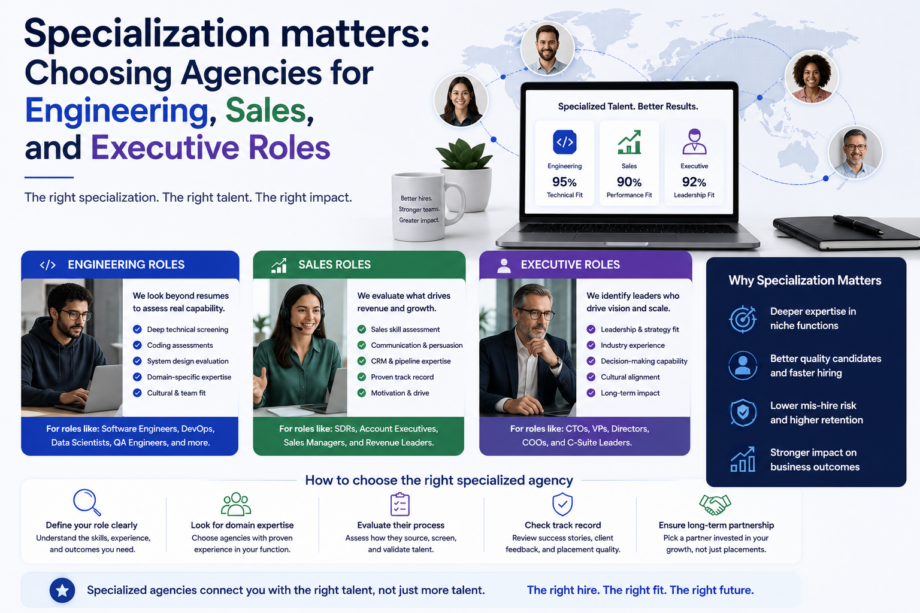
Here’s a scenario I’ve watched play out a dozen times with founders and hiring managers alike. A company needs to hire a senior engineer, maybe a VP of Engineering, and someone on the team says “let’s just use the same recruiter we used for the last five developer hires.” Six weeks later, the search has produced nothing but mid-level candidates who look great on paper but have never run a team, never owned a roadmap, never sat in a room with a board. That’s not the recruiter’s fault. It’s a mismatch of tool to task, and it happens constantly because most people assume all recruitment agencies function the same way.
They don’t. Engineering recruitment and executive search are cousins, not twins, and the differences between them determine whether your next hire shows up in three weeks or three months, whether they cost you a flat contingency fee or a hefty retainer, and whether they stick around for two years or ten. Getting this distinction right, before you sign a contract or fire off a job spec, saves an enormous amount of wasted time. And frankly, wasted money too.
How Do Engineering Recruitment and Executive Search Actually Differ?
The honest answer is that they differ in almost everything except the word “recruitment” in their name. Engineering recruitment agencies are built for velocity, they exist to move volume through a pipeline, matching skilled professionals against active job requisitions. Executive search firms operate on an entirely different logic, one built around discretion, market mapping, and the pursuit of people who aren’t even looking for a job. Industry analysts at Stanton Chase have made this distinction a central plank of how they describe the difference between the two models, and the framing holds up: one is transactional, the other is strategic.
Sourcing Model and Candidate Pool
A traditional engineering recruiter works from active pools. Job boards, applicant tracking systems, referral networks, LinkedIn searches filtered by keyword. The candidates in this pool are, by definition, looking. They’ve updated their resumes, they’re scrolling job ads on a Tuesday night, they want to move. This is a perfectly good model for filling design engineer roles, field service engineer positions, or a wave of mid-level hires needed for a product push.
Executive search inverts this completely. The best CTOs, the sharpest VPs of Engineering, are rarely applying anywhere. They’re busy running things. So the search firm’s job becomes one of direct outreach, calling, persuading, courting. It’s headhunting in the literal sense, and it demands a different skill set entirely from the recruiter doing the calling.
Fee Structure and Payment Terms
Here’s where the money conversation gets real. Engineering recruitment agencies typically work on contingency, meaning they get paid only if their candidate is hired, usually somewhere between 15 to 25 percent of first-year salary. Executive search firms almost always work retained, meaning you pay a portion upfront (often a third), another portion at milestone, and the rest on placement, regardless of how long the search drags on. According to industry data compiled by Top Exec Recruiting, retained fees for CTO-level and VP of Engineering searches commonly land between 25 and 35 percent of total first-year compensation, a number that reflects both the scarcity of candidates and the risk the firm takes on.
Scope of Roles Covered
Engineering recruiters typically stay in the individual contributor to mid-level manager band. Executive search reserves itself for business-critical, org-chart-defining roles, the kind where a bad decision ripples through an entire department for years. There’s a reason boards get twitchy about these hires. A firm like Kestria has reported that roughly 82 percent of their clients engage advisory support specifically during periods of organisational transformation, which tells you something about how these searches are viewed internally. Not as recruitment. As risk management.
When Should You Use a Specialist Engineering Recruiter?
Individual Contributor and Mid-Level Technical Roles
If you’re filling a design engineer seat, a process engineer role, or hiring your third or fourth backend developer this quarter, a specialist engineering recruitment agency is almost always the right call. These are roles where speed and volume matter more than exhaustive market mapping, and where a good recruitment consultant already has a warm pipeline of qualified candidates ready to go.
Niche Technical Skills and Rare Expertise
Some engineering skills are genuinely scarce, and not because of a broad talent shortage, but because the skill itself is narrow. Think AS9100 aerospace certification, CATIA V5 fluency, or functional safety expertise in automotive systems. A recent piece from YP Recruit argued convincingly that the engineering skills shortage is really a specificity problem rather than a raw numbers one, and niche engineering staffing firms exist precisely because generalist recruiters can’t tell a good CATIA resume from a mediocre one. This matters even more now, as demand for AI engineering talent has apparently outpaced supply by something like three to one according to recent industry benchmarking.
Volume Hiring and Fast-Growth Teams
Scaling teams fast, particularly startups post-funding round, need a recruitment partner who can run parallel searches without losing quality control. This is where the difference between a job board and a genuine recruitment partner becomes obvious fast. A board just publishes; a partner actually filters, screens, and negotiates on your behalf.
A few practical signals tell you it’s time to bring in a specialist engineering recruiter rather than trying to muddle through with HR generalists:
- You’re hiring more than two or three engineers per quarter and internal bandwidth is stretched thin
- The role requires a credential or tool proficiency your internal team can’t properly assess
- You’ve had multiple false starts with candidates who looked right on paper but failed technical screening
- Time-to-fill has crept past 60 days and is affecting delivery timelines
When Does a Senior Engineering Hire Need Executive Search?
VP of Engineering, CTO and Technical Leadership Roles
Once you’re hiring someone who’ll sit on the leadership team, set technical direction, and be accountable to the board, the calculus shifts. These aren’t job-board hires. They require what’s often called a technical search firm, one that understands both the engineering domain and the politics of executive placement.
Confidential Searches and Passive Candidates
Replacing a CTO while the current one is still in post is a delicate operation, and it’s one reason companies lean on retained search. Confidentiality isn’t a nice-to-have here, it’s the entire point. You cannot post that job publicly without triggering a chain reaction inside your own engineering team.
Cultural Fit and Long-Term Retention Stakes
Novo’s research on 2026 hiring patterns found that boards are now weighing emotional intelligence and adaptability more heavily than raw tenure when evaluating senior leadership candidates. That’s a meaningful shift, and it means executive search firms are increasingly running behavioural and psychometric assessments alongside the usual technical vetting, something a standard engineering recruitment agency simply isn’t built to do.
Retained vs Contingent Search: Which Costs More?
| Factor | Contingent (Engineering Recruitment) | Retained (Executive Search) |
|---|---|---|
| Typical fee | 15–25% of first-year salary | 25–35% of first-year compensation |
| Payment timing | Paid on successful hire only | Paid in instalments across the search |
| Exclusivity | Often non-exclusive, multiple agencies compete | Exclusive engagement with one firm |
| Search depth | Database and job board driven | Market mapping and direct headhunting |
| Typical roles | Individual contributor to mid-level | VP, CTO, senior director and above |
How Retained Search Fees Work
Retained fees are structured to compensate for time and exclusivity, not just outcome. You’re paying for a dedicated search team, market intelligence, and the guarantee that this firm isn’t juggling your search alongside six others for competing candidates.
How Contingent Fees Work
Contingency recruitment is cheaper upfront risk but noisier in practice, since multiple agencies might be pitching similar candidates for the same role, occasionally creating a slightly chaotic bidding dynamic around in-demand engineers.
Total Cost of a Bad or Delayed Hire
This is the number nobody wants to talk about honestly. A bad executive hire has been estimated to cost organisations upwards of $600,000 once you account for severance, lost productivity, team disruption and the cost of re-running the entire search, a figure laid out in sobering detail in this analysis of bad hiring costs. Compare that against a retained search fee of even $80,000 and the maths stops looking expensive and starts looking like insurance.
Should You Hire In-House or Use an Agency?
Signs Your Team Can Handle Hiring Internally
If you’ve got an internal talent acquisition function with actual engineering hiring experience, and your open roles are fairly standard, in-house recruitment can work fine. It’s cheaper, and your house recruiters already understand your culture.
Signs You Need External Recruiting Support
When the role is senior, confidential, or requires niche skills your internal team has never screened for, that’s your cue. This is a decision point worth thinking through properly, and it’s covered well in this breakdown of when to bring in a dedicated recruiter versus relying on founders for hiring.
Blended Models Using Both Approaches
Plenty of scale-ups run a hybrid, in-house recruiters handling volume hiring while a boutique agency manages senior and confidential searches. It’s not either-or, and treating it that way tends to create gaps. There’s a good case made for this blended approach in the context of boutique and niche recruitment agencies operating alongside internal teams.
How Do You Vet an Engineering or Executive Recruitment Agency?
Questions to Ask About Their Technical Vetting Process
Ask exactly how they screen for technical competence. Do they run live coding assessments, system design interviews, or rely purely on resume keyword matching? A firm like Sigma Recruitment or Goldbeck Recruiting will typically have documented processes here, and if an agency can’t explain their vetting beyond “we check references,” that’s worth noting.
Red Flags in Contracts and Guarantees
Watch for agencies unwilling to offer a replacement guarantee, vague fee structures, or contracts that lock you into exclusivity without clear deliverables or timelines.
Checking Track Record and Industry Specialisation
Ask for placement history in your specific engineering niche, not general numbers. A recruiter who’s placed forty developers but zero embedded systems engineers isn’t the right fit if that’s your gap. The distinction between how platforms and agencies handle this kind of scrutiny is worth reading about in this comparison of candidate vetting across platforms and agencies.
What Are the Hidden Costs of Delaying a Senior Hire?
An empty VP of Engineering seat doesn’t just sit there quietly costing nothing. Decisions stall, roadmaps drift, and the engineering team starts making architectural calls without senior oversight, calls that sometimes need unwinding later at real expense. Deloitte’s 2026 engineering outlook has flagged surging demand for senior technical talent tied to data centre and AI infrastructure growth, meaning every month a leadership seat sits vacant, competitors are actively courting the same shortlist of candidates you haven’t reached yet.
How Do You Start Working With a Headhunter or Specialist Firm?
Start with a scoping conversation, not a job description. A good technical headhunter will push back on vague requirements and ask about team structure, reporting lines, and what success looks like at the six-month mark. From there, expect a market mapping phase before candidate outreach even begins, particularly for confidential executive searches.
FAQ
Are you hiring for an individual contributor engineering role or a technical leadership position like VP or CTO? This single question determines almost everything else, from which recruitment agency to approach to what fee structure you should expect to negotiate.
Do you need a specific agency type for your region or industry vertical? Regional specialisation matters more than people assume, particularly for engineering fields tied to local regulatory or certification standards.
Can one firm handle both engineering recruitment and executive search? Some larger firms offer both services, but the internal teams handling each are usually separate, with different consultants, different sourcing tools, and different fee models entirely.
Conclusion
Choosing between engineering recruitment agencies and executive search firms isn’t really about which is “better.” It’s about matching the tool to the actual stakes of the hire in front of you. Get a design engineer role wrong and you re-run the search in a month. Get a CTO hire wrong and you’re looking at organisational damage that takes years to repair. Know which game you’re playing before you pick up the phone.
