
Right, so somebody on your team just spent four months trying to hire a senior backend engineer. Three recruiters. Two agencies. One candidate who ghosted after the offer letter went out. Sound familiar? If you’ve tried hiring senior engineering talent anytime in the past eighteen months, you already know the market is a mess, and the usual channels (LinkedIn, generic job boards, the agency down the road that charges you a small fortune per placement) just aren’t cutting it anymore.
That’s basically the gap IMÒ Talent is built to close. It’s a remote talent network connecting companies with vetted engineers, largely sourced from Africa, and its whole pitch rests on three pillars: cost efficiency, genuinely fast placement, and a managed workspace that takes the operational headache out of hiring across borders. Not a job board. Not a freelance marketplace where you’re gambling on unverified profiles. More like a curated bench of senior software engineer and senior solutions engineer talent that’s already been through the wringer before you ever see a CV.
I’ll be upfront: the senior hiring market right now is genuinely broken in a specific way. It’s not that there’s a shortage of engineers full stop. There’s a shortage of engineers who can actually own architecture decisions, mentor juniors, and operate confidently around AI-assisted development pipelines in production. That scarcity is well documented, and it’s precisely why platforms built around rigorous vetting rather than volume are gaining ground.
What Is IMÒ’s Value Proposition For Senior Remote Engineering Hiring?
The short answer? Speed, cost, and a workspace that doesn’t leave you managing three disconnected systems just to track one contractor. Let’s take those apart one at a time, because each piece solves a different pain point businesses actually complain about.
Cost Efficiency Versus Local Agencies
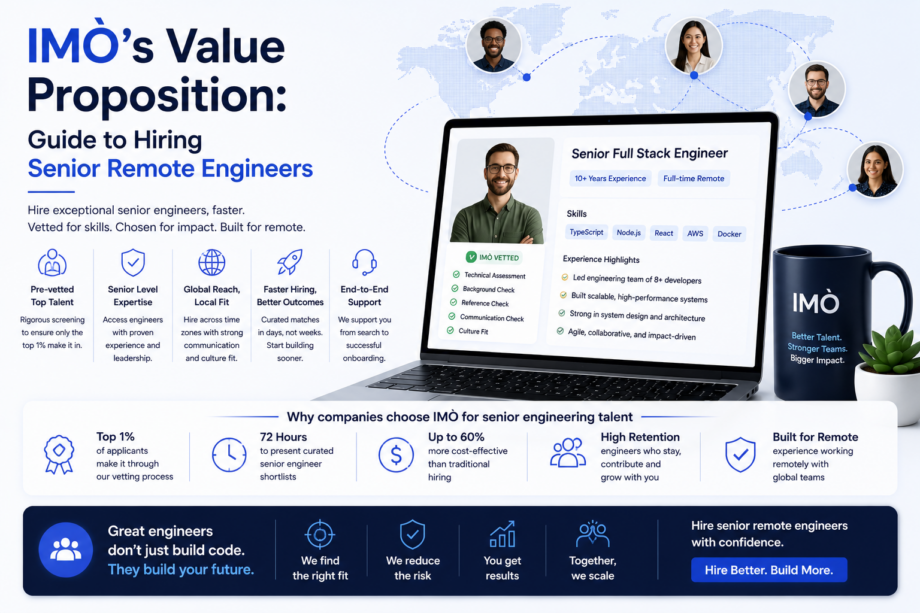
Here’s the number that tends to raise eyebrows in a boardroom: businesses hiring through IMÒ can save up to 60% compared to going through a standard local recruitment agency or a premium technical staffing network. That’s not a rounding error. For a small businesses trying to build out an engineering team without burning through a Series A round, that difference in financing can mean the gap between hiring one senior engineer or three.
It’s worth being honest about why the savings exist. It isn’t magic, and it isn’t a race to the bottom on quality either. Regional cost-of-living differences and lower overhead structures mean African-based senior engineers are compensated fairly and competitively within their own markets while still landing well under typical London or San Francisco day rates. Small businesses in particular benefit here, since traditional agency fees (often 20-30% of first-year salary) can quietly eat into a limited hiring budget before a single line of code gets written.
Speed Of Hire And Time-To-Fill
IMÒ leans hard into a 72-hour placement promise, and honestly, that’s the bit that tends to convince skeptical engineering managers to give it a proper look. Traditional recruitment can stretch to eight, ten, sometimes twelve weeks once you count sourcing, screening, technical interviews, and offer negotiation. An AI-assisted matching engine narrows that window considerably by pre-filtering candidates against role requirements before a hiring manager even opens the shortlist.
Why does speed matter this much for senior roles specifically? Because senior engineers don’t sit on the market long. The good ones get snapped up fast, often within days of becoming available, so a slow recruitment process doesn’t just cost you time, it actively costs you the best candidates.
End-To-End Managed Workspace
This is arguably the most underrated part of the whole proposition. IMÒ isn’t just a matchmaking service that disappears once the contract’s signed. It provides an actual managed environment, complete with time-tracking, task management, and performance monitoring built in. For an engineering manager juggling a distributed team across three time zones, that’s one less platform to duct-tape together with Slack, Jira, and a prayer.
What Roles And Responsibilities Does IMÒ Cover?
Core Engineering Roles Available
The talent pool spans a fairly wide capability range, though senior positions are clearly the sweet spot. Common roles include:
- Senior software engineer and senior solutions engineer positions across backend, frontend, and full stack architectures
- DevOps and infrastructure engineers with strong AWS experience and automation know-how
- Engineering managers and senior engineering managers overseeing distributed engineering teams
- Data engineers and API specialists supporting product development and modernisation projects
Typical Day-To-Day Responsibilities
A senior engineer placed through the platform isn’t just writing code in isolation. Expect involvement in architectural decisions, code review, mentoring junior engineers, and contributing to broader engineering strategy conversations with business stakeholders. For senior solutions engineers specifically, there’s usually a customer-facing element too, translating technical capability into something a non-technical customer or client can actually understand and buy into.
Reporting Lines And Team Structure
Most placements report into an existing engineering manager or technical lead within the hiring company, rather than operating as a fully detached unit. That structure matters because it keeps accountability clear and stops remote hires from becoming an afterthought bolted onto the org chart. Some senior placements, particularly those touching legacy systems or major modernisation work, end up looped into strategic discussions with technical leaders well above their immediate reporting line, simply because their architectural input carries weight.
What Are The Candidate Requirements And Vetting Standards?
Required Qualifications And Technical Skills
Vetting is where IMÒ tries to differentiate itself from the freelance-marketplace crowd, and frankly, this is the part that determines whether the whole model holds up under scrutiny. Candidates go through screening for technical proficiency (think deep dives into system design, not just leetcode-style puzzle solving), verified work history, and demonstrable ownership of past projects rather than vague resume bullet points. Best practice across the industry, as outlined in established engineering vetting frameworks, emphasises assessing architecture judgement and production experience over synthetic coding tests, and IMÒ’s process broadly mirrors that thinking.
Communication And Cultural Alignment Checks
Technical skill alone doesn’t make someone hireable for a distributed team. Communication style, written English proficiency, and general cultural alignment with a Western business context all get assessed too. This matters more than people expect. A brilliant engineer who can’t clearly explain a blocker in a standup, or who goes quiet for three days when stuck, creates more friction than a slightly less brilliant one who communicates constantly.
Nice-To-Have Skills That Strengthen Applications
Beyond the baseline requirements, certain extras noticeably strengthen an application: prior experience with fast scaling technology company environments, exposure to security-conscious industries like fintech or small business finance, and a track record of mentoring within an experienced engineering team design. None of these are dealbreakers if missing, but they do tend to push a candidate further up the shortlist.
What Does The Hiring Process Look Like Step By Step?
Application And Screening Stage
The process starts with an information collection stage covering work history, technical specialisation, and availability. From there, an initial screening filters out mismatches before a human recruiter even gets involved, which honestly saves everyone a lot of wasted calls.
Technical Assessment And Interviews
Shortlisted candidates move through technical assessments tailored to the specific role, whether that’s a system design conversation for a senior engineer or a scenario-based interview for a senior solutions engineer dealing with customer architecture questions. This stage tends to mirror what’s recommended for assessing senior AI-literate engineers more broadly: less “solve this algorithm” and more “walk me through how you’d redesign this system under these constraints.”
Offer, Onboarding And Placement Timeline
| Stage | Typical Timeframe |
|---|---|
| Initial screening | 24-48 hours |
| Technical assessment | 1-2 days |
| Client interview | 1 day |
| Offer and onboarding | Within 72 hours total |
Once an offer’s accepted, onboarding runs through IMÒ’s managed workspace, meaning access, tooling, and reporting lines are usually sorted before day one rather than scrambled together afterward.
What Benefits And Compensation Do Senior Engineers Receive?
Pay Structure And Compensation Benchmarks
Pay for senior placements is benchmarked against regional market rates rather than a flat global figure, which keeps compensation fair without pricing the whole model out of reach for smaller employers. Senior software engineer and senior engineering manager roles typically sit at the top of that band given the leadership capability and architectural responsibility involved.
Working Arrangements And Time-Zone Flexibility
Most placements work on overlapping-hours arrangements rather than rigid 9-to-5 replication, giving businesses a few hours of live collaboration each day while respecting the engineer’s own time zone. This flexibility, incidentally, is one of the bigger draws cited in broader research on remote engineering roles, which consistently links flexible scheduling to lower turnover.
Career Growth And Ongoing Support
Beyond the placement itself, there’s ongoing support built around retention, not just recruitment. That includes structured feedback loops and, per IMÒ’s own commentary on the future of remote employment, active attention paid to combating the isolation that distributed workers often report after the initial novelty wears off.
How Does IMÒ Compare To Other Remote Hiring Platforms?
Generic freelance marketplaces optimise for volume and speed of listing, not depth of vetting. Traditional recruitment agencies optimise for placement fees, which, let’s be honest, doesn’t always align neatly with getting you the best long-term fit. IMÒ positions itself somewhere in between, as a specialised alternative that trades the “browse thousands of profiles yourself” model for a curated, pre-vetted shortlist, while still keeping costs meaningfully below agency territory. Whether that positioning suits your business depends largely on how much internal recruitment capability you already have. Companies with strong internal talent teams might only need the sourcing layer. Small businesses without any dedicated HR function tend to benefit from the fuller managed-service approach.
How Do You Maintain Work-Life Balance In A Remote Engineering Role?
This one’s less about the platform and more about the engineer’s own discipline, if I’m honest. Overlapping-hours arrangements help enormously, since nobody’s expected to be online at 2am for a standup that could’ve been an async message. Clear reporting lines matter too. When a senior engineer knows exactly who to escalate blockers to and isn’t left guessing, the workday actually ends rather than bleeding into the evening. Beyond that, it comes down to boundaries that have to be enforced rather than assumed, dedicated working hours, a proper handoff at day’s end, and resisting the pull of “autopilot” mode where notifications just run unchecked into personal time.
How Should Candidates Apply To Maximise Their Chances?
Strong applications lead with specifics rather than generalities. Instead of listing “backend development” as a skill, a candidate applying for a senior software engineer role should point to a specific system they architected, the scale it handled, and what broke when it didn’t. Demonstrating prior exposure to distributed team environments, clear written communication samples, and any leadership or mentoring experience all push an application higher up the pile. It also helps enormously to be upfront about availability and time-zone overlap early, since mismatched hours are one of the more common reasons a technically strong candidate still doesn’t get placed.
FAQ
Is IMÒ only for senior roles? No, though senior software engineer and senior solutions engineer positions represent the strongest part of the talent pool, given the platform’s vetting depth suits complex technical assessments well.
Does IMÒ replace an internal recruitment process entirely? Not necessarily. Many businesses use it alongside existing recruitment, particularly for filling specialised or hard-to-source engineering roles quickly.
What happens if a placement doesn’t work out? Most managed platforms of this kind, IMÒ included, build in replacement guarantees or review periods, though specifics are worth confirming directly before signing anything.
Conclusion
None of this means IMÒ is the only sensible route into senior remote hiring, and it’d be daft to pretend otherwise. But for a business tired of watching good candidates slip away during a ten-week agency process, or wincing at fees that eat a chunk of the first year’s salary, the combination of vetted talent, genuine placement speed, and a workspace that doesn’t require six other tools bolted together is a fairly compelling answer to a problem that, frankly, most companies are still solving badly.
