

Why are you still fighting for overpriced local talent when a high-velocity tech hub is already perfectly aligned with your working hours? You’ve likely felt the sting of slow recruitment cycles and the eye-watering overheads that come with hiring in the UK or US. It’s frustrating to wait months for a senior developer only to worry about whether their skills actually match the CV or if they’ll fit your company culture.
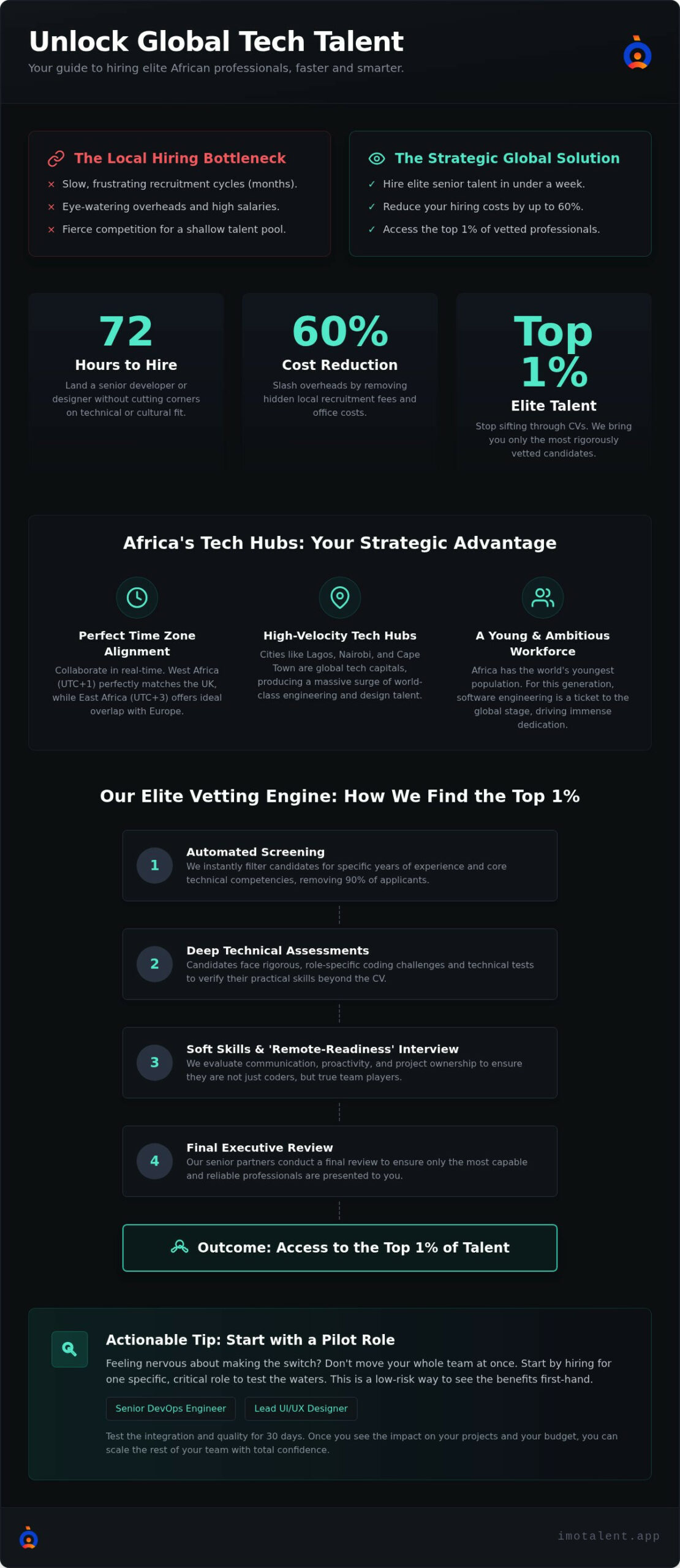
We understand that scaling a business requires both speed and precision. This guide shows you how a remote talent agency Africa can help you bypass traditional hiring bottlenecks. You’ll learn how to access the top 1% of African professionals, allowing you to hire elite senior developers or designers in under a week. By following this strategy, you can reduce your hiring costs by 60% without ever compromising on the quality of your output.
We’ll walk you through the rigorous vetting processes that guarantee excellence and explain how to build a loyal, high-performing team that drives your growth. It’s time to stop settling for local scarcity and start leveraging global elite talent.
Key Takeaways
- Understand why tech hubs like Lagos and Nairobi have become the strategic choice for global teams seeking high-performance talent in 2026.
- Learn to distinguish between basic job boards and elite vetted platforms to ensure you only interview the top 1% of candidates.
- Discover how to slash your overheads by 60% by stripping away the hidden costs of local recruitment and physical office space.
- Spot the warning signs when choosing a remote talent agency Africa so you can secure a partner that values quality over quantity.
- Master the roadmap to landing a senior developer or designer in just 72 hours without cutting any corners on technical or cultural fit.
Why Global Teams Need African Remote Talent in 2026
A modern remote talent agency Africa doesn’t just hand you a list of names. It acts as an elite gatekeeper and a master matchmaker. In 2026, the old model of “outsourcing” is dead. Companies are no longer looking for basic task-takers; they’re looking for senior developers, creative designers, and business strategists who can lead projects. This shift is driven by the rapid growth of the Economy of Africa, which has transformed cities like Lagos, Nairobi, and Cape Town into global tech capitals.
We act as your local eyes and ears on the ground. We understand the nuances of the local market, the quality of specific university programmes, and the reputations of regional tech hubs. This allows us to verify skills with a level of precision that a standard job board simply can’t match. You aren’t just hiring a remote worker; you’re integrating a vetted professional into your core team who brings fresh perspectives and high-velocity energy.
The Untapped Potential of the African Tech Hub
Africa has the world’s youngest population, and for this generation, software engineering isn’t just a job; it’s a ticket to the global stage. This has created a massive surge in high-tier talent. Communication is rarely an issue because English is the primary language of business and higher education in these key hubs. Perhaps the biggest win for UK and European teams is the time zone alignment. West Africa sits at UTC+1, perfectly matching the UK, while East Africa’s UTC+3 provides a near-perfect overlap with Central European business hours. You get real-time collaboration without the “black hole” of a 12-hour time difference.
Solving the Scaling Crisis for Startups
Traditional recruitment agencies in the UK and US are struggling to keep pace. They’re expensive, slow, and often pull from a shallow pool of local candidates who are already being chased by tech giants. For a fast-growing scale-up, waiting three months to fill a senior role is a disaster. We solve this by offering a 72-hour hiring window. By April 2026, there were over 47,000 open remote cloud positions explicitly accepting African candidates, proving that the world’s most innovative companies have already made the switch.
If you’re nervous about moving your entire operation, start small. Hire for one specific, critical role. You might look for a senior DevOps engineer (the professional who ensures your software runs smoothly after it’s built) or a lead UI designer (the person responsible for the User Interface, or the visual parts of an app that people interact with). Test the integration, communication, and output for 30 days. Once you see the 60% cost reduction and the high quality of work, you can scale the rest of the team with total confidence.
Inside the Vetting Engine: How Elite Agencies Ensure Top-Tier Quality
Most companies mistake a job board for a recruitment partner. A job board is essentially a passive library of CVs where the burden of proof sits entirely on your shoulders. In contrast, an elite remote talent agency Africa operates as a rigorous gatekeeper. We don’t just find candidates; we eliminate the noise. Because we only accept the top 1% of applicants into our network, you don’t have to waste dozens of hours interviewing people who look good on paper but fail to deliver in practice.
Our methodology is built on a four-step framework designed for speed and reliability. First, we use automated screening to filter for specific years of experience and core competencies. Second, candidates face deep technical assessments. Third, we conduct intensive interviews to evaluate soft skills and “remote-readiness.” Finally, an executive review ensures only the most capable professionals reach your desk. This level of scrutiny is why Africa’s remote workforce growth has exploded. It is not just about more people working online; it is about a higher standard of professional excellence being exported globally.
Beyond Coding: Assessing Soft Skills and Reliability
Technical brilliance is useless without strong communication. We test for proactivity and the ability to take “ownership” of a project, meaning the person takes responsibility for the result, not just the task. A vetted professional is an expert who has passed through both rigorous automated testing and comprehensive human evaluation to ensure they are ready to deliver from day one. They don’t just wait for instructions; they identify problems and suggest solutions. This mindset is critical for maintaining high performance in a distributed team where you cannot tap someone on the shoulder.
Technical Rigour: Standardised Tests and Live Challenges
We do not take a candidate’s word for it. Our vetting includes live coding environments and design critiques where experts watch their thought process in real time. This allows you to reduce hiring costs for remote talent by completely skipping the expensive and time-consuming in-house vetting phase. You are presented with a pre-vetted pool that is ready for immediate project kick-offs. This is a risk-mitigation strategy that ensures your project stays on track. If you want to see how this speed can transform your roadmap, you can explore our specific talent matching process to find your next hire.
When you partner with an agency, always ask for a breakdown of their vetting steps. A reputable partner should be able to provide you with a summary of the candidate’s technical test scores and a brief on their communication style before you even start the first interview.
The Economics of Scale: Comparing Costs and Talent ROI Across Borders
Scaling a tech team in London or New York is an expensive game. Between recruitment fees that often eat up 20% of a base salary and the rising costs of employer contributions, your budget disappears before you’ve even written a line of code. By partnering with a remote talent agency Africa, you can tap into a 60% cost advantage. This isn’t about finding “bargain” labour; it’s about high-level financial arbitrage. You’re accessing the same tier of senior expertise found in Silicon Valley but at a price point that reflects the local cost of living in hubs like Lagos or Cape Town.
The “hidden costs” of local hiring often go ignored until they hit the balance sheet. When you hire locally, you’re paying for physical office space, hardware, and complex benefit packages. A managed remote workforce removes these burdens. You can reinvest that 60% saving directly back into your product development. Instead of one senior developer in the UK, you could potentially field a team of two seniors and a designer in Africa for the same spend. This doesn’t just save money; it accelerates your entire development roadmap and increases your long-term return on investment.
Cost of Hiring: Africa vs. UK and US
Let’s look at the hard data for 2026. A senior developer in Nairobi typically commands between $4,000 and $8,000 per month. In London, a professional with the same level of experience often expects a base salary that is double or triple that amount, before you even factor in National Insurance and pension contributions. For a mid-level cloud engineer hired from Nigeria or South Africa, the annual cost ranges from $36,000 to $96,000. This represents a saving of 40% to 70% compared to a US-based hire. Because these professionals are earning well above their local market rates, they’re highly motivated and loyal. It’s a win-win scenario where your currency leverage works for you.
The Quality-to-Cost Ratio
Lower costs don’t mean lower quality in a globalised digital economy. The senior professionals we place are often working for the same global brands you admire. They use the same tools, follow the same agile methodologies, and solve the same complex problems. By focusing your budget on senior talent through a remote talent agency Africa, you ensure the cost-to-value ratio is at its absolute peak. You’re paying for experience and reliability, not just a pair of hands. This stability allows you to build a high-performing team that stays with you as you scale.
Use your savings to buy speed. If your budget allows for one local hire, use that same capital to hire two senior African professionals instead. This allows you to run parallel workstreams and hit your product milestones in half the time.
Your Roadmap to Success: Selecting the Right African Recruitment Partner
Choosing a partner is a high-stakes decision that determines whether your scale-up thrives or stalls. Many businesses fall into the trap of signing with what looks like a sophisticated remote talent agency Africa, only to realise they’ve paid for a glorified job board. If an agency simply forwards you a link to a database or cannot explain the human element of their vetting, they aren’t a partner; they’re a middleman. You need a remote talent placement service that remains invested in your team’s success long after the contract is signed.
A true partner acts as an elite gatekeeper. They should be able to tell you exactly why a candidate was selected and how they will fit your specific culture. Ask potential partners about their failure rate and how they handle replacements. If they don’t have a clear process for ongoing talent management, you’ll likely find yourself back at square one within six months. Excellence isn’t just about the hire; it’s about the integration.
Checklist for Choosing an Agency
Don’t settle for vague promises. Use these benchmarks to separate the elite facilitators from the amateurs:
- Local Market Presence: Does the agency have staff on the ground in hubs like Lagos or Nairobi? Local knowledge is essential for verifying backgrounds and reputations.
- Velocity: What is their average time-to-hire? You should look for a 72-hour turnaround for initial candidate presentations.
- Post-Placement Support: Do they offer a talent management subscription? Ongoing support is the best tool for retention and long-term performance.
Navigating Compliance and Payroll
The legal side of international hiring can feel daunting, but a professional agency makes it seamless. They should use an Employer of Record (EOR) model. This is a service that handles all local taxes, social contributions, and employment law compliance on your behalf. It allows you to hire across multiple countries while only paying a single, consolidated invoice. Most importantly, ensure your contracts explicitly state that all intellectual property (IP) belongs to your company from the moment of creation. This protects your code and designs under international law, giving you total peace of mind.
Ready to skip the recruitment headache and start building? You can book a consultation with our team to see how we handle the heavy lifting for you.
Before signing any agreement, ask to see a sample contract. Specifically, look for clauses regarding IP protection and the notice period for replacements. A transparent agency will have these documents ready for your review immediately.
The IMO Talent Advantage: Building Your High-Performance Team in 72 Hours
IMO Talent isn’t just another remote talent agency Africa; we are the high-velocity engine behind your next growth phase. We bridge the gap between ambitious global companies and the continent’s most elite professionals. While others take weeks to sift through unverified CVs, we operate from a position of readiness. Our network is already vetted, tested, and waiting to be matched with the right opportunity. This is why we are the experts in hiring remote business and design talent Africa, covering everything from senior operations leads to principal designers.
We’ve stripped away the friction of traditional hiring. Our 72-hour promise is a logistical reality built on a deep, pre-vetted pool of talent. By the time you contact us, the technical assessments and soft-skill screenings are already complete. You aren’t starting a search from scratch; you’re selecting from a curated list of winners who are ready to hit the ground running.
From Application to Hire: The 4-Step Process
Our methodology is designed for speed without sacrificing precision. We follow a linear path that moves you from a talent gap to a signed contract in record time.
- Step 1: Define. You work with our expert matchmakers to map out the specific technical requirements and cultural nuances of your ideal candidate.
- Step 2: Review. Within 72 hours, we present a curated shortlist of professionals who have already cleared our top 1% vetting benchmarks.
- Step 3: Interview. You conduct final interviews to ensure the personal chemistry is right and make your selection.
- Step 4: Onboard. We handle the managed support and administrative setup, ensuring a seamless transition into your existing workflows.
Why Managed Talent is the Future of Remote Work
There is a massive difference between hiring a gig-based freelancer and a managed professional. Freelancers often juggle multiple clients and lack long-term commitment. A managed professional from IMO Talent is a dedicated team member who benefits from our ongoing management layer. We monitor performance, handle administrative support, and ensure they remain engaged and productive. This approach provides the stability of a local hire with the 60% cost reduction we discussed earlier. You get the loyalty you need to build a lasting product, while we handle the complexities of international employment.
Don’t wait for your next big hiring round to test this model. Use our 72-hour window to fill a critical gap in your current sprint. Whether you need a Quality Assurance (QA) engineer (the specialist who tests your software to ensure it is free of bugs) or a User Interface (UI) designer (the person who creates the visual layout of your app), seeing the speed of integration firsthand is the best way to validate your scaling strategy.
Scale Your Team Without the Overhead
The competitive edge in 2026 belongs to the businesses that move fast and hire smart. You’ve seen how the right remote talent agency Africa acts as a bridge to a high-velocity workforce that matches your timezone and your standards. By stripping away the 60% extra cost of local hiring, you gain the financial freedom to reinvest in your product and hit your milestones ahead of schedule.
Success in a distributed world comes down to the quality of your vetting and the strength of your management. With a pre-vetted pool of the top 1% of talent and a 72-hour turnaround, the days of waiting months for a senior hire are over. You now have the roadmap to build a loyal, high-performing team that’s ready to deliver from day one. Our dedicated ongoing talent management ensures your professionals stay engaged, productive, and aligned with your long-term vision.
Don’t let your growth be limited by local talent pools or eye-watering recruitment fees. Build your elite remote team in 72 hours and start scaling with confidence today. Your next senior hire is ready when you are.
Frequently Asked Questions
How do you ensure the quality of remote talent from Africa?
We use a rigorous screening process that filters out all but the top 1% of applicants. This includes live coding challenges, design critiques, and proactivity assessments to ensure every candidate is ready for a high-velocity environment. By the time you see a profile, the professional has already passed both automated technical tests and deep human interviews to verify their expertise and reliability.
Can I hire for roles other than software engineering?
Absolutely. While tech is a major focus, we specialise in placing elite professionals across Business and Design as well. You can hire senior operations managers, marketing strategists, and lead designers who are experts in their respective fields. This variety allows you to scale your entire creative and operational backbone using a single remote talent agency Africa.
What is the typical time-to-hire with an African talent agency?
You can expect to see a curated shortlist of pre-vetted candidates within 72 hours of defining your role. The entire process from your initial request to a signed contract typically happens in under a week. This speed is designed to help fast-growing scale-ups fill critical gaps without stalling their development sprints or product roadmaps.
How do I handle payments and payroll for remote African workers?
We simplify the entire financial process by handling local taxes and compliance on your behalf through an Employer of Record model. You receive a single, consolidated invoice each month, regardless of how many countries your team members are based in. This removes the administrative burden of managing international payroll and ensures all your professionals are paid reliably and legally.
Is there a timezone difference I should be worried about?
Timezone alignment is actually one of the biggest advantages of hiring from the continent. West Africa sits at UTC+1, which perfectly matches the UK, while East Africa’s UTC+3 provides a significant overlap with Central European business hours. You get real-time collaboration and synchronous communication without the long delays often found in other offshore markets like Southeast Asia.
What happens if a placement doesn’t work out?
If a placement doesn’t meet your expectations, our ongoing talent management layer steps in to resolve the issue immediately. We provide a replacement guarantee to ensure your project momentum isn’t lost. Because we maintain a deep, pre-vetted network, we can find a new match quickly, often within the same 72-hour window we promise for new hires.
Do these professionals work on a freelance or full-time basis?
The professionals in our network are dedicated, full-time team members, not gig-based freelancers. They work exclusively for your company, allowing them to build deep institutional knowledge and integrate fully into your team culture. This dedication is what creates the long-term loyalty and high performance needed to scale a successful global business effectively.
How does the cost of hiring in Africa compare to the UK or US?
A remote talent agency Africa typically helps you achieve a 60% cost reduction compared to UK or US hiring. For instance, a senior developer in Nairobi might command between $4,000 and $8,000 per month. This allows you to hire top-tier senior talent for a similar cost to a junior or mid-level hire in London or New York.
