
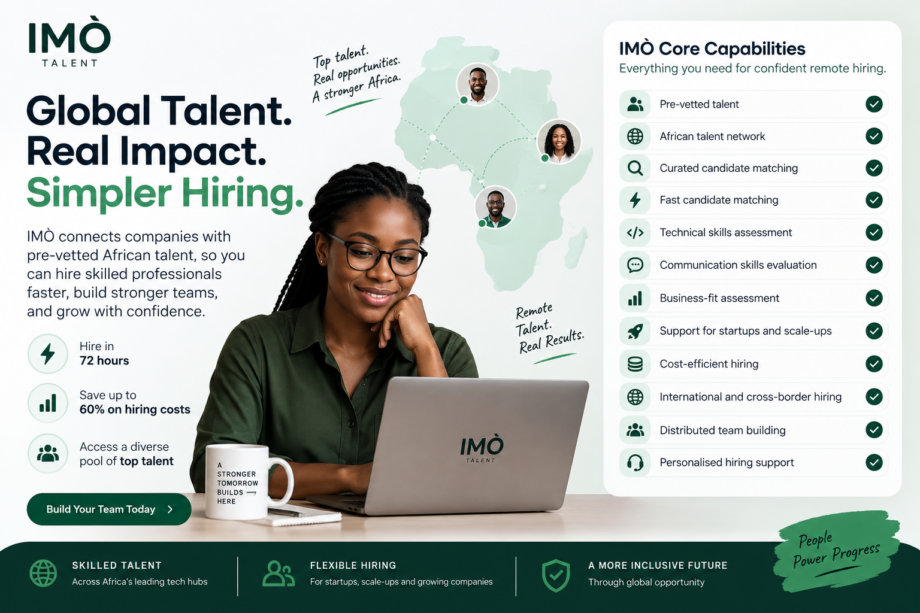
Here’s the thing nobody tells you about hiring remote developers in 2026: the platforms haven’t caught up to the problem. Most of them are still shuffling CVs and calling it innovation, while the actual bottleneck sits somewhere between “can this person code” and “will this person still be here in ninety days.” If a platform like IMÒ wants to matter in this market, it needs a feature stack built for the way distributed engineering teams actually operate, not the way HR departments wish they did.
The answer to what makes a remote hiring platform competitive isn’t a single killer feature. It’s ten of them, stacked and interlocking, covering everything from AI-driven skills verification through to post-hire retention tracking. Skip any one of these and you’ve got a leaky funnel. I’ve watched companies burn months chasing “top talent” through general remote job boards only to lose the hire within a quarter because nobody checked timezone overlap or bothered with a thirty-day pulse survey. Let’s go through what actually needs to be on the checklist.
AI-Powered Skills Assessment and Verification
Most AI code tests floating around right now are laughably gameable. Ask a candidate to reverse a binary tree under a timer and you’ve measured test anxiety, not architectural judgment. That’s not verification, that’s theatre.
A platform serious about remote developer hiring needs something closer to a containerised debugging simulation, one that injects a legacy codebase with genuine tech debt and watches how a candidate untangles a messy microservice under real constraints. That’s a far better proxy for what a senior software engineer actually does on a Tuesday afternoon than another algorithmic trivia round. Vetted assessments like these also cut down on the plagiarism problem that’s been quietly wrecking trust in remote screening pipelines, a concern raised repeatedly in this breakdown of evaluating technical skills of remote developers.
Simulation depth: real tech debt beats synthetic puzzles
Plagiarism detection: filters out copy-paste candidates before interviews waste anyone’s time
Signal quality: measures judgment, not just syntax recall
Global Talent Pool with Compliance Support
Finding a sharp backend developer in Lagos or São Paulo is the easy part. The mess starts when you try to actually employ them without triggering a permanent establishment risk or botching an IP assignment clause. I’ve seen founders discover this the hard way, usually right after an offer letter’s already gone out.
This is where an Employer of Record framework baked directly into the platform earns its keep. When compliance, tax withholding, and IP protection are handled natively rather than bolted on through a third party, hiring managers can extend an international offer without needing a call with legal every single time. It’s a shift explored in more depth in IMÒ’s positioning for senior remote engineers, and frankly it’s the difference between scaling a remote development team and drowning in paperwork.
Native EOR tooling: removes legal bottlenecks at offer stage
IP protection: localised contracts prevent ownership disputes later
Tax compliance: automated withholding avoids nasty surprises for both sides
Automated Technical Screening and Coding Tests
Strict auto-graders have a nasty habit of rejecting the outside-the-box thinkers, the ones who solve a problem through elegant design rather than chasing optimal Big-O notation. I’ve seen genuinely excellent engineers get filtered out because their solution didn’t match the expected pattern, even though it was arguably cleaner.
Semantic code evaluators fix this by grading for readability, idiomatic patterns, and security posture rather than just pass/fail against a rigid test suite. This matters more now than it did five years ago, given how much of the remote software engineering job market has shifted toward asynchronous, self-directed work where code review etiquette counts almost as much as raw output.
Readability signal: flags maintainable code over clever one-liners Security scanning: catches vulnerabilities before they reach production Idiomatic pattern recognition: rewards language-appropriate style, not brute force
Real-Time Portfolio and GitHub Integration
A flashy GitHub profile these days can be manufactured. Automated commit bots, forked repositories dressed up as original work, contribution graphs that look busy but mean nothing. Anyone who’s hired more than a handful of software developers has been burned by this at least once.
Commit-graph forensics solves for this by tracing genuine authorship, contribution depth, and how a candidate behaves in code review threads on real open-source projects. It’s a far more honest read than a wall of green squares, and it gives hiring managers something closer to a verified technical portfolio rather than a curated highlight reel.
Authorship verification: confirms the code is genuinely theirs
Contribution history: reveals sustained engagement, not one-off forks
Review etiquette: shows how they handle feedback from other engineers
Smart Matching Algorithm for Role Fit
Keyword matching died a while back, even if nobody’s updated the job boards to reflect it. Matching “Python” and “React” on a resume against a job description pairs junior developers with senior architecture roles on a near-daily basis, and everyone involved ends up frustrated.
A smarter engine trains on actual team telemetry instead, things like a developer’s historical pull request lifecycle speed, their preferred async communication style, and how much codebase complexity they’ve handled before. That’s a genuinely different kind of matching, one closer to what’s outlined in IMÒ’s value proposition for hiring senior remote engineers, and it tends to produce hires who actually fit the team’s rhythm rather than just the job title.
Telemetry-based matching: pairs candidates to team pace, not just tech stack PR lifecycle data: predicts how fast someone actually ships Communication style fit: reduces friction in async-heavy teams
Structured Remote Interview Scheduling Tools
Coordinating a live coding session across four time zones is its own special kind of misery. Scheduling ping-pong kills momentum fast, and top candidates ghost the moment it starts feeling like more admin than opportunity.
Self-optimising calendar slots that dynamically suggest high-overlap windows solve most of this friction outright, and pairing that with automated backup interviewers (in case someone gets overbooked) keeps the pipeline moving instead of stalling at the worst possible moment. It sounds like a small feature until you’ve lost a brilliant remote software engineer candidate to a competitor who simply scheduled faster.
Dynamic slot suggestion: surfaces genuine overlap automatically
Backup interviewer routing: prevents single points of failure
Reduced time-to-interview: keeps momentum before candidates disengage
Time Zone and Availability Management
There’s a particular kind of dishonesty in the phrase “flexible overlap.” Too often it translates to an engineer in Manila jumping on midnight calls so a founder in California can have a nine-to-five. That’s not flexibility, that’s just exported burnout.
Quantifying overlap visually, with a live collaboration-window metric, forces honesty into the process before an offer’s even made. It flags sustainable working hours versus the kind of arrangement that quietly burns someone out within six months. This kind of transparency also feeds directly into how well a remote team actually functions long-term, rather than just on paper.
Transparent Salary Benchmarking Data
Global pay transparency is chaos right now, frankly. Anchoring compensation to hyper-local rates versus a global tiering model creates constant friction, and developers talk to each other, so lowball offers don’t stay secret for long.
Feeding real-time, localised market data straight into the offer workflow balances cost-of-living adjustments against parity incentives. It keeps budgets realistic for the hiring company while preventing the kind of lowball offer that torches trust before day one even starts.
Region | Typical Overlap Challenge | Benchmarking Priority |
|---|---|---|
Latin America (for US clients) | High overlap, minimal disruption | Parity-adjusted pay |
Southeast Asia (for EU/US clients) | Low natural overlap | Async tooling + fair local rates |
Eastern Europe (for UK/EU clients) | Strong overlap | Cost-of-living balance |
Seamless Onboarding and Contract Management
Day-one friction sets a miserable tone, and it’s shockingly common. A new hire waiting three days for a laptop to ship or for IAM permissions to clear isn’t a minor hiccup, it’s the first impression of the entire company culture.
Automating provisioning the moment a contract is digitally signed, so identity-provider hooks, repo invites, and hardware delivery tracking all fire simultaneously, removes that awkward limbo entirely. It’s a detail covered well in this evaluation checklist for remote hiring platforms, and it’s one of those things that seems small until you’ve lived through the alternative.
Post-Hire Performance Tracking and Feedback
Retention lives and dies on early feedback loops, yet most platforms disappear the second the placement fee clears. That’s backwards, given that the first ninety days are exactly when a remote hire is most likely to quietly disengage or quit.
A lightweight 30-60-90 day pulse check catches integration friction or communication stalls between the engineering manager and the new hire before they calcify into resignation. This kind of ongoing visibility is precisely what separates a platform focused on reducing remote hiring red flags from one that treats placement as the finish line.
How Does IMÒ Compare With Legacy Hiring Platforms?
Legacy platforms, and I include a lot of the big-name marketplaces here, were built for a pre-remote era and then patched to look modern. They tend to excel at volume, throwing a wide net across a global talent pool, but they thin out fast on verification depth and almost completely on post-hire support. A platform built around the ten capabilities above treats hiring as a lifecycle rather than a transaction, which is a meaningfully different proposition, one explored further in this comparison of IMÒ against Proxify and Toptal.
What Should Hiring Managers Ask Before Choosing a Platform?
Ask how technical vetting actually works, not just whether it exists. Ask what happens to compliance risk the moment a contract crosses a border. Ask whether the platform’s involvement ends at placement or continues through the tricky first quarter, because that’s usually where remote hires either bed in or quietly walk. And ask for evidence, real case data, not marketing copy, the kind laid out in this checklist for vetting remote engineers on value versus cost.
Conclusion
None of these ten capabilities work in isolation, and that’s really the whole point. A brilliant matching algorithm means nothing if onboarding takes a week. Rigorous technical screening is wasted if nobody checks in at day thirty. Competitive remote developer hiring in 2026 demands the full stack, not a handful of shiny features bolted onto an old CV database. Platforms that understand this, and build for the entire lifecycle rather than just the moment of placement, are the ones that’ll actually earn trust from engineering managers who’ve been burned before.
FAQ
What’s the single biggest gap in most remote hiring platforms today? Post-hire tracking, without question. Most platforms vanish the moment a placement fee clears, leaving the riskiest ninety days of a remote hire’s tenure completely unmonitored.
Do AI coding tests actually predict job performance? Only when they simulate real conditions. Generic algorithmic puzzles measure test-taking skill more than they measure whether someone can maintain a messy production codebase.
How much does timezone overlap really matter for remote teams? Quite a lot, more than most hiring managers admit. Poor overlap quietly drives burnout and attrition even when the technical fit was strong on paper.
