

Introduction
The best remote hiring platforms for regulated industries are the ones that own their legal entities, keep verifiable audit trails and treat data governance as a core feature. On that test, Remote, Rippling, G-P and Deel lead the pack, each for a different reason. Job boards don’t belong in that conversation at all.
Plenty of hiring managers in fintech, healthtech and legal services still assume a clean candidate pipeline equals a compliant one. It doesn’t.
A misclassified worker or a sloppy background check can land you in front of a regulator, and regulators rarely care how quickly you filled the seat. Speed is lovely. Defensibility is what you’re actually buying.
So let’s sort the platforms that manage risk from the ones that merely find people. Along the way: pricing, suitability for different sectors, the warning signs of a vendor who isn’t ready, and how to switch without missing a pay run.
Which Remote Hiring Platforms Suit Regulated Industries Best?

Short answer: it depends on which risk keeps you awake. Cross-border IP exposure, device and access control, or hiring in a jurisdiction where one wrong move means a heavy fine. Each of the four main platforms leans a different way.
Remote
My pick for cross-border hires where intellectual property and compliance matter. Remote employs people through its own legal entities rather than leaning on local partners, and in a regulated business that ownership is the whole point. If something goes wrong in a country, you want one accountable party, not a chain of subcontractors pointing at each other.
The trade-off is rigidity. Standardised workflows mean niche roles often need manual customisation, and you’ll feel that when a role doesn’t fit the template. I’d take that annoyance over a legal grey area, honestly.
Rippling
Rippling is the odd one out, in a good way. It bridges HR infrastructure with IT governance, so device tracking, software access provisioning and payroll security sit in a single system. For a firm that has to prove who accessed what, and on which laptop, that’s genuinely useful.
Picture a compliance officer asking how you offboarded a remote analyst in Manchester. With Rippling, the device lock, the access revocation and the final pay sit on one record. Without it, you’re chasing three spreadsheets.
G-P and Deel
G-P (Globalization Partners) earns its place in legally complex or high-risk markets. Its legal and regulatory support is deep, and when a misstep means government fines, that backing matters more than a slick interface.
Deel is the speed merchant. It’s quick for onboarding international contractors, and reviewers say so repeatedly. But I’d never let that speed become an excuse to skip classification checks. Regulated firms need to double-check misclassification risk before leaning on contractor frameworks, however convenient the dashboard looks.
Platform | Best for | Watch out for |
|---|---|---|
Remote | Cross-border IP and compliance | Manual customisation for niche roles |
Rippling | HR plus IT governance | Fit for firms wanting only an EOR |
G-P | High-risk, complex markets | Premium positioning |
Deel | Fast contractor onboarding | Misclassification checks |
Why Do Job Boards Fall Short on Compliance?
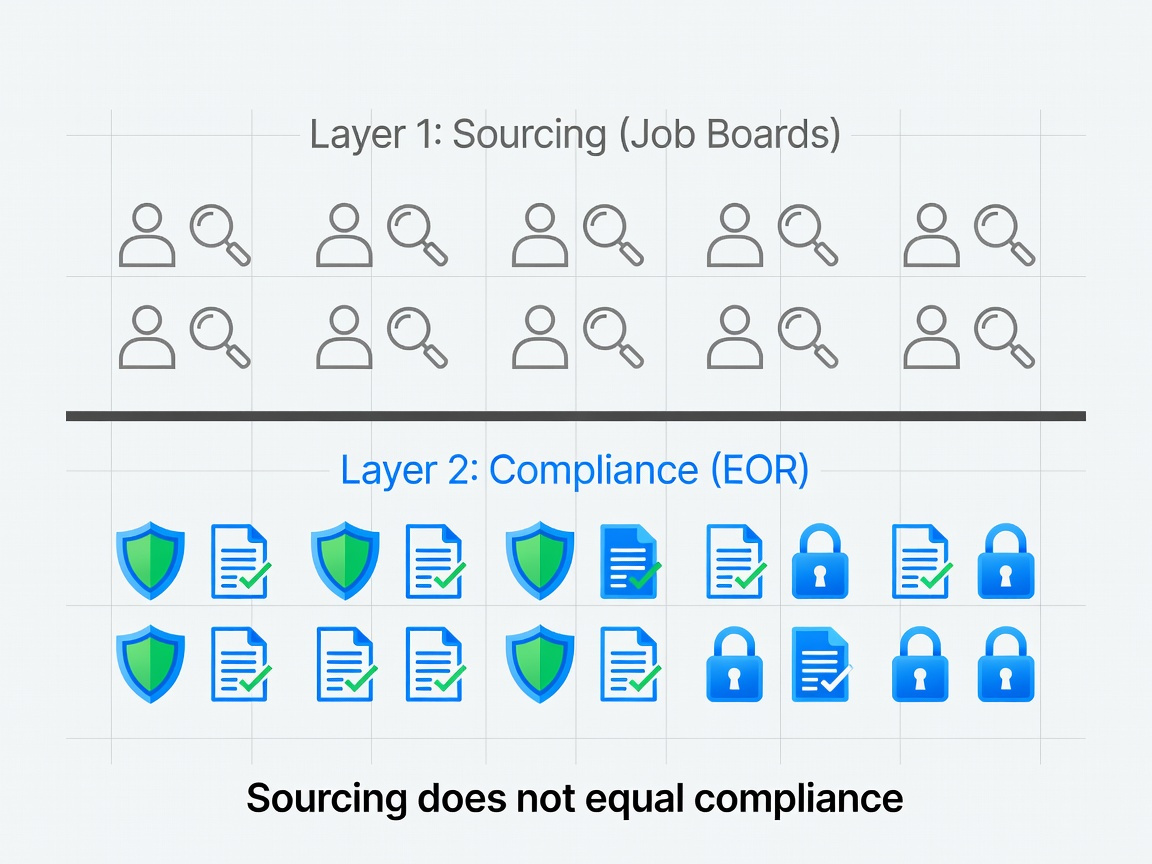
Because a board is a shopfront, not a back office. It puts candidates in front of you. It does not employ them, run payroll, hold a contract or keep the records an auditor will ask for.
Sourcing versus compliance
I’d stop pretending a job board is a compliance platform. Listings marked “pre-approved” might reassure a nervous recruiter, but they don’t solve legal entities, audit trails or worker classification. Mixing up sourcing with compliance is how you buy yourself a mess.
Think of it as two layers. Layer one finds the person. Layer two makes the employment lawful, taxed and documented. Plenty of firms buy layer one and assume layer two came free.
Specialist boards worth using
That said, boards have a place. If your legal framework is already sorted, a specialist board is a fine way to find vetted people. Our own comparison of platforms covers how the two layers fit together, and there’s a useful read on how boards compare with curated platforms if you’re still weighing it up.
Toptal and FlexJobs trade-offs
FlexJobs is widely rated for its human-vetting policy, which filters out scams and unverified applications. Good for finding remote jobs without wading through rubbish. Toptal sources screened technical and financial contractors through an intensive pre-screening process, though users on LinkedIn grumble about billing transparency. That makes me wary. When you’re already managing regulatory risk, murky invoices are one more thing to explain.
Find people with a board if you need one. Use a serious EOR or HR system to manage the actual risk.
How Do Platform Pricing and Suitability Compare?
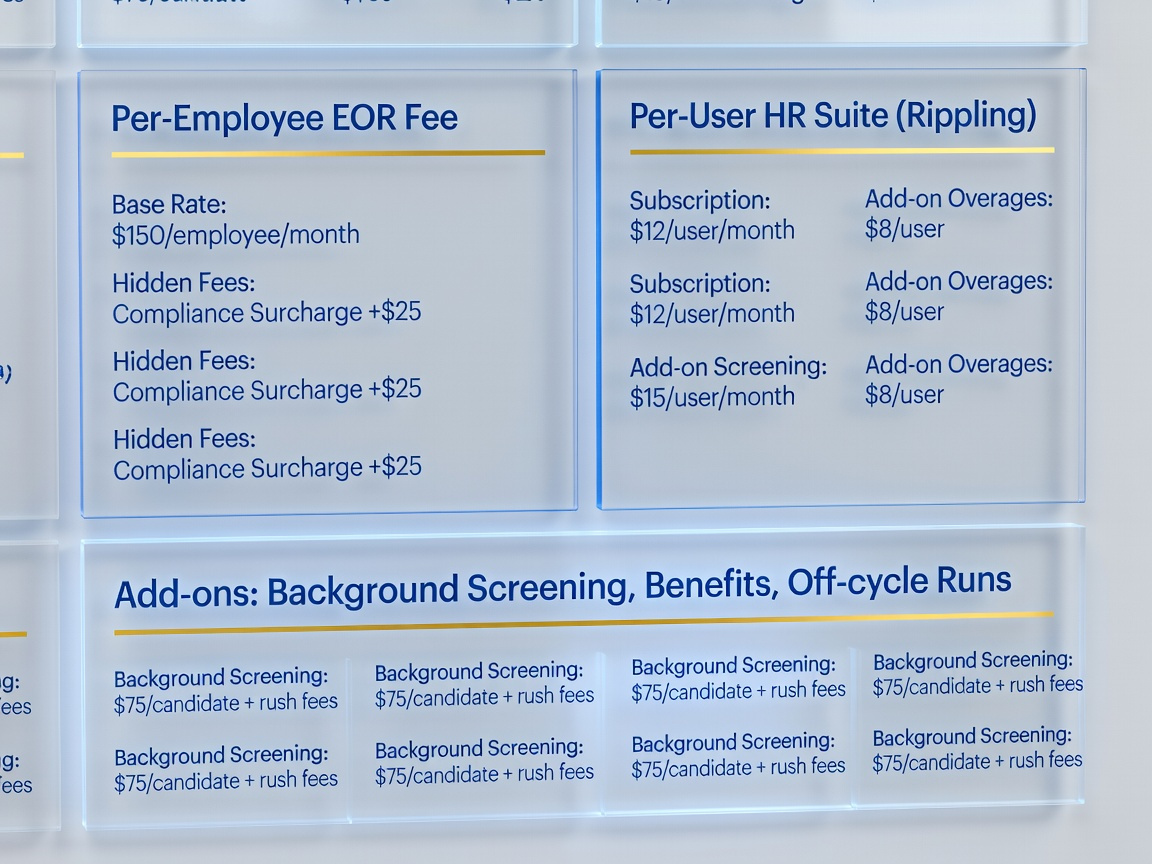
Honestly, published pricing in this space is slippery, and I won’t pretend otherwise. Check current rate cards directly before you commit.
Pricing models
Most EOR providers charge a per-employee monthly fee, with contractor tools usually cheaper per head. Enterprise HR suites such as Rippling tend to price per user, with modules stacked on top. Watch for add-ons: background screening, benefits administration and off-cycle payroll runs are where a tidy quote swells.
For a deeper cost view, the platform versus agency cost comparison is worth a look.
Small firms versus enterprise
A ten-person fintech hiring two engineers abroad needs an EOR with predictable fees and fast entity cover. An enterprise with hundreds of staff across countries needs a system of record, role-based access and reporting an auditor can read. Small firms often overbuy; large ones often underestimate integration pain.
UK and global fit
From a UK vantage, check that the provider handles HMRC PAYE and National Insurance correctly, plus pension auto-enrolment, if you’re hiring in Britain. Globally, look at how many countries are covered through owned entities and which are served through partners. That split tells you where your risk really sits.
How Should You Choose a Compliant Platform?

Work backwards from your regulator. Not from the vendor’s brochure.
Sector regulations
Financial services firms face supervision duties. FINRA Rule 3110 sets out the supervisory systems and written procedures required for distributed workforces, and a remote inspections pilot runs through June 2027 for eligible firms. Healthcare employers must protect patient data, so the HHS HIPAA guidance is your starting reference. Ask each vendor to map their features to your rules, in writing.
Vetting standards
Background checks need care. The EEOC guidance on arrest and conviction records shows where screening can tip into discrimination under US law. For sanctions risk, the OFAC search tool lets you screen international hires against watchlists. If background screening is central, see which platforms offer background checks.
Data protection and security
Ask for evidence, not promises. An ISO/IEC 27001 certificate or a SOC 2 report built on the Trust Services Criteria tells you something real. For European employee data moving abroad, the EU standard contractual clauses are the usual safeguard. And for device security, NIST’s telework guidance is a decent technical yardstick.
Employment compliance
Does the provider hold local entities? Who signs the employment contract? Who files tax? Who carries liability if a worker is misclassified? Four questions, and vague answers to any of them are an answer in themselves.
What Are the Red Flags of Poor Compliance Readiness?
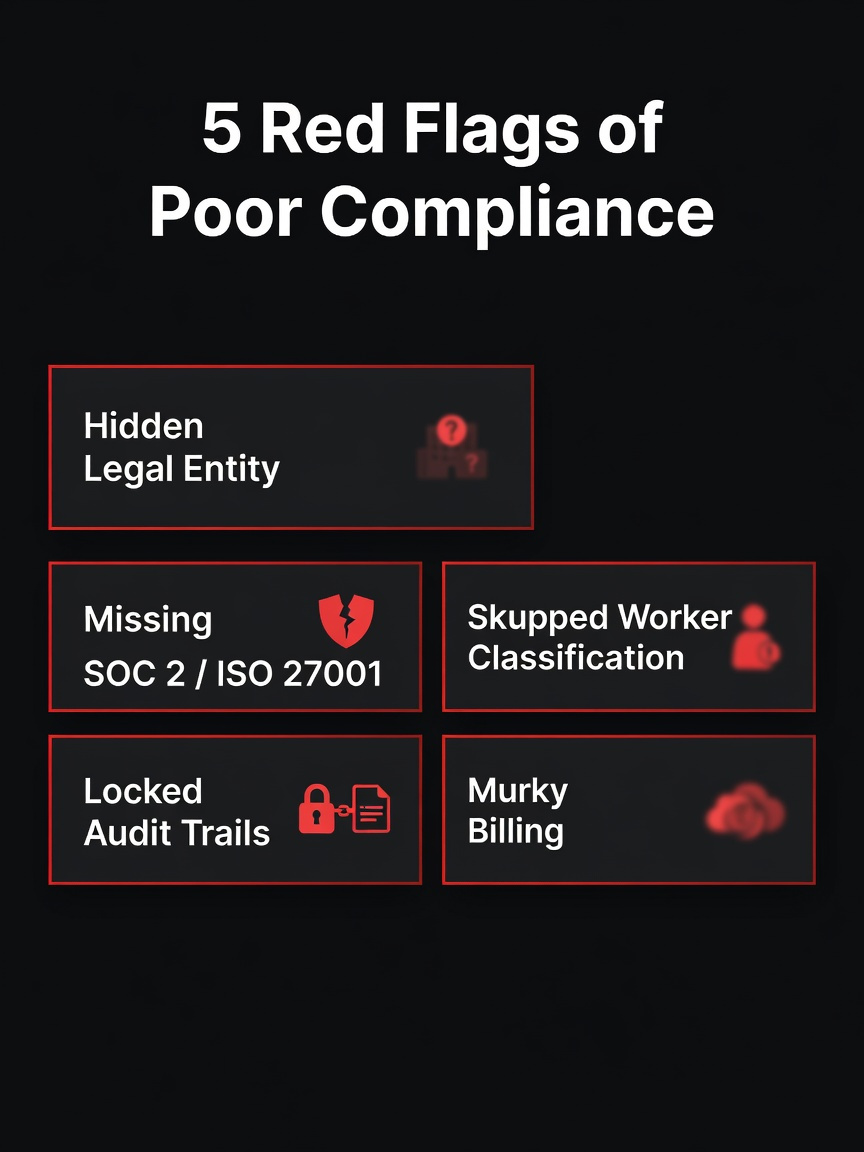
I’ve watched buyers ignore these, then regret it. Here’s what to look out for:
Unwillingness to name the legal entity that employs your people in a given country.
No current SOC 2 or ISO 27001 evidence, or a “pending” status that never changes.
Audit trails that can’t be exported on request.
Contractor onboarding that skips classification questions entirely.
Billing that you can’t reconcile line by line.
One or two might be teething trouble. Three means walk away.
Should You Hire Contractors or Employees?
In a regulated setting, lean towards employees through an EOR unless the work is truly project-based and independent. Contractors control how, when and where they work; if you dictate hours, tools and process, a regulator may see an employee wearing a contractor’s hat.
Contractors do suit short, defined engagements. Just document the independence honestly. Deel’s speed makes this tempting, which is exactly why it needs discipline.
How Do You Switch Providers Without Payroll Disruption?

Run both systems in parallel for at least one full pay cycle. Boring advice, but it saves careers.
Start by exporting every record: contracts, tax IDs, leave balances, benefits enrolments, payslip history. Agree a cut-off date with your outgoing provider, and confirm in writing who files final-period tax. Then transfer employees country by country rather than all at once, starting with the lowest-risk one. Where employees move between employing entities, local law often requires consent or formal notice, so check before you announce anything. There’s a practical walkthrough on switching platforms without disrupting your team, and an evaluation checklist helps before you sign anything new.
What Happens When a Worker Is Misclassified?
Back taxes, penalties, unpaid benefits and sometimes backdated social contributions. In regulated sectors there’s a second hit: licensing bodies take a dim view of firms that can’t control who is working for them.
Fines vary by country, so I won’t quote a number. The cost is rarely just the fine, though. It’s the remediation, the legal fees and the awkward conversation with your regulator.
Conclusion
Choose Remote for owned entities and IP-sensitive cross-border hiring, Rippling for HR and IT governance together, G-P for high-risk markets, and Deel only with proper classification checks. Use boards like FlexJobs for sourcing, never for compliance.
Ask for evidence. Test the exit before you enter. And if you’re comparing further, our TL;DR on regulated platforms is a quick next stop.
