

Somewhere around the third bad hire, most engineering leaders start asking the wrong question. They ask “why do recruiters keep sending me the same three resumes,” when the real question is “why did I hire a contingency recruiter to fill a role that needed a headhunter.” That mismatch, agency type against role type, is where most hiring budgets quietly leak away.
The short answer to the whole engineering versus executive recruitment debate is this: engineering roles get filled fastest through contingency-based agencies working a volume game against active candidates, while executive and VP-level positions demand a retained search firm doing the slow, unglamorous work of mapping a market and courting people who aren’t even looking for a job. Mixing these two models up, using a fast-and-cheap contingency shop to fill a Head of Engineering seat, or paying retained fees for a mid-level design engineer, is how companies waste both money and months. I’ve watched it happen more times than I’d like to admit, and it’s rarely the recruiter’s fault. It’s a briefing problem.
How Do Engineering Recruitment and Executive Search Actually Differ?
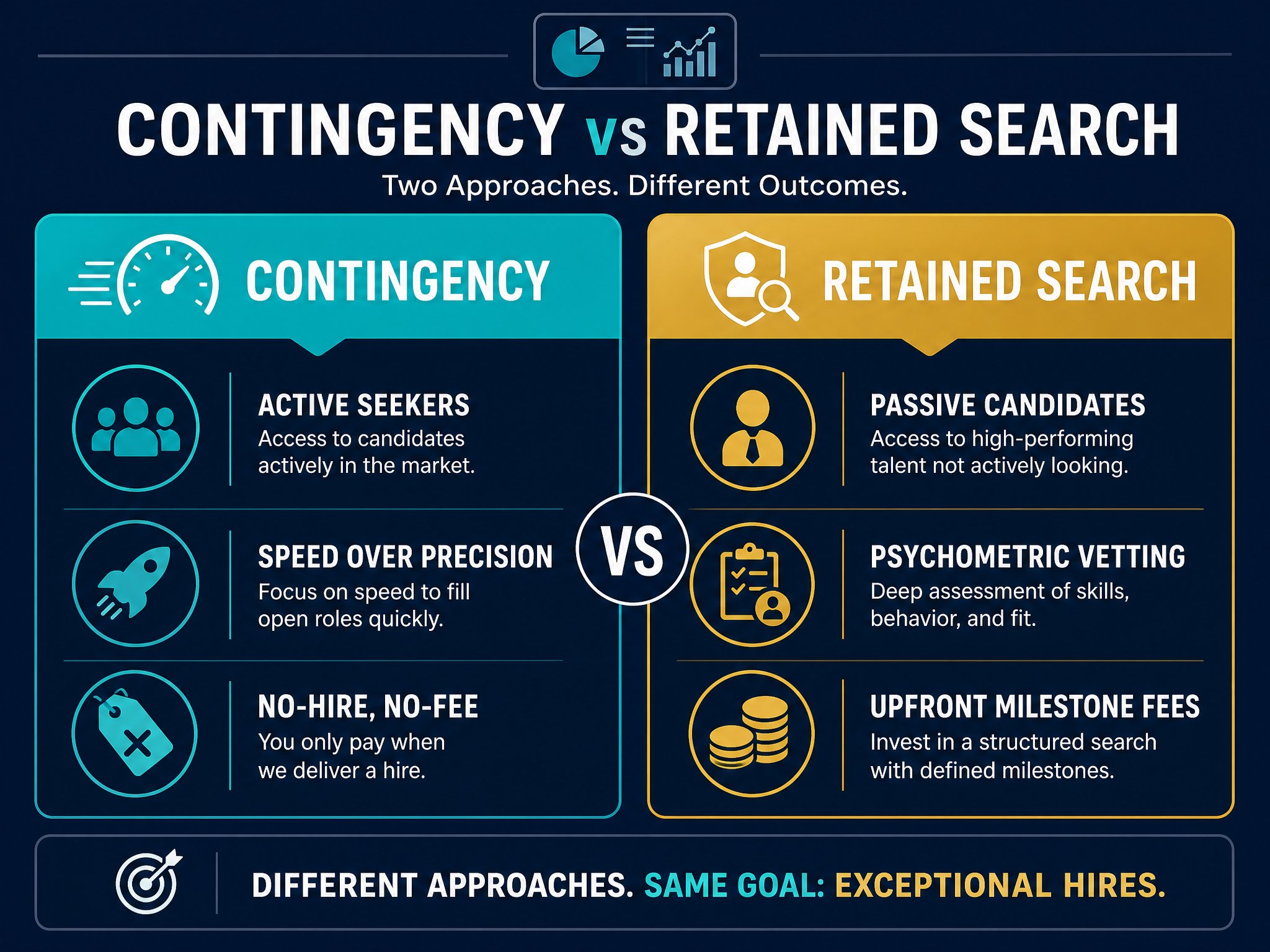
The distinction isn’t cosmetic. It’s structural, baked into how each side gets paid and who they’re chasing. Engineering recruitment, particularly for roles like field service engineer, process engineer, or senior design engineer, runs on a contingency model. Executive search runs on retainer. That single difference in fee structure changes everything downstream: who gets contacted, how thoroughly they’re vetted, and how much accountability the agency actually carries.
Contingency Model for Engineering Roles
Contingency recruitment is a no-hire, no-fee arrangement, and it shows in the pacing. Multiple agencies, sometimes three or four working the same brief simultaneously, race to present candidates from job boards and existing databases before a competitor beats them to it. Speed wins over precision here, which is exactly why 76% of UK engineering employers report ongoing difficulty filling technical roles, according to this engineering job market update for 2026. Demand for electrical, mechanical, and project engineers keeps outstripping supply, and a contingency recruiter’s incentive is to fill the seat, not necessarily to find the perfect fit. That’s not a criticism so much as an honest description of the model.
Retained Model for Executive Search
Retained search flips the incentive structure entirely. The client pays upfront, often in staggered instalments tied to milestones rather than a single success fee, which means the search firm is financially committed regardless of outcome speed. This model exists because a bad executive hire is catastrophically expensive, not just annoying. Retained search firms typically charge between 25% and 35% of first-year total compensation, with 30% being the most common figure cited by firms tracking executive search costs. That fee buys deep market mapping, confidential outreach, and psychometric-level vetting that a contingency recruiter simply has no budget or incentive to perform.
Candidate Pools and Sourcing Methods
Here’s where the two worlds genuinely diverge. Engineering recruitment leans on active job seekers, people already scrolling job boards, updating LinkedIn, applying to five roles a week. Executive search does the opposite: it hunts passive candidates who are currently employed, often thriving, and not remotely interested in a cold email until the right one lands in their inbox. As explained in this breakdown of proactive versus transactional recruitment approaches, executive search is deliberately proactive, while general recruitment tends to be transactional by design. Neither approach is wrong. They’re just solving different problems.
When Should You Use an Engineering Recruitment Agency?

If you’re hiring for standard technical roles where the skill set is well-defined and the candidate pool is reasonably deep, an engineering recruitment agency is the obvious call. Think structural engineers, field service engineer positions, or a design engineer role where the qualifications map cleanly onto a job description.
Standard Technical Roles and Skill Gaps
Skills gaps in engineering are rarely about finding someone who exists. They’re about finding someone available at the right price, in the right location, within a reasonable notice period. A dedicated engineering recruitment agency with a live database of qualified candidates and existing relationships across the engineering sector can move faster than an internal hiring manager juggling six other responsibilities. This is precisely the terrain covered in this piece on how engineering recruitment and executive search actually differ, where the contingency model proves its worth for exactly these mid-tier, high-clarity roles.
High-Volume or Time-Sensitive Hiring
Scaling an engineering team quickly, say for a manufacturing ramp-up or a project deadline, is where contingency recruitment genuinely shines. You need volume, you need speed, and frankly you can tolerate a slightly higher miss rate because you’re filling ten seats, not one irreplaceable one. Global IT spending is projected to grow nearly 10% in 2026, pushing demand for data and AI engineers even higher according to Harvey Nash’s tech recruitment outlook, which means agencies built for volume are only going to matter more, not less.
Cost and Fee Structures
Contingency fees typically run 15% to 25% of first-year salary, paid only on placement. That’s the appeal. No upfront cost, no risk if the search stalls. But the trade-off is quality control. High-volume recruitment can quietly lower the bar on candidate suitability, whereas a more deliberate, quality-focused search tends to reduce early attrition, a point made clearly in this analysis of what good engineering recruitment actually looks like.
When Should You Use an Executive Search Firm?

Executive search isn’t overkill for senior roles. It’s insurance.
C-Suite and VP Engineering Hires
A VP of Engineering, a CTO, a Head of Product Development, these hires shape strategy for years. You cannot outsource that decision to a contingency recruiter racing three other agencies to hit a deadline. Retained search firms build a shortlist through direct headhunting and confidential market mapping, not job board scraping.
Confidential or Business-Critical Searches
Sometimes the incumbent hasn’t been told yet. Sometimes the board wants three names before anyone internally knows a search is happening. That level of discretion only exists within a retained relationship, where the firm’s reputation, not just its fee, is on the line.
Retained Fees and Investment Expectations
Model | Fee Structure | Typical Cost | Best Suited For |
|---|---|---|---|
Contingency | Pay on placement | 15%-25% of salary | Engineers, technical roles, volume hiring |
Retained Search | Upfront + milestone payments | 25%-35% of salary | C-suite, VP Engineering, confidential roles |
A failed C-suite hire can cost three to five times that person’s annual salary once you tally recruitment, severance, lost productivity, and the ripple effect on team morale, a figure detailed in this complete guide to executive search costs. Against that backdrop, a 30% retained fee stops looking expensive and starts looking cheap.
Should You Hire In-House or Use a Recruitment Agency?
Benefits of In-House Recruitment
In-house recruiters know the culture, the team dynamics, the unspoken politics that never make it into a job description. They build talent pipelines over time and can move faster on repeat hiring once the relationship with hiring managers matures.
Benefits of Using an Agency
External agencies bring market intelligence you don’t have internally, access to passive candidates, and, frankly, distance. A recruiter can say things to a candidate about compensation expectations that would sound awkward coming from the actual hiring manager.
Hidden Costs of Delayed Hires
Every month a senior engineering seat sits empty costs more than the eventual recruiter fee. Projects slip, existing staff absorb overflow work and burn out, and the workforce strategy you built six months ago starts unravelling quietly.
Niche Specialist or Generalist Recruitment Agency?
What a Specialist Agency Offers
A specialised engineering recruitment agency, one that only places structural, mechanical, or process engineers, understands technical nuance that a generalist simply can’t fake. They know what “5 years of PLC experience” actually means in practice.
What a Generalist Agency Offers
Generalist firms offer breadth. If you’re building an entire department, spanning engineering, operations, and support functions, a generalist agency or platform can coordinate across roles without you juggling five separate vendor relationships, a tension explored well in this comparison of candidate vetting across platforms and agencies.
How to Decide Between Them
Ask yourself how technical the role actually is. A senior engineer position with niche skills needs a specialist. A broad operational hire probably doesn’t.
How Do Agencies Vet Technical and Executive Talent?

Technical Vetting for Engineering Candidates
Good engineering recruiters test for actual competency, not just resumes. That means technical interviews, portfolio reviews, sometimes practical assessments specific to the engineering field in question.
Leadership Assessment for Executive Candidates
Executive vetting looks completely different. It’s psychometric testing, reference calls with former board members, and scenario-based interviews probing how someone handles ambiguity, not whether they know a specific tool.
How Do You Choose the Right Recruitment Agency?
Look at their track record within your specific niche, not their general reputation. Ask how many placements they’ve made in the last quarter in your exact discipline, and ask for outcomes, not just introductions.
What Should You Check Before Partnering with an Agency?
Check their fee structure in writing, their replacement guarantee period, and whether they’re running an exclusive search or shopping your role to five other clients simultaneously.
What Does a Strong Partnership with a Headhunter Look Like?
It looks like transparency. A good headhunter tells you when a candidate is unlikely to move, pushes back on unrealistic job descriptions, and treats the search as a two-way negotiation rather than a sales pitch.
Is a Recruiter Worth It If You Have a Strong Internal Talent Pipeline?
Even with a solid pipeline, a recruiter earns their fee for the roles your pipeline can’t cover, confidential searches, hard-to-reach passive candidates, or sudden urgent gaps your internal team can’t absorb, a scenario covered in this piece on when to hire a dedicated recruiter versus relying on founders for hiring.
How Do You Know If a Recruitment Agency Is Underperforming?
Watch for generic candidate submissions that ignore your brief, long silences between updates, and an unwillingness to explain why a candidate was rejected further up the process.
Conclusion
Match the model to the role, and most of this becomes simple. Contingency for engineers, retained for executives, specialist when the skill is rare, generalist when the need is broad. Get that pairing wrong and you’ll spend months and thousands chasing a fix that a five-minute briefing conversation could have prevented.
