

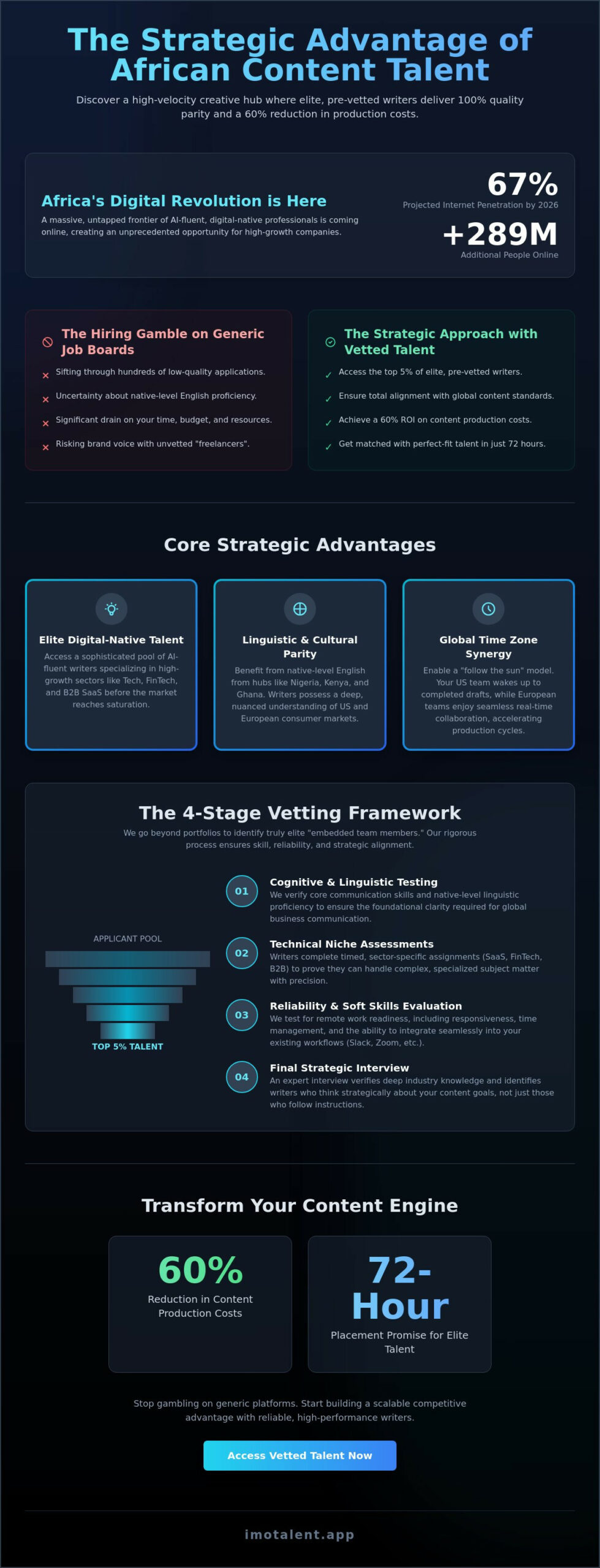
Africa isn’t just a low-cost alternative for your marketing department. It’s a high-velocity creative hub where elite talent meets 100% quality parity. By 2026, internet penetration across the continent is projected to reach 67%, bringing an additional 289 million people online. You’ve likely felt the frustration of sifting through hundreds of low-quality applications or worrying about native-level English proficiency. It’s a drain on your time and your budget. Finding remote content writers Africa shouldn’t feel like a high-stakes gamble on a generic job board.
You can stop settling for mediocrity. This guide reveals how to tap into a reliable pipeline of elite, pre-vetted talent to reduce your content production costs by 60%. We’ll explore the 2026 regulatory landscape, including Kenya’s Class N permits and South Africa’s evolving remote work standards, to ensure your operations remain seamless. You’re about to discover a strategic framework for fast onboarding that transforms your content output from a bottleneck into a scalable competitive advantage.
- Capitalize on the surge of English-speaking digital professionals to ensure total alignment with your global content standards.
- Eliminate hiring risks by identifying the top 5% of remote content writers Africa has available through advanced vetting frameworks.
- Secure a 60% ROI on content production by leveraging high-performance talent without compromising on brand voice or technical precision.
- Implement high-velocity management protocols that prioritize asynchronous communication and clear KPI tracking for remote teams.
- Accelerate your hiring timeline with a 72-hour placement promise that connects your business with pre-vetted, elite writing talent.
The Strategic Advantage of Hiring Remote Content Writers in Africa
Africa represents a massive, untapped frontier for high-growth companies. The continent currently hosts the world’s fastest-growing population of English-speaking digital professionals. This isn’t just about sheer volume. It’s about a specific tier of talent that has undergone “creative leapfrogging.” These writers didn’t transition to digital; they were born into it. They are AI-fluent and digital-native by default. As the economic landscape in Africa shifts rapidly toward technology and services, a sophisticated pool of specialist writers in Tech, FinTech, and SaaS sectors has matured. Hiring remote content writers Africa allows your brand to secure this high-velocity talent before the global market reaches saturation.
Linguistic Proficiency and Cultural Nuance
English serves as the primary language of instruction and commerce in major hubs like Nigeria, Kenya, and Ghana. This isn’t “translated” or secondary English. It’s native-level proficiency refined in rigorous academic and professional environments. Beyond basic grammar, there’s a deep-seated understanding of Western consumer markets. High levels of global media consumption ensure these writers grasp the subtle nuances of US and European audiences. They produce content that resonates internationally while maintaining an authentic, human-centric perspective. You get the benefit of diverse viewpoints without the friction of language barriers or cultural disconnects.
Time Zone Synergy for Global Teams
Operational efficiency depends on your communication flow. African talent offers substantial overlap with GMT and CET time zones. European teams enjoy seamless, real-time collaboration. For US East Coast firms, the overlap is manageable and highly productive for daily syncs. There is a distinct advantage to the “follow the sun” model. Your remote content writers Africa can execute high-volume content strategies while your US-based team sleeps. You wake up to completed drafts, ready for immediate review. This asynchronous workflow accelerates your production cycles. It ensures your content engine operates at a velocity that competitors can’t match. You aren’t just saving money; you’re buying time.
The depth of expertise in specialized fields is a significant differentiator. You aren’t just hiring generalists. You’re accessing professionals who understand the mechanics of decentralized finance, the nuances of B2B SaaS, and the complexities of the global tech ecosystem. This expertise ensures that your technical documentation and thought leadership pieces maintain a high level of authority. It’s about high-performance integration into your existing team structures. You’re hiring partners who understand your business goals, not just service providers who fill pages with words. The same African talent market that produces elite content writers also delivers world-class remote UI UX designers Africa companies are increasingly turning to for product development at a fraction of Western market rates.
Vetting for Excellence: Identifying Top-Tier Writing Talent
Generic job boards are a resource drain. You’ll face high application volumes but suffer low success rates. Finding the top 1% of remote content writers Africa requires more than a casual glance at a PDF. Most employers make the mistake of overvaluing portfolios. Portfolios are curated; they represent only 20% of the evaluation process. They don’t reveal how a writer handles tight deadlines or complex technical briefs. To secure elite performance, you must shift from hiring “freelancers” to identifying “embedded team members.” This requires a rigorous, multi-stage assessment that filters for both skill and operational readiness. If you want to bypass the noise and focus on growth, you can access pre-vetted talent that has already cleared these hurdles.
The 4-Stage Vetting Framework
Our methodology prioritizes precision over volume. We break the evaluation into four distinct phases to ensure total alignment with your brand’s needs:
- Stage 1: Cognitive and Linguistic Testing. We verify core communication skills and linguistic proficiency. This ensures the writer possesses the foundational clarity required for global business.
- Stage 2: Technical Niche Assessments. Writers complete timed assignments tailored to specific sectors like SaaS, B2B, or FinTech. This proves they can handle specialized subject matter.
- Stage 3: Reliability and Soft Skills. We evaluate remote work readiness. This includes testing for responsiveness, time management, and the ability to work within your existing Slack or Zoom workflows.
- Stage 4: Final Strategic Interview. A final expert interview verifies industry depth. We look for writers who think strategically about your content goals, not just those who follow instructions.
Verifying Industry-Specific Expertise
Subject matter authority is non-negotiable in 2026. You don’t just need words; you need research rigor and fact-checking. Our vetting process tests a writer’s ability to synthesize complex data and cite authoritative sources accurately. We look for a deep understanding of industry mechanics. This ensures your content maintains authority in technical fields. Additionally, we verify a writer’s adaptability. They must demonstrate the ability to mirror your specific brand voice and adhere to complex style guides without constant hand-holding. This level of precision transforms content from a generic output into a high-performing asset. By the time remote content writers Africa reach your desk, they’ve proven their ability to integrate seamlessly and contribute to your bottom line.
Cost-Effective Scaling: The 60% ROI Factor
Arbitrage is your greatest lever for scaling content production. In the global talent market, the math is simple: you can either pay for location or you can pay for output. By hiring remote content writers Africa, you stop paying the “geographic tax” associated with talent in London, New York, or San Francisco. This isn’t about seeking the lowest possible price point. It’s about leveraging purchasing power parity (PPP) to secure elite talent at a cost structure that makes sense for your bottom line. A 60% reduction in production costs doesn’t just save money; it creates a massive competitive advantage. You can choose to pocket the savings or, more strategically, reinvest them to triple your content volume or dominate new distribution channels.
Global Rate Comparison
The disparity in overhead is stark. According to May 2026 data from ERI SalaryExpert, the average annual salary for a content writer in South Africa is R346,340. Mid-career writers in Kenya earn an average of KSh 500.00 per hour. When you compare these figures to the six-figure USD salaries required for equivalent seniority in the US or UK, the financial logic is undeniable. Scaling a five-person writing team in Africa often costs less than employing a single senior writer in a major Western tech hub. This budget efficiency allows you to build a comprehensive content engine that produces daily thought leadership, technical whitepapers, and high-converting SEO assets simultaneously.
Quality vs. Cost: Achieving Parity
Lower cost never equals lower quality when you target the right tier of the market. Africa’s creator economy is projected to reach $17.84 billion by 2030, driven by a high supply of university graduates entering the digital workforce. This surge in talent keeps pricing competitive while quality remains elite. You aren’t hiring from a pool of amateurs. You’re accessing professionals who are often the top performers in their regional economies. This high-density talent market ensures that you secure writers who understand complex technical sectors like SaaS and FinTech. The result is a significant reduction in your cost per lead. High-quality, high-volume content becomes a sustainable growth driver rather than a prohibitive expense.
The danger lies in the “low-cost trap” of unmanaged hiring. Sourcing talent yourself on generic job boards introduces hidden costs: recruiter hours, platform fees, and the high price of a bad hire. Managed talent placement eliminates these variables. You get a direct line to the top 5% of remote content writers Africa without the administrative overhead. This streamlined approach ensures you pay fair market rates that attract the best writers while still maintaining your 60% ROI. Efficiency isn’t just about the hourly rate. It’s about the speed and reliability of the talent you bring into your organization. To maximize the organic reach of the content your writers produce, you may also want to hire SEO experts Africa provides to ensure every asset is optimized for search performance at the same competitive cost advantage.
Operational Integration: Managing Remote Writers Effectively
Efficient management is the backbone of any successful remote operation. Integrating remote content writers Africa into your global workflow requires a transition from traditional oversight to system-driven performance. Success isn’t measured by hours spent at a desk; it’s measured by output quality and alignment with your strategic objectives. Establish clear KPIs from day one. Track metrics like first-draft acceptance rates, keyword integration accuracy, and deadline reliability. High-velocity teams don’t micromanage. They provide clear documentation and let elite talent execute within a structured framework.
Tools for Seamless Collaboration
Modern collaboration tools eliminate the friction of geographic distance. Use Notion or Asana to maintain a centralized content calendar that provides total visibility across time zones. Feedback loops must be fast and iterative. Loom videos are often more effective than lengthy emails for explaining complex editorial changes. Google Docs remains the standard for collaborative drafting and real-time editing. Shared style guides and templates ensure your brand voice remains consistent, regardless of who is writing the piece. These tools bridge the gap, creating a unified workspace for your global team.
Administrative and Compliance Hurdles
Managing cross-border payments and international contracts often creates administrative bottlenecks. High wire transfer fees and fluctuating exchange rates can diminish your financial advantages if not managed correctly. You must also remain aware of local labor laws. For instance, as of February 2026, South Africa’s Department of Employment and Labour has increased its focus on the “Right to Disconnect,” requiring employers to define working hours clearly in remote contracts. Navigating these nuances requires specialized expertise. Managed platforms handle these complexities, from compliance to payments, so your internal team doesn’t have to. You can hire vetted talent today and leave the operational complexity to the experts.
Retention is driven by inclusion. Don’t treat your African writers as a separate, outsourced unit. Integrate them into your primary Slack channels and invite them to strategy meetings. Acknowledge regional holidays and respect local time zone boundaries to prevent burnout. When writers feel like embedded team members, their investment in your brand’s success increases. This cultural alignment ensures that your content engine remains high-performing and scalable for the long term. By treating remote content writers Africa as core assets, you build a resilient, global content team ready for 2026 and beyond.
The IMO Talent Solution: Accessing Vetted Writers in 72 Hours
Speed defines market leaders. You’ve seen the data on cost savings and the strategic overlap of time zones. Now, you need the engine to execute. IMO Talent provides a high-velocity solution for acquiring remote content writers Africa. We don’t just list candidates; we match you with the top 5% of the continent’s digital workforce. Our model eliminates the lag time associated with traditional recruitment. We act as an elite facilitator, connecting your global ambitions with a pre-vetted talent pool that is ready to deliver on day one.
Our operational framework is built for immediate impact. Within 72 hours of your request, we present qualified, pre-vetted candidates tailored to your specific niche. This removes the weeks of sifting through mediocre portfolios on generic boards. We handle the heavy lifting. This includes rigorous vetting, cross-border payment logistics, and long-term retention strategies. You focus on high-level strategy while we manage the talent infrastructure. Our end-to-end management ensures that administrative friction never slows your growth.
Scalability is a core component of our service. Whether you’re starting with a single lead writer or building a 10-person content department, our network scales with your requirements. We bridge the gap between global standards and local execution. You aren’t just hiring a writer; you’re securing a scalable competitive advantage.
Why IMO Talent is the Elite Choice
We act as the authoritative gatekeeper for African talent. Our vetting process is clinical and data-driven, going far beyond the surface-level checks of freelance marketplaces. We’ve placed high-performing professionals in high-growth global companies with a consistent track record of success. We don’t settle for mediocrity. We only offer elite talent that understands the nuances of modern SaaS, FinTech, and tech ecosystems. Our dedicated support ensures your writers don’t just start strong but continue to perform at a high level. We’re invested in your long-term scaling, not just the initial match.
Get Started with Your First Hire
Our 4-step process is designed for maximum efficiency and precision:
- Define: Submit your specific niche requirements and brand tone.
- Review: Evaluate our curated shortlist of pre-vetted candidates within 72 hours.
- Interview: Conduct final interviews to ensure cultural and strategic fit.
- Integrate: Onboard your new writer and begin scaling your output immediately.
This methodical approach ensures a custom match every time. You don’t have to navigate the complexities of international hiring alone. We provide the expertise and the infrastructure to make your expansion seamless. Scale your content engine with vetted African writers and transform your production capacity today. The talent you need is ready. The only thing missing is your directive.
Future-Proof Your Content Strategy with African Talent
The global talent landscape has shifted. Africa is no longer an emerging market; it’s a primary destination for elite, digital-native creators. By leveraging remote content writers Africa, your organization secures a 60% reduction in production costs without sacrificing technical precision or brand authority. You’ve seen how time zone alignment and linguistic proficiency create a seamless extension of your existing team.
Don’t let administrative friction or vetting fatigue slow your momentum. We provide the infrastructure to identify the top 5% of talent and manage all cross-border complexities. You can scale from a single specialist to a full content department with total confidence. The high-velocity growth your brand requires is within reach. Hire your next vetted remote content writer in 72 hours and take the lead in your industry. Your next content star is ready to deliver.
Frequently Asked Questions
Are African content writers native English speakers?
Yes, English is the primary language of instruction and business in major hubs like Nigeria, Kenya, and Ghana. These writers possess native-level proficiency refined through rigorous academic and professional systems. They don’t just speak the language; they master the cultural nuances required for global markets. This ensures your content remains authentic and resonates with international audiences without the friction of language barriers.
How much can I save by hiring remote writers from Africa?
You can achieve a 60% reduction in content production costs by leveraging purchasing power parity. For instance, May 2026 data shows the average annual salary for a content writer in South Africa is R346,340, which is significantly lower than equivalent seniority in the US or UK. This arbitrage allows you to scale your content volume or reinvest savings into better distribution strategies while maintaining elite quality.
What niches do African remote content writers specialise in?
African writers are highly specialized in high-growth sectors such as B2B SaaS, FinTech, and technical documentation. The continent’s digital-native professionals are AI-fluent and deeply understand the global tech ecosystem. You’ll find remote content writers Africa who offer expertise ranging from decentralized finance to complex software architecture. They are equipped to handle technical briefs that require research rigor and subject matter authority.
How do I handle payments for remote workers in Africa?
Handling international payments is seamless through managed talent platforms that eliminate high wire transfer fees and currency fluctuations. These systems ensure compliance with local tax regulations and evolving labor laws. You receive a single invoice while the platform manages the distribution to your writers. This removes the administrative burden from your finance team and ensures your remote team is paid accurately and on time.
How does IMO Talent vet its content writers?
Our vetting process is a clinical, 4-stage framework designed to identify the top 5% of talent. We evaluate cognitive proficiency, technical writing skills in specific niches, remote work reliability, and strategic thinking. This rigorous assessment ensures that every writer we present is operationally ready to integrate into your high-velocity workflow. We act as the authoritative gatekeeper, so you don’t have to sift through low-quality applications.
Can I hire a full-time remote writer in under a week?
Yes, our 72-hour promise ensures you move from request to qualified candidate presentation in three days. We maintain a pre-vetted network of elite professionals, allowing you to bypass traditional, slow-moving recruitment cycles. This high-velocity approach means your content engine can scale almost instantly to meet immediate market demands. You can transition from a talent gap to a filled position in record time.
How do I manage time zone differences with African writers?
Time zone management is a strategic advantage. Key African hubs align closely with GMT and CET, offering substantial overlap for European teams. US-based firms utilize an asynchronous “follow the sun” model where content is produced while the domestic team sleeps. This ensures a 24-hour production cycle and faster turnaround times. You wake up to completed drafts that are ready for immediate review and publication.
What is the difference between a freelancer and a managed remote professional?
Freelancers are typically gig-based and transactional, often found on unvetted marketplaces with inconsistent quality. A managed remote professional is an elite, pre-vetted team member who is fully embedded into your organization. They operate with high-performance KPIs and are supported by an infrastructure that handles administrative compliance and long-term retention. When you hire remote content writers Africa through a managed placement, you’re securing a dedicated, long-term asset for your brand.
