

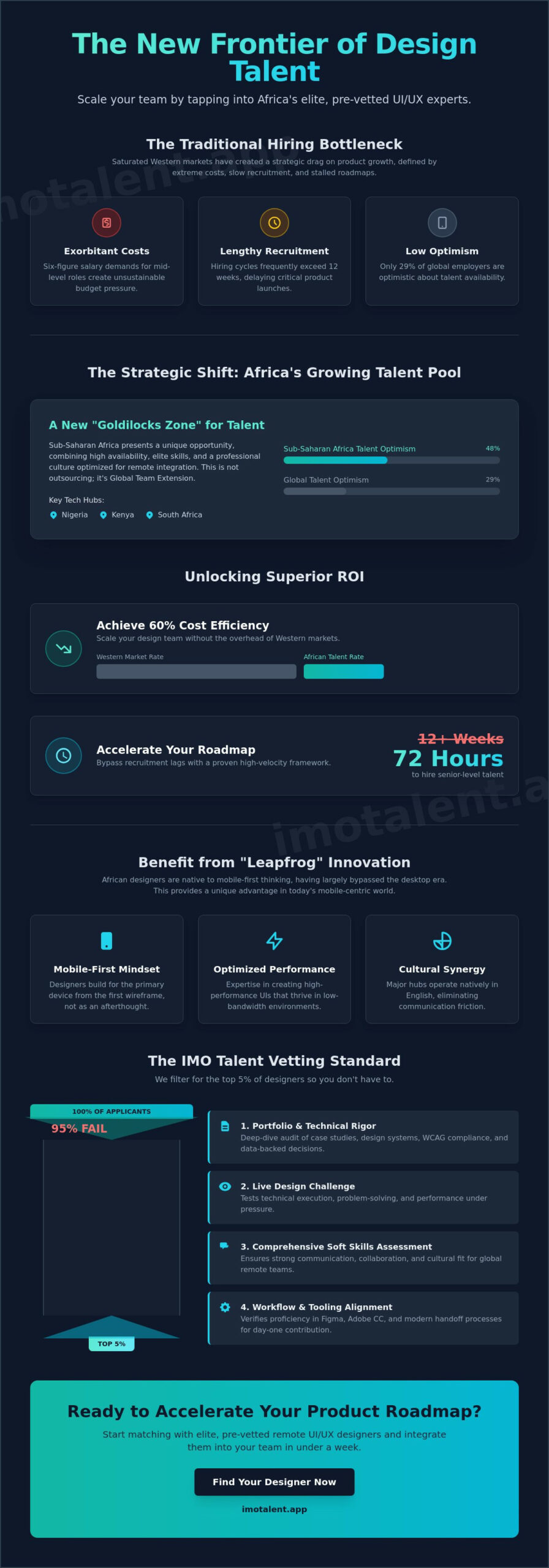
While only 29% of global employers feel optimistic about talent availability, 48% of leaders in Sub-Saharan Africa expect the talent pool to improve significantly through 2030. The traditional hunt for senior design talent in the US and UK has become a strategic bottleneck for scaling tech companies. You’re likely facing the same friction: six-figure salary demands for mid-level roles and recruitment cycles that drag on for months. It’s frustrating to watch your product roadmap stall because the domestic talent market is saturated and overpriced.
This guide changes that dynamic. You’ll learn how to secure world-class, pre-vetted remote UI UX designers Africa provides to scale your product team with 60% cost efficiency. We’ve mastered a high-velocity vetting process that allows you to hire senior-level talent in just 72 hours. We’ll explore the 2026 salary landscape in hubs like Kenya and Nigeria, legal compliance for remote teams, and the exact steps to integrate these experts into your Figma workflows seamlessly.
Key Takeaways
- Leverage the mobile-first mindset of African talent to build products that resonate in high-growth, digital-native markets.
- Learn how to access the top 5% of remote UI UX designers Africa offers through an elite, 4-stage vetting protocol.
- Optimize your budget by achieving 60% cost efficiency, allowing you to scale your design team without the overhead of Western markets.
- Implement a “single source of truth” in Figma to integrate remote designers into your existing workflows in under a week.
- Accelerate your product roadmap by bypassing traditional recruitment lags with a proven 72-hour hiring framework.
Why Global Teams are Sourcing Remote UI UX Designers in Africa
The traditional talent hubs have hit a wall. By mid-2026, the cost of senior designers in Western markets has become a massive hurdle for product growth. Recruitment cycles for a single lead role now frequently exceed twelve weeks. This isn’t just a budget issue; it’s a velocity problem. Savvy product leaders are pivoting away from these saturated markets and looking toward a more vibrant frontier.
Hiring remote UI UX designers Africa provides is no longer a secondary option. It’s a strategic move to tap into a massive demographic dividend. While global employer optimism is stagnant at 29%, 48% of employers in Sub-Saharan Africa expect talent availability to improve significantly through 2030. This creates a “Goldilocks zone” for global teams today. You gain access to high availability, elite skill sets, and a professional culture optimized for remote integration.
The Rise of African Tech Hubs
Nigeria, Kenya, and South Africa are the primary engines of this design revolution. These aren’t just emerging markets. They’re mature ecosystems. Significant infrastructure investments from global giants like Google and Microsoft have standardized local expertise. This ensures that user experience design practices in Lagos or Nairobi align perfectly with global standards. Kenya’s digital nomad permits and South Africa’s focus on labor compliance reflect a region that’s ready for high-level global partnerships. Quality is the baseline here.
Mobile-First Innovation and User Centricity
African designers lead the world in “Leapfrog” innovation. Since the continent largely bypassed the desktop era, these professionals are native to mobile-first thinking. They don’t simply shrink a web layout. They build for the primary device from the first wireframe. This expertise is invaluable for global companies targeting diverse, mobile-dependent audiences.
- Optimized Performance: African designers excel at creating high-performance interfaces that thrive in low-bandwidth environments.
- Velocity and Iteration: A culture of rapid growth has fostered a mindset of speed and high-output delivery.
- Cultural Synergy: Major hubs in Ghana and Nigeria operate natively in English. This eliminates the communication friction often found in other remote markets.
The strategy has shifted from simple outsourcing to “Global Team Extension.” You’re not just offloading tasks. You’re integrating elite specialists into your core Figma and Slack workflows. This approach builds a resilient, 24-hour design cycle that maintains high quality while reducing operational overhead. It’s about scaling your capacity without the friction of traditional geographic boundaries.
The IMO Talent Vetting Standard: Sourcing Elite Designers
Traditional job boards offer volume without verification. They force you to sift through hundreds of mediocre portfolios, wasting valuable engineering and product hours. We take the opposite approach. Our network is exclusive because we act as a rigorous filter for the top remote UI UX designers Africa has to offer. In fact, 95% of applicants fail to meet our baseline requirements. We don’t just look for designers. We look for product partners who can thrive in high-pressure, global environments.
Our 4-stage vetting protocol is designed for speed and precision. It begins with a deep-dive portfolio audit, followed by a live design challenge that tests technical execution under pressure. We then move to a comprehensive soft-skills assessment and a final workflow alignment check. This process ensures that every designer we present is ready to contribute from day one. This high standard is supported by the rapid South Africa’s digital economy growth, which has cultivated a class of professionals who understand complex digital ecosystems and global market demands. If you’re ready to bypass the screening phase entirely, you can start matching with elite talent here.
Portfolio and Technical Rigor
We don’t accept “pretty” as a metric for success. A portfolio must demonstrate a deep understanding of user psychology and business objectives. We evaluate case studies for real-world impact, looking for designers who can build scalable design systems and adhere to WCAG accessibility standards. Every candidate must be able to defend their design decisions with data and user research. We verify proficiency in Figma and Adobe Creative Cloud with a focus on component architecture and handoff readiness.
Cultural and Workflow Integration
Technical skill is only half the battle. To be a successful extension of your team, a designer must be a master of communication. We vet for native-level English proficiency and the ability to articulate complex ideas clearly. Our designers are already familiar with the tools you use every day, including Jira, Slack, and Loom. We specifically assess their ability to work in asynchronous environments, ensuring they are proactive problem-solvers who don’t need constant hand-holding. We match talent not just to your tech stack, but to your specific team dynamics and company culture.
Economic ROI: Comparing African Designers vs. Western Markets
Scaling a design department in San Francisco or London is a high-stakes gamble. The average senior salary in these hubs often consumes the majority of a seed or Series A round. By hiring remote UI UX designers Africa offers, companies realize a 60% cost efficiency. This isn’t a compromise on quality; it’s a strategic reallocation of capital. You’re moving funds from administrative overhead into core product development and aggressive marketing. Every dollar saved on a premium hire is a dollar earned in product runway.
Retention is another overlooked ROI factor. In saturated Western markets, designer churn is high as talent jumps for marginal salary increases. In contrast, African remote talent often shows higher loyalty to global companies that provide stable, high-value roles in their local context. You aren’t just hiring a freelancer; you’re building a long-term foundation with a professional who is deeply invested in your product’s success. The same cost and retention advantages apply when you hire SEO experts Africa offers to complement your design team’s organic growth strategy. To maximize this investment, pairing your design team with remote product managers Africa provides ensures your product vision is executed with the same cost efficiency and strategic depth.
Cost of Hire Breakdown
The disparity is stark. A senior designer in London might command £100,000; meanwhile, their counterpart in Lagos or Nairobi delivers the same high-velocity output at a fraction of the total cost of employment. Beyond the base salary, consider the invisible costs. You’re eliminating local payroll taxes, expensive office leases, and the burden of high-end hardware procurement. IMO Talent streamlines this by managing the administrative complexity of international hiring, so you don’t have to navigate local tax codes or compliance hurdles. Reducing hiring costs by 60% allows your team to iterate twice as fast on the same budget.
The Time Zone Advantage
Operational friction often kills remote teams. However, African hubs operate in GMT, WAT, and EAT. For European teams, this means a 0 to 2-hour difference. You’re working in real-time. For US-based companies, the “Follow the Sun” model becomes a competitive edge. Your designers in Nairobi can finish a sprint while your New York team sleeps, ensuring the product never stops moving. This synergy works exceptionally well when managing remote African developers alongside your design team. It creates a unified, high-performance output cycle that operates across continents without the lag of traditional offshore models.
Strategic Integration: Onboarding Your Remote Design Team
Successful hiring is only the first step. The real value is unlocked through precise onboarding. Many firms fail because they treat remote talent as an external vendor rather than a core team extension. When you integrate remote UI UX designers Africa provides, the first 30 days are critical. You need to establish a rhythm that balances high-velocity output with cultural alignment. It’s about moving from a “contractor” mindset to a collaborative partnership.
Figma is your primary operating system. Establishing a single source of truth here prevents version control chaos and reduces friction between design and engineering. You must standardize your design systems and component libraries from day one. This ensures that a designer in Nairobi is using the exact same assets as a developer in London. Clear documentation and component naming conventions are non-negotiable for scaling teams. If you’re ready to start this journey, book a call with our talent experts today.
Communication protocols must be surgical. Use Slack huddles for immediate, high-context syncs, but respect the “deep work” hours necessary for complex UI architecture. Transparent feedback loops and weekly design critiques build trust faster than any virtual happy hour. It’s about creating a culture where designers feel empowered to defend their decisions and iterate based on objective user data. This transparency eliminates the guesswork and keeps the product roadmap on track.
Tooling and Workflow Alignment
Handoffs shouldn’t be a mystery. Use automated documentation tools within Figma to bridge the gap between design and development. This is a core component of the build remote team Africa strategy for 2026. Standardizing your workflow ensures that geographic distance never translates to technical debt. High-performance teams rely on these rigid structures to maintain speed without sacrificing precision.
Cultural Synergy and Team Bonding
Erase the “outsourced” stigma. Your remote designers are core team members, not gig workers. Include them in global all-hands meetings and set up virtual coffee chats to foster genuine connection. Providing top-tier equipment and software access isn’t just about utility; it’s a signal of investment in their professional growth. When talent feels integrated, their output reflects the company’s mission, not just a list of tasks. This sense of belonging is what drives long-term retention and superior design quality.
The 72-Hour Hire: Accelerate Growth with IMO Talent
Speed is the ultimate competitive advantage in the 2026 tech landscape. While your competitors are stuck in four-week recruitment cycles, you can finalize your team in days. We’ve built a pre-vetted pool of the top remote UI UX designers Africa offers, eliminating the friction of traditional search. This isn’t just about filling a seat. It’s about maintaining your product velocity without compromise. Our streamlined 4-step process moves from your initial request to a confirmed hire in just 72 hours.
- Discovery: You define the specific technical and cultural requirements for your design role.
- Shortlist: We provide a curated selection of elite designers who have already passed our rigorous vetting.
- Interview: You conduct a final alignment check with your top candidates.
- Onboarding: The designer integrates into your Figma and Slack workflows immediately.
Risk mitigation is built into our model. We provide a performance guarantee that ensures talent quality remains high throughout the engagement. Our subscription-based approach isn’t just a transaction; it’s a managed solution designed for long-term retention. We handle the administrative complexities, so you can focus on the design output. If a placement doesn’t meet your expectations, our guarantee ensures a swift resolution without disrupting your roadmap.
Speed as a Competitive Advantage
For startups, waiting months for a local hire is a growth killer. Every day without a senior designer is a day your roadmap stalls. You can request a candidate shortlist for UI/UX roles today and see the caliber of our network firsthand. Consider the success of a UK-based scale-up that recently partnered with us. They needed to expand their design capacity rapidly and managed to fill three senior roles in a single week. They bypassed the domestic talent shortage and secured world-class expertise while maintaining their aggressive launch schedule.
Managed Talent Solutions
We don’t just place talent and disappear. Our role includes ongoing administrative support and performance monitoring to ensure your designers stay engaged and productive. We act as your strategic partner, managing payroll and compliance across different African jurisdictions. This allows for a seamless team extension that feels local but operates globally. If you’re ready to scale your entire engineering department, you can also hire remote developers from Africa to complement your new design team. This creates a unified, high-output product engine ready for the global market.
Secure Your Competitive Edge in Global Design
The decision to hire remote UI UX designers Africa offers isn’t just about cost; it’s about securing a high-velocity future for your product. You’ve seen how a mobile-first mindset and a 60% reduction in design overhead can transform your roadmap from stagnant to scalable. By tapping into a pre-vetted pool representing the top 5% of professional talent, you bypass the friction of traditional recruitment and focus on what matters: building world-class user experiences.
We provide the dedicated talent management support needed to ensure every placement is a long-term success. You don’t have to wait weeks to find the right fit. Our streamlined matching process delivers elite design specialists who are ready to integrate into your Figma workflows immediately. It’s time to stop overpaying for local scarcity and start investing in global excellence. Your next senior designer is ready to start.
Hire a vetted Remote UI/UX Designer in 72 hours
Frequently Asked Questions
How do you ensure the quality of remote UI UX designers in Africa?
We ensure quality through a surgical 4-stage vetting process that rejects 95% of applicants. This protocol includes a deep portfolio audit, live design challenges, and a soft-skills assessment to verify agile readiness. You only meet the top 5% of remote UI UX designers Africa offers. This eliminates the guesswork and ensures every candidate is ready to contribute to high-performance product teams from day one.
What are the typical time zone differences when hiring from Africa?
African tech hubs operate primarily in GMT, WAT, and EAT time zones. This provides a 0 to 2-hour difference for European companies, allowing for full synchronous collaboration during the standard workday. For US East Coast teams, the 5 to 7-hour overlap is ideal for daily standups and afternoon handoffs. This alignment creates a “follow the sun” model where design work continues while your core team sleeps.
Can African designers work on complex Figma design systems?
Yes, our designers specialize in building and maintaining scalable Figma design systems. They are proficient in advanced component architecture, auto-layout, and the latest Figma variables for multi-mode design. We specifically vet for the ability to create documentation that developers can follow without friction. This ensures your design system remains a single source of truth as your product scales across different platforms and regions.
How does IMO Talent handle international payroll and compliance?
IMO Talent handles the administrative complexity of international hiring through our managed placement model. We oversee the vetting process and provide ongoing support to ensure long-term talent retention. You don’t have to navigate local tax codes or international labor laws in hubs like Nigeria or Kenya. We act as the elite facilitator, allowing you to focus on product output while we manage the operational overhead.
What is the typical turnaround time for a remote design hire?
You can hire a senior designer in just 72 hours. Our pre-vetted pool of remote UI UX designers Africa allows us to bypass the traditional 4-week recruitment lag. We provide a curated shortlist of candidates who match your specific technical and cultural requirements immediately. This high-velocity approach ensures your product roadmap never stalls due to a lack of elite design capacity or slow-moving HR processes.
Do African designers have experience with US/UK design standards?
Absolutely. Designers in our network have extensive experience working with global scale-ups and strictly follow international accessibility standards like WCAG. They are native English speakers who understand the nuances of US and UK market expectations. Their mobile-first expertise is a direct result of designing for sophisticated users in Africa’s rapidly evolving digital economy, making them ideal for global product expansion and diverse audiences.
Is there a trial period for new remote design placements?
We provide a performance guarantee to ensure your hire meets the high standards of your team. Our model is built for long-term integration, but we offer the flexibility to cancel after the initial three months with a 30-day notice period. This structure builds trust and ensures that we remain an active partner in your success. We’re invested in matching you with talent that provides immediate and sustained ROI.
What design tools are most commonly used by African tech talent?
Figma is the industry standard used by 100% of the designers in our network. They are also proficient in the Adobe Creative Cloud suite for complex asset creation and motion design. For workflow management, our talent is expert in using Jira, Slack, and Loom to maintain transparent communication. These tools are standardized across our network to ensure a seamless fit into your existing product development and handoff ecosystem.
