

Why are you still paying a 30% “success fee” to recruitment agencies for talent that takes months to arrive? With the average cost-per-hire for non-executive roles sitting at approximately $4,683, the financial strain on growing companies is immense. It’s a frustrating reality where local competition for senior developers is at an all-time high, but there is a proven way to reduce hiring costs remote talent and secure elite experts without the traditional price tag.
You can actually slash your recruitment overheads by up to 60% while maintaining exceptionally high standards. By tapping into the African remote workforce, you gain access to a curated pool of senior-level professionals who are ready to integrate into your team. This isn’t about cutting corners; it’s about leveraging global economic variances to your advantage.
This guide explores how to bypass recruitment friction and fill critical tech roles in days, not months. We will break down the steps to help you cut your total recruitment spend by at least 50% and find the senior talent your business needs to scale at pace.
Key Takeaways
- Uncover the hidden “budget killers” that bloat your recruitment spend, including agency fees and the productivity drain of long interview cycles.
- Learn how to reduce hiring costs remote talent by leveraging geographic arbitrage and tapping into the elite African workforce.
- Compare data-driven salary expectations to see how you can secure senior-level professionals for up to 60% less than local hires.
- Adopt a 72-hour hiring strategy that uses pre-vetted talent to fill critical roles in days rather than months.
- Maximise your long-term ROI by implementing management practices that ensure your remote talent stays integrated and productive for years.
The Hidden Drain: Why Your Current Hiring Costs are Ballooning
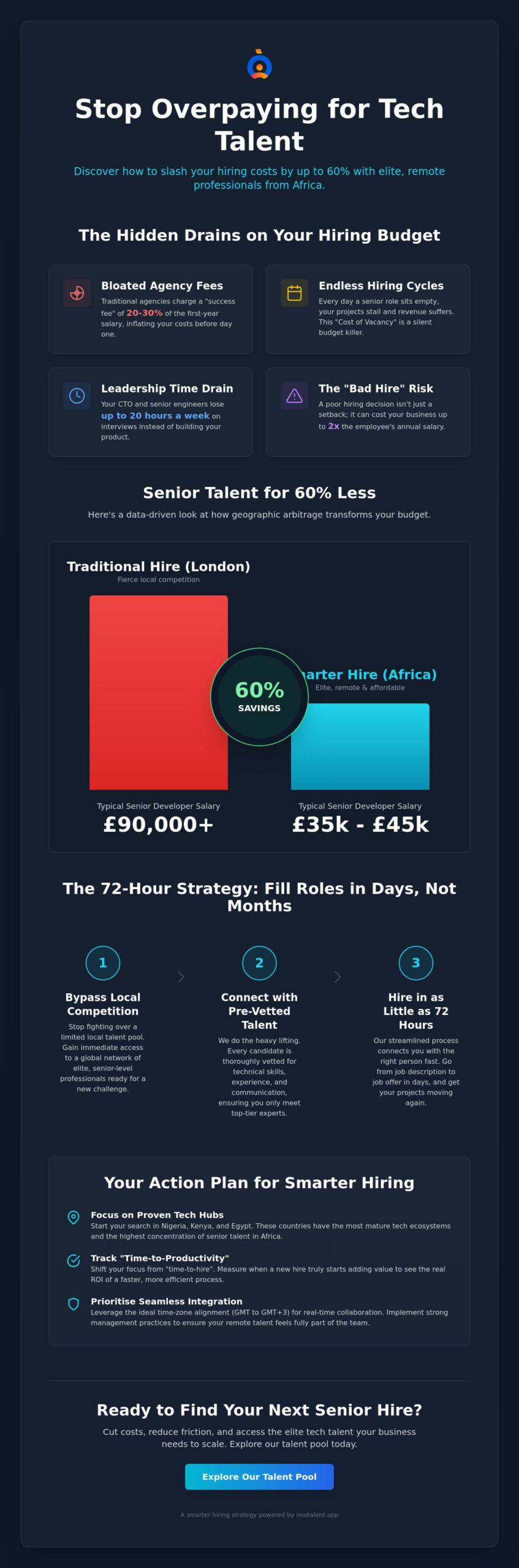
Most companies look at a recruitment agency invoice and think that’s the total cost of a new hire. They’re wrong. True cost per hire is a composite metric. It includes every pound spent from the moment a role is approved to the day the employee is fully productive. When you rely on traditional models, you aren’t just paying fees; you’re battling three major budget killers. First, agency fees often sit between 20% and 30% of a candidate’s first-year salary. Second, job board saturation means you’re paying more for less visibility. Third, interview fatigue drains your leadership team’s energy and focus.
There is also the “Cost of Vacancy.” Every day a senior role sits empty, your revenue takes a hit. Projects stall. Deadlines slip. This “Recruitment Friction” is a natural byproduct of the UK and US markets. Intense local competition makes it nearly impossible to reduce hiring costs remote talent through standard channels. You’re effectively paying a premium for a slow, inefficient process that hampers your ability to scale.
Calculating Your True Cost per Hire
Don’t ignore the hidden internal hours. When your CTO or Lead Engineers spend twenty hours a week screening CVs, they aren’t building your product. That is a massive operational drain. You also have to factor in the “bad hire” risk. Industry data suggests a poor hiring decision can cost up to twice the employee’s annual salary. Various studies on remote work highlight how shifting to a distributed model can mitigate these overheads by expanding the search radius and lowering the pressure on local resources.
Actionable Tip: Create a simple spreadsheet to track “time-to-productivity” rather than just “time-to-hire.” This gives you the real data on when a hire actually starts generating value for the business.
The 2026 Recruitment Landscape: Why Local Hiring is Broken
The salary arms race in tech hubs like London is unsustainable. Local competition is so fierce that niche job boards no longer provide a decent return on investment. You’re bidding against global giants for a handful of local candidates. Accessing global markets is no longer a luxury; it’s a strategic necessity. By moving beyond local borders, you can reduce hiring costs remote talent while securing the high-performing experts your growth requires. The shift toward global talent is the only logical response to a broken local market.
Geographic Arbitrage: Reducing Costs by Tapping into Emerging Tech Hubs
Geographic arbitrage is the strategic practice of hiring elite professionals in regions where the cost of living is significantly lower than your own headquarters. It is the most effective way to reduce hiring costs remote talent without sacrificing the technical expertise your projects demand. By 2026, Africa has firmly established itself as the final frontier for high-quality, affordable remote talent. This isn’t just about finding cheaper labour. It’s about tapping into a mature, sophisticated market that remains undervalued by traditional Western recruiters.
The quality myth regarding African tech talent has been thoroughly debunked. Global giants like Google, Microsoft, and Amazon have already established massive engineering hubs in the region. You aren’t competing for juniors. You’re accessing senior-tier experts who have been battle-tested in global environments. The time-zone advantage is also impossible to ignore. Major African hubs operate within GMT to GMT+3, aligning almost perfectly with UK and European working hours. This allows for real-time collaboration and eliminates the productivity lag often found when outsourcing to Asia or the Americas.
The Quality-to-Cost Ratio in the African Market
The financial logic is undeniable. A senior developer in London often commands a salary upwards of £90,000. In booming hubs like Lagos or Nairobi, an elite professional with the same technical stack and experience level typically expects between £35,000 and £45,000. It’s vital to remember that “affordable” does not mean “entry-level.” We are talking about vetted, senior-tier pros who can lead teams and architect systems. If you’re ready to see how this fits your budget, you can explore our talent matching options to get started.
Actionable Tip: Focus your initial search on Nigeria, Kenya, and Egypt. These countries currently boast the most robust tech ecosystems and the highest concentration of senior developers on the continent.
Cultural and Language Alignment
Language barriers are a massive hidden cost in remote hiring. Fortunately, English is the primary language of business and higher education across major African tech hubs. This creates a level of cultural and linguistic alignment that is often missing when hiring from Eastern Europe or Southeast Asia. Shared language ensures that complex requirements are understood the first time, preventing the expensive rework that stems from communication errors.
Senior Talent for 60% Less: A Data-Driven Cost Comparison
Hiring locally is a capital drain. It’s expensive. It’s slow. In 2026, the total cost of an employee is typically 1.25 to 1.4 times their base salary. This is known as the Total Cost of Employment (TCE). It covers national insurance, pension contributions, and the high price of city-centre office space. When you reduce hiring costs remote talent, you aren’t just saving on the monthly wage. You are stripping away the heavy infrastructure of traditional employment.
By shifting to a remote-first model, you eliminate the need for expensive commercial leases in tech hubs like London. You also avoid the intense payroll taxes associated with local hires. For a detailed breakdown of these figures, check the cost of hiring senior developers Africa to see how the global benchmark has shifted.
Tech vs. Business vs. Design: Where the Savings Are
Software engineers often see the most dramatic price difference. A senior developer in the UK might expect £90,000, while an equally skilled professional in an emerging hub costs significantly less. However, the savings extend to every department. Product managers and UI/UX designers are now readily available in global markets. Remote business talent is actually the fastest-growing sector for scale-ups. These roles, from operations to marketing, allow you to build a lean, high-performing team without the bloated overheads.
Eliminating the Recruitment ‘Middle Man’ Fees
Traditional recruitment agencies are a primary source of budget leakage. Paying a 20% to 30% placement fee on a £100,000 salary is a massive upfront hit. Managed talent platforms replace this outdated model with transparent, predictable costs. You avoid the ‘success fee’ trap. You also save on the time-to-hire. A six-month search for a local developer is a productivity killer. A managed platform finds that same talent in days. To see the full budget impact, compare the cost of hiring developers in US vs Africa.
The 72-Hour Strategy: How Speed and Pre-Vetting Slashes Overhead
Speed is your greatest ally when you want to reduce hiring costs remote talent. Traditional recruitment is a slow, expensive grind that drains your operational resources. Every day a critical role remains unfilled, your team’s productivity drops and your growth targets slip. The “scheduling nightmare” of traditional interviews can stretch for weeks or even months. This delay it’s a direct hit to your revenue. A 72-hour turnaround time completely eliminates this friction. By adopting a “Master Matchmaker” approach, you move from a reactive search to an elite, proactive placement model that prioritises high velocity.
You should never look at an unvetted CV again. It’s a total waste of your leadership team’s time and focus. Instead, focus on candidates who’ve already passed through a rigorous selection process. This allows you to bypass the noise and move straight to the final decision. This efficiency is what separates high-growth scale-ups from stagnant organisations. If you’re ready to accelerate your growth and stop wasting time on the wrong candidates, you can start hiring top-tier talent today.
The 4-Step Streamlined Hiring Process
A centralised process is the key to operational readiness. It removes the guesswork and creates a predictable path to your next hire. Follow these four steps to secure your next team member:
- Step 1: Define the role. Be clinical about the technical requirements and team fit.
- Step 2: Access the curated pool. Tap into a pre-vetted network of senior professionals immediately.
- Step 3: Rapid interview. Move at high velocity to assess alignment.
- Step 4: Onboard. Integrate the new hire into your workflow without any delay.
This approach saves more than 40 hours of internal HR time per hire. It prevents your CTO or senior engineers from becoming full-time recruiters, allowing them to stay focused on product development. Actionable Tip: Limit your interview process to exactly two rounds. This maintains momentum and ensures you don’t lose elite candidates to faster-moving competitors who understand the value of time.
Risk Mitigation through Rigorous Vetting
The real cost of a bad hire isn’t just the lost salary. It’s the massive disruption to your team’s morale and project timelines. “Vetted” must mean more than just a quick introductory chat. It involves deep technical testing, soft skills assessment, and thorough reliability checks. This high-level screening significantly reduces the “failed probation” rate, which is a huge hidden cost in traditional hiring. It’s a strategic move to protect your bottom line and ensure seamless integration. You can learn more about how a remote talent placement service handles these mechanics to ensure long-term success and high performance.
Beyond the Hire: Managing Remote Talent for Long-Term ROI
The real profit isn’t in the hire. It’s in the stay. While the initial placement saves you money, the true financial advantage matures when your talent remains with the company for two years or more. High turnover is a silent budget killer. It forces you back into the recruitment cycle, wasting the time and resources you worked so hard to save. Elite talent management ensures that your remote professionals aren’t just “hired hands” but integrated members of your core team. This long-term stability is what transforms a one-off saving into a sustainable growth engine.
Handling payroll, compliance, and local taxes in 2026 is a complex task. Employment laws vary wildly across borders. In California, for example, minimum wage increases and new regulations like SB 294 have changed the landscape. Trying to manage these legalities with an in-house team is expensive and risky. A managed subscription model acts as an insurance policy for your investment. It offloads the administrative burden, allowing you to focus on high-level strategy while experts handle the operational fine print.
Onboarding for Retention
The first 30 days determine the next three years. If a new hire feels isolated, they won’t stay. You need a structured integration plan that bridges the physical distance. A “Digital Welcome Kit” is a great start. It should include everything from hardware setup guides to a breakdown of your company culture. Pairing the new hire with a local “buddy” is another high-impact move. This provides them with a direct line for informal questions, speeding up their path to full productivity. For more advanced scaling techniques, you can explore how to build remote team Africa with a focus on long-term success.
Actionable Tip: Schedule a “non-work” video call within the first week. This allows the team to build a personal connection that purely task-based meetings often miss.
The ROI of a Managed Workforce
A DIY approach to global hiring often leads to legal headaches and hidden fees. Managed talent platforms provide a clear alternative. They offer performance monitoring and local support that prevents costly drops in output. You aren’t just paying for a person; you’re paying for a result. This structured oversight ensures that every hire contributes to your bottom line from day one. Managed remote talent is the most sustainable and efficient way to reduce hiring costs remote talent while building a high-performance organisation that scales with ease.
Build Your High-Performance Global Team Today
Traditional hiring is a slow, expensive bottleneck that your business can no longer afford. By embracing geographic arbitrage and pre-vetted talent, you turn recruitment from a drain into a competitive advantage. You’ve seen how easy it is to reduce hiring costs remote talent by tapping into the African tech ecosystem. It’s about more than just finding a lower price point; it’s about securing senior experts who are ready to hit the ground running.
Speed and reliability are the cornerstones of modern scaling. With a vetted network of over 5,000 African professionals, you don’t have to wait months for the right fit. Global scale-ups already trust this model to deliver elite results with an average placement time of under 72 hours. It’s time to stop overpaying for local scarcity and start leveraging global abundance.
Take the first step toward a leaner, more agile organisation. Reduce your hiring costs by 60%, book a call with IMO Talent today. Your next senior hire is closer than you think.
Frequently Asked Questions
How much can I realistically save by hiring remote talent in Africa?
You can typically slash your recruitment and salary overheads by up to 60%. This saving comes from geographic arbitrage, which is the practice of hiring experts in regions with a lower cost of living. You also bypass UK-specific expenses like National Insurance, pension contributions, and the need for a physical office. It’s a strategic way to build a senior team without the London price tag.
Is the quality of African developers comparable to UK or US talent?
Yes, the quality is world-class. Major tech hubs in Nigeria, Kenya, and Egypt are home to senior engineers who have already worked for global giants like Google and Microsoft. These professionals are battle-tested in high-pressure environments and possess the same technical rigour as developers in London or San Francisco. The only difference is the economic context in which they live and work.
What are the hidden costs of hiring remote employees overseas?
The primary hidden costs involve local compliance, international payment fees, and laptop logistics. However, when you use a managed platform, these elements are usually bundled into a single transparent fee. This prevents the “cost of vacancy,” which is the revenue you lose every day a role remains empty. It’s much cheaper than hiring a local legal team to navigate foreign labour laws.
How do I handle payroll and compliance for remote workers in Africa?
You don’t need to build an in-house legal department. Most scale-ups use a managed talent platform or an Employer of Record to handle local taxes and employment contracts. This ensures you stay compliant with local regulations without the administrative stress. It’s a plug-and-play solution that lets you reduce hiring costs remote talent while protecting your business from legal risks across different borders.
Can I hire remote talent for non-tech roles like design or business?
Absolutely. While tech is a massive sector, remote business and design talent are growing just as fast. You can easily find senior UI/UX designers, product managers, and operations specialists who are fluent in English and familiar with UK business standards. These roles are essential for scale-ups that need to build out entire departments quickly without the high costs of local city-centre recruitment.
What happens if a remote hire doesn’t work out?
If a hire isn’t the right fit, elite placement services offer a replacement guarantee. This means they’ll find a new candidate at no extra cost to your business. This safety net is vital because it protects you from the financial hit of a bad hire, which can often cost twice an employee’s annual salary. It turns a risky decision into a secure investment for your team.
How do I manage time-zone differences with a remote team?
Africa is perfectly aligned with the UK and Europe. Most major hubs operate within zero to three hours of GMT. This allows for real-time collaboration and eliminates the frustrating communication lags you find when working with teams in Southeast Asia or the Americas. You can hold team meetings during normal business hours and maintain a high velocity without anyone working through the night.
Why is a 72-hour hire better than a traditional recruitment cycle?
Speed is a massive cost-saver. A traditional hiring cycle can drag on for months, draining your leadership team’s time and stalling your product roadmap. A 72-hour hire relies on a pre-vetted network, meaning you only interview candidates who are already qualified. This efficiency slashes your process overheads and ensures you fill critical gaps before they start impacting your company’s revenue and growth targets.
