

Did you know the average time to hire a developer in the UK stretches between 35 and 45 days? It is a frustrating cycle of endless interviews and astronomical salary expectations that can stall your product roadmap for months. Most hiring managers accept this as the standard cost of doing business, but waiting that long is a luxury your startup simply cannot afford. This guide reveals how to execute a quick remote developer hire by tapping into elite, pre-vetted talent pools in Africa, where world-class engineers are ready to integrate with your team in just 72 hours.
We understand the fear of ghosting or poor quality that often comes with unvetted freelancers. That is why we focus on a curated approach that prioritises high-retention talent. You will learn how to bypass the traditional recruitment slog and secure high-performing developers who actually understand your product. We will show you how to achieve a 60% reduction in hiring costs without sacrificing the technical excellence your project demands. From rigorous vetting processes to seamless onboarding, here is your blueprint for scaling your tech team at high velocity.
Key Takeaways
- Slash your recruitment cycle from months to days by accessing pre-vetted talent pools ready for immediate interview.
- Secure a quick remote developer hire to maintain product momentum and bypass the high costs of traditional local recruitment.
- Tap into the African tech ecosystem to achieve up to 60% cost savings while working with elite engineers in your own timezone.
- Implement a 24-hour onboarding strategy to ensure your new hire is productive and integrated from their first day.
- Protect your business from the hidden productivity costs and missed deadlines associated with long-term open developer roles.
Why the Traditional Hiring Process is Costing Your Business
A quick remote developer hire is more than just a fast recruitment fix; it is a strategic necessity for any tech company looking to maintain its competitive edge. In 2026, the tech market moves at a high velocity. If your development cycle halts because you are missing a key engineer, your competitors will inevitably pull ahead. Traditional UK recruitment cycles frequently stretch beyond 90 days, leaving businesses in a state of paralysis. This delay is no longer just an inconvenience; it’s a threat to your company’s survival.
The industry has moved away from the “wild west” of general freelance marketplaces where quality is a gamble. Instead, we have seen a decisive shift toward vetted talent platforms. These platforms provide the certainty that traditional job boards lack. When you need to scale, you cannot afford to spend months sifting through unverified CVs. You need elite professionals who are ready to hit the ground running.
The True Cost of a Vacant Engineering Seat
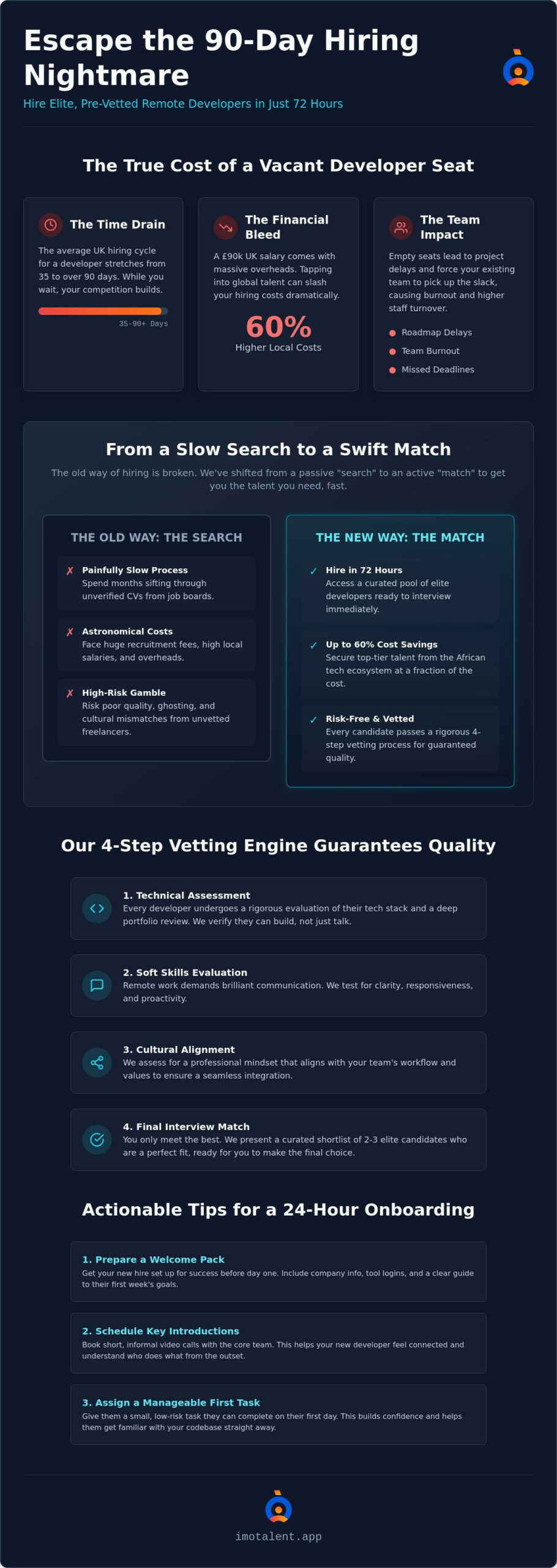
Every day a seat remains empty, your product roadmap suffers. It is not just about the code that isn’t being written. It is about the missed deadlines that frustrate stakeholders and the lost productivity that ripples through your entire organisation. When roles stay empty, the impact is felt in several ways:
- Roadmap Delays: Essential features get pushed back, delaying your market entry and giving rivals a window to capture your audience.
- Team Burnout: Your current developers must pick up the slack. This leads to fatigue, increased mistakes, and eventually, higher staff turnover as your best people look for less stressful environments.
- Financial Drain: A local UK hire with a £90k salary comes with massive overheads, including office space, national insurance, and expensive benefit packages.
The global adoption of remote work has fundamentally changed the financial equation. By looking beyond local borders, you can secure high-tier talent that offers a 60% cost reduction compared to UK-based roles, all while maintaining or even exceeding technical standards.
Why Traditional Recruitment Agencies are Too Slow
Traditional agencies usually rely on “active” candidates who are already browsing job boards. The problem is that the best talent is often “passive,” meaning they aren’t actively looking but are open to elite opportunities. Agencies spend weeks sourcing, while top-tier talent platforms already have a curated pool ready to interview.
Long-winded interview stages are another significant bottleneck. In a tight market, top talent is snatched up in days, not weeks. If your process takes a month, your ideal candidate will have signed with a competitor before you even reach the second round. Recruitment lag is the gap between identifying a resource need and that developer’s first productive day; it is a period that typically drains three months of potential growth from modern scale-ups.
The 72-Hour Hire: A Blueprint for Rapid, Risk-Free Scaling
A 72-hour turnaround feels impossible if you are starting from scratch. For a high-velocity startup, speed is the only advantage that truly matters. A quick remote developer hire is achievable because the heavy lifting happens before you even post a job description. While traditional recruiters begin a fresh “search” every time a vacancy opens, elite facilitators use a “matching” engine. This shift in mindset moves you from a passive observer of endless CVs to an active decision-maker with a curated shortlist of professionals who are ready to interview immediately.
Speed does not mean sacrificing quality. It means having an infrastructure that identifies excellence in advance. When you move from a search mindset to a matching mindset, you bypass the noise of the open market. You aren’t hoping to find the right person; you are selecting from a pool where the right person already exists.
The 4-Step Vetting Engine Explained
We do not cut corners. We simply move faster by using a methodical vetting process that ensures every candidate is ready to contribute from day one. Our engine is built on four distinct layers:
- Technical Assessment: Every engineer undergoes a rigorous evaluation of their specific tech stack and a deep portfolio review. We verify they can actually build, not just talk.
- Soft Skills Evaluation: Remote work requires exceptional communication. We test for clarity, responsiveness, and the ability to work effectively across different timezones.
- Cultural Alignment: We use problem-solving simulations to see how they handle real-world pressure and if they fit your team’s unique working style.
- Expert Matching: We hand-pick the developer who fits your specific project needs and company DNA, ensuring a seamless integration.
Reducing the Risk of a Bad Hire
Traditional recruitment is a massive financial burden. Research from SHRM indicates that the average cost per hire was nearly $4,700. A bad hire easily doubles that cost through lost time, missed deadlines, and the need for retraining. By using a pre-vetted pool, you eliminate “technical interview fatigue” for your senior staff. They no longer need to spend dozens of hours screening candidates who aren’t a technical fit.
Instead, your team focuses on the final chemistry check. This efficient remote talent placement service allows you to scale strategically without the usual friction. We provide performance guarantees to ensure the match is perfect for the long term. If you want to see how this high-velocity matching works in practice, you can explore our talent network today. Speed is your competitive edge; don’t let a slow hiring process dull it.
Why Africa is the Premier Hub for Remote Developers in 2026
Africa is no longer an “emerging” market; it is a global tech powerhouse. By 2024, the continent already boasted over 1,000 active tech hubs, with cities like Lagos and Nairobi leading the charge in Fintech and Mobile Money. This explosion of talent makes the region the most logical choice for a quick remote developer hire in 2026. While your competitors are stuck fighting over the same expensive pools in Eastern Europe, you can tap into a network that raised over $3 billion in venture capital in 2025 alone. In the first two months of 2026, that momentum continued with another $575 million raised, proving the sector’s maturity.
English proficiency is a massive, often overlooked advantage. In major hubs like Nigeria, Kenya, and Ghana, English is the official language of business and professional education. This eliminates the “translation tax” that frequently slows down development cycles in other regions. You get clear documentation, seamless stand-ups, and a developer who understands your business objectives as clearly as they understand their code. Communication is the foundation of remote success, and Africa offers it natively.
Timezone Harmony: The Secret to Agile Success
Agile development relies on rapid feedback loops. Working with developers in Asia or the US West Coast often creates a 12-hour delay that stalls momentum and kills productivity. Most African tech hubs sit within UTC to UTC+3, meaning they share nearly identical working hours with the UK and Europe. You can hold real-time stand-ups and solve urgent bugs together in the afternoon, rather than waiting for an “overnight lag” to resolve. This alignment ensures that your remote team feels like a natural extension of your office, not a distant department.
Quality Meets Affordability
The economic reality is clear. You can secure senior engineers for a fraction of the cost of a London-based developer. While US-based remote rates often exceed $50 per hour, hiring remote developers from Africa allows you to achieve a 60% reduction in costs without sacrificing seniority. It is a strategic budget move that lets you scale your engineering team without draining your runway. You are not just saving money; you are reinvesting that capital into faster growth.
Actionable Tip: To speed up integration, set up your communication channels with automated timezone reminders. Tools like Slack can show you the local time for each team member, helping you schedule meetings that respect everyone’s working hours while maximising the overlap for real-time collaboration.
Actionable Tips for Onboarding Your Quick Remote Hire
A quick remote developer hire is only as successful as the onboarding process that follows it. Speed in recruitment must be matched by speed in integration. You cannot afford to let a world-class engineer sit idle for three days while waiting for GitHub permissions or a Slack invite. If you want your new developer to be productive within their first week, you need to prepare your internal team in under 24 hours. This means having their environment ready before they even log in for the first time.
Successful onboarding isn’t about a massive handbook; it’s about momentum. By setting clear KPIs and communication protocols from day one, you remove the guesswork that often plagues remote teams. Your new hire should know exactly what success looks like for their first week, their first month, and their first quarter. This clarity builds trust and allows them to focus on what they do best: writing high-quality code.
Setting Up Your Remote Infrastructure
Efficiency starts with your toolkit. Ensure your new developer has immediate access to Slack for communication, Jira for task management, and GitHub for version control. We recommend establishing “Core Hours” where everyone is online at the same time. This 4-hour window is perfect for synchronous meetings, sprint planning, and pair programming. Clear, accessible documentation acts as a 24/7 mentor that reduces onboarding friction and empowers your new hire to solve problems independently.
Focus on Retention and Culture
We believe that remote hiring is a long-term strategic placement, not a short-term gig. Building social capital is essential for high-retention teams. Encourage your new developer to join non-work Slack channels and schedule a virtual coffee during their first 48 hours. This human connection is the glue that holds remote-first engineering teams together.
Because you are likely managing remote African developers, you should follow a high-performance integration playbook that prioritises regular feedback. Set up weekly check-ins to monitor performance and provide ongoing support. If you are ready to scale your engineering team without the usual friction, you can start your 72-hour talent match today.
The First 48 Hours Checklist:
- Hour 1-4: Complete access to all repos, documentation, and communication tools.
- Hour 4-8: Initial 1-on-1 with the Tech Lead to discuss the product roadmap.
- Day 2: Assign a “small win” task—a bug fix or minor feature—to get them into the codebase immediately.
- Day 2 Afternoon: A culture-focused meet-and-greet with the wider team.
IMO Talent: Your Partner for Elite Remote Developer Placement
Securing a quick remote developer hire shouldn’t feel like a gamble with your company’s future. We act as an elite facilitator, bridging the gap between your urgent technical needs and the vast pool of African excellence. While traditional agencies often act as passive middlemen, we operate at a high velocity to ensure your product roadmap never stalls. Our commitment is simple: we provide a curated match within 72 hours, allowing you to bypass the noise and focus on building your product.
We distinguish ourselves by focusing on “managed talent” rather than just one-off placements. This means we don’t just hand over a CV and disappear. We take an active role in ensuring your new developer is equipped to succeed within your specific organisational structure. We understand that a developer who doesn’t integrate well is a cost, not an asset. Our goal is to provide a seamless bridge that connects global standards with local expertise.
The IMO Talent Difference
Our deep roots in the African tech ecosystem give us access to proprietary vetting data that others simply don’t have. We use a “Master Matchmaker” approach that goes beyond technical skills; we find the specific developer who fits your team’s DNA. We don’t just find devs; we find your dev. This curated selection process is why global scale-ups trust us to power their engineering departments. We have seen firsthand how the right match can transform a struggling project into a market leader.
Ready to Scale Your Engineering Team?
The transition to a global workforce is the most significant growth lever available to modern businesses. Recognising that an African talent recruitment agency is your best growth engine in 2026 is the first step toward sustainable scaling. You can achieve a 60% reduction in hiring costs while maintaining a 72-hour recruitment speed, giving you a massive competitive advantage over those still stuck in local hiring cycles.
Getting started is straightforward. You can book a consultation today to view our pre-vetted shortlist of elite engineers. Tell us about your tech stack, your team culture, and your immediate goals. We will provide the talent you need to scale with confidence and precision. Don’t let a vacant seat slow your momentum; let us find your next high-performing remote developer now.
Actionable Tip: Before your consultation, define the “Top 3” non-negotiable technical skills and the “Top 2” cultural traits your team values. This clarity allows our matching engine to work even faster, often shortening the 72-hour window to a same-day introduction.
Scale Your Engineering Team at High Velocity
The days of waiting 90 days to fill a vacant engineering seat are over. You now have the blueprint to execute a quick remote developer hire that prioritises technical excellence while slashing your recruitment overheads by 60%. By shifting your focus toward the elite tech hubs in Africa, you gain access to high-performing professionals who share your timezone and speak your language natively. This approach isn’t just about filling a gap; it’s about building a high-retention team that truly understands your product vision.
Success in 2026 belongs to the businesses that can scale without the friction of traditional recruitment slogs. You have seen how a 72-hour turnaround is possible through rigorous pre-vetting and expert matching. Now, it’s time to put that knowledge into action and reclaim your product roadmap. Stop letting recruitment lag dictate your growth speed.
Hire your next elite remote developer in 72 hours with IMO Talent. We provide vetted African tech talent, massive cost savings compared to UK rates, and the ongoing management support your business deserves. Your next great hire is ready to start. Let’s get to work.
Frequently Asked Questions
How can you vet a developer in just 72 hours?
We don’t start the vetting process from scratch when you reach out. Our talent network is already pre-vetted through a rigorous four-step engine that includes technical assessments and soft skills evaluations. When you need a quick remote developer hire, we simply match your specific requirements to engineers who have already passed our high standards and are ready to interview immediately.
Which African countries have the best remote developers?
Nigeria, Kenya, Ghana, and South Africa currently lead the continent in tech talent. Nigeria is a global powerhouse for Fintech, while Kenya’s “Silicon Savannah” excels in mobile technology and Agritech. These hubs have matured significantly, with over 1,000 active tech centres across the continent providing a deep pool of senior-level expertise for international teams.
Will the timezone difference be a problem for my UK team?
No, the timezone alignment is actually a major advantage for UK and European businesses. Most African tech hubs sit within UTC to UTC+3, meaning your team and your developers share nearly identical working hours. You can enjoy real-time collaboration and afternoon stand-ups without the frustrating overnight lag often found when outsourcing to Asia or the US West Coast.
How much can I actually save by hiring a remote developer in Africa?
You can typically reduce your hiring costs by up to 60% compared to local UK or US salary expectations. These savings come from the lower cost of living in regions like Lagos or Nairobi, not from a drop in quality. You get access to senior engineers who offer elite technical skills without the astronomical overheads of office space and London-weighted benefits.
What happens if the remote developer isn’t a good fit?
We prioritise long-term retention, but we also provide performance guarantees to mitigate your risk. If a developer doesn’t meet your expectations during the initial period, we handle the replacement process at high velocity. Our “Master Matchmaker” approach is designed to find the right cultural and technical fit the first time, ensuring your product roadmap stays on track.
Is English the primary language for these developers?
Yes, English is the official language of business and professional education in major hubs like Nigeria, Kenya, and Ghana. Communication barriers are virtually non-existent because these developers are fluent and accustomed to working in global environments. You can expect clear documentation, articulate stand-up contributions, and seamless integration into your existing Slack or Jira workflows.
What tech stacks are most common among African remote developers?
You will find deep expertise in modern, high-demand stacks such as React, Node.js, Python, and Ruby on Rails. Because the African market is mobile-first, there is also an abundance of talent skilled in Swift, Kotlin, and Flutter. We use clinical precision to match developers to your specific stack, ensuring they have the exact technical tools your project requires.
Do you handle the payroll and administrative management of the talent?
We focus on elite facilitation through vetting and matching to ensure your quick remote developer hire is successful. For payroll and administrative compliance, many of our clients use Employer of Record (EOR) services. This approach simplifies local labour laws and tax regulations, allowing you to manage your new developer as a natural extension of your team without the administrative headache.
