

What if you could stop choosing between your runway and your engineering standards? By mid-2026, the average cost per hire has surged past $4,700, and that’s before you factor in the 6.7% rise in health benefit expenses or the heavy weight of National Insurance. It’s a frustrating cycle that makes it feel nearly impossible to cut hiring costs 60 percent without sacrificing the quality of your code. You likely feel the pressure of local salary expectations that simply don’t align with your need to remain lean and agile.
We understand that the old way of recruitment is no longer sustainable for high-growth teams. This guide promises a better way forward; you’ll discover how to access elite, vetted professionals from Africa’s thriving tech hubs who deliver world-class results at a fraction of the traditional overhead. We will walk through the strategic steps to reduce your burn rate and scale your team rapidly, showing you how to achieve a 72-hour placement turnaround. This ensures you hit your 2026 targets without the typical friction of slow, expensive hiring processes.
Key Takeaways
- Understand why rising taxes and wage inflation in the UK and US are making local recruitment unsustainable for growth-focused firms in 2026.
- Learn how to use geographic arbitrage to cut hiring costs 60 percent by tapping into high-skill, lower-overhead talent markets like Africa.
- Discover the vetting secrets that ensure remote talent meets elite engineering and design standards without compromising on quality or performance.
- Identify which of your current vacancies are truly location-independent to begin a smooth transition to a global remote model.
- Find out how to scale your team in just 72 hours by partnering with a specialist that handles the heavy lifting of talent management and support.
The 2026 Talent Crunch: Why Local Hiring Costs are Skyrocketing
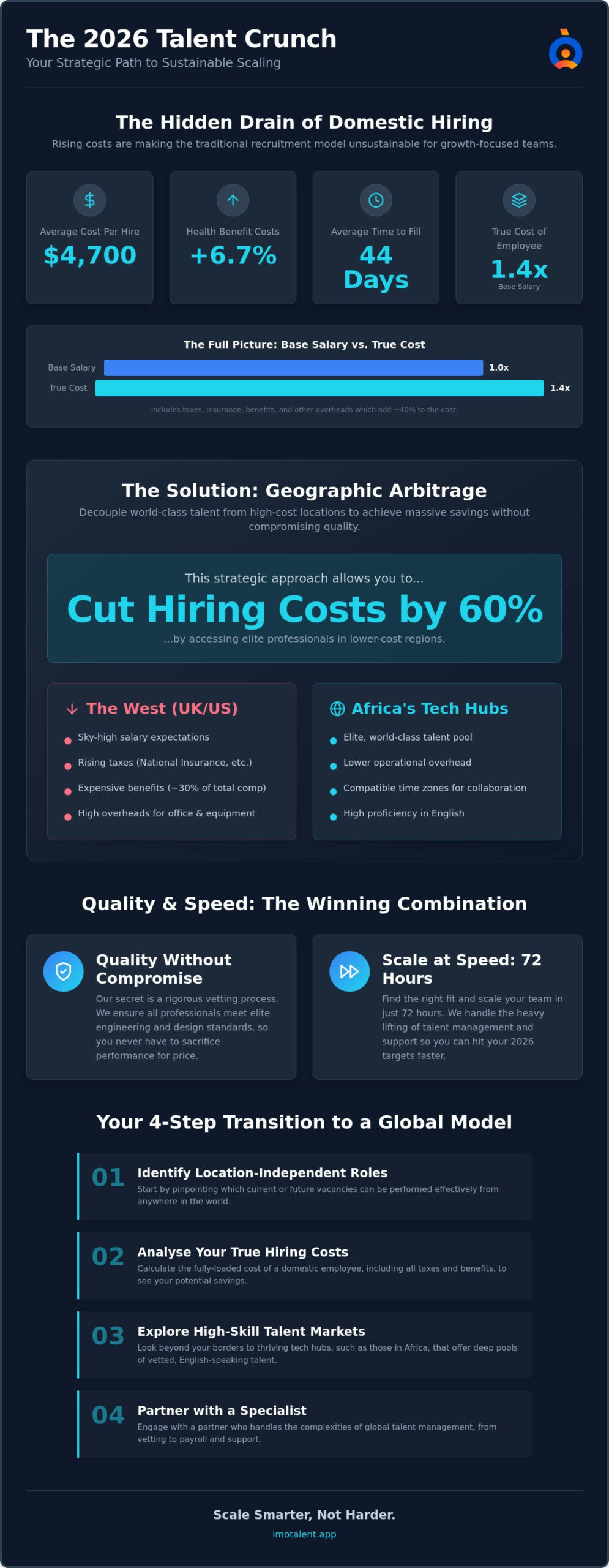
The 2025 and 2026 UK budget changes have fundamentally altered the recruitment landscape. With National Insurance contributions on the rise, businesses are facing a steep climb just to maintain their current headcount. It’s a similar story in the US, where Social Security taxes now apply to wages up to $184,500. When you combine these tax burdens with wage inflation that consistently outpaces productivity, the traditional model of local hiring starts to look broken. You’re paying more for the same output, which is a recipe for stagnant growth.
To stay competitive and hit your 2026 targets, you need to cut hiring costs 60 percent, but doing that within your local market is almost impossible. You aren’t just paying a base salary; you’re absorbing a 6.7% projected increase in health benefit costs and the 30% of total compensation that goes toward insurance and taxes. The true cost of an employee is often 1.4 times their base salary. This financial pressure is why many forward-thinking leaders are turning to Geographic Arbitrage to find a sustainable way forward.
The Hidden Drain of Domestic Recruitment
Domestic recruitment is littered with “invisible” expenses that eat your budget before a candidate even signs a contract. The average cost per hire has climbed to roughly $4,700 in the US, driven by expensive job board fees and hundreds of internal HR hours spent sifting through resumes. There’s also the massive opportunity cost of roles remaining vacant. Every day a niche tech role stays open, you lose between $98 and $500 in potential productivity. When roles take 44 days to fill on average, those losses compound quickly, making it vital to cut hiring costs 60 percent by looking beyond your immediate borders.
Why a Hiring Freeze is Not the Answer
When budgets get tight, the instinctive reaction is often to announce a hiring freeze. While this might protect your bank balance for a quarter, it’s a short-term fix that creates long-term damage. Your competitors aren’t stopping; they’re simply becoming leaner by accessing global talent pools. A freeze kills your momentum and leaves your existing team burnt out and overstretched. Instead of stopping altogether, you should shift your mindset toward optimising value. This means moving away from high-overhead local markets and toward regions where elite talent is available without the crushing weight of domestic tax hikes and sky-high office costs.
How Geographic Arbitrage Can Cut Hiring Costs by 60 Percent
Geographic arbitrage sounds like a complex financial term, but the core idea is simple. It’s about hiring elite talent in regions where the cost of living is significantly lower while the skill level remains world-class. This isn’t about compromising on quality; it’s about decoupling talent from expensive postcodes. When you stop paying for a developer’s London rent or a designer’s New York commute, you can cut hiring costs 60 percent without losing an ounce of expertise.
The financial logic is undeniable. According to data on The Real Costs of Recruitment, the average cost per hire in the West has spiked to nearly $4,700. Africa has emerged as the premier frontier for this model. It offers a massive pool of tech-savvy professionals who are fluent in English, work in compatible time zones, and operate at a fraction of the fully-loaded cost of Western employees. You’re effectively accessing the same high-tier talent without the heavy weight of domestic inflation.
The Cost Comparison: Africa vs. The West
Let’s look at the numbers for 2026. A Senior Developer in London now carries a massive price tag once you include the recent National Insurance hikes and mandatory benefits packages. In contrast, a Senior Developer in Lagos or Nairobi provides the same technical mastery but requires significantly less overhead. You aren’t just saving on the base salary. You’re also eliminating local payroll taxes, office space requirements, and expensive equipment stipends. For a detailed breakdown of these figures, see our cost of hiring developers in US vs Africa guide.
Beyond Developers: Savings in Design and Business
This strategy isn’t limited to engineering. The ability to cut hiring costs 60 percent extends to Product Managers, UI/UX Designers, and Business Development roles. This creates a powerful scalability advantage. Instead of hiring one local junior designer, you could potentially bring on two senior professionals from a thriving African tech hub for the same budget. This allows you to scale your team quickly to meet your 2026 goals while maintaining a lean burn rate. If you’re ready to explore these roles, our hire remote business and design talent Africa guide explains exactly how to start. You might find that matching with vetted African professionals is the most efficient way to protect your margins this year.
Quality Without Compromise: The Vetting Secret
A common misconception persists that choosing remote talent from emerging markets requires a trade-off in quality. This simply isn’t true. High-performance engineering and design standards aren’t exclusive to Silicon Valley or London. By moving your focus to thriving tech hubs in Africa, you can cut hiring costs 60 percent while actually increasing the technical rigour of your team. The secret lies in a vetting process that is far more demanding than the average internal HR screen.
Most firms struggle with a 44-day average time-to-fill because they start from zero every time a vacancy opens. A 72-hour turnaround is only possible when you work with a pre-vetted talent pool that has already passed through a gauntlet of assessments. African professionals in these hubs are often more “remote-ready” than their Western counterparts. They’ve built their careers in global-first environments, meaning they’re already accustomed to the tools, communication styles, and high-velocity rhythms that modern tech firms demand.
The 4-Step Vetting Framework
To maintain elite standards, every candidate must pass through a methodical four-stage process. We begin with an initial screening to ensure they meet global communication standards and possess native-level English proficiency. This is followed by deep-dive technical assessments and live coding challenges that test their problem-solving speed. We then evaluate soft skills and cultural fit to ensure they’ll integrate seamlessly with your existing team. Finally, we conduct rigorous reference checks to verify their historical performance and reliability.
Overcoming the Time Zone and Culture Barrier
Nigeria and Kenya are perfectly aligned with UK and European time zones. Nigeria sits just one hour ahead of London, while Kenya is only three hours ahead. This overlap allows for a full day of synchronous work, avoiding the lag often found with Asian or Eastern European teams. Since English is the primary business language in these major hubs, the culture barrier is virtually non-existent. You’re hiring professionals who share your business vocabulary and work ethic, making the transition effortless.
Actionable Tip: To build trust and speed up integration, organise a “shadowing week” for your new hire. Have them sit in on all key meetings and pair-program with a senior team member. This immediate immersion helps them understand your internal “shorthand” and builds the social capital needed for long-term success. It’s a simple step that ensures your mission to cut hiring costs 60 percent doesn’t come at the expense of team cohesion.
Practical Steps to Transition to a Global Remote Model
Moving your operations to a global model requires more than just a Slack account and a Zoom link. It’s a deliberate process of identifying where your budget is leaking and where you can find the highest return on investment. If you want to cut hiring costs 60 percent, you have to start by looking at your internal processes through a global lens. This means auditing your current vacancies to see which roles are truly location-independent and which ones are simply being held back by traditional office-first thinking.
Transitioning isn’t about doing less; it’s about being smarter with your resources. You need to invest in asynchronous communication tools to manage a distributed team effectively. Tools that allow for documentation and video updates ensure that your team can move forward without waiting for a specific meeting time. This reduces friction and keeps your engineering and design cycles moving at a high velocity.
Auditing Your Hiring Pipeline
Start by identifying high-cost roles that are currently draining your budget. Senior engineering positions, UI/UX designers, and product managers are often the best candidates for a global shift because their output is easily measured through digital platforms. In the African market, technical stacks like JavaScript, Python, and Java are incredibly abundant. This offers a deep pool of talent that is ready to hit the ground running. For a deeper look at the specific regions and skills available, check out our hire remote developers from Africa guide.
Setting Up for Remote Success
Actionable Tip: Use a “Project First” approach for the first 30 days. Instead of overwhelming a new hire with abstract company culture sessions, give them a concrete, high-impact project with clear KPIs. This allows you to measure the ROI of your new hire immediately and builds confidence on both sides. It’s the most effective way to ensure your efforts to cut hiring costs 60 percent result in actual productivity rather than just lower expenses.
Managing global payments and compliance can often feel like a massive headache for HR teams. This is why a managed talent partner is almost always safer and more efficient than a freelance marketplace. A partner handles the administrative weight, ensuring that your hires are compliant with local laws and that payments are handled without delay. If you’re ready to stop the administrative drain and focus on growth, you can start matching with vetted talent today and see how quickly you can scale your team.
Scaling at Speed: Why IMO Talent is the Strategic Choice
Scaling your team shouldn’t feel like a high-stakes gamble with your runway. While we’ve discussed the theory of geographic arbitrage and the vetting frameworks required to maintain standards, the actual execution is where most firms stumble. This is where IMO Talent acts as your elite facilitator. We don’t just provide a list of names; we provide a bridge to a curated network of African professionals who are ready to integrate into your workflow immediately. It’s the most direct way to cut hiring costs 60 percent while bypassing the months of trial and error that usually come with global expansion.
We handle the heavy lifting that typically derails remote initiatives. From the initial technical gauntlet to the ongoing administrative management, our role is to ensure you focus on your product while we focus on the people. This managed approach is designed for long-term retention. We provide ongoing support for your remote workers, ensuring they stay engaged and high-performing long after the initial onboarding phase. You get the full financial benefit of a global team without the administrative nightmare of managing international payroll or local compliance.
The IMO Talent Advantage
Whether you need to scale your engineering squad or find elite UI/UX designers, we operate as a one-stop-shop for growth. Our expertise spans across Tech, Business, and Design, allowing you to build a cohesive, cross-functional team under one strategic umbrella. We don’t just place a candidate and disappear. We provide ongoing performance monitoring to ensure that your new hires continue to meet the high standards your 2026 goals require. For a deeper look at how we streamline this process, explore our remote talent placement service guide.
Start Cutting Costs Today
Taking the first step toward a leaner, more agile team is straightforward. You can book a consultation to audit your current hiring needs and identify which roles will offer the most immediate impact on your burn rate. We offer a “No Risk” promise because our talent is already vetted and ready to go. You aren’t starting a search from scratch; you’re accessing a ready-made pipeline of excellence. If you’re ready to cut hiring costs 60 percent and protect your margins for the year ahead, it’s time to move. You can hire your first remote professional in 72 hours and see the difference a strategic global partner makes to your bottom line.
Secure Your 2026 Growth Strategy
The economic shifts of 2026 don’t have to stall your progress. By moving beyond high-overhead local markets and embracing geographic arbitrage, you can maintain elite engineering and design standards while protecting your runway. We’ve explored how a rigorous vetting process and a shift to global remote models allow you to cut hiring costs 60 percent without compromising on performance. Africa’s tech hubs are ready to provide the specialised talent you need to stay ahead of leaner, more agile competitors who are already looking abroad.
With IMO Talent, you gain immediate access to a 100% vetted talent network and can expect placements within just 72 hours. This approach effectively eliminates the administrative weight of international compliance and payroll management. It isn’t just about saving money; it’s about building a high-velocity team that scales as fast as your ambitions. You can achieve a 60% cost reduction compared to traditional UK or US hiring without the usual friction of long-distance recruitment.
Ready to transform your recruitment model and secure your margins? Book a consultation to cut your hiring costs by 60% today. Your next elite hire is closer than you think, and we’re here to help you bridge the gap. Let’s start building your global team together.
Frequently Asked Questions
Is it really possible to cut hiring costs by 60 percent without losing quality?
Yes, you can cut hiring costs 60 percent by leveraging geographic arbitrage and managed remote models. The primary savings come from avoiding high Western payroll taxes, rising National Insurance contributions, and expensive office overheads. Quality remains elite because candidates in our network undergo more rigorous technical and soft skill testing than most internal HR teams can provide.
What are the best countries in Africa to hire remote developers from in 2026?
Nigeria, Kenya, and Egypt are the leading hubs for tech talent in 2026. Nigeria offers a massive pool of senior engineers, while Kenya’s “Silicon Savannah” is world-renowned for its innovation in mobile tech and fintech. These countries have established tech ecosystems that produce professionals who are already accustomed to working with global firms.
How do you handle time zone differences when hiring in Africa for a UK team?
Time zone differences are actually a major advantage when hiring from Africa for a UK-based team. Nigeria is only one hour ahead of London, and Kenya is just three hours ahead. This allows for a full day of synchronous work, meaning your team can collaborate in real time without the communication lag common with teams in Asia or the US.
Does IMO Talent handle the legal and payroll compliance for remote hires?
We manage all the administrative heavy lifting, including legal compliance and payroll. You won’t need to worry about the complexities of international employment law or local tax regulations in different countries. We handle the contracts and secure payments, allowing you to focus entirely on your project goals.
How quickly can I actually get a remote developer started on my project?
You can get a professional started in as little as 72 hours. Because we maintain a pre-vetted network across tech, business, and design, we don’t need to start a recruitment search from scratch. We match your specific requirements with elite talent that is already tested and ready for immediate placement.
What tech stacks are most common among African remote professionals?
African tech hubs are particularly strong in JavaScript, Python, Java, and PHP. You will find an abundance of experts specialising in frameworks like React, Node.js, and Django. This alignment with popular global stacks makes it easy to find talent that fits perfectly into your existing technical architecture.
Can I hire for non-technical roles like Marketing or Design through IMO Talent?
Yes, we provide placement services for various non-technical roles including UI/UX Design, Product Management, and Business Development. Our network is curated to help you scale your entire operation, not just your engineering team. This ensures you can apply the same cost-saving model to your creative and business growth departments.
