

What if you could slash your engineering overhead by 60% without losing a single hour of real-time collaboration? You likely already know that sourcing senior talent in the UK or US has become a costly, slow-moving hurdle for growth. When you finally find a candidate, the price tag is often eye-watering, and the technical vetting process eats up weeks of your roadmap. It’s a frustrating bottleneck that stalls innovation and drains your budget.
The solution lies in a region that perfectly balances elite skill with operational efficiency. When you hire South African developers, you gain access to a world-class talent pool that shares your time zone and your work ethic. This guide provides everything you need to secure senior engineering talent in as little as 72 hours while maintaining total code quality. We’ll break down the 2026 salary benchmarks in Cape Town, explain the latest SARS tax adjustments for remote contractors, and show you how to integrate these experts into your Agile workflows without any friction. You’re about to discover how to scale your team with precision and speed.
Key Takeaways
- Discover how to reduce your engineering spend by up to 60% by taking advantage of a highly favourable exchange rate and lower overheads.
- Learn how to leverage the GMT+2 time zone to ensure your remote team is perfectly aligned with UK working hours for seamless collaboration.
- Follow a proven 4-step framework to hire South African developers who have been rigorously vetted for technical skill and cultural fit.
- Identify the most in-demand technical skills and software languages for 2026 to ensure your new hires can integrate into your existing workflows.
- Find out how to bypass the traditional months-long recruitment cycle and secure senior-level engineering talent in as little as 72 hours.
Why Hire South African Developers in 2026?
South Africa has rapidly emerged as the primary destination for companies looking to scale their technical teams without the logistical headaches of traditional offshoring. It’s not just about the cost savings; it’s about the quality of the output. When you decide to hire South African developers, you’re tapping into a talent pool that’s spent decades building complex systems for one of the most sophisticated financial sectors in the world.
The Economy of South Africa is highly industrialised and technologically advanced. This environment has produced engineers who aren’t just coders; they’re business-minded problem solvers. They understand high-stakes environments, regulatory compliance, and the need for robust, scalable architecture. They’re used to working in professional frameworks that mirror those in London, New York, or Berlin.
One of the biggest wins is the “Time Zone Advantage”. South Africa operates on SAST (GMT+2). For UK-based teams, this means a near-perfect overlap. You can hold your daily stand-ups, run pair programming sessions, and get immediate answers to Slack messages during your standard 9-to-5. There’s no more waiting until late afternoon for a reply from a developer in a distant time zone. It keeps your development velocity high and your feedback loops tight.
The South African Tech Hubs: Cape Town and Johannesburg
The tech landscape is concentrated in two major cities, each with its own distinct flavour. Cape Town, often called “Silicon Cape”, is the heart of the startup scene. It’s where you’ll find creative, agile talent working on disruptive tech and modern web frameworks. Johannesburg is the financial powerhouse. Developers here tend to specialise in fintech, enterprise-level systems, and heavy-duty backend architecture for global corporations.
Actionable tip: Focus your search on Cape Town if you need agile, product-focused developers for a startup. Look towards Johannesburg if you’re an enterprise firm needing specialists in secure, high-volume transactional systems. This targeted approach saves time and ensures a better skill match.
Cultural Synergy and Communication
Communication gaps are the silent killers of remote projects. South Africa eliminates this risk. English is the primary language of business and higher education. This means native-level proficiency is the standard, not the exception. You won’t struggle with language barriers or lost-in-translation requirements. Your documentation remains clear, and your meetings remain productive.
Beyond language, there’s a deep cultural alignment with the UK. The work ethics, professional standards, and even the sense of humour are remarkably similar. This synergy allows South African engineers to integrate into your existing team almost instantly. They don’t just follow instructions; they contribute to the conversation and challenge ideas. This is exactly what you want from a senior-level hire who is invested in your product’s success.
Technical Expertise: The Most Popular Stacks in South Africa
South African developers are known for being incredibly versatile. This isn’t by accident. The steady growth of South Africa’s digital economy has forced engineers to adapt to diverse requirements across various sectors. When you hire South African developers, you’re getting talent that understands how to build for a global audience. They don’t just stick to one niche; they often master multiple layers of the stack to stay competitive in a high-growth market.
Backend development is a particular strength in this region. You’ll find that Python and Node.js are the dominant choices for startups and fast-scaling tech firms. Python is frequently paired with Django or Flask, especially in the data-heavy fintech space. For enterprise-level applications, Java remains the undisputed backbone, particularly within the massive financial hubs of Johannesburg. These developers are used to handling high-volume, secure transactions where system uptime is critical.
Frontend excellence is equally visible. React and Vue.js are the primary frameworks used to build modern, responsive interfaces. Because South African engineers often work with international clients, they have a keen eye for UI/UX design principles and performance optimisation. Many senior developers now treat TypeScript as a standard requirement, ensuring that the code they deliver is maintainable and less prone to errors as your product scales.
Mobile development is another area where South Africa punches above its weight. Since the African market is primarily mobile-first, engineers have a unique perspective on building high-performance apps for a wide range of devices. Flutter and React Native are the go-to tools here. They allow for rapid deployment across both iOS and Android without sacrificing the native feel that users expect. If you’re ready to skip the manual resume filtering, consider using vetted talent placement to find your next lead engineer.
Seniority and Education Levels
Education standards are exceptionally high. Graduates from the University of Cape Town (UCT), Wits, and Stellenbosch enter the market with a rigorous foundation in computer science. Many senior professionals have 8 or more years of experience working for global companies. We define a “Senior South African Developer” as a professional who pairs deep technical skill with the business acumen required to drive a product forward. They aren’t just taking tickets; they’re architecting solutions.
Specialised Roles: AI, Cloud, and Fintech
Specialised roles are booming across the country. Cape Town has become a hotspot for AI and Machine Learning, with engineers focusing on predictive analytics and automation. Cloud infrastructure expertise in AWS and Azure is now the baseline for any remote-ready engineer. To see how this fits into a broader strategy, you can hire remote developers from Africa to bolster your entire engineering department.
The Economic Case: Calculating Your Hiring ROI
Budgeting for a high-growth tech team is often a balancing act between speed and sustainability. You need senior talent to hit your milestones, but the skyrocketing costs of the UK and US markets can quickly drain your runway. When you hire South African developers, you aren’t just looking for a cheaper alternative; you’re making a strategic investment that can reduce your total engineering spend by up to 60%. This isn’t about cutting corners. It’s about capitalising on a unique economic window that benefits both the employer and the engineer.
The primary driver of this ROI is the currency advantage. The exchange rate between the British Pound (GBP) and the South African Rand (ZAR) provides significant purchasing power for UK firms. You can offer a salary that is highly competitive and prestigious in the local South African market while still spending far less than you would for a local London hire. This allows you to attract the top 1% of talent, individuals who are often the lead architects and senior engineers in their respective hubs.
Beyond the base salary, the savings on overheads are substantial. There is no need for expensive UK office space or the associated utility costs. You also bypass local National Insurance contributions and the heavy administrative burden of UK-based benefits packages. By shifting these resources to a remote model, you’re effectively trimming the fat from your operational budget without sacrificing a single line of code quality.
Salary Comparison: London vs. Cape Town
As of July 2026, the data shows a clear divide. A senior software developer in Cape Town with over 10 years of experience earns an average of R105,092 per month. In contrast, a senior developer in London often commands a monthly salary of £7,000 to £9,000, which doesn’t even include the additional 13.8% in employer National Insurance. For a deeper dive into the numbers, check our cost of hiring developers in US vs Africa guide for a full breakdown. When you factor in our management subscriptions, the total cost remains significantly lower than a traditional local hire.
Hidden Savings: Retention and Productivity
High turnover is a silent killer of productivity in the UK tech scene. Developers often jump ship for minor pay rises in hyper-competitive local markets. Remote South African talent tends to show much higher retention rates. They value the stability of working with international firms and the flexibility of a remote lifestyle. Furthermore, the zero time zone lag ensures 100% overlap for stand-ups and pair programming, meaning no billable hours are wasted waiting for a response.
Actionable tip: Take the 60% you save on hiring and reinvest it into your product roadmap. Use those funds to purchase better dev tools, increase your marketing spend, or hire a second developer to double your output speed. This is how you turn a budget saving into a competitive edge.
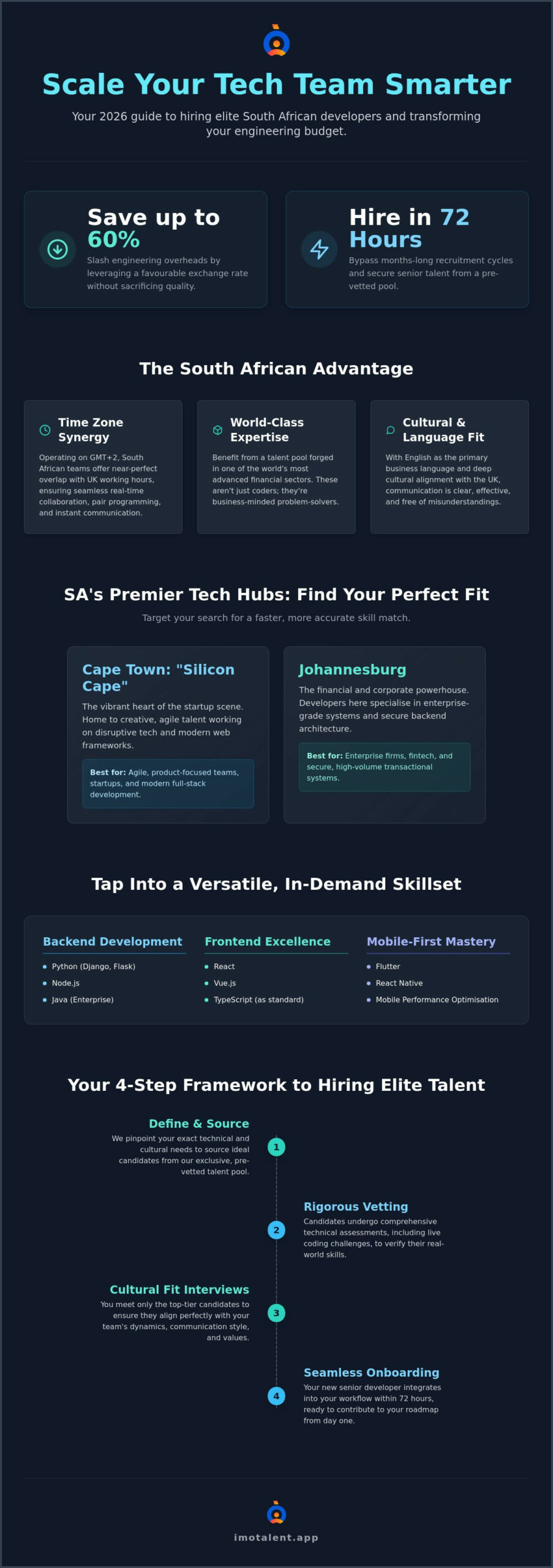
How to Hire South African Developers: A 4-Step Framework
Knowing why this region is a tech powerhouse is only half the battle. The real challenge is execution. To hire South African developers successfully, you need a repeatable process that filters out the noise and identifies top-tier talent quickly. Most businesses fail because they treat remote hiring like a local job post, but the global stage requires a more methodical approach. Here is our 4-step framework for 2026.
First, define your technical and cultural requirements with clinical precision. Don’t just list “Python” or “React”. Be specific about the complexity of the systems they’ll be building and the level of autonomy you expect. Second, implement a rigorous vetting process. This should include a live coding session and an architectural review. You want to see how they think, not just how they type. Third, navigate the legal landscape. Most South African developers working for international firms operate as independent contractors. You’ll need to ensure they understand their provisional tax obligations with SARS. Finally, onboard for deep integration. Set up your communication tools and documentation before day one so they can hit the ground running.
Vetting for Technical and Soft Skills
Technical skills are only 50% of the equation for a remote hire. A developer might be a genius with the MERN stack, but if they can’t communicate their progress or manage their time, the project will stall. You need to verify their ability to work asynchronously and their willingness to speak up during stand-ups.
Actionable tip: Conduct a dedicated ‘cultural interview’ as your final step. Don’t talk about code. Instead, focus on how they handle feedback, how they prioritise tasks under pressure, and how they’ve solved conflicts in previous remote teams. This ensures the developer fits your team’s rhythm and values from the start. You can also use automated testing tools to filter the top 5% of candidates before you ever hop on a call.
Compliance and Remote Management
Managing the administrative side of a cross-border hire can be a headache if you do it alone. You have to consider local labour laws, currency conversions, and data privacy. Robust IP protection and data security clauses are the foundation of any remote contract, ensuring your proprietary code remains yours regardless of where the developer is sitting. Using a remote talent placement service removes this burden entirely. They handle the compliance and ongoing management so you can focus on your product roadmap. If you’re ready to scale without the paperwork, book a talent consultation today and meet your next senior engineer.
Hire Elite South African Talent in 72 Hours
Speed is the new currency in the tech world. Waiting three to six months to fill a senior role in London or New York is no longer a viable strategy for a fast-moving company. While you’re waiting for a local candidate to finish a long notice period, your competitors are shipping features and capturing market share. This is where the traditional recruitment model breaks down. When you hire South African developers through a curated network, you’re choosing a high-velocity path that matches the pace of your product roadmap.
Our 72-hour promise changes the game. We move from your initial request to a shortlist of qualified, interviewed candidates in just three days. This isn’t about rushing the process; it’s about having already done the hard work. We maintain a constant pulse on the market, identifying top-tier engineers before you even realise you need them. It’s a proactive approach that turns a months-long headache into a three-day win for your engineering department.
The IMO Talent Vetting Process
We don’t just post on job boards and hope for the best. Our team filters thousands of applications to find the top-tier professionals who are already remote-ready. We use a rigorous four-step vetting process that covers technical proficiency, language clarity, and cultural alignment. This ensures every placement is zero-risk for your business. Because we maintain a pre-vetted pool of engineers, we can bypass the standard recruitment bottleneck. This is why our 72-hour turnaround is the fastest in the African tech market, giving you an immediate edge in talent acquisition.
Scaling Your Team with Confidence
Growth shouldn’t be a logistical nightmare. You might start with a single senior backend engineer to fix an immediate bottleneck, but our model allows you to scale to a full squad within weeks. This flexibility is vital for startups and enterprise teams that need to adapt to changing market demands. We don’t just find the talent and walk away. We manage the ongoing relationship and payroll through our management subscription. This ensures long-term retention and high morale, as we handle the administrative nuances of the South African market on your behalf.
Actionable tip: Book a consultation today to see our current available talent in the South African market. It’s the fastest way to see exactly who is ready to join your team and start contributing to your codebase immediately. Don’t let a slow hiring process stall your 2026 growth targets.
Future-Proof Your Engineering Roadmap
South Africa has established itself as the ultimate destination for high-growth tech teams. By tapping into this market, you solve the dual challenge of rising overheads and talent scarcity. You gain access to senior engineers who work in your time zone and understand the nuances of building scalable architecture. It’s a strategic move that allows you to ship features faster while achieving 60% cost savings compared to local UK hires. You aren’t just filling a seat; you’re adding a business-minded problem solver to your ranks.
When you decide to hire South African developers, you don’t have to settle for the slow pace of traditional recruitment. You can leverage a network of 100% vetted remote professionals who are ready to integrate into your team immediately. Stop letting local hiring bottlenecks drain your budget and stall your product development. Hire top South African developers in 72 hours with IMO Talent and experience a candidate matching guarantee that keeps your momentum high. It’s time to build your elite squad with confidence and speed. Your next breakthrough is just three days away.
Frequently Asked Questions
Is it legal to hire South African developers for a UK-based company?
Yes, it’s perfectly legal for a UK-based company to hire South African developers. Most professionals operate as independent contractors, which means they are responsible for their own tax obligations with the South African Revenue Service (SARS). We recommend using a robust contract that clearly defines intellectual property rights and data security to ensure your business stays protected across borders.
What is the average salary for a senior developer in South Africa in 2026?
As of July 2026, the average monthly salary for a senior developer with over 10 years of experience is R100,232. In major tech hubs like Cape Town, this average reaches R105,092 per month. While these are top-tier local rates, the favourable exchange rate still allows UK firms to reduce their total engineering spend by up to 60%.
How do I handle the 2-hour time difference between the UK and South Africa?
The time difference is actually one of the biggest advantages of this region. Since South Africa is only two hours ahead of the UK, your teams share almost the entire working day. You can hold your morning stand-ups and afternoon reviews in real-time without anyone needing to work unsociable hours. This near-perfect alignment keeps your development velocity high.
What are the most common programming languages used by South African engineers?
The MERN stack (MongoDB, Express, React, and Node.js) is currently the most popular choice for modern web applications. Python and Django are also in high demand, particularly for AI and data-heavy projects. For mobile development, you’ll find that most senior engineers are highly proficient in Flutter and React Native to support the mobile-first African market.
How does IMO Talent vet its developers for technical proficiency?
We use a rigorous four-step vetting process that filters thousands of applicants down to the top-tier professionals. This includes an initial technical screening, live coding challenges, and a deep-dive architectural review. We also assess soft skills and English proficiency to ensure every developer in our pre-vetted pool can integrate seamlessly into a global team environment.
What happens if a remote hire doesn’t work out within the first month?
Our management subscription includes ongoing support to ensure the placement is a success. If a developer isn’t the right fit during the initial period, we take immediate action to manage the transition and provide a qualified replacement. This “set-and-forget” approach to management removes the traditional risks associated with long-distance hiring and protects your project timeline.
Can I hire a full team of developers in South Africa through IMO Talent?
You can easily scale from a single specialist to a full squad within a few weeks. We help you assemble multi-disciplinary teams that include frontend, backend, and mobile experts who are used to working in Agile workflows. This is an efficient way to expand your technical capacity without the overheads of local UK recruitment.
Do South African developers have reliable internet and electricity for remote work?
Professional remote developers in South Africa treat their infrastructure as a priority. High-speed fibre-optic internet is the standard in urban tech hubs like Cape Town and Johannesburg. Most senior pros also use backup power systems, such as inverters and batteries, to ensure they remain online and productive during any local power grid maintenance or outages.
