

Why settle for a six-month recruitment cycle when your competitors are closing elite engineering talent in 72 hours? In 2026, the total first-year cost of a senior developer in the U.S. can exceed $248,000, yet many firms remain trapped in a slow, high-friction remote developer hiring process. You already know that the search for affordable, high-quality talent in traditional markets is becoming unsustainable. You’ve likely felt the frustration of endless interviews and the difficulty of verifying technical skills in unfamiliar foreign markets. It’s time to stop treating recruitment as a bottleneck and start seeing it as a competitive advantage.
This guide provides a high-velocity framework to master your acquisition strategy. By following this methodology, you’ll secure top-tier engineering talent while reducing recruitment costs by 60%. We’ll explore how to access pre-vetted global professionals and implement a streamlined 72-hour hiring window that prioritizes operational readiness. You’ll move from a state of talent scarcity to a position of total hiring confidence. We’re breaking down the exact steps to build an elite, globally-distributed engineering team without the traditional overhead or the wait times.
Key Takeaways
- Transition to a high-velocity recruitment model to close elite engineering roles within a 72-hour window.
- Unlock a 60% reduction in recruitment costs by leveraging pre-vetted, top-tier talent from emerging global markets.
- Master a remote developer hiring process that balances technical rigor with critical soft skill assessments for asynchronous environments.
- Move beyond traditional resumes by utilizing verified GitHub history and live architecture reviews to ensure technical mastery.
- Drive immediate ROI through a structured onboarding framework that establishes clear KPIs within the first 30 days.
Why the Traditional Developer Hiring Process is Failing in 2026
The local talent war is over. In 2026, your engineering roadmap is either a growth engine or a casualty of slow decision-making. Relying on local markets in the US or UK has become a strategic bottleneck. High-velocity firms have moved beyond geographic constraints, yet many still cling to a remote developer hiring process designed for a different era. The pace of global competition has set a new standard that traditional recruitment models simply can’t meet.
Traditional six-week interview cycles are no longer just slow; they’re destructive. Data indicates a 40% candidate drop-off rate when recruitment cycles drag. The best engineers are off the market before your third internal stakeholder has even reviewed their CV. Legacy “post and pray” job boards are relics that yield noise rather than signal. They force your team to sift through hundreds of unqualified applications, wasting valuable engineering hours on a discovery phase that shouldn’t exist in a modern workflow.
The High Cost of Slow Decision-Making
Speed-to-hire is the ultimate indicator of organizational health. When a critical role remains vacant for months, the cost isn’t just an empty desk. It’s the lost productivity of a stalled product launch. It’s the technical debt that accumulates when your current team is forced to patch holes rather than build features. In a competitive market, speed correlates directly with technical excellence. Top-tier talent migrates toward teams that demonstrate operational readiness and respect for their time. If your process is slow, you aren’t just losing time; you’re losing the elite 1% to more agile competitors.
Shifting from Sourcing to Accessing Talent
The evolution of remote work has changed the fundamental mechanics of recruitment. You shouldn’t be wasting weeks on the initial vetting of candidates from unknown markets. The industry standard has shifted from open marketplaces to curated talent networks. By utilizing pre-vetted remote professionals, you eliminate the uncertainty of foreign markets entirely. You aren’t just finding a developer; you’re accessing a verified pipeline of elite engineers who are ready to integrate on day one. This shift from sourcing to instant access is what separates scaling leaders from those stuck in the legacy recruitment trap. It’s about moving from a search-based model to an access-based model where the vetting is already done.
The 4-Step Framework for Rapid Remote Talent Placement
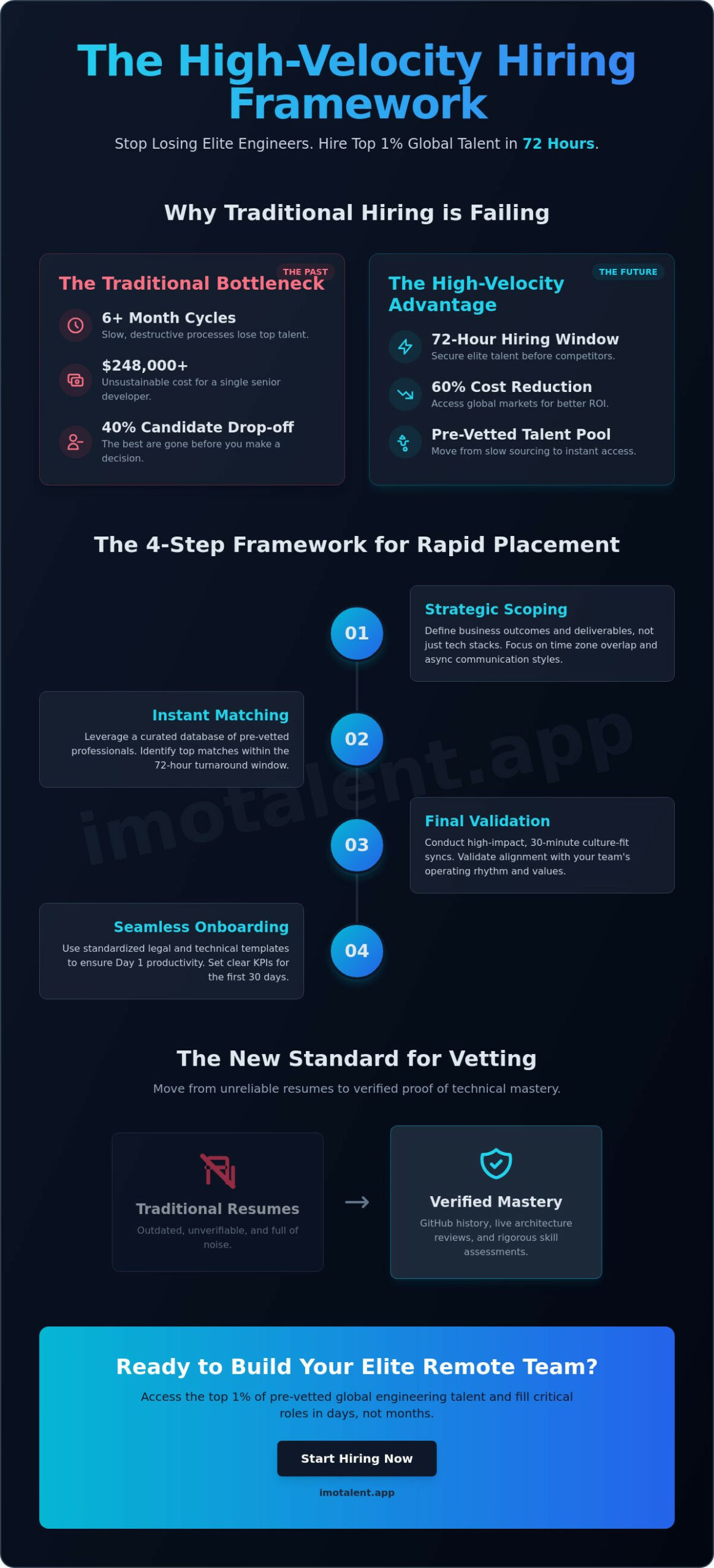
Speed isn’t just a metric; it’s a filter. If your remote developer hiring process takes months, you’re only seeing the candidates who couldn’t find work elsewhere. To win in 2026, you need a framework that prioritizes precision and velocity over traditional bureaucratic hurdles. This four-step methodology is designed to move from vacancy to signed contract in days, not weeks.
- Phase 1: Strategic Scoping. Define the specific business outcomes the hire must achieve rather than listing every tech stack they might touch.
- Phase 2: Instant Matching. Leverage AI-driven curated databases to identify pre-vetted matches within a 72-hour turnaround.
- Phase 3: Final Validation. Conduct high-impact, 30-minute culture-fit syncs to confirm alignment with your team’s operating rhythm.
- Phase 4: Seamless Onboarding. Utilize standardized legal and technical integration templates to ensure the developer is productive on day one.
By following this linear progression, you remove the “discovery phase” that plagues traditional recruitment. You aren’t searching; you are selecting from a pool of elite talent that has already been verified for technical mastery and operational readiness. Leaders who invest in an efficient remote talent placement service gain a decisive edge by compressing their hiring timelines without sacrificing quality.
Defining the Ideal Candidate Profile (ICP)
Stop hiring for a generic “Senior Developer” and start hiring for specific deliverables. Your ICP should outline whether the candidate is building a new microservice architecture or optimizing a legacy database. Early assessment of time zone overlaps and asynchronous communication styles is non-negotiable for remote success. High-velocity hiring is a key strategy for attracting top talent who value clarity and respect for their time. The ICP is the definitive blueprint that translates business objectives into technical talent requirements.
Accelerating the Interview Funnel
The traditional five-round interview is a relic of indecision. Cut your funnel to two rounds: one for technical validation and one for cultural alignment. If uncertainty remains, implement a “Contract-to-Hire” model. This provides a low-risk trial period where the developer proves their value in your actual codebase before you commit to a long-term role. Automate the administrative friction of global contracts and compliance through specialized platforms to keep the momentum high. If you want to see how this works in practice, you can explore curated talent networks that handle the heavy lifting for you. This approach ensures your remote developer hiring process remains lean and outcome-focused while securing the best engineers on the market.
Rigorous Vetting: How to Identify Elite Software Engineers Remotely
Traditional resumes are a poor proxy for performance. In a high-stakes remote developer hiring process, you need objective data to separate the builders from the talkers. This starts with a deep dive into verified GitHub history and live architecture reviews. You aren’t looking for someone who can memorize syntax; you’re looking for an engineer who understands how to scale complex systems under pressure. Technical mastery is non-negotiable, but it’s only the baseline for entry into an elite engineering team.
Soft skills are the true differentiator in distributed environments. Remote-first success hinges on self-management and asynchronous communication. If a developer can’t document their logic or manage their own sprint without constant supervision, they’ll quickly become a bottleneck. We prioritize identifying “Remote-Ready” professionals who have a proven track record of delivering results across cross-continental teams. This requires a shift in how you evaluate cultural alignment, ensuring shared values and a high degree of accountability regardless of geographic location.
Technical Validation Without the Fluff
Live coding exercises often fail to reflect real-world engineering challenges. They test for performance anxiety rather than architectural depth. Elite developers often find these tests reductive and may even opt out of your process if they feel their time isn’t being respected. Shift your focus to peer-reviewed technical assessments that prioritize problem-solving logic over syntax memorization. A rigorous remote talent vetting process ensures your hires can navigate the messy, non-linear reality of production environments. You need engineers who can think through edge cases and system dependencies, not just pass a proctored test in a vacuum.
The African Talent Advantage
Africa has emerged as the most significant growth hub for firms looking to hire remote developers from Africa. This isn’t merely about cost optimization; it’s about accessing a massive, untapped reservoir of technical brilliance. The African tech ecosystem is defined by a culture of resilience and rapid innovation. African engineers are often forced to build sophisticated solutions with high efficiency, leading to a level of technical rigor that is increasingly rare in saturated Western markets. Specialized platforms have already placed over 500 high-performing professionals into global companies, proving that the talent is there. It’s time to move past regional misconceptions and recognize that the next generation of elite software engineers is coming from this vibrant, high-velocity market.
From Offer to Integration: Mastering Remote Onboarding and Retention
The signed contract is only the halfway mark. A high-velocity remote developer hiring process is meaningless if your integration strategy is fragmented. Successful scaling in 2026 requires a transition from candidate selection to operational immersion within days. You must establish clear, measurable KPIs within the first 30 days to validate the hire’s technical impact and cultural fit. This isn’t about oversight; it’s about setting a benchmark for excellence that the developer can hit immediately.
Retention begins with clarity. Implementing a “Buddy System” pairs your new hire with an established engineer to navigate internal documentation and unwritten team norms. This social bridge accelerates technical output by removing the friction of “who do I ask?” On the legal front, you must choose between Employer of Record (EOR) and Contractor models based on your long-term goals. EOR services handle payroll and local compliance, mitigating the permanent establishment risks that tax authorities are scrutinizing more heavily in 2026. For instance, the OECD’s updated 2025 Model Tax Convention triggers risk when employees work more than 50% of their time from another country. Performance monitoring should focus on output and commit quality, avoiding the counterproductive trap of micromanagement.
High-Impact Remote Onboarding
The first 48 hours define the trajectory of the hire. Ensure all hardware, repository access, and documentation are ready before the developer’s start date. When you build a remote team in Africa, the goal is to create a seamless environment that feels local. Standardizing communication channels like Slack for real-time syncs, Jira for task tracking, and Loom for asynchronous updates ensures no information is lost in transition. A structured first week builds the confidence necessary for long-term success.
Long-Term Retention Strategies
Elite engineers don’t just want a salary; they want a trajectory. Retention is driven by ongoing professional development and clear career pathing. Managed talent solutions provide a layer of support that traditional marketplaces lack, ensuring developers remain engaged and aligned with your roadmap. It’s vital to recognize how managing remote African developers requires a focus on high-performance integration rather than just oversight. This approach builds loyalty and reduces turnover in a highly competitive global market. If you’re ready to secure and retain top-tier talent without the administrative burden, partner with IMO Talent to streamline your global expansion.
Scaling with IMO Talent: Your Bridge to Africa’s Top 1% Tech Talent
The traditional recruitment model is a liability. In a market where the first-year cost of a senior U.S. developer can exceed $248,000, sticking to legacy methods isn’t just slow; it’s fiscally irresponsible. IMO Talent provides a high-velocity alternative. We’ve optimized the remote developer hiring process to move from your initial application to a signed contract in just 72 hours. This isn’t a promise of “fast” recruitment. It’s a fundamental shift in how global teams access and integrate elite engineering power.
We operate as a master matchmaker, not a passive job board. Our approach eliminates the noise of unvetted marketplaces by providing direct access to a curated network of Tech, Business, and Design professionals. By tapping into the African tech ecosystem, you secure top-tier talent while reducing hiring costs by 60% compared to US or UK markets. This financial optimization happens without a single compromise on technical quality or operational readiness. We don’t just source names; we ensure every professional is prepared to drive immediate ROI within your specific technical roadmap.
Why IMO Talent is the Elite Choice
Our selection process is unapologetically rigorous. Only the top 1% of applicants make it through our vetting pipeline. This ensures that when we present a candidate, the technical validation is already a certainty. We’ve placed over 500 high-performing professionals into global companies, proving our model’s success across the most demanding US and UK engineering environments. Beyond the match, we handle the end-to-end management of the administrative burden. From compliance to integration support, we remove the friction points that typically stall international expansion. You focus on building your product while we manage the complexities of global talent acquisition.
Get Started Today
Scaling your engineering capacity shouldn’t be a months-long ordeal. We’ve distilled the path to your next hire into four linear steps designed for maximum efficiency. It begins with defining your specific outcomes, followed by an instant match from our pre-vetted pool. You conduct a final 30-minute validation sync, and we handle the standardized onboarding. This methodical approach ensures your remote developer hiring process remains lean and results-oriented. Schedule a discovery call with our team today to define your requirements and see the difference that elite global talent makes.
Scale your team with elite African talent in 72 hours
Secure Your Engineering Competitive Advantage
The era of the six-week interview cycle is over. To dominate your sector, you must adopt an acquisition strategy that matches the speed of modern technology. You now have the framework to replace legacy recruitment with a high-velocity remote developer hiring process that prioritizes precision and speed. By leveraging curated talent networks, you eliminate the noise and risk of unvetted markets. You aren’t just filling a role; you’re securing a foundation for long-term technical excellence.
IMO Talent is ready to facilitate your expansion. We provide the bridge to a top 1% vetted talent pool, ensuring your engineering team is staffed by elite professionals who drive results. Our model delivers a 72-hour placement guarantee and a 60% cost reduction without sacrificing the technical rigor your roadmap demands. Don’t let administrative friction or talent scarcity hold back your next breakthrough. The elite engineers you need are already verified and ready to scale with you. It’s time to build at the speed of your ambition.
Hire elite remote developers in 72 hours
Frequently Asked Questions
How long does the remote developer hiring process actually take?
Our framework delivers a signed contract in as little as 72 hours. We bypass the legacy 6-week recruitment cycle by providing instant access to a curated pool of elite talent. This high-velocity approach ensures you secure top engineers before they are snapped up by competitors.
Is it cheaper to hire remote developers from Africa than the US or UK?
You can expect a 60% reduction in total recruitment and overhead costs when hiring from Africa compared to US or UK markets. This efficiency is driven by regional economic factors rather than a compromise on expertise. You access the same technical rigor at a fraction of the traditional fully-loaded cost.
How do you verify the technical skills of remote developers in Africa?
We verify skills through a multi-layered vetting process that includes live architecture reviews and deep GitHub audits. Only the top 1% of candidates pass our rigorous screening pipeline. This ensures your remote developer hiring process leads to engineers who are production-ready and capable of immediate contribution.
What legal compliance issues should I be aware of when hiring in Africa?
Managing Permanent Establishment (PE) risk is the primary compliance hurdle. The OECD 2025 update suggests that working over 50% of the time from a foreign country can trigger local tax liabilities. We help you navigate these complexities using compliant Employer of Record (EOR) or specialized contractor models.
Can remote developers in Africa work in my time zone?
African developers offer excellent time zone alignment for European firms and manageable overlaps for US-based companies. Most professionals in our network are highly experienced in asynchronous communication and flexible scheduling. We match talent specifically to your team’s core working hours to ensure seamless collaboration.
What is the difference between a pre-vetted developer and a freelancer?
Pre-vetted developers are elite professionals who have passed high-level technical and soft-skill screenings for long-term roles. Freelancers are often unverified gig workers focused on short-term, transactional tasks. Our developers are selected for deep integration and are ready to scale with your organization’s roadmap.
How does IMO Talent handle ongoing developer management?
We handle the administrative and performance management layers to ensure high-performance integration. Our role doesn’t end at the hire; we act as a bridge between your team and the developer. This managed approach handles the friction of global talent management so you can focus on building your product.
What happens if a remote hire is not a good fit for my team?
We provide a rapid replacement to ensure your engineering roadmap stays on track. Our “Contract-to-Hire” model also functions as a low-risk trial period for both parties. If technical or cultural alignment isn’t perfect, we move quickly to find a better match without disrupting your development velocity.
