

Did you know that 74% of employees report their remote onboarding was a failure? When you decide to onboard remote African professionals, you aren’t just sending a welcome email; you’re bridging the gap between global ambition and local execution. It’s natural to worry about connectivity hurdles or cultural alignment during those critical first weeks. You want elite talent, but you cannot afford the 20% turnover rate that typically impacts new hires within their first 90 days.
We agree that a “sink or swim” approach is a liability for any scaling business. This guide provides the definitive 2026 integration template to transform your hiring process into a high-velocity engine. You’ll master a 90-day framework designed to integrate top-tier talent with zero friction. We’ll show you how to build a repeatable system that makes new team members productive by week two, resulting in a 60% reduction in hiring costs without a drop in quality.
Key Takeaways
- Protect your 60% cost advantage by closing the “Integration Gap” through high-velocity onboarding strategies.
- Deploy a “Zero-Day” infrastructure checklist to ensure your team has redundant power and connectivity before their first login.
- Implement a structured 90-day framework to onboard remote African professionals and move them from context absorption to high-impact contribution.
- Leverage Cultural Intelligence (CQ) and the “Buddy System” to eliminate friction and foster immediate team synergy.
- Discover how elite vetting and managed placement can accelerate your hire-to-onboard pipeline by up to 40%.
Why Strategic Onboarding is Critical for African Remote Talent
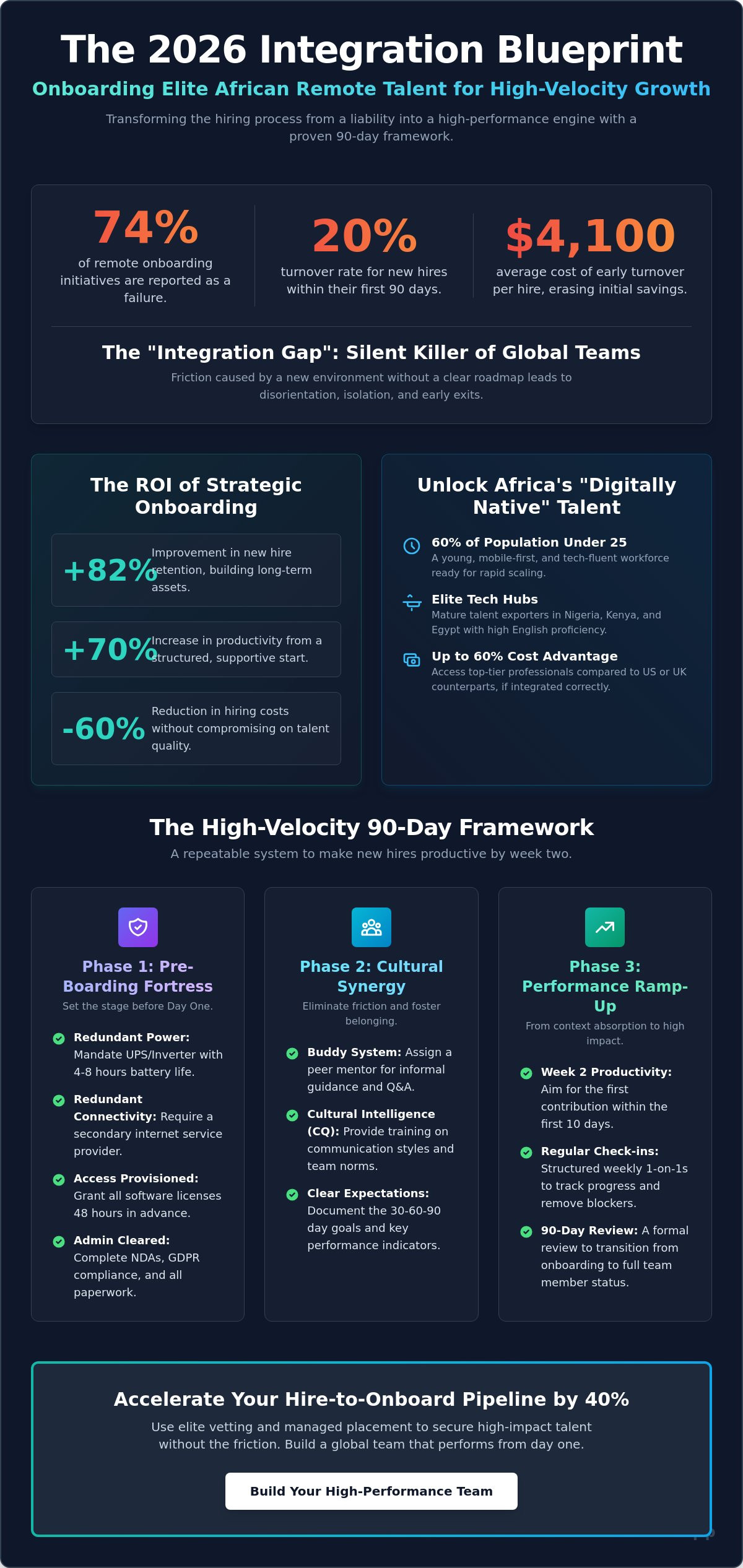
The “Integration Gap” is the silent killer of global remote teams. It is the friction that exists when a high-performing professional enters a new environment without a clear roadmap. When you onboard remote African professionals, you are accessing a talent pool that offers up to 60% in cost savings compared to US or UK counterparts. However, those savings are only realized if the talent stays. Poor integration leads to early turnover, which costs an average of $4,100 per hire according to industry data.
Strategic onboarding shifts the dynamic from transactional hiring to a high-value partnership. African professionals are uniquely positioned as “digitally native” assets. With over 60% of the continent’s population under the age of 25, this workforce is mobile-first, tech-fluent, and ready for rapid scaling. Onboarding is the bridge that converts this raw potential into operational excellence. It’s the difference between a temporary contractor and a long-term strategic asset.
The 2026 African Talent Landscape
Tech hubs in Nigeria, Kenya, and Egypt have matured into elite talent exporters. These regions offer a unique combination of high English proficiency and minimal time zone friction for European and Middle Eastern firms. Success requires a deep understanding of cross-cultural communication principles to align diverse teams effectively. For technical leaders, mastering the nuances of managing remote African developers is essential for long-term scaling and code quality. These hubs aren’t just emerging; they’re dominating the global remote landscape.
Onboarding as a Retention Tool
The trajectory of a remote hire is decided in the first seven days. Without a structured plan, 60% of remote hires feel disoriented, leading to a high “isolation factor” that triggers early exits. Organizations with robust processes see 82% better retention and 70% higher productivity. You must eliminate the silence that often follows a signed contract. A proactive approach builds trust and loyalty from day one.
Onboarding ROI is the delta between hiring cost and 12-month productivity. By investing in the first 90 days, you protect your initial investment and ensure your new hire becomes a high-impact contributor by week two. Efficiency isn’t just about speed; it’s about building a foundation that lasts. A strong start is the only way to secure a high-performance finish.
Pre-boarding Infrastructure: Setting the Stage for Day One
Excellence starts before the first Zoom call. When you onboard remote African professionals, the pre-boarding phase is your primary defense against a disjointed start. This stage is about building an operational fortress. You must transition from a signed contract to a fully functional workspace within 72 hours. This requires a “Zero-Day” checklist that covers everything from hardware procurement to data privacy protocols like GDPR compliance and signed NDAs. Efficiency here dictates the speed of your ROI.
Redundancy is the elite standard for remote infrastructure. While tech hubs in Nigeria, Kenya, and Egypt offer high-speed fiber, the stability of Africa’s growing gig economy depends on backup systems. You aren’t just hiring a person; you’re vetting a workspace. This means mandating a secondary internet service provider and a dedicated power solution like a UPS or inverter system. These aren’t luxuries. They’re essential for maintaining “Always-On” reliability in high-stakes tech and design roles. If you’re still finding vetted talent, ensure these infrastructure audits are part of your selection criteria.
Infrastructure and Connectivity Vetting
Don’t leave connectivity to chance. Conduct a formal audit of your remote professional’s workspace before their start date. This includes speed tests and a verification of their backup power capacity. In regional hubs, power fluctuations can occur, so an inverter with at least 4-8 hours of battery life is the professional benchmark. Establishing these expectations early ensures that technical roles remain productive regardless of local infrastructure shifts. To achieve this level of operational readiness, businesses often turn to Mytech Partners for strategic IT consulting and managed support services. It’s about proactive problem-solving, not reactive excuses.
Access and Administrative Setup
Administrative friction is a momentum killer. Provision all software licenses, including Slack, Jira, and Figma, at least 48 hours in advance. This allows the new hire to troubleshoot access issues before their official start time. Leveraging a global remote hiring solution can streamline this process by handling local compliance and contract logistics automatically. Once the tools are ready, prepare your internal team. A simple announcement and a clear first-day agenda go a long way in making a new hire feel like a partner rather than a ghost in the machine. Speed and clarity are your best tools for a seamless integration.
Bridging the Gap: Cultural Integration and Team Synergy
Cultural Intelligence (CQ) is the differentiator between a functional team and a high-performance unit. When you onboard remote African professionals, you aren’t just adding headcount. You’re integrating a new cultural perspective into your organizational DNA. This requires a “Communication Manifesto” that clearly defines synchronous and asynchronous expectations. Don’t leave your team guessing. Establish exactly when a Slack message is sufficient and when a face-to-face call is mandatory to maintain momentum.
Time zone optimization is your primary strategic advantage. Unlike traditional outsourcing hubs in Asia, Africa shares a 0-3 hour overlap with Europe and the UK. This allows for real-time collaboration during peak business hours. Africa’s time zone alignment with Europe and the UK virtually eliminates the 12-hour “wait-time” lag often associated with Asian outsourcing hubs. It turns your distributed team into a seamless, high-velocity operation without the communication delays that stall projects.
Effective Communication Protocols
Managers must understand the shift from low-context to high-context communication. In many Western cultures, communication is low-context; meaning is found strictly in the words. In high-context cultures, the relationship and the setting carry significant weight. Standardize your feedback loops to avoid “politeness bias,” where new hires might hesitate to challenge a superior’s idea. Encourage directness through structured “Ask Me Anything” sessions and clear, data-driven performance metrics. This clarity prevents misunderstandings and accelerates delivery.
Building Social Capital Remotely
Isolation is a significant retention risk in distributed environments. Deploy the “Buddy System” to pair new hires with internal veterans for the first 30 days. This facilitates the informal knowledge transfer that standard documentation often misses. Schedule virtual coffee chats and create an “unstructured” digital watercooler to build rapport. Inclusion strategies must ensure remote professionals are present for key decision-making meetings, not just the follow-up summary. Aligning your internal culture with remote worker retention Africa best practices ensures your talent feels valued and integrated. Social capital is the glue that keeps high-performing teams together across borders.
The 90-Day Performance Framework: From Hire to High-Impact
Successful integration is a marathon of precision, not a sprint of luck. To effectively onboard remote African professionals, you need a structured 90-day roadmap that moves from initial absorption to full project ownership. Organizations that utilize a formalized framework see 70% higher productivity from new hires. This process isn’t about hand-holding. It’s about providing the high-velocity context required for elite talent to thrive. By breaking the first three months into distinct phases, you eliminate ambiguity and set a standard for excellence from day one.
Building momentum requires “Quick Win” milestones. These are small, high-visibility tasks that a new hire can complete within their first 14 days. Whether it’s resolving a backlog ticket or drafting a design component, these wins build confidence and prove the hire’s immediate value to the team. If you want to hire and integrate elite talent using this high-performance model, your documentation must be ready before the professional begins their first task.
The First 30 Days: The Absorption Phase
The first month is dedicated to tool mastery and cultural alignment. During Week 1, focus entirely on team introductions and technical stack orientation. By Week 2, the professional should transition to shadowing senior peers and completing their “First Ticket.” This is a low-risk task designed to test their understanding of your internal workflows. A formal 30-day check-in is mandatory. Use this meeting to course-correct any early friction points and validate that the hire has the resources they need to succeed. Silence at the 30-day mark is a precursor to turnover.
Months 2 and 3: Driving Autonomy
Phase 2 (Days 31-60) shifts the focus to “Contribution and Feedback.” This is where the professional moves from guided tasks to independent project ownership. You should begin identifying specific “Skill Gaps” during this period. If a developer needs to master a specific internal library or a designer needs to align closer with your brand guidelines, provide targeted professional development immediately. By Phase 3 (Days 61-90), the goal is “Ownership and Optimization.”
Formalize your performance metrics during this final stage. Transition from observing activity to measuring results through clearly defined KPIs or OKRs. A high-impact professional should be operating with 90% autonomy by the end of month three. This structured progression ensures that your investment in African talent yields a productive, long-term partner who understands your business as well as any local hire. Clarity is the foundation of high-performance remote work.
Scaling with IMO Talent: Managed Onboarding for Global Teams
Efficiency is the hallmark of a global scale-up. When you choose to onboard remote African professionals through IMO Talent, you aren’t just filling a vacancy; you’re activating a high-velocity growth engine. We’ve optimized the hire-to-onboard pipeline to a 72-hour window. This speed ensures that your project momentum never stalls while waiting for administrative hurdles or local compliance checks. We operate at the pace your business demands.
The “Vetting Advantage” is a core component of our model. Our pre-vetted professionals are selected not only for technical mastery but also for their readiness to operate within global team structures. This rigorous selection process means our talent integrates 40% faster than general marketplace hires. You bypass the common friction points of cultural misalignment and technical mismatching. By the time a professional reaches your team, they’re already primed for the 90-day framework we’ve established.
The IMO End-to-End Solution
We act as an elite facilitator, managing the entire talent lifecycle from initial vetting to long-term retention. Our model removes the administrative and compliance burden from your internal HR teams. We handle the complexities of local labor laws and tax regulations, allowing you to focus strictly on output. Performance monitoring is built into our service, ensuring that the integration stages are executed with clinical precision. We don’t just find talent; we manage the partnership.
Investing in hiring remote developers from Africa is a strategic move for any firm looking to scale without compromising on quality. We provide a bridge between elite talent and global demand, ensuring that every placement is a match for both skill and culture. It’s a comprehensive management approach that prioritizes your operational readiness. We have no patience for slow-moving traditional processes that hinder growth.
Ready to Scale Your Team?
The economic and operational benefits of African talent are undeniable. You’re looking at a 60% reduction in hiring costs paired with 100% quality assurance. This isn’t just about cost-cutting; it’s about accessing a youthful, digitally native workforce that is eager to drive your business forward. Companies that choose to build a remote team with African talent gain an immediate competitive edge through pre-vetted, senior professionals who are ready to integrate into existing workflows within days. We take the risk out of international hiring by providing a repeatable, managed system for success. Our goal is to make global expansion feel seamless and high-end.
Don’t let traditional hiring processes slow your expansion. Our system is designed for companies that value excellence and demand immediate results. You get the talent you need, the compliance you require, and the performance you expect. Schedule a consultation with IMO Talent to find your next elite remote hire.
Master Your Global Integration Strategy
Operational excellence is the only path to sustainable scaling. By implementing a rigorous 90-day framework and prioritizing infrastructure redundancy, you eliminate the friction that stalls most global teams. Success depends on moving beyond transactional hiring to a model of strategic partnership. When you onboard remote African professionals, you secure a 60% cost reduction compared to US or UK hires without sacrificing the quality of your output.
The 2026 talent landscape belongs to those who move with speed and precision. You now have the template to bridge cultural gaps, optimize time zone overlaps, and drive autonomy from day one. Our elite network of tech, business, and design pros is ready to integrate into your workflow immediately. Stop settling for slow-moving traditional processes that hinder your growth.
Access Vetted African Professionals in 72 Hours
Your team’s next high-impact contributor is ready to start. Build your future with the confidence of a proven integration system.
Frequently Asked Questions
What are the main challenges when onboarding remote African professionals?
The primary challenges involve bridging the “Integration Gap” and ensuring infrastructure stability. While the talent is elite, you must proactively manage cultural synergy and local compliance to avoid the high turnover risk seen in many distributed teams. Success requires a shift from transactional hiring to a structured 90-day partnership that prioritizes clear communication and operational readiness from day one.
How do you handle time zone differences between the US/UK and Africa?
Africa’s time zones offer a significant strategic advantage, particularly for European and UK firms. There is a 0-3 hour overlap that allows for real-time collaboration during peak business hours. US-based companies often leverage this alignment to create a “follow-the-sun” model, ensuring that high-velocity projects maintain momentum while Western teams are offline. This proximity virtually eliminates the long wait times associated with Asian outsourcing.
Is the internet infrastructure in Africa reliable for remote tech roles?
Yes, fiber-optic internet is the professional standard in major tech hubs like Lagos, Nairobi, and Cairo. However, reliability is maintained through redundancy rather than luck. We mandate that all professionals have secondary internet service providers and dedicated power solutions like UPS or inverter systems. This setup ensures 100% uptime and prevents local power fluctuations from disrupting your technical workflows or delivery schedules.
How can I ensure cultural alignment with my remote African team members?
Cultural alignment is achieved through high Cultural Intelligence (CQ) and standardized communication protocols. When you onboard remote African professionals, you should implement a “Communication Manifesto” that defines expectations for synchronous and asynchronous work. Using a buddy system for the first 30 days also helps new hires navigate informal team norms and eliminates the “politeness bias” that can sometimes stall direct feedback loops.
What is the best way to handle equipment and hardware for remote hires in Africa?
Providing local stipends for hardware procurement is typically the most efficient method. This approach bypasses the complexities of international shipping, customs delays, and high import duties. It ensures that your hire can access high-spec equipment locally while allowing your IT team to maintain security standards through remote management software and VPN protocols. Efficiency in hardware setup is critical for a week-one start.
How long does it typically take for a remote African professional to become fully productive?
A high-impact professional should be fully productive and operating with 90% autonomy within 90 days. However, a structured onboarding framework allows for “Quick Wins” as early as week two. By following a phased approach of absorption, contribution, and ownership, you ensure the hire moves from shadowing to independent project delivery without the friction that typically slows down traditional remote integrations.
Can IMO Talent help with the legal and compliance aspects of hiring in Africa?
IMO Talent manages the entire administrative and compliance burden for your organization. We navigate local labor laws, tax residency requirements, and mandatory contributions like Kenya’s Social Health Insurance Fund (SHIF) or Nigeria’s updated 2026 tax codes. This end-to-end management allows you to scale your team across different jurisdictions without the legal complexity of setting up local entities in every country.
What specific roles are most suitable for remote African talent?
African talent is exceptionally well-suited for specialized roles in software development, cybersecurity, and data analysis. The continent’s youthful, digitally native workforce also delivers elite performance in UI/UX design and business operations. Because English is the primary language of business in major hubs, these professionals integrate seamlessly into Western corporate environments, providing high-quality output across tech, design, and business disciplines.
