

Why are most companies still using a dated vetting process when remote talent quality assurance in Africa has already evolved into a high-precision science? You likely recognise the massive potential within the continent’s tech hubs, yet the fear of wasting time on unqualified candidates or hitting a cultural wall often stalls your progress. It’s a valid concern; nobody wants to risk their project’s velocity on a bad hire.
We’re here to help you move past that hesitation. You’ll learn a rigorous framework to vet, verify, and maintain elite performance standards when hiring remote professionals from Africa. We’ll break down how to bridge communication gaps and verify technical skills with clinical precision. By the end, you’ll have a faster way to scale your team without ever compromising on the quality of your output. It’s time to stop second-guessing and start building with the best talent the global market has to offer.
Key Takeaways
- Move beyond basic CV screening by implementing a multi-layered process that prioritises cognitive ability and real-world technical simulations.
- Discover how a structured framework for remote talent quality assurance eliminates guesswork and ensures every new hire meets your specific performance standards.
- Learn why emerging tech hubs like Lagos, Nairobi, and Accra are producing world-class professionals who compete at the highest global levels.
- Secure long-term success by establishing clear KPIs and feedback loops during the critical first 30 days of your new team member’s journey.
- Find out how to bypass the administrative grind and access the top 2% of African talent in as little as 72 hours.
What is Remote Talent Quality Assurance?
Think of What is Quality Assurance? as the safety net for your scaling efforts. In the world of global recruitment, remote talent quality assurance is the systematic process of verifying a candidate’s technical skills, reliability, and cultural alignment before they ever set foot in your virtual office. It’s about moving beyond the surface level to ensure you aren’t just hiring a person, but a high-performance solution for your team.
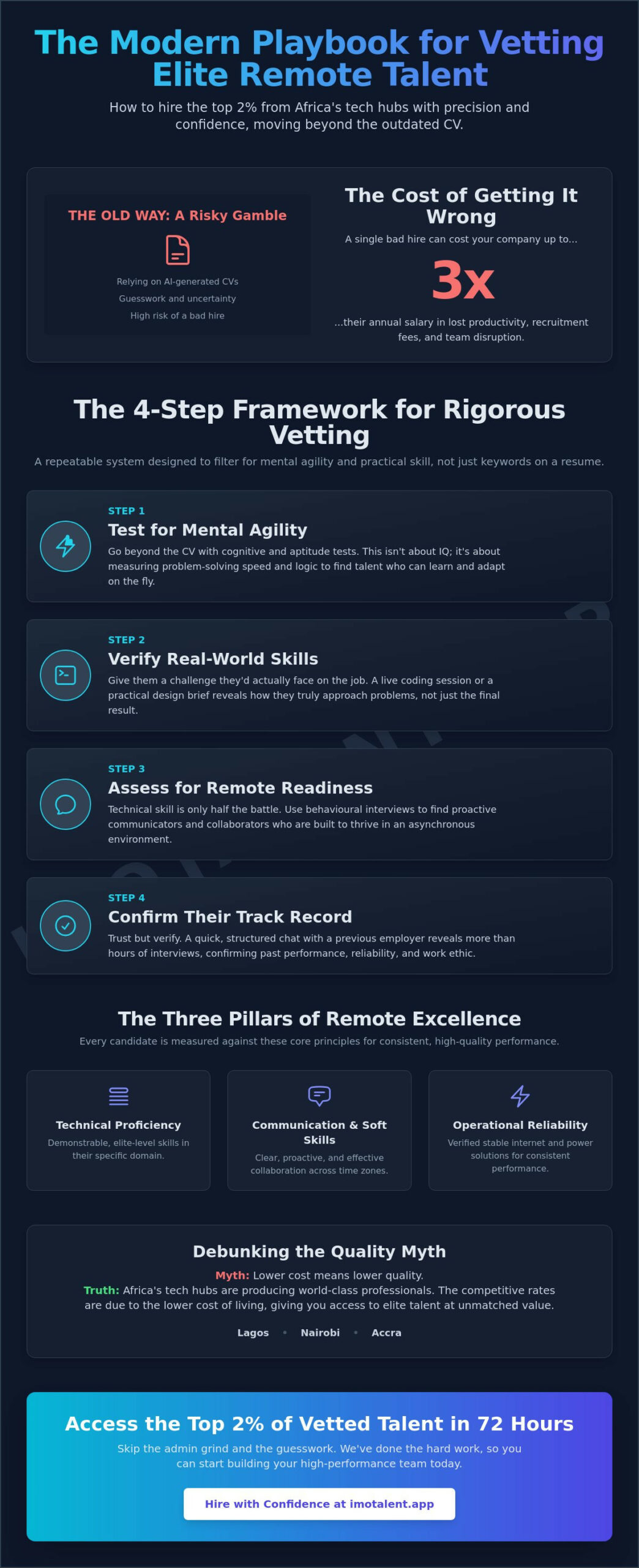
By 2026, traditional CV screening has become almost obsolete for remote-first companies. With AI-generated resumes and inflated LinkedIn profiles, a document alone can’t tell you if a developer in Nairobi can handle a complex sprint or if a designer in Lagos understands your brand’s nuance. Relying on a piece of paper is a gamble you can’t afford. Industry data suggests that a bad hire can cost a company up to three times a developer’s annual salary when you factor in lost productivity, recruitment fees, and the impact on team morale. That’s a heavy price for a preventable mistake.
Many leaders fall into the ‘Quality-Cost Paradox’ trap. They assume that because markets like Africa offer competitive rates, the standards must be lower. This is a myth. The lower cost of living in these regions allows you to access elite professionals at a price point that would only get you junior talent in London or San Francisco. High quality and lower costs aren’t mutually exclusive; you just need the right filters to find the gems.
The Three Pillars of Remote Excellence
To get remote talent quality assurance right, you need to look at three specific areas. First is technical proficiency. Don’t just take their word for it; use live coding sessions or real-world tasks to see how they think. Second is communication and soft skills. Can they collaborate across time zones and explain complex ideas simply? Finally, look at operational reliability. This means ensuring they have a stable internet connection and backup power solutions. These are vital for consistent performance in any remote setting and should be verified during the interview phase.
Why Quality Assurance is Critical for African Talent
The African talent pool is massive and growing at a record pace. While this is great news, it means you need better filtering mechanisms to separate the top 2% from the rest. For first-time employers in the region, a rigorous process helps bridge the ‘trust gap’ and provides peace of mind. It doesn’t just protect your company; it also protects the reputation of the professional. When a candidate passes a tough vetting process, they enter your team with immediate authority and the confidence to deliver results from day one.
The 4-Step Framework for Rigorous Talent Vetting
Establishing a world-class team requires more than just a gut feeling; it demands a repeatable system. This 4-step framework is designed to help you master remote talent quality assurance by filtering for mental agility and practical skill. By moving beyond the resume, you uncover how a candidate actually operates under pressure. Drawing on principles of global talent management, the most successful remote organisations are those that prioritise evidence over claims. If you want to bypass the manual setup, you can access pre-vetted talent pools that have already cleared these rigorous hurdles.
Step 1: Cognitive and Aptitude Testing. This is your initial filter. It isn’t about measuring raw IQ in a vacuum; it’s about testing for problem-solving speed and logic. In a fast-moving tech environment, you need people who can learn a new tool or framework on the fly. If they struggle with basic logic, they’ll likely struggle with complex project requirements later on.
Step 2: Role-Specific Technical Challenges. Once they’ve proven they have the mental agility, it’s time to see them work. This is where you test their actual craft. Whether it’s a coding challenge or a design brief, the task must be relevant to their daily responsibilities. You want to see how they approach a problem, not just the final result.
Step 3: Behavioural and Cultural Interviews. Skill is only half the battle. You need to know if they’ll thrive in a remote setting. Look for traits like proactivity and clear communication. A brilliant developer who can’t collaborate asynchronously will eventually become a bottleneck for your entire team.
Step 4: Background and Reference Verification. Never take a candidate’s history at face value. A quick ten-minute chat with a previous employer can reveal more than five hours of interviewing. Confirm their past performance and reliability to ensure they aren’t just good at interviewing, but good at their job.
Designing the Perfect Technical Assessment
Stop using abstract puzzles, often called ‘leetcoding’, that have nothing to do with the job. Instead, focus on tasks the talent will actually perform. If you’re hiring a web developer, ask them to debug a real piece of code or build a small feature. Set clear time limits. This helps you measure efficiency alongside accuracy. Always provide brief feedback to candidates who don’t make the cut. It protects your brand and keeps the door open for future roles.
Vetting for Remote-First Soft Skills
Testing for asynchronous communication is vital. This is the ability to share information clearly through writing or recorded messages without needing a real-time meeting. You can test this by giving them a written task during the recruitment process and seeing how they structure their response. You’re looking for self-starters who don’t need a manager to hold their hand every hour.
Actionable Tip: During the interview, ask the candidate: “How do you handle two conflicting priorities when your manager is offline and won’t be back for four hours?” Their answer will show you if they have the decisiveness and proactivity required for remote success.
Debunking the Quality Myth: The Truth About African Professionals
Affordable isn’t a synonym for amateur. One of the biggest hurdles in remote talent quality assurance is overcoming the bias that lower costs mean lower standards. In reality, tech hubs like Lagos, Nairobi, and Accra are producing world-class talent that rivals anything found in Silicon Valley. These professionals aren’t just ‘good for the price’; they are globally competitive experts who often possess a higher ‘grit’ score. Thriving in some of the world’s fastest-growing and most competitive economies builds a level of resilience and problem-solving ability that’s hard to replicate.
English proficiency is another massive, often overlooked advantage. Nigeria and Kenya consistently rank among the top English-speaking nations globally. This eliminates the communication friction that often plagues offshore teams in other regions. You aren’t just hiring a coder; you’re hiring a collaborator who understands the nuance of your requirements from the first meeting. Consider these factors that define the current African talent landscape:
- Global Standard Education: A mix of top-tier local universities and ‘self-taught’ excellence through international certification programmes.
- High-Stakes Experience: Many African professionals have built products for millions of users in the fintech and agritech sectors.
- Cultural Fluency: A deep understanding of Western business culture, particularly for UK and European markets.
Case Study: The 72-Hour Quality Turnaround
Speed is a competitive advantage. While companies in London or San Francisco might spend months searching for a senior engineer, savvy teams are using a different playbook. By hiring remote developers from Africa through a structured platform, businesses are seeing senior-level placements in as little as 72 hours. The results are striking: companies report up to 60% cost savings without any dip in output quality or project velocity. It’s about efficiency, not shortcuts.
Aligning Time Zones for Seamless Quality
A major pain point with traditional outsourcing is the ‘black box’ effect caused by massive time differences. If you’re based in the UK or Europe, Africa offers a near-perfect time zone overlap. This makes ‘Live QA’ sessions and collaborative coding as easy as if the talent were in the next room. Unlike teams in Southeast Asia that require late-night or early-morning calls, African talent works while you work. This synchronisation is a core component of effective remote talent quality assurance, allowing for real-time feedback and faster iteration cycles. For companies seeking a particularly frictionless entry point, Ghana tech talent remote offers a native GMT time zone and exceptional English proficiency that makes real-time collaboration seamless from day one.
Actionable Tip: During the vetting process, look for ‘self-taught excellence’. Ask candidates about a complex technical problem they solved without formal training. This often reveals the self-starter mindset that defines top-tier African professionals.
Post-Hire Quality Assurance: Maintaining High Standards
Landing the right person is just the first step. True remote talent quality assurance is a continuous loop that requires active management. It’s a mistake to think that once the contract is signed, your work is done. To maintain the high standards you vetted for, you must ensure those qualities translate into long-term results through structured oversight and clear expectations.
The first 30 days are your most critical window. This is when you set the tone for the entire relationship. You need to establish clear KPIs (Key Performance Indicators) from day one so your new hire isn’t left guessing what success looks like. Create tight feedback loops. Start with daily check-ins during the first week and transition to weekly sessions once they’ve found their rhythm. This structure provides the support needed for a professional to integrate into your workflow without feeling lost.
Actionable Tip: Implement weekly ‘Sync’ meetings. These shouldn’t be simple status updates. Instead, use them as a proactive space to catch blockers before they turn into bugs or missed deadlines. If you identify a hurdle early, you save days of wasted effort.
Measuring Remote Performance Effectively
Stop watching the clock. In a remote-first environment, ‘hours at desk’ is a vanity metric that tells you nothing about quality. You must focus on outcomes. Track how much code was pushed, how many tasks were completed, and the overall accuracy of the work. High-velocity teams often use tools like Jira or Linear to monitor velocity and quality with clinical precision. Peer reviews are also a vital part of this process. They ensure your codebase stays clean and that every team member, regardless of location, is adhering to your internal standards.
Integrating Talent into Your Culture
Successful managing remote African developers hinges on psychological safety. Your remote team members need to feel safe enough to speak up, share their ideas, and admit when they’re stuck. If a developer feels like a ‘hidden’ contractor rather than a core part of the team, their contribution will naturally be limited. Encourage ‘voice’ by asking for their input during strategy sessions and product meetings.
Actionable Tip: Create a digital ‘watercooler’ space in Slack or Discord. It might seem like a small detail, but building rapport across borders is what turns a group of individuals into a unified, high-performing team. It’s about creating a global culture that values every professional’s presence.
If the burden of constant performance monitoring feels too heavy for your current leadership team, consider a ‘Managed Talent’ model. This approach allows you to outsource the operational monitoring to experts, ensuring quality stays high without draining your internal resources. Ready to scale your team with total confidence? You can start building your high-performance team today.
How IMO Talent Automates Your Quality Assurance
Building a manual vetting system is a massive undertaking for any growing business. This is where IMO Talent steps in. We’ve developed a proprietary system that automates remote talent quality assurance, allowing you to focus on your core product while we handle the heavy lifting of recruitment. We don’t just find candidates; we act as a discerning gatekeeper to ensure only the most elite professionals reach your interview stage.
Our 72-hour promise is built on precision. We identify and present the top 2% of African talent within three days of your request. This speed is possible because we’ve already performed the cognitive testing, technical deep dives, and reference checks mentioned in our framework. This efficiency allows you to build a remote team in Africa that is ready to scale at high velocity. Most of our clients achieve 60% cost savings compared to local hiring, all while maintaining or exceeding their existing quality standards.
Actionable Tip: When you book your initial consultation, bring your most difficult technical hurdle or project blocker. We’ll show you exactly how our pre-vetted talent has solved similar high-stakes challenges for other global scale-ups.
Our Vetting Engine
We use a rigorous multi-stage testing process tailored for Tech, Business, and Design roles. Every candidate undergoes a specialised path that includes verifying ‘operational readiness’. We don’t just check their portfolio; we verify their hardware specs, backup power solutions, and internet stability. Global scale-ups trust us as their ‘Master Matchmaker’ because we understand that technical brilliance is useless without the reliable infrastructure to support it. We ensure every professional is ready to integrate seamlessly into your workflow from day one.
Start Your Quality-First Hiring Journey
Stop settling for ‘good enough’ candidates who drain your time and slow down your development cycles. The talent you need to reach your next milestone is already in our network, fully vetted and ready to deliver. Quality is the foundation of your success, and we make it accessible without the traditional recruitment friction. Book a consultation today to see our talent pool and experience a faster, more reliable way to grow your team.
Hire vetted remote talent with IMO Talent today
Scale Your Team with Certainty
Scaling a global team doesn’t have to be a gamble. By shifting your focus from document-based screening to evidence-led vetting, you turn remote talent quality assurance into your greatest competitive advantage. You’ve seen how the combination of cognitive testing, role-specific challenges, and structured management creates a foundation for long-term success. The African tech ecosystem is ready to provide the elite skills your business needs to grow without the traditional overheads of local hiring.
We’re here to make that transition seamless. With our UK-based support and management, you can access our top 2% vetted talent pool and start seeing results immediately. Most of our partners enjoy a 60% reduction in hiring costs while actually increasing their project’s velocity. It’s time to stop worrying about the ‘trust gap’ and start building with the world’s most resilient professionals.
Hire Vetted, High-Performance African Talent in 72 Hours
Take the first step toward a more efficient, high-performing workforce today. You have the framework and the tools; now it’s time to execute.
Frequently Asked Questions
How do you verify the technical skills of remote talent in Africa?
We use a multi-layered approach that includes cognitive assessments, live coding sessions, and real-world project simulations. It isn’t enough to just look at a portfolio. We test how a candidate thinks and solves problems under pressure. This rigorous remote talent quality assurance ensures that every professional in our network can deliver high-quality work from day one.
Is there a significant time zone difference between the UK and Africa?
There is little to no time zone difference between the UK and major African tech hubs. Most regions in Africa operate between GMT and GMT+3, providing a near-perfect overlap with the UK and Europe. This synchronisation allows for real-time collaboration and meetings without the late-night or early-morning calls required when hiring from Asia or the Americas.
Can I hire roles other than developers, such as Product Managers?
Yes, we place a wide range of professionals, including Product Managers, Designers, and Business Operations specialists. While we have a deep network of tech talent, our vetting process is equally robust for business and design roles. We ensure that every hire, regardless of their discipline, possesses the ‘remote-first’ traits and technical expertise needed to thrive in your team.
What happens if a remote hire doesn’t meet our quality standards after starting?
We provide ongoing performance monitoring and a replacement policy to protect your investment. If a hire doesn’t meet the agreed-upon standards during the initial period, we work quickly to identify the issue. If it can’t be resolved through feedback, we find a suitable replacement at no extra cost, ensuring your project’s momentum stays on track.
How does the cost of African talent compare to the UK or US?
Hiring from Africa typically results in a 60% reduction in total costs compared to the UK or US. Because the cost of living is lower in hubs like Nigeria or South Africa, you can access senior-level expertise for a price that would only secure a junior or mid-level professional in London or San Francisco. It is a strategic way to scale without draining your budget.
Is the English proficiency of African professionals high enough for global teams?
English proficiency is exceptionally high, particularly in nations like Nigeria and Kenya, which are global leaders in English-speaking talent. Most professionals in these hubs have been educated in English and have extensive experience working with international clients. You can expect clear, nuanced communication in every stand-up and strategy session.
How quickly can I onboard a new remote professional through IMO Talent?
You can onboard a new team member in as little as 72 hours. Because we maintain a pre-vetted network of the top 2% of African talent, we skip the traditional months-long recruitment cycle. We identify the best matches for your specific needs and present them to you immediately, allowing you to hire at high velocity.
What infrastructure checks do you perform on candidates?
We perform mandatory checks on every candidate’s internet stability, hardware specifications, and backup power solutions. Reliability is a pillar of our remote talent quality assurance process. We verify that each professional has a stable environment to work from, ensuring that local infrastructure challenges never interfere with your team’s productivity or deadlines.
