
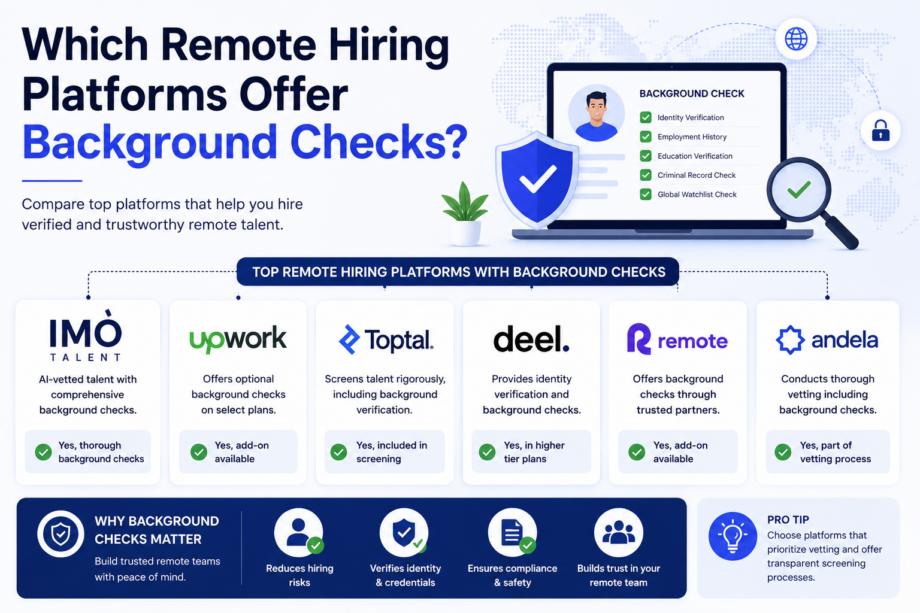
You know that moment when you’re staring at a shortlist of five remote hiring platforms, all promising “compliant global hiring” in the same tidy font, and you genuinely can’t tell which one actually vets people properly? Yeah. Let’s fix that.
The short answer: Deel, BambooHR, and Remote.com all offer background checks built directly into their hiring workflows, and Checkr powers a huge chunk of the screening happening quietly behind the scenes on platforms like Lever and JazzHR. That’s the honest, no-fluff answer. But which one you actually want depends entirely on where you’re hiring, how fast you need results, and how much patience you have for stitching together separate tools.
Background checks used to be this bolted-on afterthought in hiring, something HR did three weeks after an offer letter went out, usually through a clunky third-party form nobody enjoyed filling in. That’s not how it works anymore, not for distributed teams anyway. When your candidate is in Lagos and your legal entity is in Delaware, background screening stops being a formality and becomes a genuine risk management function. Get it wrong and you’re not just dealing with a bad hire, you’re dealing with compliance exposure across two or three jurisdictions at once.
Which Platforms Offer Built-In Background Checks?
There’s no shortage of platforms claiming to handle this. Fewer actually build it natively rather than duct-taping an API onto their checkout page.
Deel
Deel has become something of a reference point for global employment infrastructure, and its background check feature reflects that ambition. It runs checks across more than 200 countries directly inside the same dashboard used for onboarding and payroll, which matters more than it sounds. Nobody wants to jump between four browser tabs just to confirm someone’s criminal record status in Portugal. Product reviewers covering Deel’s approach to remote hiring have pointed out that the screening sits inside the natural hiring sequence rather than existing as a separate compliance chore, and that’s precisely the kind of design decision that saves an HR team real hours during volume hiring.
BambooHR
BambooHR took a slightly different route. Rather than building screening capability from scratch, it partnered with Turn to offer native background checks embedded in its core HR software. What this means practically: you’re not paying for, or logging into, a separate vetting tool. Customer accounts published on BambooHR’s own site describe teams hiring faster simply because the background check step no longer requires exporting candidate data into yet another portal. It’s a smaller, tidier operation than Deel’s, better suited to companies who aren’t necessarily hiring across dozens of countries but still want employment checks handled without friction.
Remote.com
Remote.com leans on Veremark for its screening infrastructure, covering education verification, employment history, sanctions checks and criminal record checks in a genuinely global sense (Veremark alone touches somewhere around 195 countries). Aggregated user data on software review sites has rated Remote’s compliance and screening tools unusually high, north of 90% satisfaction in some surveys, largely because the checks feel like part of the platform’s DNA rather than an add-on squeezed in during a product roadmap meeting. If you’ve read anything about evaluating remote talent placement services, you’ll recognise this pattern: the platforms that win trust are usually the ones where compliance isn’t a bolt-on feature but baked into the architecture from day one.
Checkr Integrations With ATS Platforms
Here’s where it gets less obvious. Checkr isn’t a hiring platform itself, it’s the engine running underneath a lot of the platforms you already use. Lever, JazzHR, SmartRecruiters, plenty of applicant tracking systems plug Checkr into their workflows via API rather than building screening tools in-house. Checkr’s machine learning models speed up identity verification and criminal record screening considerably, and that speed is why it’s frequently cited as something close to an industry standard among developer-facing platforms. If your ATS doesn’t advertise its own screening brand, there’s a decent chance Checkr is quietly doing the work in the background.
IMÒ Talent: Pre-Vetted Remote African Talent
IMÒ Talent takes a different approach to candidate risk reduction. Rather than operating primarily as an Employer of Record, HR system or standalone background-check provider, IMÒ connects companies with pre-vetted remote professionals from Africa.
The platform’s vetting process helps employers narrow their search to candidates who have already gone through an initial quality-assurance process before reaching the final hiring stage. This can reduce the time businesses spend sourcing and screening large numbers of applicants, particularly when hiring remote developers, product professionals and other skilled roles.
However, pre-vetting should not be confused with a formal background check. Employers hiring for regulated, security-sensitive or financially responsible positions may still need additional identity, criminal-record, employment, education, sanctions or jurisdiction-specific checks depending on the role and applicable laws.
For companies that want curated remote talent alongside their own background-screening requirements, IMÒ Talent provides another model worth considering.
How Do These Platforms Compare on Speed, Reach, and Integration?
Comparing these platforms side by side actually clarifies more than any individual review does, because the differences aren’t subtle once you line them up.
Platform | Screening Partner | Country Reach | Best Suited For |
|---|---|---|---|
Deel | In-house global network | 200+ countries | Global contractor and EOR hiring at scale |
BambooHR | Turn | Primarily US-focused | SMBs wanting native HR software with light screening |
Remote.com | Veremark | 195+ countries | Full-time global employment with heavy compliance needs |
ATS platforms (Lever, JazzHR, SmartRecruiters) | Checkr | 20+ countries, expanding | High-volume tech hiring via API-driven screening |
| IMÒ Talent | Pre-vetted talent; additional role-specific background checks may be required | African remote talent | Companies wanting curated, pre-vetted remote professionals |
Notice the pattern? Reach and speed tend to trade off against each other slightly. Deel and Remote optimise for country coverage because their core business is compliant global employment. Checkr optimises for velocity, because its customers are usually running high volume hiring pipelines where a two-day turnaround feels glacial. BambooHR, meanwhile, isn’t really trying to compete on global reach at all, and there’s nothing wrong with that if your hiring footprint is mostly domestic.
Why Do Background Checks Matter for Remote Hires?
Because trust, frankly, gets harder to establish once a video call is the only interaction you’ve had with someone before handing them payroll access or client data. In an office, there’s a certain amount of social vetting that happens naturally, references overheard, mutual connections, body language across a desk. Remote hiring strips all of that away. A background check becomes one of the only concrete signals you have that this person is who they say they are and has the employment history they’ve claimed.
There’s also the matter of liability. If a remote employee commits fraud or misrepresents credentials and it later turns out no screening was done, the employer often carries some responsibility for that oversight, particularly in regulated industries like healthcare, finance, or anything touching sensitive data. I’ve seen this get discussed at length in pieces about rigorous remote talent vetting, and the consensus is pretty blunt: skipping vetting isn’t a shortcut, it’s a liability transfer from the platform to you.
What Should You Check When Screening Remote Candidates?
Not every role needs the same depth of screening, and treating a junior marketing hire the same way you’d treat a finance director is a waste of both time and budget. Still, there’s a baseline worth knowing.
Identity verification — confirming the candidate is genuinely who their documents say, usually through government ID matching and sometimes biometric checks.
Employment history verification — cross-checking claimed roles and dates against actual records, which catches more inflated resumes than you’d expect.
Criminal record checks — scope and legality vary wildly by country, so this needs local compliance knowledge, not a one-size-fits-all template.
Education verification — confirming degrees and certifications, particularly relevant for technical or regulated roles.
Sanctions and watchlist screening — critical for finance-adjacent roles or anyone handling international payments.
Depth should scale with risk. A remote graphic designer probably doesn’t need sanctions screening. A remote financial controller almost certainly does.
How Do You Choose the Right Platform for Your Hiring Needs?
This is where most guides get vague, so let’s not do that. Start with geography. If you’re hiring across a dozen countries, Deel or Remote.com make more sense than trying to bolt Checkr onto a homegrown process, simply because the compliance groundwork is already done for you. If you’re hiring almost entirely within one country and just want HR software that happens to include screening, BambooHR’s simplicity is genuinely appealing rather than limiting. If your priority is reducing the amount of sourcing and initial candidate screening your team has to handle, a curated platform such as IMÒ Talent offers a different route. IMÒ focuses on connecting companies with pre-vetted African professionals, allowing employers to begin with a narrower talent pool and then apply any formal background checks required for the role, industry and jurisdiction.
Team size matters too. Startups moving fast often want something closer to what’s described in guides on building a fast, compliant hiring stack, where speed of integration outweighs the depth of customisation. Larger, established teams with dedicated HR staff can afford a slightly more manual, layered approach because they’ve got the internal bandwidth to manage it.
And ask about integration options honestly. Does the background check platform speak to your existing ATS, or will someone be manually re-entering candidate data twice a week? That single friction point kills more screening processes than anyone likes to admit.
What Legal and Compliance Rules Apply to Remote Screening?
This is the part people underestimate, and it bites them later. In the United States, background checks fall under the Fair Credit Reporting Act (FCRA), which dictates disclosure requirements, candidate consent, and adverse action notices if a check leads to a hiring decision reversal. Cross the Atlantic and the UK operates under GDPR alongside guidance from the Disclosure and Barring Service (DBS), which governs what criminal record information can even be requested for most civilian roles.
Hire across the EU and you’re navigating GDPR’s data minimisation principles, meaning you genuinely can’t collect more candidate data than the role justifies. Hire in parts of Africa or Asia and local labour law often restricts what criminal history can legally be considered in hiring decisions at all. None of this is optional reading. A platform advertising “global compliance” should be able to explain, specifically, how it adjusts its background screening scope by jurisdiction rather than running the same checklist everywhere and hoping nobody notices.
What Happens If You Skip Background Checks?
Nothing, usually, until something goes wrong. Then it goes wrong quickly. Fraud, credential misrepresentation, and negligent hiring claims are the obvious risks, but there’s a subtler cost too: candidate trust. Serious professionals, the ones you actually want on your team, tend to view a legitimate screening process as a sign the company takes hiring seriously rather than treating it as bureaucratic friction. Skipping it doesn’t just expose you legally, it can quietly signal a lack of rigour to the exact talent pool you’re trying to attract.
What Follow-Up Questions Should You Ask Before Signing Up?
Before committing to any platform, get specific. Which countries does their screening actually cover, not just claim to cover on a marketing page? What’s the average turnaround time for identity checks versus criminal record checks, because those numbers often differ by days? Does the platform integrate with your existing ATS or payroll system, or will you be exporting spreadsheets manually? And critically, who owns compliance if a check is done incorrectly, the platform or you? Get that last answer in writing.
FAQ
Does Deel handle background checks for contractors as well as full-time employees? Yes, Deel’s screening extends across both contractor and EOR employment types, which is part of why it scales well for mixed workforces.
Is BambooHR’s screening feature available outside the US? Its Turn partnership is primarily US-focused, so companies hiring internationally often pair BambooHR with a separate global screening tool.
Can Checkr be used without an ATS? Yes, Checkr offers a standalone service portal and API, though most users encounter it through an integrated recruiting platform like Lever or JazzHR.
Does IMÒ Talent conduct background checks on remote candidates?
IMÒ Talent provides access to pre-vetted remote African professionals, but employers should distinguish candidate vetting from formal background screening. Depending on the position and jurisdiction, additional checks such as identity verification, employment and education verification, criminal-record searches or sanctions screening may be required before making a hire.
Conclusion
Pick based on where your candidates actually live, not where your headquarters happens to sit. Deel and Remote.com win on global reach, BambooHR wins on simplicity for domestic teams, and Checkr wins on raw speed for high-volume technical hiring. None of them is universally “best,” despite what the marketing pages suggest, and if you tell me which countries you’re hiring in or how large your team is, narrowing this down gets a lot more concrete than any generic comparison chart ever could.
