

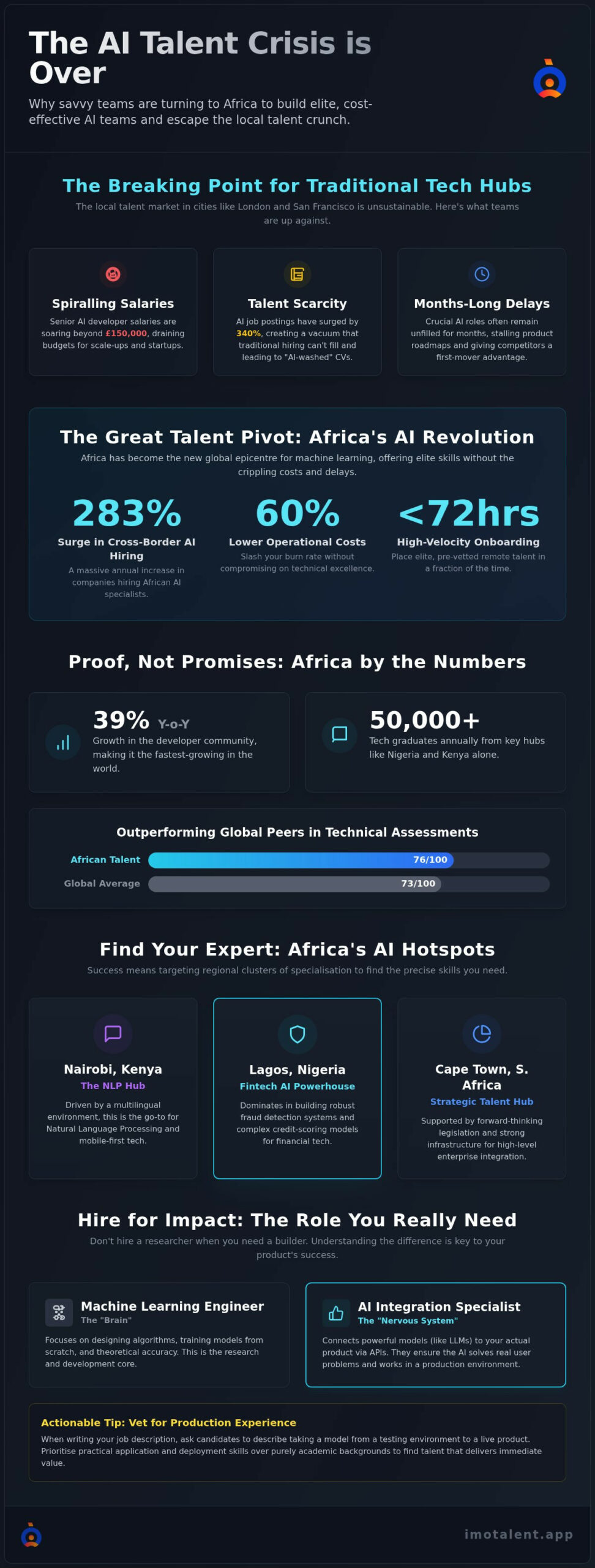
Did you know that cross-border hiring for AI specialists surged by 283% last year? While most firms are still fighting over overpriced local talent, savvy teams are choosing to hire AI developers in Africa to solve the talent crisis. You’ve likely noticed that finding a genuine expert is becoming an expensive, months-long ordeal; it’s a bottleneck that stalls your product roadmap and drains your budget. It’s time to stop settling for “AI-washing” on CVs and mediocre results.
This guide shows you how to slash your hiring costs by 60% without sacrificing technical excellence. Africa now boasts the fastest-growing developer community globally, with a 39% year-on-year growth rate and average technical scores that actually outperform the global average. You’ll learn how to navigate these top tech hubs and onboard elite, vetted talent in under 72 hours. We’re going to break down the exact steps to build a high-performing, remote-ready team that integrates seamlessly with your current workflow and helps you scale at velocity.
Key Takeaways
- Discover why Africa’s booming tech scene is the strategic solution to the 2026 global AI talent shortage and soaring local costs.
- Identify which regional hubs, such as Nairobi or Lagos, specialise in the specific machine learning or data skills your product needs to scale.
- Learn our proven four-step vetting process to hire AI developers in Africa who possess genuine technical expertise rather than just trendy buzzwords.
- Streamline your internal hiring workflow to onboard elite remote talent in under 72 hours using a high-velocity placement model.
- Slash your operational burn rate by 60% while enjoying the peace of mind that comes with a managed talent approach and high retention rates.
The 2026 AI Talent Crisis: Why Global Teams are Turning to Africa
The local talent market in London and San Francisco has hit a breaking point in 2026. If you’re trying to build an AI product today, you’ve likely seen senior salaries spiral beyond £150,000, often for developers who are just as likely to be poached by a big tech giant within months. This isn’t just a budget issue; it’s a survival crisis for scale-ups. Since 2024, AI-related job postings have surged by 340%, creating a vacuum that traditional hiring methods simply can’t fill. This pressure is driving the “Great Talent Pivot,” a strategic shift where successful teams are looking beyond their immediate geography to hire AI developers in Africa.
Africa has quietly become the new global epicentre for machine learning and AI integration. It isn’t only about lower costs. It’s about a massive, young population that treats AI as a native language rather than a new tool. With the fastest-growing developer community in the world, expanding at 39% year-on-year, the continent is producing over 50,000 tech graduates annually from hubs like Nigeria and Kenya alone. These developers aren’t just eager; they’re outperforming their global peers, with average technical assessment scores of 76/100 compared to the global average of 73/100. This combination of youth, hunger, and elite skill sets makes the region the most logical choice for teams that need to scale without compromise.
The Cost of Inaction in the AI Race
Every month your senior AI role remains unfilled, your product roadmap slips further behind. In 2026, speed is the only real competitive advantage. When hiring takes months, you aren’t just losing time; you’re bleeding capital through missed market opportunities and overstretched internal teams. Relying on generic freelance marketplaces often backfires because these platforms are frequently flooded with “AI-washed” CVs that lack technical depth. You need a high-velocity model that prioritises precision and operational readiness over sheer volume.
Africa’s Tech Hubs: The Silicon Savannah and Beyond
Infrastructure in cities like Lagos, Nairobi, and Cape Town has seen a monumental boom. Global giants like Microsoft and Google have invested heavily in local training programmes, ensuring that the talent pool is ready for high-level integration. This shift is supported by forward-thinking legislation, such as South Africa’s National AI Policy, which outlines clear strategic pillars for talent and capacity building. 2026 represents the “sweet spot” for global teams. The talent is elite, the infrastructure is stable, and the competition for these specialists still offers a massive first-mover advantage for those who act now.
Identifying AI Specialisations: Where to Find Your Expert
Success in 2026 requires more than a generic “AI” search. You need to target specific clusters to find the right fit. Nairobi has evolved into the continent’s hub for Natural Language Processing (NLP), driven by a multilingual environment and massive investment in mobile-first tech. Meanwhile, Lagos dominates Fintech AI, where developers excel at building fraud detection systems and credit-scoring models. This regional specialisation is a core driver behind Africa’s AI Productivity Gain, reflecting a continent-wide push to integrate intelligence into every commercial sector.
The most critical role in 2026 isn’t the data scientist working in a vacuum. It’s the AI Integration Specialist. These experts bridge the gap between complex Large Language Models (LLMs) and your actual product. They ensure that the “intelligence” you’re buying actually solves a user problem. If you’re looking to find these niche experts quickly, focus on their ability to deploy models into production environments rather than just their academic background. When you hire AI developers in Africa, you’re tapping into a market that prioritises practical application over theoretical research.
Machine Learning vs. AI Integration
It’s easy to get these roles confused. Machine Learning (ML) engineers focus on the “brain,” which involves designing algorithms and training models from scratch. AI Integration Specialists focus on the “nervous system,” which means connecting those models to your APIs and user interface. Don’t hire a PhD researcher if you actually need someone to build a responsive customer service bot.
Actionable Tip: When writing your job description, focus on “Production Experience.” Ask candidates to describe a time they took a model from a testing environment to a live product. Avoid candidates who only talk about “accuracy scores” without mentioning how they handled real-world user data.
The 2026 Tech Stack: What African AI Developers Use
African developers typically work in lean, cloud-native environments. This makes them incredibly adaptable to the latest frameworks. While PyTorch and TensorFlow remain the industry standards, the 2026 talent pool is heavily focused on LLM frameworks like LangChain. They understand that modern AI development is about speed and efficient resource management.
Because infrastructure in hubs like Cape Town and Nairobi is built on modern cloud foundations, these developers are often more proficient in AWS, Azure, or Google Cloud AI tools than their peers in legacy-heavy markets. They don’t just write code; they understand the entire deployment pipeline. This adaptability is exactly what you need when you hire AI developers in Africa to future-proof your product against the next wave of technological shifts.
Vetting AI Developers: How to Spot Real Expertise
In 2026, every second CV seems to claim expertise in “Generative AI” or “Neural Networks.” This “AI-washing” makes it incredibly difficult to find genuine talent in a crowded market. If you want to hire AI developers in Africa who can actually deliver, you need a vetting process that looks past the buzzwords. We use a rigorous four-step framework designed to filter out the noise and identify elite performers. It isn’t just about whether they can write Python; it’s about whether they can solve complex problems under pressure while working in a remote environment.
Our vetting focuses on the “why” behind the code. High-performing AI developers don’t just follow instructions; they challenge assumptions. They understand that a model is only as good as the data feeding it. When you’re looking to build an elite team, you need people who can think critically about data bias and ethical AI implementation. These are the nuances that differentiate a junior coder from a senior AI engineer. Our framework includes:
- Communication Audit: We assess fluency and the ability to explain complex technical concepts to non-experts.
- Logic and Architecture Assessment: We test how a candidate structures AI solutions from the ground up.
- Live Technical Evaluation: Real-time problem solving through pair-programming.
- Operational Readiness Review: Ensuring the developer has the infrastructure and mindset for high-velocity remote work.
The AI Technical Challenge
Standard coding tests often fail to measure the specific logic required for machine learning. Instead of generic algorithms, ask your candidates to explain a complex model in plain English. If they can’t explain how a decision was made by the AI, they don’t understand the model well enough to maintain it. Actionable Tip: Use pair-programming sessions to test real-time collaboration. Watch how they handle unexpected data errors or model drifts. This tells you more about their expertise than any static test ever could.
Assessing Remote Readiness
Technical skill is only half the battle. To successfully hire AI developers in Africa, you must ensure they are ready for global collaboration. This means vetting for time-zone management and proactive communication. We look for “proactive communicators” who flag potential roadblocks before they become product-killing issues. Our “72-hour test” identifies talent ready to integrate immediately. IMO Talent handles this heavy lifting, vetting thousands of candidates so you only interview the top 2% who are operationally ready to hit the ground running.
The 72-Hour Roadmap: Onboarding African AI Talent Effortlessly
Speed is the ultimate currency in 2026. While traditional hiring platforms often boast about a 30-day average for placements, that’s a lifetime in the AI race. High-growth teams don’t have a month to wait; they need experts who can contribute to their codebase by the end of the week. To hire AI developers in Africa successfully, you need to abandon slow, legacy hiring cycles and adopt a high-velocity model. We’ve refined a process that takes you from a talent gap to a signed contract in just three days without cutting corners on quality.
Success starts with streamlining your internal approval process. Most delays happen because decision-makers are out of sync or interview loops are too long. By the time you reach a consensus, elite developers have already accepted another offer. You can avoid this by pre-approving budget ranges and dedicating specific blocks of time for final evaluations. This readiness allows you to move at the same speed as the talent you’re trying to attract. If you’re ready to accelerate your growth, you can get started with our high-velocity matching today.
Step 1: The High-Velocity Brief
A vague job description is the enemy of speed. To trigger our 72-hour match, your requirements must be razor-sharp. We don’t just look for Python or PyTorch proficiency; we look for “culture-fit” alignment. This means identifying if you need a developer who thrives in a chaotic startup environment or one who excels in a structured, enterprise-level team. Once we have this brief, we filter our global network to present you with the top three candidates who are operationally ready to begin immediately.
Step 2: The Efficient Interview Loop
Consolidate your interviews into a single day. This “Master Matchmaker” approach ensures that momentum isn’t lost. Instead of four separate calls over two weeks, host a single, comprehensive session that covers technical logic and team integration. This efficiency signals to the candidate that your organisation is decisive and tech-forward. For more on this, read about Efficient Remote Talent Placement: Scaling Your Team Strategically.
The first 30 days are critical for long-term retention. Once you hire AI developers in Africa, you must integrate them into your existing team structure. We recommend a “buddy system” where your new remote specialist is paired with a UK or US-based developer. This isn’t for technical supervision, but for cultural and operational alignment. It ensures that your new hire understands the nuances of your workflow, from Slack etiquette to sprint cycles, from day one. This proactive approach leads to a 94% retention rate, far exceeding the industry standard for remote tech teams.
Why IMO Talent is Your Strategic AI Scaling Partner
Scaling an AI team in 2026 requires more than a simple recruitment agency. You need a partner that understands the friction of cross-border operations and eliminates it. IMO Talent isn’t a passive marketplace; we act as an elite facilitator that manages the entire lifecycle of your remote team. When you choose to hire AI developers Africa wide through our managed model, you’re offloading the administrative weight of payroll, local compliance, and ongoing support. This allows your internal leadership to focus on product innovation while we ensure your team is operationally ready and supported from day one.
We help you move from a single hire to building a sustainable AI centre of excellence. By handling the nuances of local employment law and providing a dedicated support structure, we bridge the gap between your global headquarters and your talent hub. This isn’t just about filling seats; it’s about creating a high-performance environment where your developers can thrive for the long term. Our goal is to make the process of scaling your technical capacity as smooth and predictable as any local hire.
The 60% Cost Advantage Explained
The financial logic is undeniable. A senior developer in Africa offers the same technical precision as a peer in San Francisco but at a fraction of the total employer cost. You can explore the specific data points in our cost of hiring developers in US vs Africa guide. Reducing your burn rate by 60% doesn’t mean you’re compromising on quality; it means you’re taking advantage of the lower cost of living in hubs like Lagos and Nairobi. This budget optimisation allows you to scale your AI roadmap twice as fast as your competitors who are stuck paying inflated local salaries.
Retention and Long-term Success
High retention is the backbone of a successful AI strategy. Managed African tech teams currently see a 94% retention rate, which is significantly higher than the 82% average for US-based remote teams. We achieve this by acting as a constant bridge, ensuring that your remote developers feel like an integral part of your company culture. Our ongoing management takes the guesswork out of remote integration, providing the stability needed for complex, multi-year AI projects. If you’re ready to secure elite talent and start building your future, you can hire remote developers from Africa today and see the impact on your product velocity within weeks.
Accelerate Your AI Innovation with Certainty
The 2026 AI race doesn’t wait for slow hiring cycles or inflated budgets. It’s clear that the most successful global teams are now looking toward the Silicon Savannah to find their competitive edge. Deciding to hire AI developers Africa wide gives you access to a talent pool that’s younger, faster, and technically superior to many traditional markets. You’ve seen how regional hubs like Nairobi and Lagos offer specialised expertise, and how a high-velocity onboarding roadmap can get your product back on track in days rather than months.
Choosing IMO Talent means you aren’t just finding a developer; you’re gaining a strategic scaling partner. We handle the complex administrative heavy lifting, from payroll to local compliance, while delivering 60% lower hiring costs compared to UK or US rates. With our managed talent support and elite vetting process, you can onboard world-class experts with total confidence. Don’t let your product roadmap stall while your competitors scale. Hire elite African AI developers in 72 hours and start building the future of your business today. We’re ready to help you succeed.
Frequently Asked Questions
How much can I save by hiring AI developers in Africa compared to the UK?
You can typically reduce your hiring costs by up to 60% compared to London or San Francisco rates. This financial advantage stems from the lower cost of living in major African tech hubs rather than a difference in technical skill. It allows your business to scale its technical capacity much faster without increasing your current burn rate.
What are the top African cities for finding senior AI engineers in 2026?
Lagos, Nairobi, and Cape Town are the primary centres for elite AI talent. Lagos has become the dominant hub for Fintech AI and fraud detection systems. Nairobi leads the way in Natural Language Processing (NLP), while Cape Town is highly regarded for senior engineers specialising in AI infrastructure and cloud-native engineering.
How does IMO Talent vet AI developers for technical accuracy?
We use a rigorous four-stage vetting process that prioritises practical problem-solving over theoretical knowledge. This includes communication audits, logic assessments, and live pair-programming sessions where we watch how candidates handle real-world data errors. Our goal is to ensure that when you hire AI developers in Africa, they are ready to contribute to your codebase immediately.
Can I hire a full AI team in Africa in under 72 hours?
Yes, our high-velocity model is designed to match you with pre-vetted specialists in just three days. We maintain an active network of elite developers who have already passed our technical and operational readiness tests. This speed allows you to bypass the traditional 30-day hiring cycle and meet your product deadlines without delay.
How do you handle time zone differences between Africa and the US or UK?
African time zones (GMT+1 to GMT+3) offer an excellent overlap with the UK and Europe, often allowing for a full day of synchronous work. For US-based teams, there is typically a 4 to 6-hour overlap with the East Coast. We specifically vet for developers who are proficient in asynchronous communication to ensure project momentum never stalls.
What programming languages and AI frameworks are most common in Africa?
Python is the universal standard, usually paired with PyTorch or TensorFlow for model development. In 2026, we’ve seen a significant shift toward LLM frameworks like LangChain and cloud-native AI tools on AWS and Google Cloud. African developers are often more adaptable to lean, modern tech stacks because they build for cloud-first environments.
Does IMO Talent handle the legal and payroll aspects of remote hiring?
We manage the entire administrative burden, including international payroll, local tax compliance, and employment contracts. This managed talent approach removes the legal complexity of cross-border hiring. You don’t need to worry about setting up local entities; you simply focus on managing your new team members while we handle the back-office operations.
Is it better to hire a freelance AI developer or a vetted full-time professional?
Vetted full-time professionals are the superior choice for long-term AI projects that require deep institutional knowledge. While freelancers are fine for gig-based tasks, they often lack the commitment needed for complex model training and integration. When you hire AI developers in Africa through a managed model, you benefit from a 94% retention rate and much higher security standards.
