

Hiring in Lagos or Nairobi isn’t a hidden secret anymore; it’s a high-velocity global race where the finish line keeps moving. You’ve likely realized that securing a 60% cost saving on elite tech talent is only a victory if those experts stay past the first year. High competition for senior developers in Nigeria and Kenya means your top performers are constantly targeted by firms offering global-standard stability. Improving remote worker retention Africa is now the primary lever for protecting your recruitment ROI. It’s exhausting to watch your momentum stall because of cultural friction or infrastructure-related burnout that feels out of your control.
You can stop the churn and secure a stable, high-performing team. We’ve developed the 2026 checklist to help you master remote worker retention Africa by solving the specific local operational frictions that drive talent away. You’ll learn how to navigate infrastructure barriers, leverage new digital nomad permits in Kenya and South Africa, and implement the professional stability that elite talent demands. This is your roadmap to shorter recruitment cycles and a permanent cost-saving advantage.
Key Takeaways
- Identify the primary drivers of churn, including aggressive headhunting and infrastructure fatigue, to master remote worker retention Africa.
- Structure high-impact compensation packages by benchmarking against global rates and offering stability through currency-pegged payments.
- Eliminate operational friction by subsidizing solar power backups and ensuring internet redundancy with high-speed providers like Starlink.
- Foster deep integration through asynchronous communication models and clear career pathing that resonates with elite African talent.
- Secure your long-term ROI by focusing on the critical 90-day retention window through proactive performance monitoring and talent advocacy.
The Retention Landscape: Why Remote Worker Retention in Africa is Different
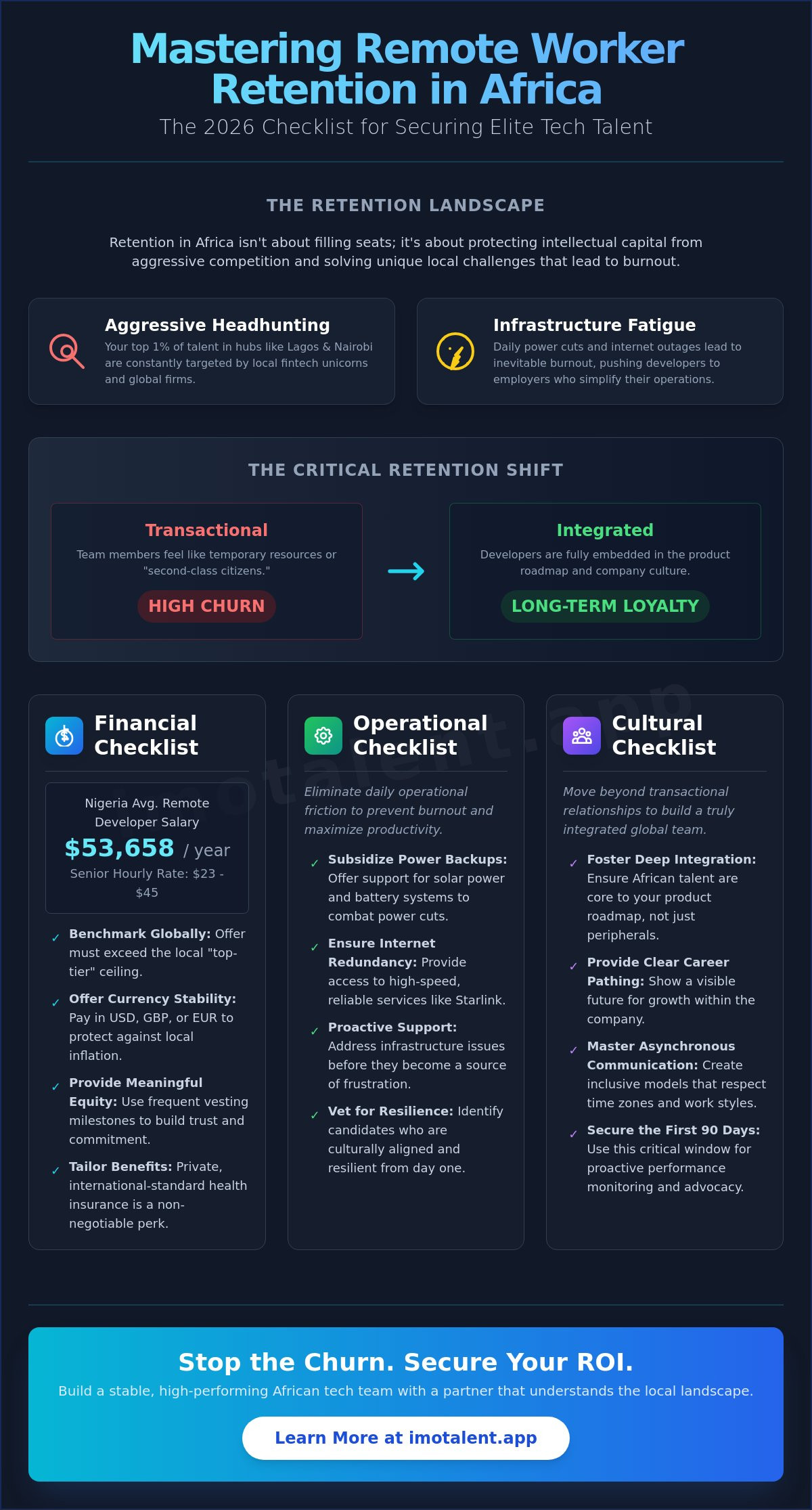
Africa is no longer a low-cost alternative for basic tasks. It is an elite talent reservoir. Unlike traditional outsourcing hubs where work is often transactional, the African market is experiencing a “Brain Gain.” Top-tier professionals are staying in their home countries while building global products. This shift changes the rules of remote worker retention Africa. Retention here isn’t just about keeping a seat filled; it’s about protecting your intellectual capital from aggressive local fintechs and other global firms. You are competing for the top 1% of a young, highly motivated workforce that knows its value.
Churn in this region stems from two primary sources. First, there is the hyper-competitive headhunting environment in cities like Lagos and Nairobi. Second, there is infrastructure fatigue. When a developer spends four hours a day managing power cuts or internet outages, burnout is inevitable. They will leave for any employer who simplifies their daily operations. Our “Master Matchmaker” philosophy addresses this early. We vet for culture fit and resilience because retention begins during the recruitment phase, not after the contract is signed. By the time a hire starts, they must already feel aligned with your mission.
The Rise of African Tech Hubs
The “Big Four” ecosystems (Nigeria, Kenya, Egypt, and South Africa) are maturing at a high velocity. Local fintech growth has created a competitive floor for salaries. You aren’t just competing with other remote firms; you’re competing with local unicorns that offer prestige and equity. To win, you must be an “Employer of Choice.” This requires offering more than a paycheck. It requires offering the same professional prestige found in Silicon Valley or London while acknowledging the unique growth of local markets.
The Psychological Contract of Remote Work
Retention is the alignment of global opportunity with local stability. While global remote work trends focus on flexibility, African talent prioritizes integration. Transactional relationships lead to high turnover. If your team feels like “second-class citizens” compared to your HQ staff, they will churn. True remote worker retention Africa happens when your developers are fully integrated into your product roadmap and company culture. They need to see a future where they grow alongside the company, not just as a temporary resource. Moving from “transactional” to “integrated” is the only way to secure long-term loyalty.
The Financial Checklist: Competitive Compensation and Benefit Structuring
Retaining elite talent in 2026 requires a “Dual-Market” perspective. You aren’t just competing with other remote firms. You are competing with local fintech hubs that offer high-prestige roles and competitive local salaries. In Nigeria, for instance, the average salary for a remote software developer is approximately $53,658 per year. Hourly rates for senior developers range from $23 to $45. To master remote worker retention Africa, your offer must exceed the local “top-tier” ceiling while remaining significantly more efficient than Silicon Valley payrolls.
Equity is another critical lever. While traditional four-year vesting schedules are standard, consider more frequent milestones for African professionals. This builds immediate trust and demonstrates a long-term commitment to their career growth. When you partner with a specialized talent placement service, you can benchmark these packages with precision to ensure your offers remain unblockable by competitors.
Currency Stability as a Retention Strategy
Currency volatility is a daily reality in many African markets. Paying in hard currencies like USD, GBP, or EUR is the single most effective way to build loyalty. It protects your team against local inflation and allows them to plan their financial futures with certainty. Avoid fee erosion by using modern cross-border payment platforms. Providing access to financial planning services as an added benefit further cements your position as an elite employer who understands local challenges.
Tailored Benefits for the African Context
Forget the ping-pong tables. In this market, family-centric benefits and professional growth are the true gold standards. Private, international-standard health insurance is a non-negotiable perk. It provides a level of security that local public systems often cannot match. Unlike the “cool office” perks seen in Western hubs, these benefits directly impact the quality of life for your employee and their dependents. To further support their home wellness, you can visit ITAMILANO to discover premium bathroom filtration systems that enhance daily living.
- Education Stipends: Fund certifications to keep your team at the cutting edge of technology.
- Pension Contributions: Use an Employer of Record (EOR) to manage local compliance and retirement funds.
- EOR Budgeting: Plan for EOR fees, which in Kenya generally range from $200 to $500 per employee per month.
A stable financial foundation is the bedrock of remote worker retention Africa. By solving the currency and security challenges your team faces locally, you transform from a “client” into a vital partner in their professional and personal success.
The Operational Checklist: Solving Infrastructure Friction
Retention in the African tech market is as much about logistics as it is about leadership. You can provide the best culture in the world, but if your lead developer is fighting daily power outages, their loyalty will erode. Infrastructure fatigue is a silent killer of remote worker retention Africa. To keep your team focused on high-level output, you must remove the friction of their physical environment. This isn’t a luxury; it’s a foundational requirement for operational readiness.
Power stability is the first hurdle. In many regions, the national grid is unreliable. Elite employers provide or subsidize solar inverters and backup batteries to ensure zero downtime. Connectivity follows a similar rule of redundancy. Relying on a single fiber provider is a risk. Your talent needs at least two high-speed options, typically a combination of Fiber and Starlink or a dedicated 5G backup. While portable satellite internet terminals start at $1,295 USD, the cost is negligible compared to the loss of a week’s productivity from a senior engineer. In Sub-Saharan Africa, where a basic data plan can cost 3.9% of the average monthly income, subsidizing these costs is a powerful retention signal.
The “Always-On” Infrastructure Protocol
Implement a “Work-from-Home” grant for every new hire. This capital allows them to optimize their setup before day one. Eliminating technical downtime directly reduces employee stress and burnout. It transforms the working experience from a struggle against local limitations into a seamless global collaboration. For more on this, see our guide on managing remote African developers. When home environments aren’t optimal, co-working stipends are the solution. In Nairobi, for instance, a monthly membership at a premium space like Mokka Spaces costs approximately Ksh. 25,000. Providing this option shows you value their output over their location.
Hardware as a Status Symbol and Tool
High-spec equipment serves as both a recruitment and retention tool. In many African tech hubs, the quality of a developer’s machine is a significant status symbol. It signals that the employer views them as an elite professional. We recommend a 72-hour replacement rule for all critical hardware. If a laptop fails, a replacement must be in their hands within three days, regardless of local customs complexities. Over-speccing hardware has a high ROI. It prevents future friction and extends the lifecycle of the device. By managing the logistics of getting elite hardware into complex regions, you demonstrate a level of operational mastery that few competitors can match. This commitment to their tools is a commitment to their long-term success.
The Cultural Checklist: Integration, Visibility, and Growth
Cultural integration is the invisible glue of remote worker retention Africa. While competitive pay and hardware provide the foundation, elite talent stays where they are seen, heard, and challenged. You must shift from a “hub-and-spoke” model to a truly distributed culture. This means moving beyond transactional task management to deep professional integration. If your African team feels like an isolated satellite, they will eventually drift toward a competitor who offers a seat at the main table.
Asynchronous communication is the first pillar of this integration. While Nigeria and Kenya share favorable time zones with Europe, global teams must prioritize documentation over constant meetings. This respects local boundaries while maintaining high velocity. Pair this with a clear career trajectory. Elite African developers are highly ambitious. They need to see a path from Junior to Lead within your global hierarchy. If the “Lead” roles are reserved for HQ staff, you have already signaled a ceiling on their growth. High performers don’t stay under ceilings.
Visibility is reinforced through mentorship and physical connection. Pair your African talent with global senior leadership for regular 1:1s. This signals that their development is a corporate priority. The “Annual Fly-in” or regional retreat is also a high-impact retention tool. In-person connection builds a level of trust that digital tools cannot replicate. To build a team that stays, you need a strategy that integrates. Secure your elite African team today by focusing on these high-value cultural touchpoints.
Fostering a Culture of High Performance
Implement rigorous performance monitoring that rewards output over hours. In a high-velocity environment, results are the only metric that matters. Celebrate local holidays and cultural milestones alongside your HQ traditions. This small gesture shows a sophisticated understanding of their world. Ensure remote workers have “Internal Visibility” by giving them lead roles in global meetings and product demos. Excellence should be celebrated publicly, regardless of geography.
Professional Development Pathways
Budget for global conferences as a primary retention reward. Sending a senior developer from Nairobi to Web Summit or AWS Re:Invent is a powerful signal of investment. As you look to hire remote developers from Africa, emphasize your commitment to upskilling for the 2026 AI-driven economy. Provide access to advanced certifications and specialized training. When you invest in their skill set, you aren’t just improving your product; you are building a barrier to entry for recruiters who only offer a paycheck.
Scaling with Certainty: The Role of Managed Talent Services
Recruitment is a single event. Retention is a continuous process. Many global firms fail because they treat the signing of a contract as the finish line. In reality, the first 90 days represent a critical window where remote worker retention Africa is won or lost. This is the period when local operational friction or cultural misalignment usually surfaces. To successfully onboard remote African professionals with zero friction, you need a structured 90-day integration framework that transforms new hires into productive team members from week two. Managed talent services move beyond simple placement. They provide the ongoing advocacy and performance monitoring required to turn a new hire into a long-term strategic asset.
The administrative burden of managing a distributed team across different jurisdictions can be immense. Handling local labor laws, tax compliance, and payroll across Nigeria, Kenya, or South Africa requires specialized expertise. Managed services strip away this complexity. By handling the mechanics of employment, these services allow your leadership to focus entirely on product velocity. You gain the benefits of a global team without the operational headaches of a traditional multinational corporation.
The Talent Management Subscription Model
Ongoing support identifies churn risks before they manifest as resignations. Our model relies on a local Talent Success Manager who acts as a vital bridge between your HQ and the remote professional. This manager understands the local context. They can spot signs of infrastructure fatigue or headhunting attempts early. This proactive approach allows IMO Talent to maintain retention rates that consistently outperform the industry average. It transforms the relationship from a transactional one into a partnership built on mutual growth and transparency.
Future-Proofing Your African Team
Scaling requires speed and reliability. When you are ready to build a remote team in Africa, you need an insurance policy against turnover. Our 72-hour hire promise for vetted talent ensures that your momentum never stalls. If a gap appears, it is filled with elite professionals who have already passed our rigorous vetting process. This level of readiness is what separates high-growth scale-ups from stagnant organizations. You don’t just hire; you scale with absolute certainty.
The 2026 talent market demands a sophisticated approach. Solving the challenges of remote worker retention Africa requires more than just high salaries. It requires a dedicated partner who understands the nuances of the continent’s tech hubs. Book a consultation to secure your remote workforce and ensure your 60% cost-saving advantage remains a long-term reality.
Secure Your Global Competitive Edge
Mastering remote worker retention Africa is no longer a luxury; it’s a strategic necessity for global scale-ups. By solving local infrastructure friction and providing hard-currency stability, you transition from a temporary client to a vital career partner. Integration is the final piece of the puzzle. When your African talent sees a clear global trajectory and feels fully integrated into your HQ culture, loyalty becomes the default rather than the exception. You’re not just hiring; you’re building a resilient, high-performance engine for growth.
Recruitment is just the first step. To truly scale, you need a partner who understands the nuances of the continent’s elite tech hubs. You can reduce hiring costs by up to 60% while accessing a vetted talent pool ready in just 72 hours. We specialize in Tech, Business, and Design disciplines, ensuring you find the exact match for your high-growth needs. Don’t let your momentum stall because of talent churn. If you’re ready to build a remote team with African talent and slash your engineering overheads without compromising on technical seniority, our 2026 strategic guide walks you through every practical step.
Secure your elite African remote team with IMO Talent today and build a workforce that drives your global momentum forward. The future of work is distributed, and it’s powered by African excellence.
Frequently Asked Questions
What is the average retention rate for remote developers in Africa?
Stability varies by sector, but companies using managed talent models report significantly higher stability than those using gig-based marketplaces. Retention in this region is less about a specific percentage and more about the quality of the “psychological contract.” When you provide global-standard professional stability and solve local operational friction, you create a barrier to entry for local headhunters.
How does currency volatility affect remote worker retention in Nigeria?
Currency volatility is a primary driver of churn in the Nigerian market. Frequent fluctuations in the Naira create financial anxiety and erode the real value of local-currency salaries. Providing hard-currency payments is the most effective way to build loyalty. It allows your team to plan their financial futures with certainty and protects their purchasing power against local inflation.
Is it better to pay remote African workers in USD or local currency?
Hard-currency payments in USD, GBP, or EUR are the gold standard for remote worker retention Africa. While paying in local currency pegged to an exchange rate is an option, it often leads to friction during periods of high volatility. Fixed hard-currency payments eliminate the need for constant renegotiation and position your firm as an elite global employer.
What infrastructure support should I provide to remote workers in Kenya?
You should prioritize power redundancy and internet reliability. This includes subsidizing solar inverters or backup batteries and ensuring at least two high-speed internet connections. In Nairobi, a monthly membership at a premium co-working space like Mokka Spaces costs approximately Ksh. 25,000. Providing these stipends removes the literal “power struggle” from their daily routine.
How do I handle time zone differences between the UK and West Africa?
The overlap is actually a competitive advantage. West Africa Time (WAT) is usually only one hour ahead of UK time, allowing for near-perfect synchronous collaboration. You can maintain high velocity by scheduling core meetings during the midday overlap and using asynchronous documentation for everything else. It’s a seamless fit for European-based scale-ups.
What are the most valued benefits for tech talent in Africa?
Family-centric benefits and professional growth are the true priorities. International-standard private health insurance is a non-negotiable perk for elite talent. Education stipends for global certifications and pension contributions through an Employer of Record (EOR) also carry significant weight. These benefits provide the security and upward mobility that top-tier professionals demand in 2026.
How can an Employer of Record (EoR) help with retention?
An EoR provides your remote workers with a legal employment contract and handles local tax and social security compliance. In Kenya, EOR fees generally range from $200 to $500 per employee per month. This structure gives the worker the same level of job security and benefits as a local employee, which is essential for remote worker retention Africa.
Does providing hardware actually improve remote worker loyalty?
Yes, high-spec equipment is both a tool and a status symbol in African tech hubs. It signals that you view your remote team as elite professionals worthy of the best resources. Implementing a 72-hour replacement rule for laptops demonstrates operational mastery. When you over-spec hardware, you reduce technical friction and show a long-term commitment to their success.
