

Did you know that Africa now boasts a talent pool of over 1 million professional software developers? If you’ve been struggling to scale your team, the smartest move you can make is to hire React developers Africa provides. You’re likely feeling the weight of skyrocketing engineering salaries in the UK and the persistent fear that remote hires won’t communicate effectively. It’s exhausting to deal with recruitment cycles that take months, only to end up with talent that doesn’t quite fit your technical standards.
We understand that you need reliability and speed without sacrificing quality. This guide shows you the exact steps to source, vet, and hire world-class React experts proficient in version 19.2.7 in under 72 hours. You’ll learn how to save up to 60% on costs while ensuring your new hires integrate perfectly into your existing Agile teams. We’ll break down the vetting process and provide practical advice to help you reduce engineering overhead and start building immediately.
Key Takeaways
- Reduce your engineering overhead by up to 60% by tapping into Africa’s mature and high-velocity tech ecosystem.
- Prioritise developers who have mastered React 19.2.7 and modern state management to ensure your code is scalable and robust.
- Learn the exact steps to hire React developers Africa offers in under 72 hours using a proven vetting framework.
- Prevent remote drift by setting clear expectations and using digital office tools like Slack and Jira from day one.
- Build a seamless bridge between your current team and elite talent through a curated matching service that eliminates hiring risks.
Why Hire React Developers in Africa in 2026?
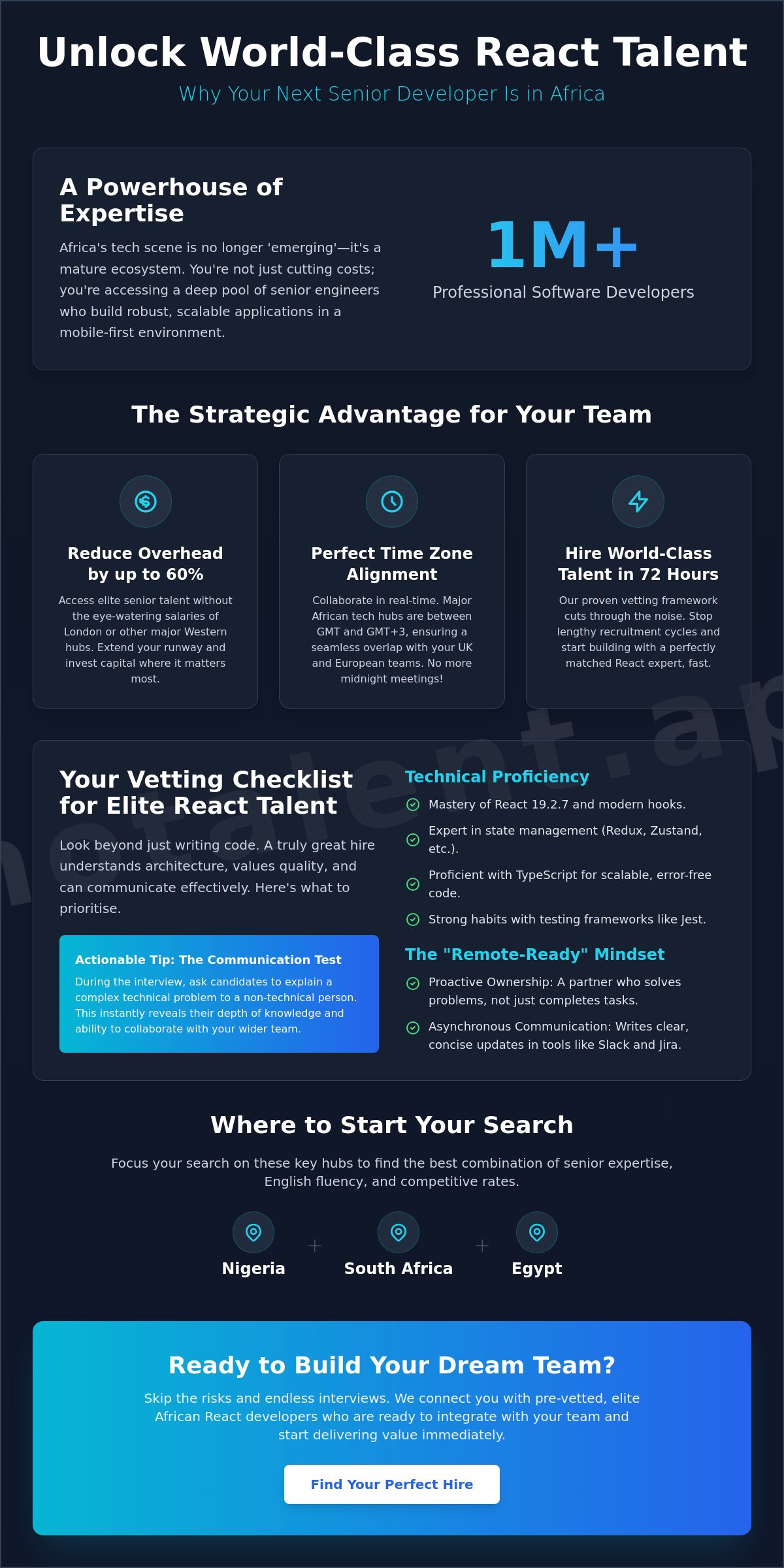
The African tech scene isn’t just “emerging” anymore. It’s a powerhouse. By 2026, the continent has matured into a global hub for frontend excellence. When you decide to hire React developers Africa provides, you aren’t just looking for lower costs. You’re accessing a pool of over 1 million professional developers who live and breathe modern JavaScript. These engineers are building some of the most resilient applications on the planet, driven by a unique mobile-first environment.
This maturity means you get access to senior talent that understands systems thinking. They don’t just write code; they design scalable architectures. With React 19.2.7 now the industry standard, African developers have stayed at the cutting edge, mastering the latest hooks and server components to deliver high-performance user interfaces. It’s a strategic move for any business that values speed and technical precision.
The Economic Advantage for UK Teams
Hiring a Senior React Developer in London is a massive financial commitment. Salaries in the UK capital often reach eye-watering levels, and that’s before you consider national insurance and office overheads. In contrast, senior talent in hubs like Lagos or Nairobi offers a much leaner alternative. You can reduce your hiring spend by up to 60% without compromising on quality. This financial efficiency allows startups to extend their runway significantly. It gives you the breathing room to iterate on your product or scale your marketing efforts without draining your capital on a single hire.
Cultural and Time Zone Alignment
Remote work often fails when communication breaks down across awkward time gaps. This is where the African market shines for European and UK companies. Major tech hubs sit between GMT and GMT+3, providing a near-perfect overlap with your existing team. There’s no waiting 12 hours for a pull request review or a Slack reply. To understand the digital backbone supporting this growth, it helps to look at the state of mobile technology in Africa. This infrastructure has fostered a professional culture that mirrors Western standards, complete with high English proficiency and a deep understanding of Agile methodologies. Time zone alignment is the secret to remote success because it enables real-time collaboration without the burnout of midnight meetings.
When you start your search, focus on Nigeria, South Africa, or Egypt first. These countries hold the largest developer populations and offer the most competitive mix of senior expertise and English fluency.
What to Look for When You Hire React Developers
Finding a developer who can write code is easy. Finding one who can build a scalable, production-ready product is the real challenge. To successfully hire React developers Africa has to offer, you must prioritise candidates who stay current with the latest releases, such as React 19.2.7. You need someone who understands the “why” behind the code, not just the “how”.
State management is essentially the nervous system of your application. It handles how data flows between different parts of your site. If a developer doesn’t understand tools like Redux, MobX, or Zustand, your app will eventually become a tangled mess that’s impossible to update. You also need a developer with a sharp eye for design. Proficiency in Styled Components or Tailwind ensures your user interface is polished and responsive across all devices.
Technical Proficiency Beyond the Code
Technical depth is about more than just React hooks. You should look for engineers who are comfortable with TypeScript. Think of TypeScript as a safety net; it’s a tool that catches coding mistakes before they ever reach your users. This is vital for large projects where one small error can break the entire system. Additionally, ensure they use testing frameworks like Jest. A developer who tests their own work is a developer who values reliability and long-term stability. If your product roadmap also requires backend capabilities, you may want to explore how to hire Python developers Africa has to offer, as pairing React frontend talent with strong Python engineers is a powerful combination for full-stack delivery.
The “Remote-Ready” Mindset
Ownership is the most important soft skill in a remote environment. You need a partner who doesn’t wait for a list of instructions but proactively looks for ways to improve the product. High English proficiency is common in major African tech hubs, but you should also test for asynchronous communication. This means being able to write clear, concise updates that don’t require a constant stream of meetings to understand. If your roadmap includes machine learning or intelligent features, you may also want to consider how to hire AI developers in Africa to complement your React team with specialists who can build the intelligent backends your product needs.
During the interview, ask the candidate to explain a complex technical problem they solved to a non-technical person. This quickly reveals both their depth of understanding and their ability to communicate with your broader business team. If you want to skip the vetting headache, our team can help you find vetted tech talent who already tick all these boxes.
Problem-solving is best assessed through a live chat rather than a static test. Watch how they approach a challenge. Do they ask clarifying questions? Do they consider the user’s perspective? These traits separate a standard coder from a true engineer who will help your company grow.
How to Hire React Developers in Africa: The 4-Step Process
Hiring elite talent doesn’t need to be a six-month slog. You need a system that operates at the speed of your business. When you decide to hire React developers Africa offers, you can bypass the traditional recruitment headaches by following a lean, four-step framework. This approach prioritises technical excellence while cutting out the bureaucratic filler that often slows down growth.
Defining Your React Requirements
Before you start your search, you must be clear about the work ahead. Are you building a “greenfield” project, which means starting from scratch, or are you maintaining a legacy system? A developer who excels at creating brand-new, interactive user interfaces might have a different skill set than one who is adept at untangling older codebases. You should also decide if you need a specialist who focuses purely on the frontend or a full-stack leaning developer who can help with server-side logic. For a broader look at building your remote team, see our Hire Remote Developers from Africa: The 2026 Strategic Guide.
The Power of Pre-Vetting
Traditional hiring is slow because you’re the one doing all the heavy lifting. You’re sorting through hundreds of CVs and running basic coding tests that don’t always reflect real-world performance. Partnering with an elite facilitator like IMO Talent changes the dynamic completely. We handle the rigorous screening, so you only meet candidates who are already verified. Our 72-hour promise means you go from request to your first qualified match in just three days. Remember, technical tests are only half the battle. A truly “remote-ready” developer must also demonstrate high-velocity communication and a proactive attitude.
- Step 3: The Values-Based Interview. Don’t spend this time re-testing their React hooks. Instead, focus on cultural fit. Ask about their experience with Agile workflows and how they handle feedback in a remote setting.
- Step 4: Streamlined Onboarding. Success is decided in the first 48 hours. Ensure your new developer has GitHub access, Slack invites, and a clearly defined first task ready for their start date.
Create a “Day One” checklist for every new hire. This should include documentation for your tech stack, a list of key team members, and a small, achievable coding task. This builds immediate momentum and helps the developer feel like part of the team right away.
By following this process, you ensure that you hire React developers Africa provides who aren’t just great coders, but valuable long-term assets to your engineering team. Efficiency is the goal. Quality is the standard.
Integrating Your New Developer for Long-Term Success
Finding the right person is only half the battle. If you want to see a real return on your decision to hire React developers Africa provides, you must focus on the integration phase. Many companies fail because they treat remote developers as “plug-and-play” components rather than team members. This leads to “remote drift”, where a developer loses touch with company goals and starts working in a vacuum.
Clear expectations are your best defence against misalignment. From day one, set specific KPIs that define what success looks like in your environment. Whether it’s the frequency of pull requests or the speed of bug fixes, having a shared scoreboard keeps everyone focused. Your digital office is built on tools like Slack, Jira, and GitHub. These aren’t just for tasks; they’re the lifeblood of your culture. Use them to maintain a high-velocity feedback loop that mirrors the energy of an in-person office.
The First 30 Days: A High-Performance Playbook
Momentum is everything in the first month. Give your new hire a “quick win” task within their first week. This could be a small UI fix or a component update that allows them to push code to production immediately. It builds confidence and proves they can navigate your deployment pipeline. Assigning a “culture buddy” also helps. This is a team member who can answer non-technical questions about how the company operates. For a deeper dive into this phase, check out Managing Remote African Developers: The High-Performance Integration Playbook.
Handling Compliance and Payroll
Managing international payments and local labour laws can be a logistical nightmare. You need to ensure your hire is legal and secure without spending hours on paperwork. Managed services take this headache away by handling the heavy lifting of global payroll. IMO Talent handles administrative support to ensure everything remains compliant with regional regulations. This allows you to focus on engineering while we handle the back-office complexity.
Schedule a weekly 1-on-1 that isn’t about status updates. Use this time to discuss career growth, technical challenges, and personal alignment. It’s the most effective way to build the trust necessary for a long-term partnership.
A culture of inclusion means inviting your remote developers to the same “all-hands” meetings and social sessions your local team enjoys. When people feel seen, they perform better. If you’re ready to scale without the stress, you can get started with our talent matching service today and see how easy it is to build a global team.
Why IMO Talent is Your Best Route to African React Talent
Efficiency is your greatest competitive advantage in 2026. When you decide to hire React developers Africa offers through our platform, you aren’t just filling a vacancy. You’re gaining an elite engineering partner. We act as a confident gatekeeper, providing access to a curated network of professionals who have already cleared our rigorous technical and communication hurdles. This isn’t a general job board; it’s a high-performance talent pipeline designed for businesses that refuse to settle for mediocrity.
Our model is built on the certainty that quality and speed can coexist. We’ve helped companies reduce their engineering spend by up to 60% while actually increasing the velocity of their development cycles. By removing the guesswork from international hiring, we allow your internal team to focus on what they do best: building great products. We handle the complexity so you can focus on the growth.
The 72-Hour Match Guarantee
The traditional three-month hiring cycle is a relic of the past. It’s too slow for the modern tech landscape. Our 72-hour turnaround time is possible because we’ve already done the hard work. We maintain a pre-vetted pool of senior React experts who are ready to integrate into your workflow immediately. During those three days, our master matchmakers analyze your specific technical stack and team culture to ensure the fit is precise. To understand how this fits into a larger growth strategy, explore our guide on how to Build a Remote Team in Africa: The 2026 Strategic Blueprint for Global Scale-ups.
End-to-End Support
Our commitment to your success doesn’t end when the contract is signed. We provide ongoing talent management to ensure high retention and long-term alignment with your company goals. This includes regular performance monitoring and handling the intricate details of local compliance and payroll. We’ve moved beyond the “transactional” hiring model to become a true facilitator for global scale-ups. This comprehensive support is why our placements tend to stay longer and produce more impactful results than traditional remote hires. We’re invested in your scaling journey from day one until your product dominates the market.
Don’t wait until your team is at a breaking point to start looking for talent. Start the conversation now. Even if you aren’t ready to hire today, knowing the calibre of developers available in our network allows you to plan your roadmap with much more confidence.
You need a partner who operates at your speed and understands the high stakes of modern engineering. Ready to scale? Hire your React developer in 72 hours with IMO Talent.
Build Your High-Performance Frontend Team Now
The global race for engineering talent has never been more intense. By choosing to hire React developers Africa offers, you’re securing a competitive edge that combines technical mastery with significant financial efficiency. You now have the framework to source, vet, and integrate these professionals into your existing Agile workflows. Remember to prioritise state management expertise and a proactive “remote-ready” mindset to ensure your project remains scalable for years to come.
Success isn’t just about finding a coder; it’s about building a partnership that lasts. Our vetted network of elite African professionals is ready to help you reduce your hiring costs by up to 60% without sacrificing a single drop of quality. We’ve eliminated the friction of international recruitment so you can focus on shipping features and hitting your growth milestones. Don’t let slow hiring cycles hold your product back any longer.
Hire your next React expert in 72 hours and start building today. We’re here to help you bridge the gap between your vision and a world-class engineering reality. Your team is waiting.
Frequently Asked Questions
Is it difficult to manage React developers in Africa due to time zones?
Management is actually quite simple because major tech hubs like Lagos, Nairobi, and Johannesburg sit within GMT to GMT+3. This provides a near-perfect overlap with UK working hours. You won’t experience the long delays common with teams in Asia or the US West Coast. It allows for real-time collaboration during your core business day, making it easy to maintain daily stand-ups and Agile rituals without anyone working anti-social hours.
How do I ensure the technical quality of a remote React developer?
You ensure quality by using a multi-layered vetting process that goes beyond basic coding tests. Look for developers who can explain their architectural choices and demonstrate proficiency in React 19.2.7. A high-quality candidate should be able to walk you through a production-ready codebase and explain how they handle complex state management. Testing for “clean code” and documentation skills is just as important as the logic itself.
What is the average cost saving when hiring from Africa compared to the UK?
Hiring from the continent typically allows you to reduce your engineering spend by up to 60% compared to London rates. When you hire React developers Africa provides, you’re accessing senior talent at a cost often lower than a local junior developer. These savings aren’t about “cheap” labour; they reflect the lower cost of living in hubs like Egypt or Nigeria while the technical standards remain world-class.
Can I hire a full-time React developer through IMO Talent, or is it just for projects?
Yes, you can hire dedicated, full-time React developers who become an integral part of your long-term engineering team. While some platforms focus on short-term gig work, we specialise in permanent remote placements that offer stability and consistency. This ensures your developer builds deep institutional knowledge of your product, leading to better code quality and faster feature delivery as they grow with your company over several years.
How does IMO Talent vet its React developers?
Our vetting process is a rigorous framework designed to filter for the top 3% of talent. It starts with a comprehensive technical screening followed by a deep-dive code review conducted by senior engineers. We also place a heavy emphasis on “remote-readiness” to ensure the developer can manage their time and communicate effectively in an asynchronous environment. Only those who excel in both coding and soft skills make the cut.
What happens if the developer is not a good fit for my team?
If a developer isn’t the right fit, we act as a master matchmaker to find a replacement quickly. We understand that cultural alignment is just as important as technical skill. If the initial placement doesn’t meet your expectations during the early stages, we handle the transition and provide a new shortlist of vetted candidates. This removes the risk from your hiring process and ensures your project momentum isn’t lost.
Do African developers have experience with modern tools like Next.js and TypeScript?
Absolutely, as African developers work in a mobile-first environment where performance and efficiency are critical. Mastery of Next.js, TypeScript, and React Native is standard for senior engineers in the region. Because Africa’s internet economy is projected to reach $180 billion by 2025, the local talent pool has stayed at the cutting edge of modern web technologies to build the robust, scalable apps required by this market.
How do international payments and local taxes work for my new hire?
We handle the administrative complexity by using managed services to process international payments and ensure local tax compliance. You don’t need to worry about setting up a legal entity in multiple countries or navigating foreign labour laws. We provide a single invoice and handle the distribution of funds and statutory requirements on the ground. This ensures your hire is secure, legal, and paid on time without extra work for your team.
