

Your next senior engineer isn’t sitting in a London boardroom; they’re likely building the future of mobile-first tech in Lagos or Nairobi. It’s exhausting to watch your product roadmap stall because local recruitment takes months and costs a fortune. You’ve probably felt the sting of sky-high salary demands that eat your runway before you’ve even scaled. When you decide to hire remote developers from Africa, you aren’t just looking for a bargain. You’re looking for a strategic advantage that allows your team to move faster than the competition.
I’ll show you exactly how to tap into an elite network of tech talent while slashing your engineering overheads by 60%. We’ve refined a process that lets you onboard vetted, high-performing developers in as little as 72 hours. This guide covers everything you need to know about the 2026 landscape. We’ll explore current salary benchmarks, navigate the latest legal updates in countries like Kenya and Egypt, and explain how to verify technical skills across borders. It’s time to build a leaner, more diverse team without losing an ounce of velocity.
Key Takeaways
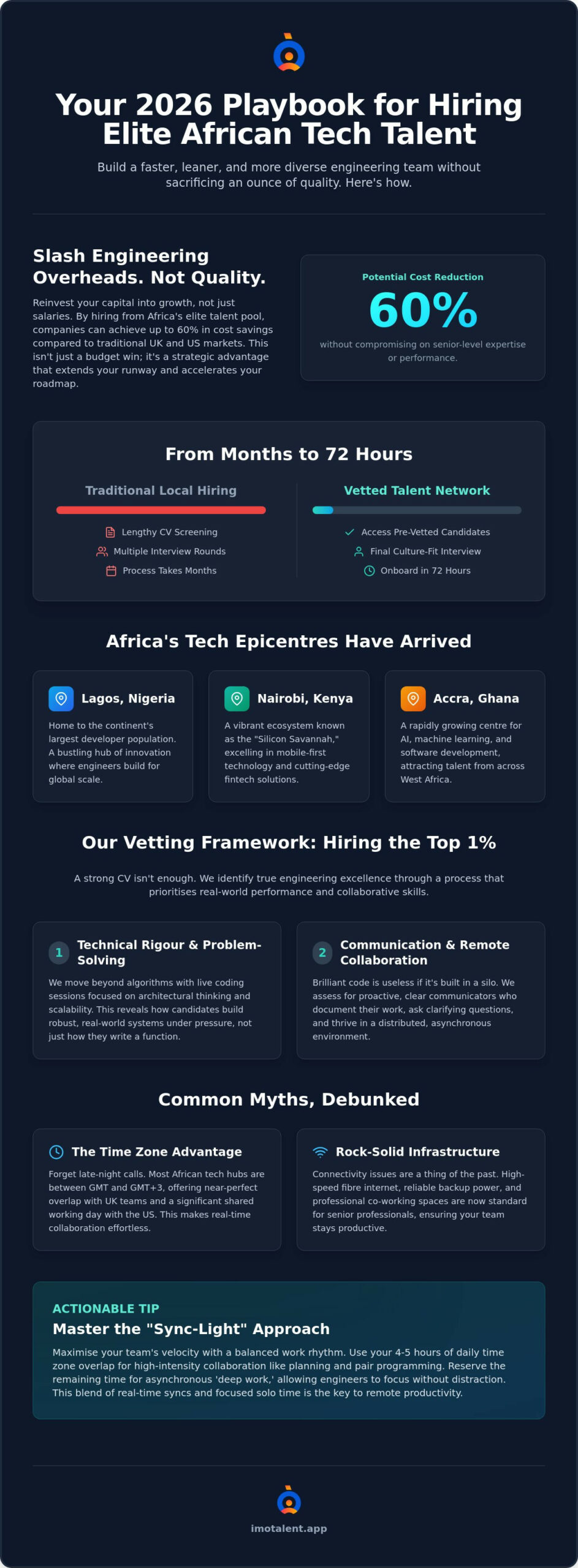
- Understand why Africa’s maturing tech hubs are the strategic choice for teams looking to slash engineering overheads by 60% without sacrificing quality.
- Discover how to hire remote developers from Africa using a vetting framework that prioritises live technical performance over simple CV reviews.
- Master the “buddy system” and managed support strategies to ensure your remote engineers integrate seamlessly and maintain long-term productivity.
- Find out how to accelerate your hiring timeline from months to just 72 hours by leveraging a curated network of the top 1% of African talent.
Why Global Leaders are Turning to Africa for Tech Talent in 2026
The old way of outsourcing was about throwing tasks over a wall and hoping for the best. In 2026, the game has changed. Savvy teams don’t just want tasks completed; they want partners who can think critically and scale alongside them. When you choose to hire remote developers from Africa, you aren’t just looking for a pair of hands. You’re tapping into a market that has matured from a cost-saving secret into a global tech powerhouse. It’s about high-impact partnerships that drive product velocity.
Saving 60% on engineering costs isn’t just a budget win. It’s a fundamental shift in how you manage your runway. In the current economic climate, that extra capital often means the difference between hitting your next milestone or stalling. But the talent pool isn’t limited to code. We’re seeing a massive rise in remote business and design talent Africa, allowing companies to build entire cross-functional units at speed. This holistic approach to hiring is why elite scale-ups are pivoting away from traditional hubs.
The 2026 Talent Landscape in Africa
Lagos, Nairobi, and Accra have become the epicentres of this movement. Nigeria currently boasts the largest developer population on the continent, and these hubs are no longer “emerging”—they’ve arrived. The remote-first shift has levelled the playing field. African engineers are working for the world’s biggest brands, bringing that high-level experience back into the local ecosystem. By deciding to hire remote developers from Africa, you gain access to professionals who are already accustomed to international standards and agile workflows.
English is the primary language of business in these regions, which removes the biggest barrier to entry for UK and US teams. You won’t struggle with miscommunications or lost context. Instead, you’ll find developers who are already culturally aligned with Western tech stacks. This makes the onboarding process exceptionally smooth.
Addressing the Time Zone and Connectivity Myths
One of the biggest misconceptions is that Africa is “too far away” for real-time collaboration. The reality is quite the opposite. Most African tech hubs sit between GMT and GMT+3. For a UK-based team, this means your developers are working almost identical hours to you. Even for US teams, the overlap is often better than traditional offshore hubs in Asia, allowing for a shared working day that maintains momentum.
Infrastructure has also taken a massive leap forward. Thanks to Africa’s growing internet penetration and the rise of reliable co-working spaces in major cities, connectivity issues are largely a thing of the past. High-speed fibre and backup power solutions are now standard for senior professionals.
Actionable Tip: To get the most out of your team, lean into a “sync-light” approach. Use your 4-5 hours of overlap for deep-dive meetings and pair programming. Use the remaining time for “asynchronous” work, where developers focus on deep coding without the distraction of constant notifications. This balance keeps velocity high while respecting different work rhythms.
A Step-by-Step Framework for Vetting Remote African Engineers
Vetting isn’t just about checking boxes. It’s about risk mitigation. A CV might look perfect on paper, but it won’t tell you if a developer can handle the unique pressures of a distributed team or a fast-moving product roadmap. When you look to hire remote developers from Africa, your framework needs to be rigorous, transparent, and fast. You aren’t just hiring for today; you’re hiring for the scale you expect to reach in the next six months. Relying on “gut feeling” or a quick chat is a recipe for expensive hiring mistakes.
Step 1: Technical Rigour and Problem Solving
Architectural thinking is the difference between a coder and an engineer. We don’t just test if a candidate knows how to write a loop in Python or a basic component in React. We want to see how they structure an entire application to handle thousands of users. This involves understanding “scalability”—the ability of a system to grow and handle more work without breaking. We prioritise live coding sessions over take-home assignments because take-home tests are often too easy to game or over-engineer. A live session reveals how they actually think, how they debug under pressure, and how they explain their technical choices to a peer.
Step 2: Communication and Remote Collaboration
Communication is the lifeblood of remote work. It doesn’t matter how brilliant a developer is if they disappear for three days when they hit a snag. We evaluate written and verbal English clarity to ensure they can contribute to your Slack channels and stand-up meetings without friction. We also look for “proactive ownership.” This means they don’t just wait for instructions; they identify potential issues before they become blockers. We use situational questions to see if they’ve mastered the art of “over-communication,” which is essential when you can’t just tap someone on the shoulder in an office.
Our vetting process at IMO Talent is designed to find the top 1% of talent. We’ve already done the technical deep dives and cultural assessments, which is how we can offer a 72-hour turnaround. If you want to skip the months of trial and error, you can access our vetted talent pool and start interviewing high-calibre candidates immediately. We take the guesswork out of the equation so you can focus on building your product.
Actionable Tip: During your interview, use the “Blocker Test.” Ask the candidate to describe a recent technical hurdle they couldn’t solve alone. Listen for whether they took ownership of the problem or blamed the tools. High-performing remote developers will explain how they communicated the delay to their team and what they did to find a workaround while waiting for help.
Comparing the Costs: Hiring in Africa vs. the UK and US
Hiring locally in London or San Francisco has become a luxury that most scale-ups can no longer afford. When you look at the cost of hiring developers in US vs Africa, the gap isn’t just wide; it’s transformative. In the US, a senior engineer often commands a base salary exceeding $180,000. Once you add recruitment fees, health insurance, office stipends, and payroll taxes, that figure easily clears $220,000. By choosing to hire remote developers from Africa, you’re looking at a total cost reduction of roughly 60% without compromising on technical excellence.
This saving allows you to reinvest in your product roadmap. You could hire two senior engineers in Africa for the price of one in the UK. This isn’t about finding “cheap” labour. It’s about global parity. A senior developer in Lagos or Nairobi earning $8,000 a month enjoys a level of purchasing power that far exceeds someone on £80,000 in London. This financial advantage leads to higher job satisfaction and much better retention rates for your team. You get elite talent that stays for the long haul.
Salary Benchmarks for 2026
In 2026, the market for remote African talent has stabilised. For senior full-stack roles in tech hubs like Nigeria and Kenya, monthly rates for international companies typically range between $6,000 and $12,000. If you’re hiring on an hourly basis, expect to pay between $40 and $70 for senior-level expertise. Compare this to the $150+ hourly rates common in major US tech hubs. Even with the addition of Employer of Record (EOR) fees, which usually sit between $299 and $599 per month, the financial logic is undeniable.
The ROI of Speed: The 72-Hour Advantage
The true cost of hiring isn’t just the salary; it’s the “vacancy cost.” Every day a critical seat remains empty, your product velocity drops. Traditional recruitment cycles in the UK or US can drag on for three to four months. Our remote talent placement services eliminate this friction. We move from initial request to a vetted shortlist in just 72 hours. Reducing your time-to-hire by 90 days can save your business tens of thousands in lost productivity and missed market opportunities.
Actionable Tip: Calculate your “Revenue per Developer” to understand the real cost of a slow hire. Divide your annual revenue by your total number of engineers. If an engineer is responsible for £200,000 in value, every month that seat is empty costs you over £16,000. Use this math to justify moving away from slow local recruitment and towards faster, global talent pools.
How to Successfully Manage and Retain Your Remote African Team
Getting the signature on the contract is just the start. To see a real return on your investment, you need a system that turns a new hire into a core contributor. When you hire remote developers from Africa, you’re bringing in elite talent that thrives on clear expectations and high-trust environments. The most successful teams don’t treat remote engineers as “add-ons” or a separate offshore unit. They treat them as integral parts of the engineering culture. For a deeper dive into these frameworks, read our playbook on managing remote African developers.
One of the most effective ways to bridge the geographic gap is the “buddy system.” Pair your new African developer with a senior member of your local team for the first 30 days. This isn’t for technical hand-holding. It’s for cultural and operational navigation. It gives the new hire a safe space to ask “how we do things here” without feeling like they’re bothering the whole team. This simple step can reduce onboarding friction and significantly speed up their time to first commit.
Tools and Infrastructure for Success
Success in a distributed setup requires a “documentation-first” mindset. Since you’re likely working across a small time zone difference, you should lean into an “async-first” tech stack. Tools like Slack and Jira are standard, but adding Loom for quick video walkthroughs can eliminate hours of back-and-forth emails. It’s also vital to respect the “right to disconnect,” which is becoming a legal standard in countries like Kenya and South Africa in 2026. Respecting these boundaries isn’t just about compliance; it’s about preventing burnout.
Don’t let payroll and local taxes become a distraction. In 2026, using an Employer of Record (EOR) is the standard way to handle these logistics. These services typically cost between $299 and $599 per employee, per month. They manage everything from Nigeria’s 2026 tax regulations to South Africa’s employment acts. This allows you to focus on engineering while they handle the paperwork. If you’re ready to skip the administrative headache, you can build your high-performance team today with our managed support.
Retention Strategies for Global Teams
Retention in the tech world is driven by growth, not just salary. African developers are highly motivated by opportunities to work on global-scale problems and master new tech stacks. Offer clear career paths and include them in high-level product discussions. When a developer feels their work has a direct impact on a global mission, they’re far less likely to be swayed by a slightly higher offer elsewhere. IMO Talent provides ongoing management support to ensure these relationships remain strong and productive over the long term.
Actionable Tip: Implement “The Documentation Rule.” If a decision is made in a live meeting, it must be summarised in a shared Notion or Confluence page within an hour. This ensures your remote team members never feel out of the loop and can catch up on context without needing a “meeting about the meeting.”
Scaling Your Engineering Team with IMO Talent’s 72-Hour Turnaround
You’ve seen the data and you’ve done the math. The decision to hire remote developers from Africa isn’t just about saving money; it’s about giving your organisation the agility to outpace the market. When you’re ready to move beyond the research phase and start executing, you need a partner who operates at your speed. We don’t believe in the slow, traditional recruitment cycles that leave your roadmap in limbo for months. We’ve built a system designed for high-velocity scale-ups that need elite talent yesterday.
If you’re wondering how to build a remote team in Africa that actually works, the secret is in the execution. We don’t just hand you a list of names and walk away. We act as your growth partner, handling the heavy lifting of vetting and matching so you can focus on your product. Our 72-hour turnaround isn’t just a goal; it’s our standard for identifying the top 1% of talent across tech, design, and business roles.
From Application to Onboarding in 4 Simple Steps
We’ve stripped away the bureaucracy of traditional hiring to create a lean, four-step process. First, you define your specific requirements with our expert matchmakers. We don’t just look at tech stacks; we look at your team culture and product goals. Second, you’ll receive a curated shortlist of pre-vetted professionals who have already cleared our technical and communication hurdles. You won’t waste time on “maybe” candidates.
The third step is the final interview. Since we’ve already done the deep-dive vetting, you can focus on specific project fit and chemistry. Finally, once you make the offer, we facilitate a seamless integration into your existing workflow. We handle the administrative complexities, including compliance and payroll, so your new hire can start contributing from day one.
The IMO Talent Difference
We are more than just a job board. A job board gives you a pile of CVs; we give you a high-performance engineering unit. Our managed subscription model provides long-term support, ensuring that your remote team stays engaged and productive as you scale. We are committed to diversity and excellence, helping you build a team that brings fresh perspectives to your most complex technical challenges.
Actionable Tip: If you’re feeling hesitant about a full-scale pivot, start with a “Trial Pilot.” Hire one senior developer to tackle a specific, high-priority feature. This allows you to test our vetting quality and your own internal remote processes without a massive upfront commitment. Once you see the velocity and quality of the output, you can scale the rest of the team with total confidence.
Ready to see what the top 1% of African tech talent can do for your roadmap? Book a discovery call today and see your first vetted candidates in just 72 hours.
The Future of Your Engineering Velocity
Building a high-performance team shouldn’t be a constant battle against local talent scarcity and inflated budgets. The path forward is clear. You can access the top 1% of technical talent, maintain your development speed, and reduce your hiring overheads by up to 60%. When you choose to hire remote developers from Africa, you aren’t just filling a vacancy; you’re future-proofing your product with engineers who are mobile-first, culturally aligned, and ready to scale immediately.
Success comes down to two things: technical rigour and seamless integration. By focusing on architectural thinking during the vetting process and using a “buddy system” for onboarding, you ensure your new hires become core contributors within days, not months. You don’t have to navigate this transition alone. Whether you need senior engineers or high-impact business and design talent, the infrastructure for global growth is ready for you. Stop letting slow recruitment cycles stall your roadmap and start building at the speed your vision requires.
Scale your team with vetted African developers; get matched in 72 hours
The talent is ready. Your roadmap is waiting. It’s time to build something great together.
Common Questions About African Tech Talent
Is it legal to hire remote developers from Africa if my company is in the UK or US?
Yes, it is entirely legal and a standard practice for global companies. Most businesses use an Employer of Record (EOR) to handle local contracts, taxes, and benefits. This ensures you comply with local labour laws, such as Uganda’s 2026 Employment Amendment Act, without needing to set up a foreign legal entity yourself. It is a secure, “plug-and-play” way to expand your team globally.
How do I handle the time zone difference with African developers?
You will find that the time zone overlap is one of the biggest strategic advantages. Most African tech hubs are between zero and three hours ahead of the UK, meaning you share almost a full working day. For US teams, the East Coast usually has a four to five-hour overlap. Actionable tip: Use your morning overlap for live meetings and the afternoon for focused, “async” deep work to keep velocity high.
What is the typical English proficiency of developers in countries like Nigeria and Kenya?
English is the official language of business and education in Nigeria and Kenya. You won’t just find basic proficiency; you will find developers who are native or near-native speakers. This eliminates the communication friction often found in other offshore regions. It allows for complex technical discussions and architectural planning without anything getting lost in translation or needing constant clarification.
Can I hire a full team of developers, designers, and product managers at once?
Yes, you can build a complete cross-functional unit through our platform. We specialise in placing vetted professionals across tech, business, and design roles. It is a strategic move to hire remote developers from Africa as part of a balanced team that includes product managers and designers. This ensures your projects have the leadership and creative input they need to succeed from day one.
How does the vetting process at IMO Talent ensure technical quality?
We use a multi-stage framework that moves beyond simple CV checks to find the top 1% of talent. Every candidate undergoes live coding challenges to test their architectural thinking and problem-solving skills under pressure. We focus on specific frameworks like React, Node.js, and Python. This rigorous approach ensures that every placement meets international engineering standards for quality and speed before they ever reach your desk.
What happens if a remote hire isn’t a good fit for my team?
We provide ongoing managed support to ensure long-term success and team harmony. If a hire doesn’t meet your expectations during the initial period, we work quickly to understand the gap and provide a replacement. Our goal is to maintain your development velocity, so we handle the transition logistics to keep your roadmap on track. We act as a partner in your growth, not just a one-time service provider.
How do I pay my remote African developers and stay compliant with local laws?
The most efficient way is through an EOR service. These platforms handle local payroll and tax compliance, including Nigeria’s Jan 1, 2026 tax updates. These services typically cost between $299 and $599 per employee, per month. Actionable tip: Always ask your EOR for a “total cost of employment” breakdown before signing an offer letter to ensure your budget accounts for local social security and taxes.
Why is the cost of hiring in Africa so much lower than in the US?
The difference is driven by purchasing power parity rather than a difference in skill. A senior developer earning a global-standard salary in a hub like Nairobi lives exceptionally well compared to someone on the same salary in San Francisco. You get the same elite technical ability at a 60% lower cost because the local cost of living is significantly lower. It is a financial arbitrage that benefits both the company and the developer.
